
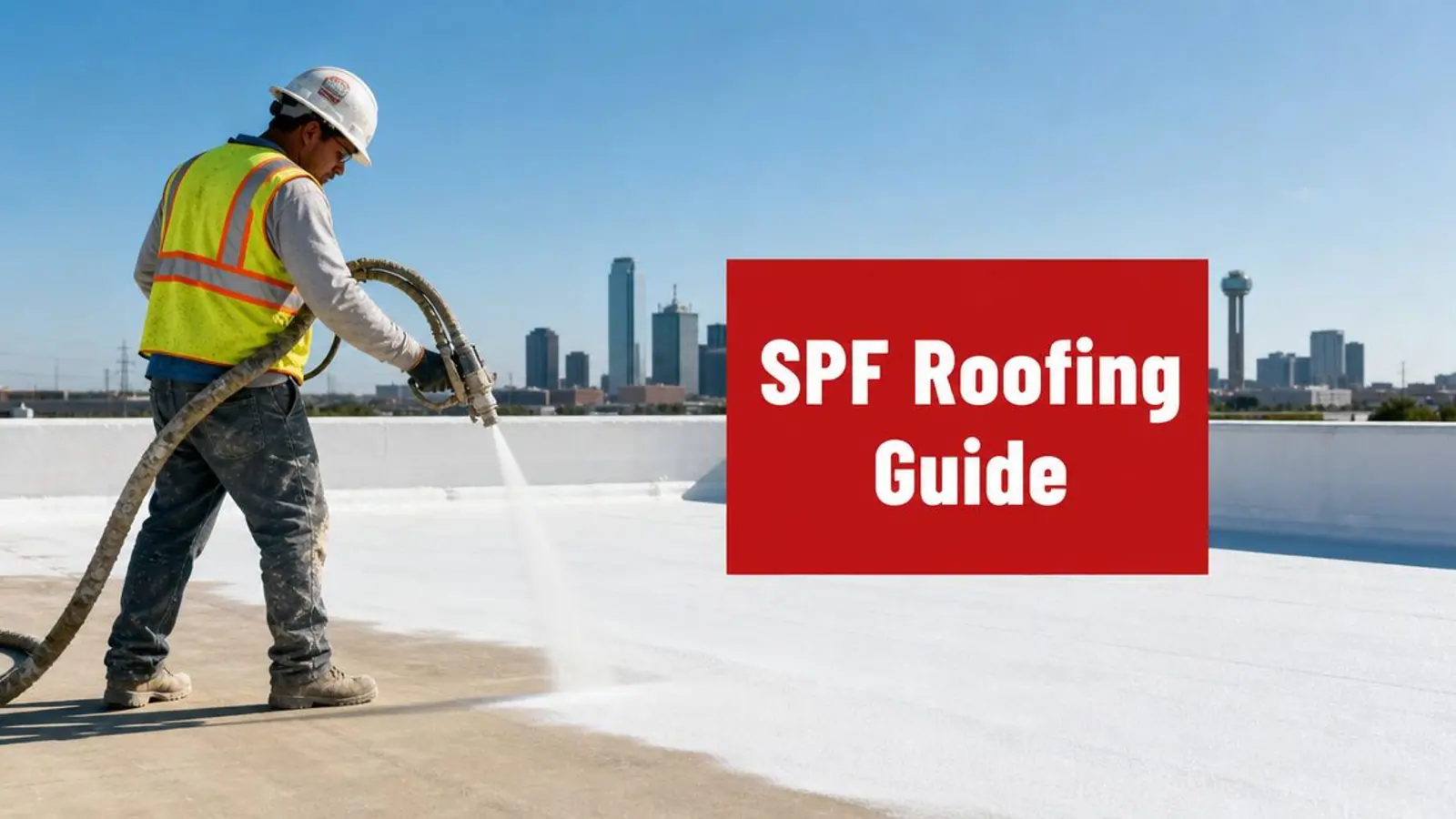
A lot of Dallas-Fort Worth and East Texas property owners end up in the same spot. The flat roof over the office, warehouse, retail strip, patio cover, or room addition keeps getting patched, but each big rain seems to find a new weak spot. By August, the AC runs hard all afternoon, and the building still feels warm.
That's usually when polyurethane foam roofing enters the conversation.
It gets attention for two reasons that matter in Texas. First, it can turn an aging low-slope roof into a continuous surface with built-in insulation. Second, it can often be installed over an existing roof assembly when the substrate is still a good candidate, which changes the replacement-versus-restoration discussion. But SPF is not a miracle coating in a bucket, and it's not forgiving of sloppy work. In our climate, where heat, hail, humidity, and fast-moving storms all show up on the same roof, the difference between a durable SPF roof and a problem roof comes down to design, prep, application control, and maintenance.
Your Guide to a Smarter Flat Roof in Texas
A common local scenario looks like this. A property owner in Arlington or Tyler has a low-slope roof with recurring leaks around penetrations, ponding in a few areas, and years of repairs layered over older repairs. Nobody wants another short-term patch, but a full tear-off feels expensive, disruptive, and hard to time around business operations or family life.
That's where polyurethane foam roofing starts to make sense. Not because it solves every roofing problem, but because it addresses the ones Texas owners complain about most. Heat gain. Seam failures. Flashing trouble. Water finding the smallest opening during a hard storm.
SPF works best when the roof needs more than patching but still has a structure worth saving. The foam is sprayed in place, shaped to the roof, and then protected with a coating system. Done right, it creates a roof assembly that's monolithic, insulated, and easier to renew than many traditional flat roof systems.
In North Texas, a flat roof usually doesn't fail from one dramatic event alone. It fails from years of UV, expansion and contraction, wet spots, rushed repairs, and one storm too many.
That's the honest way to look at it. If your roof deck is saturated, if the substrate is unstable, or if you hire a crew that treats SPF like paint, polyurethane foam roofing can disappoint you fast. If the roof is a good candidate and the installer knows how to manage Texas weather, it can be one of the more practical flat-roof options on the table.
What Exactly Is Polyurethane Foam Roofing
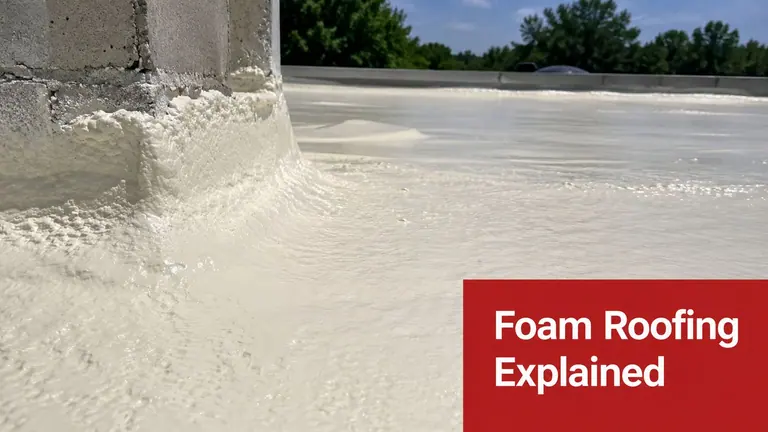
Polyurethane foam roofing, or SPF roofing, is a roof system built in place on your building. The crew heats two liquid components, pumps them through proportioning equipment, and mixes them at the spray gun. The material expands on contact, turns into rigid closed-cell foam, and bonds to the prepared substrate.
That jobsite reaction is what makes SPF different from sheet-applied roofs. The installer is not rolling out a factory membrane and welding seams together. The roof is created on the surface itself, then covered with a protective coating that handles UV exposure, weather, and normal foot traffic.
How the material works
Industry guidance describes SPF roofing as a field-applied, closed-cell system with an R-value of roughly 5.5 to 6.5 per inch, according to the IBHS spray foam roof guide. In real terms, thickness matters. A thin application will not perform like a properly built SPF roof, either on insulation or long-term durability.
Closed-cell foam matters for another reason. It resists water movement better than open-cell foam used inside walls and other building assemblies. That does not make it waterproof forever, and it does not excuse neglected maintenance. Cuts, hail strikes, coating wear, and bad detailing still need repair.
In North Texas and East Texas, installation conditions matter more than many owners realize. Heat, humidity, surface moisture, wind, and afternoon storm patterns all affect how the foam rises, adheres, and cures. A crew that understands Dallas-Fort Worth and East Texas weather will schedule spray windows carefully and stop when conditions are wrong. A crew that treats SPF like paint can ruin the roof before the coating ever goes on.
Why owners in Texas pay attention to SPF
The practical advantage is how SPF fits the roof. It conforms around curbs, drains, vent pipes, equipment stands, and odd transitions that give other low-slope systems trouble. On older commercial roofs in DFW, where penetrations have been added over time and previous repairs are all over the place, that can simplify leak control.
The insulation benefit also matters here. Texas roofs take constant sun, and low-slope assemblies over conditioned space feel that load every day from late spring through early fall. SPF adds insulation at the roof line instead of relying only on what may or may not be below the deck.
That said, foam alone is not the finished roof.
Practical rule: SPF is one system made of foam plus coating. If the coating wears out, the roof is no longer properly protected.
The coating protects the foam from sunlight, weathering, and surface erosion. Silicone, acrylic, and other options each have a place depending on drainage, exposure, and service needs. Property owners comparing coating options can review these best roof coatings for flat roofs to understand how the top layer affects the whole SPF system.
That top layer also matters after hail. In Dallas-Fort Worth, a storm may leave obvious damage, or it may leave smaller coating fractures and bruised areas that only show up during a trained inspection. Insurance adjusters often want clear documentation showing whether the impact affected just the coating, the foam beneath it, or both. That is one reason contractor qualifications matter so much with SPF in Texas. The roof has to be installed right, and it has to be inspected by someone who knows what storm damage on foam looks like.
SPF Performance vs Other Flat Roofs in Texas
Texas owners usually compare SPF with TPO, EPDM, or modified bitumen. That's the right comparison, because each system solves a different problem well and brings a different set of risks.
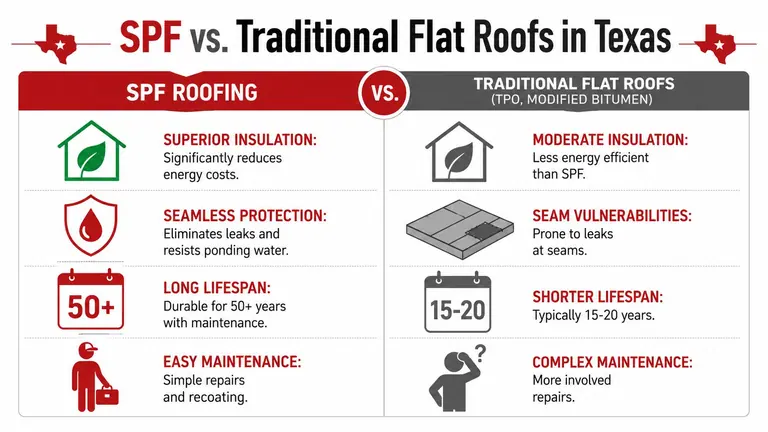
Flat roof system comparison for Texas properties
| Feature | Polyurethane Foam (SPF) | TPO Membrane | EPDM Membrane | Modified Bitumen |
|---|---|---|---|---|
| Leak pathways | Seamless field-applied surface reduces seam-related leak points | Seams must be welded and maintained | Seams and terminations require close attention | Multiple laps and flashing details create more failure points over time |
| Insulation | Built-in insulation layer | Usually depends on separate insulation package | Usually depends on separate insulation package | Usually depends on separate insulation package |
| Fit around penetrations | Conforms well to irregular details | Good with skilled detailing | Good, but detail quality matters | Detail work can be labor-intensive |
| Hail response | Depends heavily on foam thickness, coating condition, and post-storm inspection | Membrane can be punctured or stressed | Membrane can be punctured or torn | Surfacing can crack, split, or wear |
| Ponding concerns | Must be sprayed evenly to avoid drainage issues | Depends on substrate and slope design | Depends on substrate and slope design | Depends on substrate and slope design |
| Restoration path | Often maintained through recoating if still a good candidate | Often repair or recover, depending on condition | Often repair or recover, depending on condition | Often repair, recover, or replace depending on age and condition |
Where SPF tends to outperform
The economics are a major reason SPF remains in the market. A Spray Polyurethane Foam Alliance life-cycle cost study found that over a 30-year period, SPF roofing showed a cost advantage over membrane roofs ranging from 13% to 56%, and the same material set commonly cites insulating value in the range of R-5.0 to R-8.0 per inch in lifecycle discussions through the SPFA life-cycle cost study.
For a Texas owner, that matters most on larger roofs and buildings with long cooling seasons. A roof that combines waterproofing and insulation in one system can change operating costs over time, especially where the old roof has weak thermal performance.
SPF also shines on roofs with awkward penetrations, equipment curbs, transitions, and hard-to-detail shapes. It can simplify areas where sheet goods require a lot of cuts, laps, edge details, and workmanship at every joint.
Where membranes may still be the better fit
SPF is not automatically the right answer.
If a site has overspray concerns, sensitive neighboring properties, poor staging conditions, or weather windows that won't cooperate, a membrane system may be easier to control. If the building owner wants a roof system with a familiar inspection standard for every adjuster and consultant who steps onto the roof, TPO or modified bitumen may feel more straightforward.
For owners weighing coatings and restoration options on existing low-slope systems, this guide to roof coatings for flat roofs helps frame where SPF fits and where a different restoration path may be smarter.
The Texas decision point
In DFW and East Texas, the main question isn't “which roof is best on paper?” It's “which system matches this building, this drainage pattern, this hail exposure, and this maintenance discipline?”
SPF usually wins when insulation, monolithic detailing, and renewal potential matter most. Traditional membranes usually win when site conditions, contractor availability, or owner preferences make a sheet system simpler to execute and inspect.
The SPF Application Process From Start to Finish
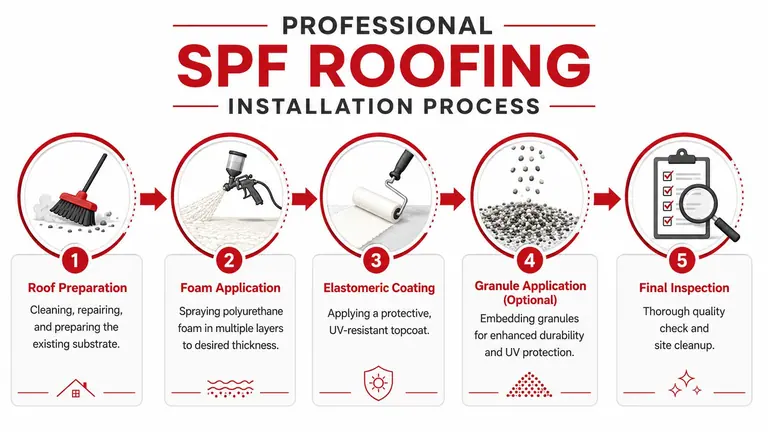
SPF roofing looks simple from the parking lot. It isn't. Good work comes from prep, moisture control, calibrated equipment, trained applicators, and strict inspection during every phase.
Step one starts before any spraying
The existing roof has to be evaluated first. Wet materials, unstable sections, deteriorated flashing areas, and contamination all have to be identified before foam enters the picture. The substrate must be clean, dry, and suitable for adhesion. If the roof surface isn't ready, the foam won't save it.
That first stage includes repairs, cleaning, and preparation of the deck or existing roof assembly. This is also where experienced contractors separate roofs that can be restored from roofs that need partial tear-off or replacement.
Foam application is controlled, not casual
Once the roof is ready, technicians spray the foam in passes to build the target profile and thickness. Uniformity matters. Thin spots reduce insulation value. Uneven application can create low areas that hold water. Poor proportioning or weather-related application mistakes can lead to adhesion issues and surface defects.
A contractor who knows SPF should be able to explain substrate prep, weather limits, lift control, and daily quality checks in plain language. If you want a baseline for what coating application discipline should look like, this walkthrough on how roof coating is applied is useful context.
Here's a look at the process in action:
The coating system finishes the roof
The foam is only part of the assembly. Specification guidance for durable SPF roofs calls for protective elastomeric coating systems in the 20 to 30 mil range, often with multiple coats and embedded granules to improve impact resistance and fire classification, and the foam itself is specified with a minimum compressive strength of 50 psi in the Arizona SPF roofing specification document.
That's why a professional install doesn't end when the foam cures.
Typical closing steps include:
- Base coating application: The crew applies the first protective coat at the specified coverage and checks for uniform film build.
- Granules where specified: Some systems add broadcast granules for added weatherability, impact resistance, and surface protection.
- Final inspection: The roof is checked for thickness consistency, flashing integrity, drain function, coating coverage, and site cleanup.
A foam roof with a weak coating package is like a truck with a good engine and bald tires. The missing performance shows up fast.
Benefits and Drawbacks for DFW & East Texas Properties
SPF roofing fits Texas well in some ways, and fights Texas in others. Owners need both sides before they sign anything.
Where SPF fits our climate
The biggest local strength is heat performance. In Dallas, Fort Worth, Longview, Tyler, and the rest of East Texas, roofs take a beating from long hot seasons. An insulated roof system can reduce how much heat pushes into the building during the day, which is one reason owners looking at older low-slope roofs keep SPF on the shortlist.
The second strength is water management around details. Flat and low-slope roofs in this region often have penetrations, transitions, edge conditions, and retrofitted equipment that become chronic leak zones. SPF's fully adhered, field-shaped application can simplify those trouble spots in a way sheet membranes sometimes don't.
There's also a practical restoration advantage on the right building. If the substrate is sound, SPF can turn a rough, patch-heavy roof into a continuous system without rebuilding every inch from scratch.
Where owners get in trouble
DFW hail changes the conversation. A lot of marketing around spray foam focuses on its continuous application and stops there. In practice, hail-prone markets like Dallas-Fort Worth expose installation flaws fast. Independent discussion of SPF failures notes that problems can come from poor adhesion, uneven application, and moisture-sensitive installation conditions, and that post-storm performance depends on initial quality assurance and coating maintenance, not just the fact that the roof is foam, as discussed in this analysis of common spray foam roofing problems.
That's the part many owners don't hear soon enough.
What works and what doesn't
What works in North and East Texas:
- Dry substrate and tight prep: Crews need a clean, stable surface before spraying.
- Weather-window discipline: Humidity, surface moisture, and changing conditions matter.
- Consistent thickness: The roof has to be shaped correctly so drainage still works.
- Coating maintenance: The protective surface has to stay intact after years of sun and storms.
What doesn't work:
- Bidding SPF like commodity paint work: The cheapest applicator can leave you with expensive corrections.
- Ignoring hail inspections: Some damage is subtle and shows up later as coating failure or water entry.
- Spraying over a bad roof just to avoid tear-off: Foam won't fix saturated or unstable materials underneath.
- Treating the topcoat as optional or cosmetic: It's part of the waterproofing and durability package.
On a Texas foam roof, workmanship is not a bonus feature. It is the product.
Best-fit buildings
SPF tends to be a strong fit for commercial buildings, warehouses, schools, and low-slope residential sections where owners want insulation and a monolithic surface in one system. It's a weaker fit where the roof condition is too far gone, access is poor, overspray risk is unacceptable, or the owner won't commit to periodic inspection and maintenance.
SPF Roof Cost Maintenance and Insurance Claims
Most owners ask the wrong cost question first. They ask what the install costs today. The better question is what the roof will cost to own, maintain, document, and insure over time.
Think in lifecycle, not just invoice total
Polyurethane foam roofing has a long technical history. Earlier National Bureau of Standards reporting described polyurethane roofing materials with densities in the 1.5 to 2.5 pcf range and noted their strong adhesion, while also pointing out the early lack of long-term field data across different climates. That history matters because it pushed the industry toward stricter standards, testing, and maintenance practices that still affect durability expectations and claims documentation today, as summarized in this review of polyurethane spray foam roofing history.
For an owner, the practical takeaway is simple. SPF is a managed roof system. You don't install it and forget it. You inspect it, maintain the coating, document storm events, and restore it when the system still qualifies for restoration.
Maintenance affects claims
Insurance conversations on SPF roofs can get messy if the owner has poor records. After hail, adjusters and consultants usually want to know what they're looking at. Was the coating already worn? Are there documented maintenance intervals? Was there pre-existing ponding, erosion, or prior repair work?
That's why inspection logs, photos, repair invoices, and manufacturer or contractor records matter. If you're dealing with storm damage, these expert tips from For The Public Adjusters are a useful complement to your roofing documentation. They help owners understand how to organize a claim before small details turn into disputes.
A leak response history matters too. If the building already has active water entry, that needs to be tracked and repaired quickly. Owners comparing restoration, patching, and active problem areas should also understand the basics of flat roof leak repair before assuming every wet ceiling means full replacement.
What adjusters and contractors should verify
A solid post-storm SPF review usually includes:
- Surface condition records: Photos of coating wear, punctures, depressions, granule loss where applicable, and visible impact marks.
- Moisture-related follow-up: Interior leak mapping and targeted testing where the roof condition raises concern.
- Repairability review: Whether the roof needs localized repair, coating restoration, or broader system action.
- Timeline documentation: Dates of storms, when damage was first observed, and when temporary protection was installed.
If you're in Texas, hire people who can explain the distinction between cosmetic marks, coating damage, foam damage, and functional damage in plain terms. That's where claims are won or lost.
How to Hire the Right SPF Roofing Contractor in Texas
The quality of an SPF roof depends more on the applicator than the brochure. That's not a slogan. This is the nature of a field-made system.
The contractor matters more than the product label
A strong SPF manufacturer and good materials still won't protect you from bad prep, poor proportioning, missed wet spots, or a rushed coating job. In Texas, the right contractor has to understand local heat, sudden humidity changes, storm exposure, and insurance scrutiny after hail events.
Ask direct questions and listen for direct answers.

Questions worth asking before you sign
- How do you evaluate moisture and substrate condition? If the answer is vague, move on.
- Who sprays the foam and who applies the coating? Some companies sell the job well and staff it poorly.
- What daily quality checks do you document? Thickness checks, adhesion checks, and weather monitoring should not surprise them.
- What local SPF jobs can I look at? Ask for projects in DFW or East Texas, not a gallery from somewhere with different weather.
- How do you handle storm follow-up? Hail response should be part of the conversation from day one.
- What exactly is included in the proposal? Prep scope, repairs, foam thickness target, coating system, warranty terms, and exclusions should all be clear.
One practical option in this market is Hail King Professionals, which handles flat-roof evaluations and storm-related roofing work in DFW and East Texas. That only matters if their project scope, documentation, and proposed system match your building. The same standard should apply to every bidder.
Check their reputation the smart way
A polished website doesn't prove SPF skill. It does show whether the company takes communication seriously. If you want a useful look at how reputable roofers present themselves online, this guide on how firms boost roofing company visibility can help you read digital signals more critically when comparing contractors.
The right SPF contractor doesn't just promise a seamless roof. They explain what can go wrong, how they prevent it, and how they'll document the job.
Green flags and red flags
Good signs include detailed scopes, clear exclusions, local references, and no hesitation when you ask about prep and weather limits.
Bad signs include vague square-foot pricing with no system detail, pressure to sign before inspection findings are explained, and sales language that treats SPF like a cure-all. In Texas, that kind of shortcut usually shows up later as a warranty dispute or a claim problem.
Frequently Asked Questions About SPF Roofing
Can you install solar panels on an SPF roof
Yes, but the mounting and waterproofing details have to be planned carefully. On low-slope roofs, penetrations and equipment support points need to be coordinated so the roof remains serviceable. If a building already has rooftop solar and needs reroofing work, owners should ask early about detach-and-reset logistics, access paths, and how penetrations will be flashed and documented before panels go back.
What does hail damage look like on a foam roof
Sometimes it's obvious. Sometimes it isn't.
You may see coating disruption, impact marks, crushed areas, or localized surface distress. On other roofs, the first warning is less dramatic, such as faster coating wear, isolated leaks after the next storm, or changes around high-exposure areas. That's why post-storm inspection on SPF should focus on function, not just whether the roof still “looks okay” from the ladder.
Is polyurethane foam roofing environmentally friendly
It can be part of a lower-waste roofing strategy, but the answer isn't as simple as “yes” or “no.” The environmental case depends on how long the roof stays in service, whether it's maintained through recoating, and whether premature replacement is avoided. Building research around SPF points out that its sustainability story is tied to balancing the impacts of periodic recoating against the waste generated by tear-off and landfill disposal of other roofing materials, and that roofing is a major waste stream in construction and demolition, as discussed in this NRCA and EPA-related spray foam roofing overview.
That means an SPF roof is greener when the owner maintains it and extends its service life.
How often should an SPF roof be inspected
It should be inspected routinely and after major storms. In Texas, that includes hail events, high-wind events, and periods when heavy rain exposes drainage problems. The inspection should focus on coating condition, penetrations, ponding areas, edge details, and any signs of physical damage or wear.
What should I ask for in an SPF proposal
Ask for a written scope that identifies prep work, substrate repairs, target thickness, coating system, treatment at penetrations and drains, warranty terms, and what conditions would require change orders. If you want a cleaner way to compare proposals side by side, using a contractor-style worksheet such as Revlit's free quote template can help you spot missing scope before you commit.
Is SPF good for every flat roof in DFW or East Texas
No. It's a strong option for many low-slope roofs, especially where insulation and continuous detailing matter, but it's not right for every substrate or every site. Some roofs are too wet, too deteriorated, or too exposed to overspray risk to make SPF the smartest choice. A serious contractor should be willing to tell you when another system is a better fit.
If you're weighing polyurethane foam roofing for a property in Dallas-Fort Worth or East Texas, Hail King Professionals can inspect the roof, identify whether SPF is a realistic option, and document what's happening with the substrate, drainage, storm exposure, and repair history before you commit to the wrong system.