
Pitched Roof on Flat Roof Your Complete Conversion Guide
If you’re tired of the constant battle with your flat roof, you’re not alone. Adding a pitched roof on top is a game-changing solution that tackles persistent drainage problems for good. Think of it less as a repair and more as a fundamental upgrade—one that boosts your home’s value, insulation, and curb appeal by eliminating the inherent flaws of a flat design.
Why Convert a Flat Roof to a Pitched Roof?
Let's be honest, staring at a flat roof often means staring at a cycle of frustration. You've got pooling water after every storm, a constant need for maintenance, and that nagging worry about leaks. A flat roof is basically a giant dinner plate on top of your house; even the slightest imperfection invites standing water, which will always find a way to cause damage. This is why so many people end up searching for flat roof leak repair, looking for a quick fix to a problem that just keeps coming back.
Converting to a pitched roof is like swapping that dinner plate for a funnel. It’s that simple. The sloped design puts gravity on your side, effortlessly shedding rain, snow, and debris. This isn't just another patch—it’s a smart, strategic move that gets to the root cause of why flat roofs fail.
The Underlying Benefits of a Conversion
The perks go way beyond just solving drainage headaches. A pitched roof conversion delivers a whole package of improvements for your property:
- Eliminates Ponding Water: This is the big one. No more standing water means no more primary cause of leaks and material breakdown.
- Enhances Structural Longevity: By keeping water moving, you’re protecting the underlying roof deck and the rest of your home’s structure from rot and moisture damage.
- Improves Energy Efficiency: The conversion creates a new attic space. This can be properly insulated and ventilated, which helps cut down on heat loss in the winter and heat gain in the summer.
- Boosts Curb Appeal and Property Value: A well-designed pitched roof can completely transform the look of a building, adding serious market value.
A pitched roof conversion is an investment in peace of mind. It replaces the cycle of frequent, costly repairs with a durable, long-term solution that protects your home for decades.
It's interesting to see how trends differ between residential and commercial properties. While homeowners are often eager to get away from flat roofs, the commercial world is leaning into them. The re-roofing sector is driving a massive $30.9 billion flat roofing market, with renovations in North America making up over 50% of the demand. Many older commercial buildings are actually replacing pitched roofs with modern flat systems that use advanced coatings to extend their lifespan by 15-20 years. You can dig deeper into these flat roofing market dynamics on transparencymarketresearch.com.
For homeowners, though, making the switch to a pitched roof remains the gold standard for a lasting, worry-free solution.
Understanding the Two Main Conversion Methods
So, how do you actually turn a flat roof into a pitched one? It's not as simple as just adding a triangle on top; it's a serious construction project that boils down to one of two main approaches for building the new roof structure.
Think of it like building a piece of furniture. You can either buy the raw lumber and cut, assemble, and finish every piece yourself on-site, or you can buy a precisely engineered kit where the major components are pre-built and you just have to assemble them. Both get you a finished product, but the process, timeline, and cost can be very different. Your contractor will recommend the best fit for your home, but knowing the basics will help you understand their proposal.
This flowchart breaks down how the conversion solves common flat roof headaches and boosts your home's long-term health and value.
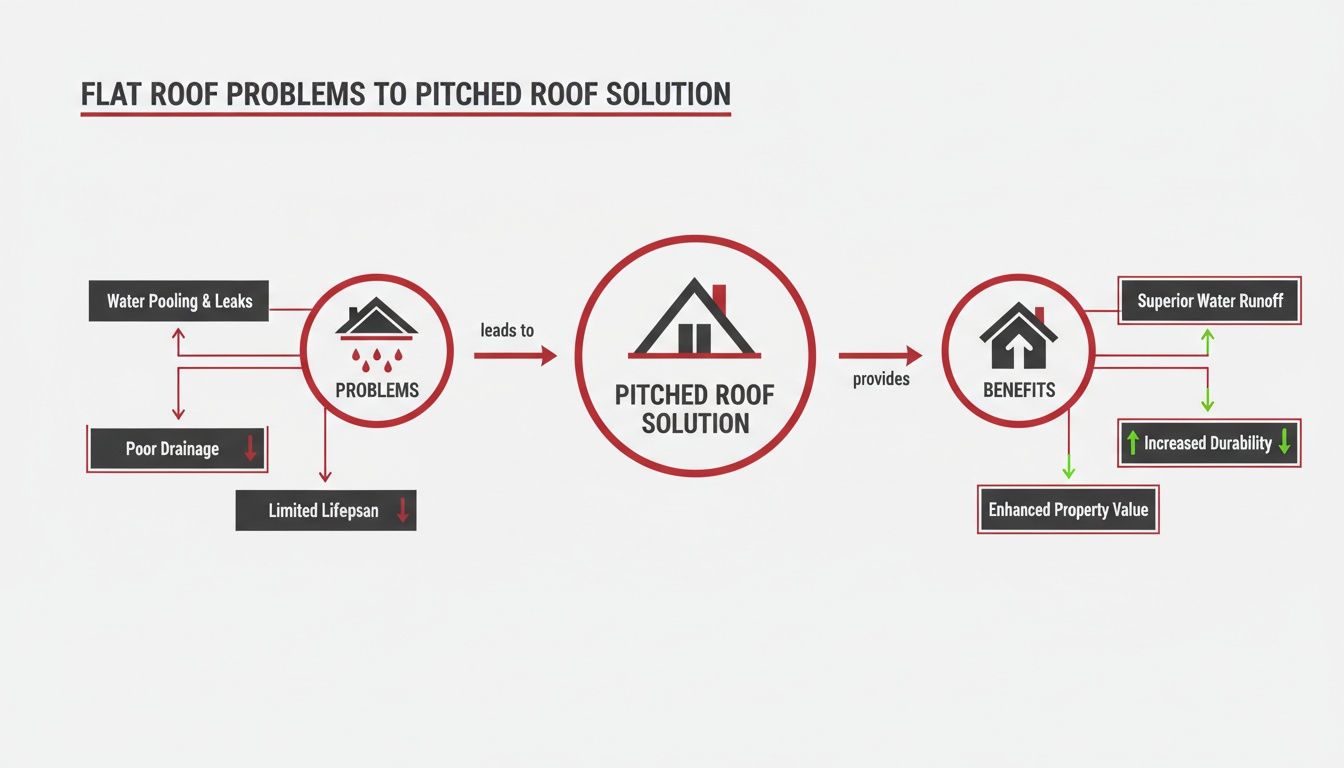
As you can see, tackling the core issue—poor drainage—creates a ripple effect of positive outcomes. Now, let’s get into the nitty-gritty of the two methods that make it all happen.
The Stick-Built Method: On-Site Custom Construction
The first route is the traditional stick-built method. This is old-school carpentry at its best, where the entire new roof frame is built piece-by-piece, right on top of your existing roof.
Carpenters will literally measure, cut, and fasten every single rafter, ridge board, and joist on-site. It's a completely custom job, tailored perfectly to the unique dimensions and quirks of your home. This hands-on approach offers incredible flexibility, making it a great choice for homes with unusual layouts or complex architectural features.
The stick-built method is true on-site craftsmanship. It allows for adjustments during the build and is ideal for homes where lifting heavy, pre-made structures is difficult or impossible due to site constraints like trees or power lines.
Because every component is handled manually on-site, this process is naturally more labor-intensive and takes longer to complete. However, for a one-of-a-kind design or a tricky property, it's often the only way to go.
The Prefabricated Truss Method: Off-Site Precision Engineering
The second, and often more popular, option uses prefabricated trusses. These are engineered triangular wood frames built to exact specifications in a factory, delivered to your house on a truck, and then lifted into place with a crane.
It’s a much more modern and streamlined process. The trusses arrive as a complete set, designed by engineers using software to handle your area's specific snow and wind loads. The on-site work is less about building from scratch and more about expert assembly.
This method comes with some big advantages:
- Speed: With the trusses already built, the framing can go up incredibly fast—sometimes in just a single day. This is a huge plus because it minimizes the time your home's interior is exposed to the weather.
- Cost-Effectiveness: Factory production lines are efficient. That efficiency often translates into lower labor costs compared to a fully custom, stick-built job.
- Engineering Confidence: You get a high degree of structural certainty. Each truss is designed to meet or exceed local building codes, taking the guesswork out of the structural equation.
Comparing the Two Approaches
So, which is better? Neither. The right choice completely depends on your project. A stick-built frame and prefabricated trusses are just two different tools for the same job, and the best one depends on your home’s structure, your design vision, and your budget.
Here’s a quick side-by-side to make the differences clear:
| Feature | Stick-Built Method | Prefabricated Truss Method |
|---|---|---|
| Construction Site | Entirely on-site | Trusses built in a factory |
| Flexibility | High customization possible | Limited by engineered design |
| Timeline | Longer, more labor-intensive | Faster on-site assembly |
| Ideal For | Complex designs, tight spaces | Standard roof shapes, speed |
| Cost | Can be higher due to labor | Often more cost-effective |
Ultimately, any good contractor will walk you through their recommendation and explain why it's the right call for your property. Now that you understand the lingo, you can have a much more productive conversation about the plan to give your home the strong, reliable pitched roof it deserves.
Planning Your Project: The Critical First Steps
It’s easy to get excited about converting a flat roof to a pitched one, but diving in without a solid plan is a fast track to headaches and budget overruns. Before you even think about ordering materials, a few critical steps will lay the groundwork for a safe, legal, and durable new roof.
Think of it this way: you wouldn't build a house on shaky ground. This pre-construction phase is all about checking the foundation—your home's existing structure—and getting the blueprint right.
Can Your Home Handle The Weight?
This is the first, and most important, question to answer. A pitched roof adds a tremendous amount of weight—what engineers call a dead load—that your home was never designed to hold. We're talking about the combined weight of framing, sheathing, underlayment, and your final roofing material, whether it's shingles or metal.
You absolutely need a licensed structural engineer for this. They’ll perform a top-to-bottom assessment, looking at:
- Foundation Integrity: Are there existing cracks or signs of stress that could get worse under the new load?
- Load-Bearing Walls: Can the walls under the roof's edge support the concentrated weight from the new trusses or rafters?
- Existing Framing: They'll inspect the current roof joists to see if they can be reinforced or need to be replaced entirely.
Skipping a professional structural assessment is the single biggest gamble you can take on a project like this. It's a non-negotiable step to prevent a catastrophic failure down the road.
Navigating Building Codes And Permits
Once an engineer gives you the green light, your next stop is the local building department. A project of this size always requires a building permit. Trying to fly under the radar is a bad idea—it can lead to steep fines, stop-work orders, and a massive headache when you try to sell your home.
To get a permit, you'll need to submit detailed architectural plans along with the structural engineer's report. The city reviews everything to make sure your project is up to code, covering things like:
- Roof Pitch: Minimum slope requirements for different roofing materials.
- Snow and Wind Loads: Designs that can handle your area's worst weather.
- Fire Safety: Rules for materials and proper attic access.
This process isn't just red tape; it's there to protect you and ensure the final job is safe and sound.
Assessing The Existing Flat Roof
So, what happens to the old roof? Most of the time, it stays right where it is, acting as an air and vapor barrier for the new attic space. But its current condition matters. A lot.
Before you build over it, a roofer needs to inspect the existing flat roof for trapped moisture, rot, or serious wear. Covering up a leaky or damaged roof just traps the problem, creating a perfect environment for mold and decay inside your brand-new structure. Any and all repairs have to be done first.
While homeowners often move away from flat roofs for better drainage and longevity, it's interesting to see the commercial world heading in the opposite direction. Driven by cost and storm resilience, the flat roofing market is projected to grow from USD 13.49 billion in 2026 to USD 17.81 billion by 2032. North America is a big part of that, accounting for 45% of renovation installs. You can dive into the full report on flat roof market trends at researchandmarkets.com. For homes, though, a well-built pitched roof is almost always the better long-term investment.
Pitched Roof vs Flat Roof Key Differences
To truly understand the value of this conversion, it helps to see a side-by-side comparison of what you're leaving behind and what you're gaining.
| Feature | Flat Roof | Pitched Roof |
|---|---|---|
| Drainage | Relies on slight slope and internal drains; prone to ponding water. | Sheds water and snow naturally due to steep slope. |
| Lifespan | 10-20 years on average; membrane is exposed to harsh elements. | 20-50+ years depending on material; shingles/panels are durable. |
| Maintenance | Requires frequent inspections for leaks, punctures, and drain clogs. | Needs less frequent maintenance; primarily gutter cleaning. |
| Initial Cost | Generally lower upfront cost for materials and installation. | Higher initial investment for framing, materials, and labor. |
| Energy Efficiency | Can absorb significant heat; often requires reflective coatings. | Creates an attic space for insulation, improving energy efficiency. |
| Aesthetics | Modern, minimalist look; common on commercial and contemporary homes. | Traditional, classic appearance; offers more design flexibility. |
| Usable Space | Can be converted into a rooftop deck or garden. | Creates a usable attic or vaulted ceiling space inside. |
| Structural Demands | Places a uniform, lighter load on the building structure. | Adds significant dead load, requiring robust structural support. |
As the table shows, a pitched roof is a significant upgrade in durability and performance, though it comes with a higher initial cost and more complex structural requirements.
Planning For Rooftop Equipment
Finally, don't forget about the stuff that's already up there. HVAC units, plumbing vents, and exhaust fans can't just be framed over.
Your contractor's plan needs to map out how to handle each one. This usually involves:
- Professionally disconnecting and temporarily moving any HVAC equipment.
- Extending all plumbing vents and ducts up through the new roof deck.
- Properly flashing and sealing every single penetration to make it watertight.
As you design the new roof, think about insulation. This new attic is a golden opportunity to slash your energy bills. It's a great time to research topics like how to insulate a vaulted ceiling, as many of the same principles apply. Tackling these details before the first hammer swings is the key to a project that goes smoothly from start to finish.
Weighing the Pros and Cons of Conversion
Deciding to put a pitched roof over an existing flat one is a massive undertaking—it's far more than a simple repair. Think of it as a major structural upgrade. It’s a serious investment that can deliver some powerful, long-term rewards, but it also demands a pretty hefty commitment right out of the gate.
Before you jump in, it’s crucial to look at both sides of the coin. This isn't a weekend DIY project; you're fundamentally changing your home's entire roofline and structure. Getting the full picture now helps you make a confident decision that actually fits your budget, timeline, and what you want for your property down the road.
The Clear Advantages of a Pitched Roof
Let's start with the good stuff. The biggest reason people make this switch is to permanently fix the headaches that are practically built into flat roofs. The benefits go way beyond just making your house look better; they offer real, tangible improvements.
- Superior Water Drainage: This is the number one reason, hands down. A pitched roof uses gravity to its advantage, shedding water and snow almost instantly. You can finally say goodbye to that dreaded ponding water that causes leaks and wrecks roofing materials over time.
- Enhanced Energy Efficiency: Building a pitched roof creates a brand-new attic space, which is a total game-changer for your home's insulation. A properly insulated and ventilated attic acts like a thermal buffer, drastically cutting down on heat loss in the winter and keeping your home cooler in the summer. That often means lower energy bills.
- Increased Curb Appeal and Property Value: Let’s be honest, a well-designed pitched roof just looks better on most homes. It can transform a boxy, commercial-looking building into something with a more traditional and inviting feel. This visual upgrade almost always translates to a higher market value.
- Long-Term Durability: Pitched roofing materials like architectural shingles or metal panels are built to last—we're talking lifespans of 20 to 50+ years. Compare that to most flat roof membranes, and you're looking at fewer replacements and a lot less worry over the long haul. We break this down even further in our article on flat roof vs pitched roof considerations.
The Realistic Disadvantages to Consider
As great as those benefits sound, you have to go into this with your eyes wide open. The challenges are real, and they mostly boil down to the sheer complexity and cost of a project this big.
A pitched roof conversion is a complex construction project with structural implications. The upfront cost, timeline, and potential for disruption are serious factors that every homeowner must weigh carefully against the long-term gains.
Here’s a frank look at the hurdles you’ll face:
- Significant Upfront Cost: This is the biggest showstopper for most people. A conversion isn't just slapping on some new shingles. It requires engineering plans, tons of labor, and a mountain of materials. It is substantially more expensive than just putting a new membrane on your existing flat roof.
- Complex Structural Requirements: You can't just start building a new roof on top of the old one. The project absolutely requires a structural engineer to come in and verify that your home's foundation and walls can handle the significant new weight.
- Extended Construction Timeline: A simple re-roofing job might take a few days. A full conversion? It could easily take weeks. You’ve got multiple phases, from getting permits and engineering designs to framing, sheathing, and finishing. It's a much longer disruption to your daily life.
- Potential for Unforeseen Issues: Once you start opening things up, you never know what you'll find. It's not uncommon to uncover hidden problems like rot or moisture damage in the existing structure, which can tack on unexpected costs and delays.
It's interesting to note that while homeowners are often running away from flat roofs, these designs are actually gaining ground in the commercial world. The global flat roofing market sees them as versatile spaces for things like rooftop gardens or solar panels. You can find more on the rise of flat roofs in modern design on daedal-research.com.
For most residential properties, though, the long-term reliability of a pitched roof is hard to beat. In the end, carefully weighing these pros and cons is the only way to know if adding a pitched roof is the right investment for you.
Estimating Your Project Cost and Timeline
Alright, let's get down to brass tacks: the money and the time. Converting a flat roof to a pitched one is a serious upgrade, and you need to go in with your eyes wide open about what it's going to cost and how long your home will be a construction zone. This isn't just a re-roof; it’s a major structural addition.
Think of this project less like a simple roof replacement and more like a small-scale home addition. The budgeting principles are surprisingly similar. For a deep dive into that side of things, check out this complete budgeting guide for the cost of a home addition.
Key Factors Driving Your Project Cost
So, what actually determines the final number on your quote? It's a mix of several key ingredients, and tweaking any one of them can significantly change the price.
- Total Square Footage: This one’s simple. A bigger roof means more lumber, more shingles, and more hours for the crew. It’s the single biggest factor.
- Roof Pitch and Complexity: A straightforward, low-slope gable roof is one thing. But if you start adding multiple hips, valleys, or dormers, the framing gets exponentially more complex and expensive. Steeper pitches also mean more safety gear and slower work, which bumps up the labor cost.
- Choice of Materials: This is where you have a lot of control over the budget. Standard asphalt shingles are the workhorse and the most affordable option. But stepping up to a standing seam metal roof or Class 4 impact-resistant shingles will cost more now but will save you headaches and money down the road.
- Structural Engineering and Permits: These are non-negotiable line items. You absolutely need a structural engineer to draw up and sign off on the plans. Then, you have to pay the city or county for building permits. These fees can vary wildly depending on where you live.
For a pitched roof on a flat roof conversion, you should realistically budget for $30 to $55 per square foot. On a typical 1,500 sq. ft. home, that puts you in the ballpark of $45,000 to $82,500.
That range should cover everything—engineering, permits, labor, and all the materials. To get a better handle on how different roofing materials affect that number, our guide on how much a new roof costs breaks it down pretty clearly.
Mapping Out a Typical Project Timeline
Beyond the check you’ll have to write, you need to be ready for the timeline. This is not a weekend project. From the day you first call a contractor to the final inspection, a full conversion can easily take four to eight weeks.
Knowing the phases helps you understand why it takes so long and lets you see the light at the end of the tunnel.
- Initial Consultation and Design (1-2 weeks): This is the discovery phase. A good contractor will come out, take measurements, and talk through your goals and budget. From there, they’ll create initial drawings and a detailed proposal.
- Engineering and Permitting (2-4 weeks): Once you give the green light, the plans head to a structural engineer. After they stamp them, the whole package goes to your local building department. Honestly, this waiting game is often the longest part of the entire project.
- Material Ordering and Staging (1 week): The moment the permit is approved, your contractor will order everything—trusses, lumber, sheathing, underlayment, and your roofing. It all gets delivered and carefully staged on your property just before the real work begins.
- Construction and Installation (1-2 weeks): This is go-time. The crew frames the new roof structure, lays down the sheathing and underlayment, and then installs the final roofing material. This is also when they’ll extend plumbing vents and install all the critical flashing around chimneys and walls.
- Final Inspections and Cleanup (2-3 days): Once the last shingle is in place, the crew does a full site cleanup. Then, the city inspector comes for the final sign-off to make sure everything is built to code. When that’s passed, you can officially pop the champagne. Your project is done.
Finding the Right Professional for Your Roof Conversion
Let's be perfectly clear: slapping a pitched roof on an existing flat roof is a major construction project. This isn't a job for a weekend warrior or a general handyman. We're talking about fundamentally changing the structure of your home, and the consequences of a mistake—think structural failure or catastrophic leaks—are just too severe to risk.
Hiring a contractor who specializes in these conversions is non-negotiable. The right pro brings a unique blend of skills that are absolutely essential for success. They've been down this road before and know the entire process, from getting the initial engineering right to laying that final ridge cap.
What Expertise to Look For
Not all roofers are created equal, and most are not equipped to handle a conversion. You need a crew with a proven track record in this specific niche. As you start talking to contractors, make sure they have a firm grasp on these key areas:
- Structural Understanding: Can they read an engineer's report and understand how the new weight will transfer all the way down to your foundation? This is paramount.
- Code Navigation: They need to be fluent in local building codes. A pro knows what the inspectors are looking for and can get permits secured without frustrating delays.
- Framing and Carpentry: This is where the skill really shows. Whether they’re stick-building the frame or setting pre-fabricated trusses, the work has to be precise.
- Advanced Roofing Techniques: This goes way beyond standard shingling. It involves complex flashing where the new roof meets old walls, proper ventilation design, and a dozen other details that prevent leaks.
The best contractor for a roof conversion isn't just a roofer—they're a project manager. They'll be the one coordinating the engineer, the truss manufacturer, the material suppliers, and the city inspectors to make the whole process feel seamless for you.
Questions to Ask Potential Contractors
When you sit down with a potential contractor, you need to be ready with some tough questions. A true professional will welcome them and have solid, confident answers.
- Can you show me a portfolio with pictures of other flat-to-pitched conversions you've actually done?
- How many of these specific projects have you completed in the last five years?
- Do you have a structural engineer you regularly work with, or will I need to find my own?
- What's your plan for handling the existing rooftop equipment, like my HVAC unit and vents?
Choosing your contractor is the single most important decision you'll make in this entire process. Think of it as your insurance policy against shoddy work and future headaches. It's how you guarantee your investment pays off with a strong, beautiful, and safe new roof.
Got Questions? We've Got Answers
Even with all the details on methods and costs, it's natural to still have a few questions floating around. Tackling a roof conversion is a big deal, and you want to be sure about every last detail before you start. Let's walk through some of the most common things homeowners ask us.
Do I Have to Tear Off the Old Flat Roof?
Usually, no, you don't. In most cases, we can build the new pitched roof system right over top of the existing flat roof. That old roof then gets a new job, acting as an excellent secondary barrier against air and moisture, safely tucked away inside the new attic space.
But—and this is a big but—it all depends on the condition of that old roof. A professional has to give it a thorough inspection first. If we find any major water damage, trapped moisture, or rot, those issues have to be fixed or removed. The last thing you want is to seal in a problem that will cause trouble down the road.
Will This Actually Lower My Energy Bills?
You can bet on it. The conversion creates a brand-new attic space between your ceiling and the new pitched roof. This is a golden opportunity to pack in a thick layer of modern insulation and install proper ventilation.
This new buffer zone is a game-changer for your home's temperature. It drastically cuts down on heat seeping in during a blistering summer and stops your expensive heat from escaping in the winter. Most homeowners see a real, noticeable drop in their heating and cooling bills.
The attic space from a roof conversion is one of the most underrated perks. It completely overhauls your home's thermal performance, turning what was once an energy weak point into an asset that saves you money month after month.
What About My Rooftop A/C Unit and Vents?
That's all part of the plan. Any equipment on your current roof—HVAC units, plumbing vents, exhaust fans, skylights—has to be moved or modified. This is a standard part of any professional roof conversion.
Your contractor will either extend these penetrations up through the new roofline, sealing them with new, watertight flashing, or relocate them to a better spot. A good pro will map all this out in the initial design and quote. Getting these details right is non-negotiable for preventing leaks.
Is a Pitched Roof Really Better in a Hailstorm?
Without a doubt. This is one of the biggest reasons people in storm-prone areas make the switch. A pitched roof is designed to use gravity to its advantage, shedding hail and heavy rain immediately. You completely eliminate the risk of pooling water, which is the number one enemy of a flat roof.
On top of that, you can opt for incredibly tough, impact-resistant materials like Class 4 shingles. These are built specifically to take a beating from severe hail. It's an upgrade that gives you both rock-solid structural protection and some serious peace of mind when the sky turns dark.
Ready to put your flat roof problems behind you for good while boosting your home's value and resilience? The team at Hail King Professionals has been the go-to expert for roof conversions across Texas since 1991. We handle everything from the engineering to the final walkthrough, making sure your new roof is built to last. Get a free, no-obligation inspection and quote today!