


Solar Panel Removal for Roof Repair: A Practical Guide
When a Texas hailstorm tears through your neighborhood, dealing with a damaged roof is stressful enough. But when you have solar panels, that stress can feel like it's doubled. This is where a professional solar panel removal for roof repair—what we in the industry call a "detach-and-reset"—becomes absolutely essential. It’s a specialized job that protects your solar investment and ensures your home is repaired correctly.
Why Roof Repair Requires a Solar-Savvy Roofer
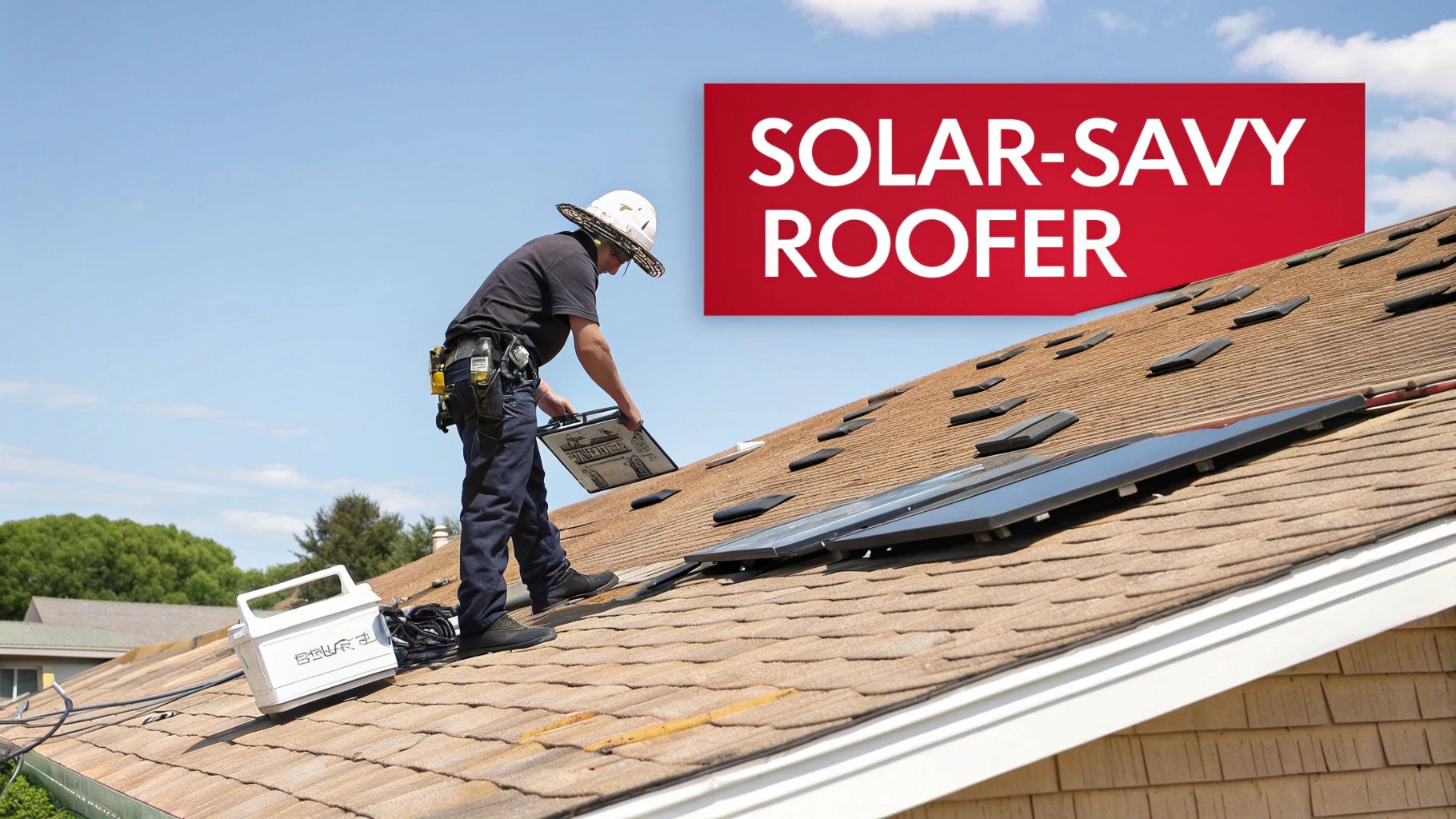
Picture this: a major storm just hammered Dallas-Fort Worth, and your roof is a mess. Those solar panels you invested thousands in are now sitting on top of a failing structure. This isn't just a roofing job anymore. It’s a complex project that requires someone who knows both roofing and solar inside and out.
Hiring a general roofer without solar training is asking for trouble. Sure, they can nail down shingles, but they don't have the skills to safely disconnect, handle, and reinstall the sensitive electrical and mounting hardware of your solar array. A specialized detach-and-reset service isn't just a good idea; it's a must.
The Dangers of Unqualified Removal
I've seen firsthand what happens when homeowners try to cut corners here. Letting an unqualified roofer touch your solar panels can lead to some seriously expensive mistakes. The risks are huge and often don't show up until months later.
- Voided Warranties: Solar manufacturers are very specific about who can work on their equipment. If an uncertified contractor so much as loosens a bolt, you can kiss your panel, inverter, and workmanship warranties goodbye.
- Equipment Damage: Panels look tough, but they can be damaged in ways you can't even see. Improper handling can cause tiny microcracks in the solar cells, harm the wiring, or warp the frames, all of which kill your system's efficiency.
- Roof Integrity Issues: A roofer who doesn’t understand solar racking can easily compromise your roof's waterproofing during the removal process. This can cause persistent leaks around the mounting points after your brand-new roof is already installed.
Think of your solar system as a power plant on your roof. You wouldn't let a regular mechanic work on an airplane engine, right? The same logic applies here—the risk of a costly error is just too high to gamble on.
The Specialist Advantage
A true solar-savvy roofer, like the team at Hail King Professionals, brings both skill sets to the table. We understand the delicate dance between the roofing materials and the solar components, ensuring the entire project is handled correctly from the moment we arrive. This integrated expertise is a hallmark of the modern solar energy industry, where precision is everything.
Trying to juggle a separate roofer and a separate solar company is a logistical nightmare. It often leads to delays, communication gaps, and a blame game if problems arise. A single, qualified team streamlines everything, managing the detach-and-reset and the reroof under one coordinated plan. This saves you a massive headache and provides clear accountability. The type of roof you have also plays a big role, which you can read more about in our guide to roofing system types. Ultimately, choosing a professional who masters both sides of the job is the only way to safeguard your home and your energy investment.
Understanding the Costs of a Solar Detach and Reset

When your roof needs to be replaced, the cost of the solar work is a significant budget item you absolutely can't overlook. This isn't just an arbitrary fee; it’s a reflection of the skilled labor, specialized equipment, and careful planning required to safeguard your investment in clean energy. Getting a handle on what drives this cost will help you sort through quotes and make a confident decision.
The most straightforward way companies price a solar detach-and-reset service is a flat rate per panel. This makes it pretty simple to get a ballpark idea of the total cost just by knowing how many panels you have. A smaller home might have 15 panels, while a larger one could easily have 30 or more.
Industry numbers give us a solid baseline. For example, recent data from Paradise Solar Energy shows the cost for removal and reinstallation lands somewhere between $275 and $300 per panel. This is a great benchmark to keep in mind, clearly showing how the system size directly impacts the project's price tag.
A Look at Real-World Numbers
So, what does that per-panel rate look like in practice for a typical Texas home? Let's break it down.
If you have a standard 15-panel system, which we see all the time in the DFW area, you’re looking at a total cost between $4,125 and $4,500. For a bigger roof with a 30-panel array, the cost scales up to a range of $8,250 to $9,000.
This price tag isn't just for taking the panels down. It covers the entire process: professionally shutting down the system, detaching the panels and racking, carefully storing them on-site during the roof work, and then putting it all back together and recommissioning the system once the new roof is on.
To give you a clearer picture, here’s a quick breakdown of what you can expect based on system size.
Estimated Costs for Solar Panel Detach and Reset
| System Size (Number of Panels) | Estimated Cost Range (per panel at $275-$300) | Total Estimated Project Cost |
|---|---|---|
| Small System (15 Panels) | $4,125 – $4,500 | $4,125 – $4,500 |
| Medium System (25 Panels) | $6,875 – $7,500 | $6,875 – $7,500 |
| Large System (35 Panels) | $9,625 – $10,500 | $9,625 – $10,500 |
These figures should help you budget more effectively and evaluate the quotes you receive from different contractors.
A key takeaway here: The solar detach-and-reset is a separate, specialized service from the roof replacement itself. Bundling both jobs with a single, qualified contractor is almost always the best route for a smooth project and better value.
What Else Can Influence Your Final Quote?
While the per-panel rate is a great starting point, a few things about your specific property can nudge that final price up or down. A professional quote will always factor in the unique challenges of your home.
Here are three key things that can increase the cost:
- Steep Roof Pitch: The steeper the roof, the tougher and more dangerous it is for the crew. It demands extra safety gear and more time to move around, which bumps up the labor costs.
- Building Height: Working on a two- or three-story home is a bigger logistical challenge than a single-story ranch. Height impacts everything from setting up ladders to safely getting panels down to the ground.
- Complex Racking System: Not all solar mounting systems are created equal. An intricate setup with proprietary hardware can take longer to disassemble and reassemble correctly, adding to the labor bill.
In our experience, these factors can add a variance of 10% to 20% to the base price. This is exactly why an on-site inspection is non-negotiable for getting an accurate quote.
The Clear Advantage of Bundled Services
Choosing a contractor like Hail King Professionals that can handle both the roofing and the solar work in-house just makes life easier. Instead of juggling two different companies and trying to sync up their schedules, you get one unified project plan from a single point of contact. This integrated approach is fantastic for preventing delays and miscommunication, and it can even lead to cost savings.
When one team manages the entire workflow, they can schedule the solar removal, roof replacement, and reinstallation back-to-back, which means your system is down for the shortest possible time. That efficiency often results in a more competitive price than hiring two separate specialists. Of course, the solar work is just one piece of the puzzle; it's also important to understand how much a new roof costs to budget for the entire project.
What a Professional Detach and Reset Process Looks Like
When your roof needs work and you have solar panels, the whole process of getting them off and back on can feel like a black box. It’s a lot more involved than just unscrewing a few bolts. A proper detach and reset is a carefully coordinated effort to protect your home, your new roof, and your big investment in solar energy.
Honestly, this isn't a job for your average roofer—it demands specialized skills from beginning to end. Let's pull back the curtain on what a top-tier, professional solar panel removal for roof repair actually involves. Knowing these steps will help you feel confident your system is in good hands.
It All Starts With a Plan: Initial System Assessment and Mapping
Before a single tool comes out of the truck, the first thing a real pro does is a thorough on-site inspection. A qualified technician doesn't just show up and start yanking wires; they act more like a cartographer, meticulously mapping out your system’s unique layout.
This critical first phase includes:
- Performance Benchmarking: We run diagnostics to get a snapshot of your system's current energy output. This gives us a baseline so we can prove it's working just as well—or even better—when we're done.
- Component Inventory: Every single panel, inverter, and piece of racking hardware gets documented. We often log serial numbers to keep track of each specific component.
- Electrical Mapping: This is the most important part. Every wire and connection is carefully labeled and photographed. This detailed "map" is our blueprint for putting it all back together perfectly.
Trying to do this without that prep work is just asking for trouble. It turns the reinstallation into a guessing game that can kill your system's efficiency and even create safety hazards.
The Safe Shutdown and Detachment
With the system fully documented, the hands-on work begins, and safety is the absolute priority. Your solar array is basically a live power plant on your roof, so shutting it down correctly is non-negotiable. Our crew de-energizes the system at several points, starting at your main electrical panel and working back to the inverters and junction boxes on the roof.
Once we're sure everything is safely powered down, the physical work starts. We carefully disconnect the panels from each other and from their mounting racks. These panels can weigh around 40 pounds each, so we handle them with specialized gear to avoid causing any microcracks or damage to the frames. After they're off the roof, we store them in a secure spot on your property where they'll be out of the way and safe from the roofing work.
Next, the racking system itself comes off, clearing the way for the roofers to have full access. This is a crucial handoff, and tight coordination is everything.
I can't stress this enough: a successful reinstallation is completely dependent on a perfect removal. Every bolt is saved, every wire is labeled, and every component is treated with care. It's that fanatical attention to detail that separates the pros from the amateurs.
Coordination, Reinstallation, and a Watertight Finish
With the solar gear safely stored, the roofing contractor can jump in and replace your roof. When you work with a company that handles both services in-house, like Hail King Professionals, this transition is seamless. You avoid the headache and delays of trying to sync up schedules between two different companies.
After the new roof is on and has passed inspection, we get to work on the reinstallation. Using those detailed maps and photos we took at the beginning, we put everything back exactly where it belongs. Think of it as a mirror image of the removal, but with an even stronger focus on precision.
The racking goes back on first, and we make absolutely certain that every single mounting point is perfectly sealed to protect your new roof's waterproof integrity. This step is huge—improperly sealed mounts are one of the biggest causes of roof leaks down the road. The type of roof you have can also play a role; you can learn more about how different materials work with solar by reading about flat roofs versus pitched roofs and their unique demands.
Bringing It Back to Life: Recommissioning and Final Tests
With the panels mounted and all the electrical connections restored, it's time to bring the system back online. We call this recommissioning.
This final, critical stage involves:
- A careful, step-by-step power-up: The system is turned back on in a specific sequence to avoid any electrical surges.
- Performance verification: We run the same diagnostic tests from day one to confirm the system's output is right back where it should be, matching the original benchmarks.
- A final, thorough inspection: The crew does one last sweep, checking every connection, making sure every panel is perfectly aligned, and leaving the work area spotless.
The job isn't done until your system is performing exactly as it should. This rigorous, multi-step process is the only way to ensure your solar investment is protected for years to come.
How to Handle Insurance Claims for Roofs with Solar Panels
Filing an insurance claim for roof damage is already a headache. Throw solar panels into the equation, and it can feel downright overwhelming. But it doesn't have to be. With the right strategy, you can navigate the process and make sure you get the full coverage you're entitled to.
The good news is that most standard Texas homeowners' insurance policies cover the cost of a solar panel removal for roof repair when it’s tied to a covered loss, like hail damage. The trick is to position the "detach-and-reset" service as a non-negotiable part of the roof restoration itself.
Your Game Plan for a Successful Claim
The second you think your roof might be damaged, switch into documentation mode. The more proof you give your insurance adjuster, the better. Vague claims often lead to disappointing results, while detailed, well-documented claims get approved.
Start by taking clear photos and videos of everything. Snap pictures of damaged shingles, dented vents, and any scuffs or impact marks on your solar panels. If you can safely get a higher-angle view, do it. Don't just focus on the obvious damage; capture the entire roof to give the adjuster the full context.
Your smartphone is your best friend right after a storm. Time-stamped photos and quick notes create a powerful, undeniable record of the damage. This documentation is your single greatest piece of leverage in the claims process.
Once you’ve captured the evidence, your next call should be to a reputable contractor who handles both roofing and solar, like us at Hail King Professionals. An expert assessment is critical. A pro can spot damage an untrained eye would miss and provide a detailed, all-in-one quote that clearly separates the roofing costs from the solar detach-and-reset costs. This is precisely the kind of breakdown your adjuster needs to see.
Communicating with Your Insurance Adjuster
When you talk to your adjuster, be clear and confident. Explain that removing the solar panels is a mandatory step to properly replace the roof. I've found it helps to frame it as a "necessary cost to facilitate a covered repair." Using this specific language helps them categorize the expense correctly and push it through the system.
Be ready to emphasize a few key points:
- The panels have to come off to give the roofers unobstructed access.
- A certified solar technician is required to do the work to keep your warranties intact.
- The quote you’re providing includes both the roof replacement and the professional solar detach-and-reset service.
This infographic breaks down the professional reset process, which is a key part of your insurance claim.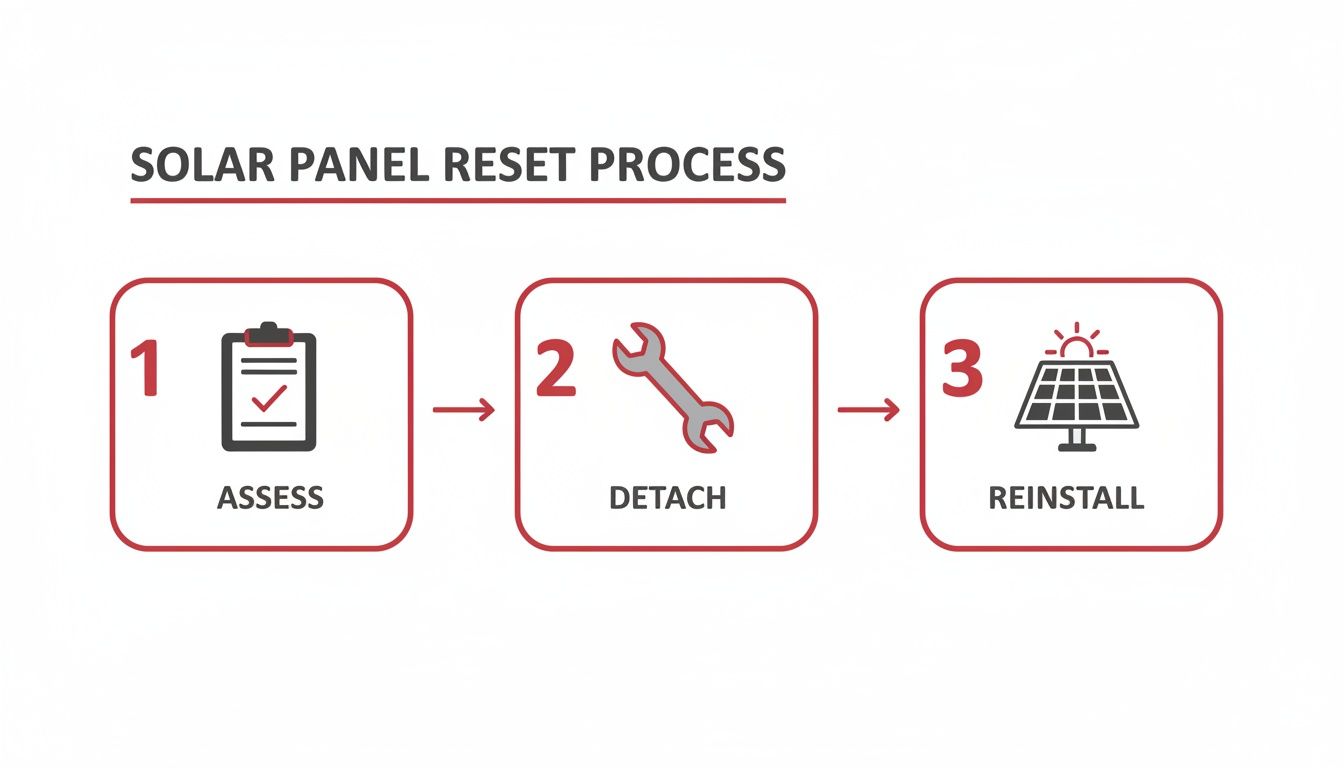
This visual shows how each phase—assessment, detachment, and reinstallation—is a distinct and essential service needed for a complete roof restoration.
Why a Specialized Contractor Is Your Best Advocate
Hail and storm damage are the biggest reasons for these kinds of repairs, especially here in Texas. The DFW area alone can get hit with 10-15 significant hail events every single year, causing billions in insurance claims. While a typical hail damage roof repair might run anywhere from $700 to $4,000, solar panels introduce another layer of complexity and cost. A safe, professional panel removal alone can add $400 to $600 to the job before a single shingle is replaced. You can dig into what drives these costs by checking out industry data on platforms like Angi.com.
An experienced contractor becomes your advocate with the insurance company. They know the lingo, understand what adjusters need to see, and can provide the technical documents to justify every line item. At Hail King Professionals, we’ve handled countless claims just like this. We provide the detailed reports, photos, and itemized estimates that help move your claim from "pending" to "approved," ensuring you're fully compensated for both the roof and the critical solar work.
The High Cost of Hiring an Unqualified Roofer
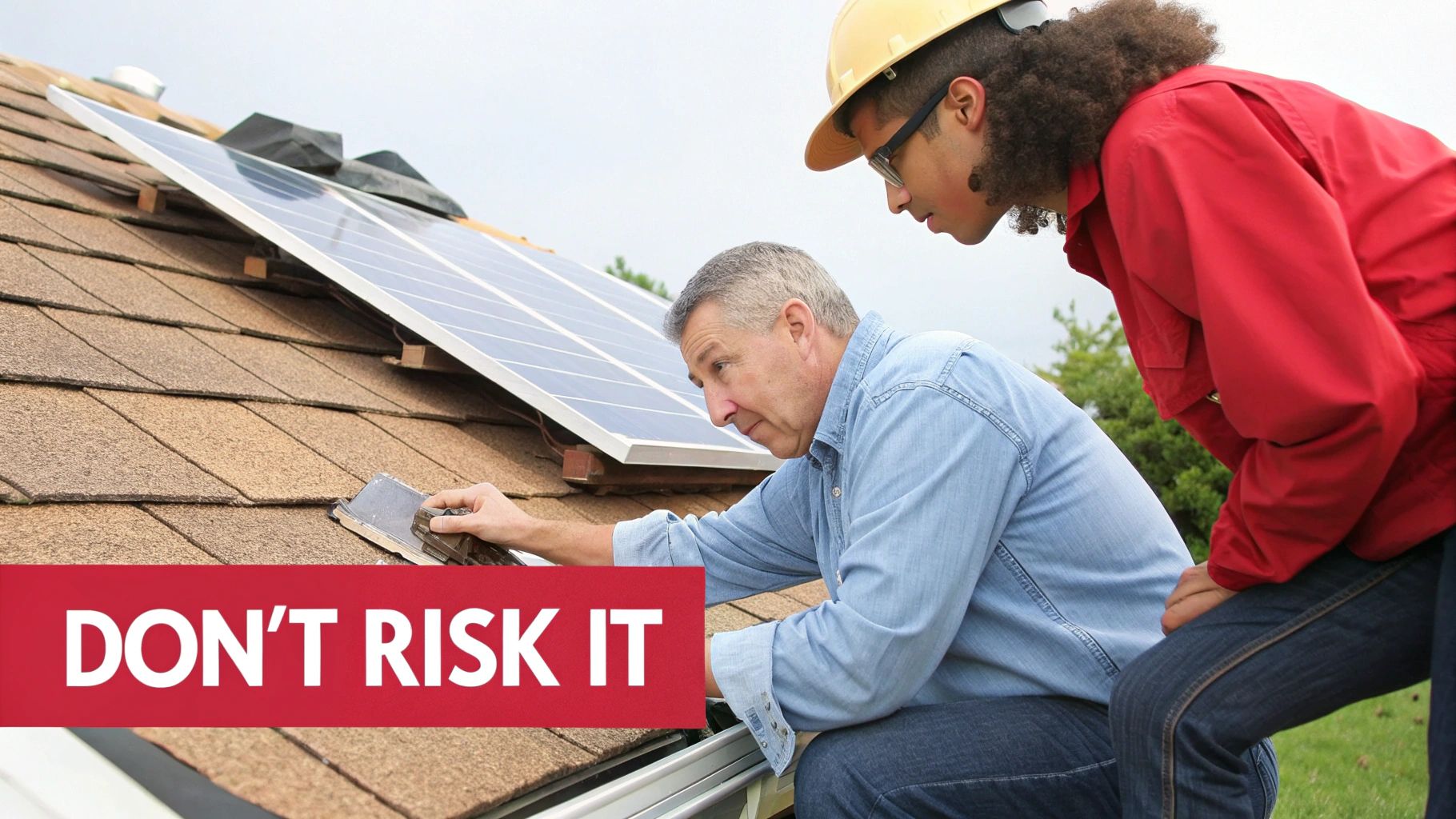
We get it. A roof replacement is already a major expense, so when someone offers to cut corners on the solar panel removal, it sounds tempting. But letting a general roofer—or worse, trying it yourself—handle your solar system is a high-stakes gamble that almost never pays off.
Any money you think you're saving upfront can easily be dwarfed by the massive costs of fixing the damage later. This isn't just about unscrewing a few bolts. It’s about protecting two of your home's most expensive and important assets: your roof and your solar power system. An unqualified person can cause serious harm you might not even notice for months.
The Instant Death of Your Warranties
Here’s one of the fastest ways to turn your solar investment into a liability: let an uncertified person touch it. Solar panel and inverter manufacturers have very strict warranty conditions, and for good reason. These are sophisticated pieces of technology that demand expert handling.
The second an unqualified roofer disconnects a wire or loosens a mounting clamp, you’ve likely voided multiple warranties.
- Panel Performance Warranty: This is the big one, guaranteeing your panels will produce a certain amount of power for up to 25 years. If they get mishandled and develop microcracks, the manufacturer won't cover the lost output.
- Inverter Warranty: The inverter is your system's brain. One wrong move with the electrical connections can fry it, and the manufacturer will point straight to the unauthorized work when they deny your claim.
- Workmanship Warranty: The company that originally installed your system guarantees their labor. As soon as another company messes with it, that protection is gone.
Think of it this way: your warranty is an insurance policy on a five-figure investment. Letting an unqualified roofer touch your panels is like tearing up that policy to save a fraction of the cost. It’s a financial move that simply doesn’t make sense.
Hidden Damage and Declining Performance
Beyond just paperwork and warranties, the physical damage can be even more punishing. A roofer who doesn’t specialize in solar can easily damage the panels themselves or compromise your roof’s waterproofing layers in subtle ways that slash your system’s efficiency.
This isn't a small problem. The National Roofing Contractors Association (NRCA) has noted that improper solar panel removal is a leading cause of post-repair roof issues. It contributes to a 20% to 30% spike in future repair costs, mostly from leaks caused by torn flashing or cracked underlayment.
On top of that, research from the National Renewable Energy Laboratory (NREL) confirms that incorrect handling during removal or reinstallation can cause your panel efficiency to drop by as much as 15%. You can learn more about why professional solar panel removal is the safe choice and avoid these pitfalls.
The Very Real Electrical and Fire Hazards
Finally, and most importantly, let's talk about safety. Your home’s solar array carries a dangerous amount of direct current (DC) electricity. Even when you flip the switch to "off," there's still live power in the lines running across your roof.
When an unqualified person attempts a solar panel removal for roof repair, they're working with a live electrical system they don't understand. A single mistake can lead to disaster.
- Severe Electrical Shock: DC electricity is incredibly dangerous. An accidental connection can cause serious injury or even prove fatal.
- Arc Flashes: Disconnect wires the wrong way, and you can create an arc flash—an explosive electrical event that causes severe burns and can easily ignite roofing materials.
- Fire Risk: Faulty wiring during reinstallation is a ticking time bomb. It can create hot spots that smolder for weeks before erupting into a fire in your attic or on your roof.
No amount of upfront savings is worth the risk of a house fire or personal injury. Hiring a certified, insured professional who understands both roofing and solar electrical systems isn't just a good idea—it's the only responsible way to protect your home and your family.
Common Questions About Solar Panel Removal and Roof Repair
When your roof needs work and you’ve got solar panels, it’s only natural to have a few questions. It feels like a complex puzzle, but it’s actually a pretty straightforward process when you have the right information. Let's walk through some of the most common questions we hear from homeowners in Texas.
How Long Will My Solar System Be Offline?
This is usually the first thing people ask. You invested in solar to generate your own power, so every hour the system is down feels like lost money. I get it. The good news is, with a coordinated team, the downtime is much shorter than you might think.
For a typical home, expect your solar system to be offline for about 3 to 5 days.
How does it happen so fast? It’s all about an integrated workflow. Day one is for a full system check, a safe electrical shutdown, and the careful removal of your panels. The next day or two, the roofing crew comes in and does their thing—a full roof replacement. On the final day or two, we get the racking and panels back up, reconnect everything, and run tests to make sure it’s all working perfectly before we flip the switch.
When one company handles both the solar and the roofing, you avoid the scheduling nightmares that can drag a project out for weeks.
Will Removing My Solar Panels Void Their Warranty?
This is a big one, and the answer is a hard no—if the work is done by a certified professional. Solar manufacturers are very strict about this. Their warranties require any service, from removal to reinstallation, to be handled by technicians who know what they're doing.
Letting a general roofer or a local handyman touch your solar equipment is one of the fastest ways to void those valuable manufacturer warranties. You have a 25-year performance warranty on your panels and another on your inverter; protecting them is non-negotiable.
A professional solar team understands these rules inside and out. They'll document the entire process and follow the manufacturer's exact protocols, ensuring every warranty on your equipment stays locked in. It’s all about protecting your investment for the long haul.
Is This a Good Time to Upgrade My Roofing Material?
Absolutely. In fact, there's no better time. With the solar panels already coming off the roof, it just makes sense to invest in a better, more durable roofing system. Think of it as a one-and-done opportunity to really fortify your home, especially here in Texas where hail is a constant threat.
We often suggest homeowners look into upgrading to Class 4 impact-resistant shingles. These aren't your standard shingles; they're specifically engineered and tested to handle serious hail impacts. Upgrading can dramatically cut down the risk of future damage to both your new roof and the solar panels sitting on top of it.
Will My Homeowners Insurance Cover The Solar Panel Removal?
For storm-related claims, like hail damage, the answer is almost always yes. A standard homeowners policy is designed to cover all the costs needed to get your property back to how it was before the storm. That includes the "reasonable and necessary" expense of having a professional solar company detach and reset your panels.
The trick is to work with a contractor who speaks the insurance language. They know how to provide the detailed, line-item quotes that adjusters need to approve the solar-related costs. We frame the solar work as an essential step in completing the covered roof repair, which is exactly what it is. Of course, always check your specific policy, but this is standard practice for legitimate storm claims.
Beyond the repair process itself, you might also have questions about maintaining your system long-term. For example, a lot of people wonder do solar panels really need cleaning to keep them producing at their best. It's another important part of getting the most out of your solar investment.
Tackling a roof replacement when you have solar panels doesn't have to be a headache. With the right partner, you can protect your home, keep your warranties intact, and get your system back to generating power in no time. Hail King Professionals specializes in this exact scenario, offering a seamless, all-in-one service for both your roofing and solar needs. If a storm has left its mark on your roof, contact us today for a free, no-obligation inspection.