

Your Guide to Commercial Roof Replacement Cost in Texas
Let's get right to it. You can expect a commercial roof replacement in Texas to cost somewhere between $10 and $30+ per square foot. But that’s a huge range, right? The final number on your invoice will really come down to the materials you pick, the sheer size of your roof, and how complicated the job is.
What's The Real Cost of a Commercial Roof Replacement?
When you're trying to budget for a new roof, that per-square-foot price is just the beginning of the conversation. It’s a lot like buying a truck. You see the base model price, but then you start adding things—four-wheel drive, a towing package, the premium interior. Suddenly, the price looks very different.
Your roof works the same way. Do you want to beef up the insulation to slash your summer cooling bills? Or maybe you need a tougher membrane that can shrug off a classic Texas hailstorm? What if your building is several stories high and requires special lifts and safety rigging? All these choices add to the final investment. It’s a major capital expense, and knowing what goes into it is half the battle.
Breaking Down the Numbers
Lately, the entire U.S. roofing industry has seen costs climb, now hitting nearly $31 billion annually. This isn't surprising when you factor in inflation, lingering supply chain hiccups, and the wild weather we get here in areas like Dallas-Fort Worth.
A basic roof replacement might start around $10 per square foot, but it's not uncommon to see prices push past $20 or even $30 per square foot for high-performance systems designed to last for decades.
To put this into perspective, here’s a quick look at what you might expect for a fairly standard 20,000-square-foot commercial building in Texas.
Estimated Cost For A 20,000 Sq Ft Commercial Roof Replacement In Texas
This table provides a snapshot of what different roofing systems could cost for a common commercial roof size. These are ballpark figures to help you start budgeting.
| Roofing System | Average Cost Per Square Foot | Estimated Total Cost Range |
|---|---|---|
| TPO | $10 – $18 | $200,000 – $360,000 |
| EPDM | $12 – $20 | $240,000 – $400,000 |
| Metal | $15 – $30+ | $300,000 – $600,000+ |
Of course, these numbers are just a starting point. The only way to get a firm, reliable quote is to have a professional get up on your roof for a thorough inspection. They’ll be able to assess the unique conditions of your building and give you a precise figure.
Understanding the Full Scope of Your Quote
A good, transparent quote from a contractor will break everything down for you. It should clearly list out the costs for materials, labor, permits, and even waste disposal. This level of detail ensures you aren't hit with surprise charges later on.
It can be helpful to understand how contractors put these numbers together. Many use specialized tools like Exayard general contractor estimating software to manage all the moving parts of a complex project. Seeing an itemized bid empowers you to compare different offers intelligently and makes you a much more confident property owner.
How Roofing Materials Impact Your Budget
When you're pricing a commercial roof, think of it like buying tires for a heavy-duty truck. You wouldn't put standard passenger car tires on a semi-rig that hauls goods across Texas, right? Each roofing material is engineered for a specific job, and its price reflects its performance, how long it will last, and the value it brings to your building over its lifetime.
The commercial roof replacement cost is much more than just the upfront materials invoice. It’s an investment in your building's next 20, 30, or even 50 years. Some systems are designed to slash your energy bills, while others offer brute-force protection against our notorious Texas hail storms. Getting a handle on these differences is the key to making a smart financial decision.
This chart gives you a quick snapshot of the typical costs you'll see for the most common commercial roofing systems around DFW and East Texas.
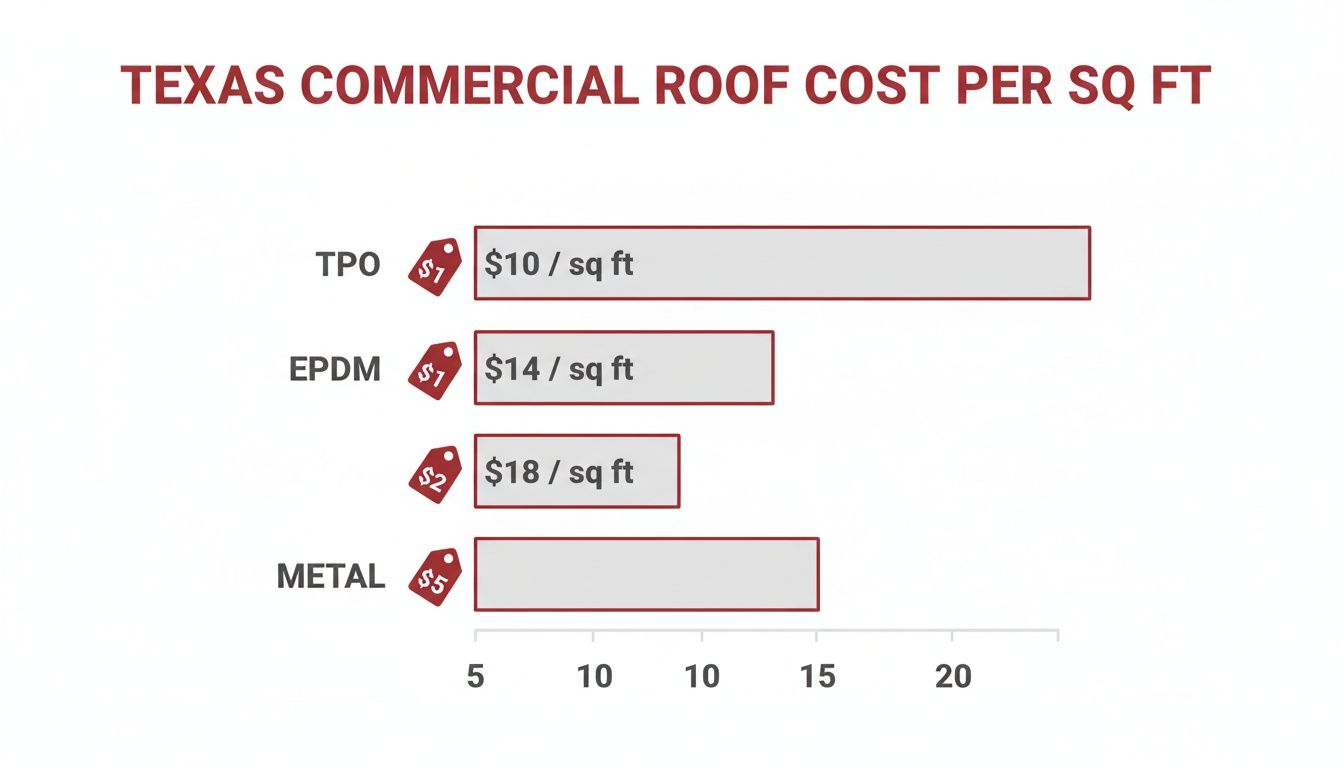
As you can see, there’s a definite range. Systems like metal command a higher initial price, but that’s because they’re built for exceptional durability and an incredibly long lifespan.
To help you compare your options, here's a quick breakdown of the most common systems we install.
Commercial Roofing Systems At A Glance
| Roof System | Typical Cost Per Sq. Ft. | Average Lifespan | Key Benefit |
|---|---|---|---|
| TPO | $7.50 – $14.00 | 20-30 years | Superior energy efficiency |
| EPDM | $8.00 – $15.00 | 25-35 years | Extreme durability & flexibility |
| Metal | $10.00 – $20.00+ | 50+ years | Unmatched longevity |
| Modified Bitumen | $7.00 – $13.00 | 15-25 years | Excellent puncture resistance |
| Roof Coatings | $4.00 – $8.00 | 10-15 years | Extends life of existing roof |
This table provides a high-level view, but the real story is in how each system performs day-to-day on your specific building. Let's dig into the details.
TPO Roofing: The Energy-Efficient Workhorse
Thermoplastic Olefin (TPO) is easily one of the most popular choices for flat and low-slope roofs in Texas, and it's no surprise why. This single-ply membrane is usually brilliant white, acting like a massive reflector that bounces the sun's harsh UV rays away from your building.
Think of it this way: on a blazing Dallas August afternoon, would you rather be in a white car or a black one? The white surface stays dramatically cooler, forcing your HVAC system to work less. That translates directly into lower energy bills, often cutting cooling costs by 10-30% and helping the roof pay for itself over time.
EPDM Roofing: The Durable Guardian
Ethylene Propylene Diene Monomer (EPDM) is, for all intents and purposes, a high-performance rubber roof. Its superpower is its incredible flexibility and durability. This material is built to handle Texas's wild temperature swings, expanding in the heat and contracting in the cold without cracking or becoming brittle.
It's the difference between a new rubber band and an old, stiff piece of plastic. The rubber band can stretch and snap back countless times; the plastic will break under stress. EPDM's resilience makes it a champion against punctures and hail damage, offering a long, reliable service life. For many property owners, it's a true "set it and forget it" solution.
Metal Roofing: The Lifetime Investment
When your number one priority is longevity, metal roofing is in a league of its own. While it often has the highest upfront commercial roof replacement cost, it also delivers a service life that can easily exceed 50 years with proper care. It’s the very definition of a long-term capital investment.
Metal systems are exceptionally tough, providing best-in-class resistance to fire, wind, and impact. They also come in reflective finishes that contribute to energy savings. For a building owner who plans to hold onto a property for decades, the higher initial outlay is almost always justified by completely avoiding the cost and disruption of a future replacement.
Modified Bitumen and Built-Up Roofing
These are the time-tested veterans of the flat roofing world. Modified Bitumen is essentially asphalt supercharged with rubber modifiers for added flexibility and strength. It's applied in multiple layers, creating a tough, redundant surface that's fantastic at resisting punctures from foot traffic or dropped tools.
Built-Up Roofing (BUR) is the original multi-ply system, constructed with alternating layers of bitumen (asphalt) and reinforcing fabrics. It's heavy, robust, and has been protecting commercial buildings for over a century.
Expert Insight: The choice between these multi-ply systems often comes down to the building's specific use. A distribution center with dozens of rooftop HVAC units and regular maintenance traffic would be a perfect candidate for the superior puncture resistance of Modified Bitumen.
The Role of Roof Coatings
Sometimes, you don't need a full tear-off and replacement. If your existing roof membrane is still in fundamentally good shape but is starting to show its age, a high-performance roof coating can be a fantastic alternative.
These fluid-applied systems create a brand new, seamless, and highly reflective surface directly over your current roof. This strategy can add another 10-15 years to your roof's life, pushing a costly replacement far down the road and saving a significant amount of money in the process. It's a smart, cost-effective way to restore performance without the major expense and disruption of a full replacement.
Uncovering the Hidden Costs in Your Roofing Quote
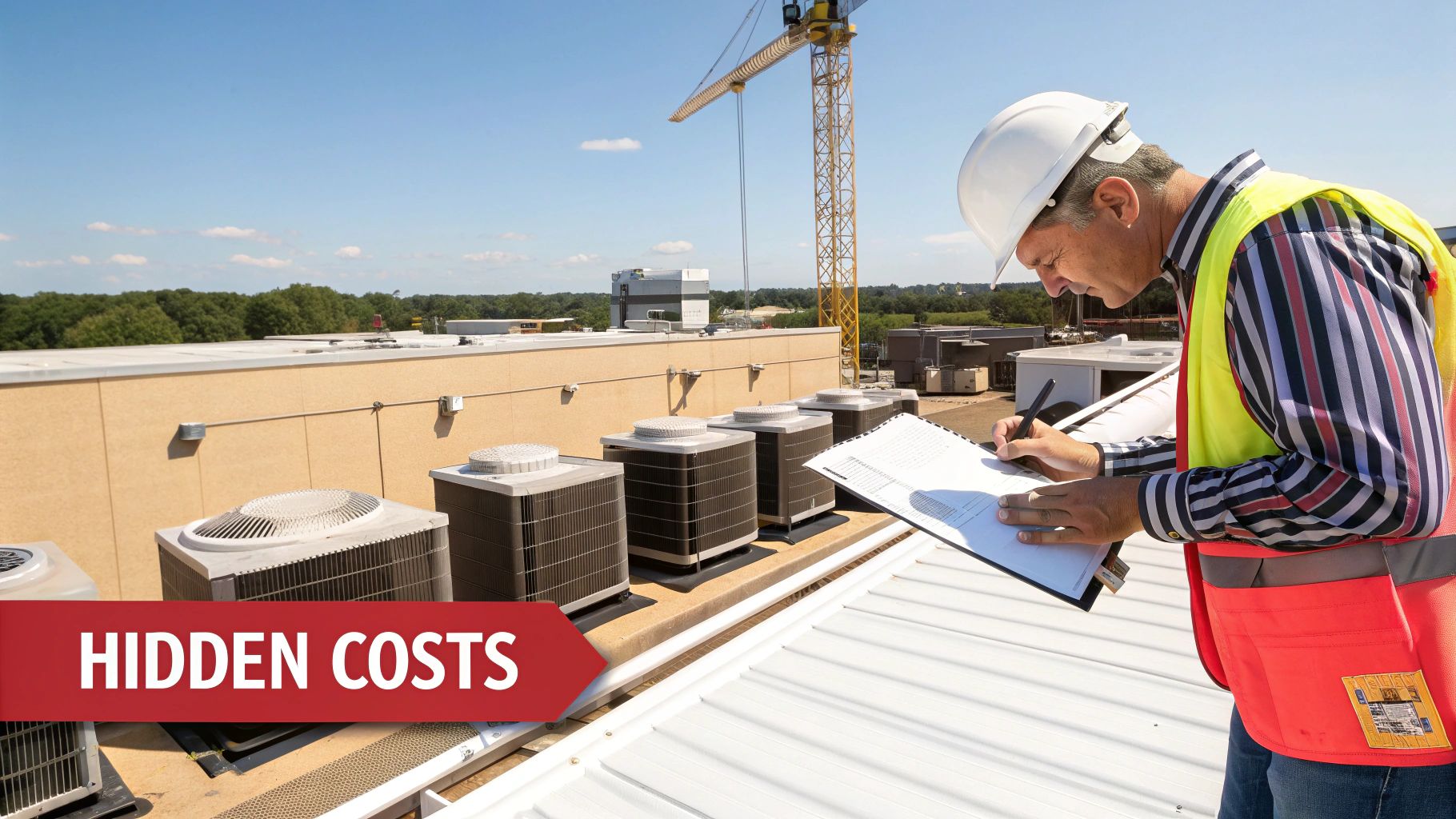
The roofing material itself is a big piece of the puzzle, but it’s rarely the biggest line item on your quote. A real-world estimate for a commercial roof replacement cost is a complex equation, and a handful of key variables can swing the final price dramatically. Getting a handle on these factors is the best way to keep your budget on track and avoid any nasty surprises.
Think of it like getting a major repair done on your car. The final bill isn't just for the new transmission; it’s for the mechanic's time, the specialized tools, and the headache of disposing of the old, busted parts. Your roof replacement is no different, with several major cost drivers you need to be aware of.
Why Labor Is a Major Investment
You might be surprised to see that labor often makes up 40% to 60% of the total project cost. This isn't just a couple of guys rolling out new material. It's the cost of a large, skilled, and coordinated crew handling everything from demolition and surface prep to the painstaking detail work around flashings and safe material handling.
Hiring an experienced, well-trained crew is a direct investment in the long-term health of your new roof. A cheaper, less experienced team might cut corners on the critical stuff—like seam welding or flashing around vents—which almost always leads to premature failures and expensive leak repairs down the road. It's the classic case of "you get what you pay for."
For a 50,000 sq ft warehouse roof, you might see base costs of $12-$18 per sq ft for a TPO system ($600,000-$900,000 total). With skilled labor in high demand—36% of commercial contractors cite worker shortages as a top worry—that labor portion can easily skew higher. You can dig into regional pricing trends on fred.stlouisfed.org to see how things are shaping up locally.
The Critical Choice: Tear-Off vs. Overlay
One of the first big forks in the road for your budget is deciding between a full tear-off and a roof overlay. Each path has totally different implications for your wallet and your building.
Roof Overlay: This is exactly what it sounds like—we install a new roofing membrane directly on top of the old one. The main upside is saving money by skipping the demolition and disposal process. The catch? It can only be done if the existing roof structure is in good shape and local building codes allow for a second layer.
Full Tear-Off: Here, we strip everything off down to the structural deck. It’s more expensive upfront, no question. But it gives us a clean slate, allowing for a thorough inspection (and repair) of any hidden rot, water damage, or insulation issues. This ensures your brand-new roof is sitting on a solid foundation.
Why a Tear-Off is Often the Safer Bet: An overlay can be like putting a band-aid on a broken bone. It might hide underlying problems like trapped moisture or deteriorating insulation. A full tear-off guarantees you aren’t just covering up a failing system, giving you far greater peace of mind for the long haul.
How Roof Complexity and Access Drive Costs Up
No two roofs are the same. The specific layout of your roof and the building's location play a massive role in the final price tag. You could have two buildings with the exact same square footage but wildly different replacement costs.
Here are the factors that add complexity and pump up the labor hours:
- Accessibility: Is your building a single-story warehouse with a huge, open lot? Or is it a five-story office building in downtown Dallas that needs a crane just to get materials to the roof? The logistics of getting our crew and equipment up there directly impacts the bottom line.
- Roof Penetrations: A simple, wide-open roof is a breeze. A roof crowded with HVAC units, skylights, plumbing vents, and drains is another story. Every single one of those penetrations requires meticulous, time-consuming flashing work to create a perfect watertight seal.
- Structural Complexity: Does the roof have multiple levels, steep pitches, or weird angles? Complex geometry means more custom material cutting and specialized installation techniques, all of which add to the labor bill.
At the end of the day, a good, transparent quote will itemize these factors clearly. When you can see the breakdown of labor, demolition, and logistical costs, you can understand the true value of the work being proposed and make a smarter decision for your property.
Why Roofing in Texas Is a Whole Different Ball Game
A commercial roof in a mild climate like Oregon has a pretty straightforward job. Here in Texas? That's a different story entirely. Our weather, especially across the Dallas-Fort Worth Metroplex and East Texas, throws everything it has at a roof, adding a unique and often expensive twist to your commercial roof replacement cost. You're not just keeping the rain out; you're building a fortress against some of the most aggressive weather in the country.
The biggest culprit, without a doubt, is hail. Texas leads the nation in severe hail events year after year. We’re talking storms that drop ice the size of golf balls or even baseballs. A standard roofing membrane that would last decades elsewhere can be shredded in just a few minutes during a classic DFW hailstorm, leading to catastrophic leaks and devastating interior damage.
This constant threat means choosing the right material isn't just a matter of preference—it's about financial survival.
The Class 4 Advantage
To fight back against the hail, smart property owners invest in Class 4 impact-resistant materials. These aren't just slightly tougher materials; they are roofing systems specifically engineered and tested to take a beating from hail and keep on ticking. The test is pretty dramatic: a two-inch steel ball is dropped from 20 feet, and to pass, the material can't show any signs of cracking or splitting.
Yes, a Class 4 system—whether it's a durable TPO membrane or specialized metal panels—costs more upfront. But think of it as a calculated business decision. The real payoff isn't just in dodging a full replacement after the next big storm. Many insurance carriers offer significant premium discounts for buildings with Class 4 roofs, which can go a long way in offsetting that initial investment over the years.
The Bottom Line: A non-impact-rated roof might seem like a bargain, saving you 10-15% on the install. But one bad hailstorm can instantly wipe out those savings and force you into another full replacement, turning a small up-front gain into a massive long-term loss.
Navigating the Maze of Local Codes
On top of the weather, you have to contend with a patchwork of local regulations across Texas that can swing your budget one way or another. The permit process and building codes in Dallas can be very different from Fort Worth, and even more so when you get out to the smaller towns in East Texas.
These local rules dictate crucial parts of your project, including:
- Insulation Requirements: Some cities have adopted stricter energy codes, meaning you might be required to install insulation with a higher R-value, adding to material costs.
- Wind Uplift Standards: North Texas is no stranger to high winds. Local codes have specific fastening requirements to make sure your roof doesn't peel off like a tin can lid in a severe storm.
- Number of Roof Layers: Most jurisdictions cap you at two roofing layers. If your building already has a roof-over-roof system, a complete tear-off is no longer optional—it's mandatory, which means higher labor and disposal fees.
Getting these local details wrong can bring your project to a screeching halt with failed inspections, frustrating delays, and unexpected costs. This is where a contractor with deep local roots is invaluable. They know the ins and outs of the local codes and will build those requirements into your initial quote, so there are no nasty surprises down the road. To see how different materials perform under these conditions, check out our guide to commercial roofing system types.
Turning Your New Roof Into a Smart Investment
It’s easy to look at a new roof and just see a massive expense. But that's a mistake. A new roof is actually a powerful capital investment, one that directly impacts your property's financial health for decades to come. The commercial roof replacement cost is just the beginning of the story; the real value is in the return on investment (ROI) it delivers over its lifetime.
This isn't just theory. You'll see the proof show up on your bottom line in very real ways. From slashing monthly operational costs to making your property more valuable, a strategic roof replacement can literally pay for itself.
Unlocking Immediate and Long-Term Savings
One of the first places you’ll see a return is on your utility bills. Modern roofing systems, especially reflective "cool roofs" like TPO, are designed to bounce the brutal Texas sun right off your building. It’s a simple concept, but it means your HVAC system doesn't have to fight nearly as hard to keep things cool inside.
What does that look like in practice? Many property owners report a significant drop in cooling costs, often in the 15-30% range. When you add that up over a 20-year lifespan, the energy savings alone can cover a huge chunk of the roof's original cost.
Beyond the energy savings, a new, professionally installed roof puts an end to the constant financial bleed of patching old leaks and scrambling for emergency repairs. Your roofing budget stops being a reactive, unpredictable headache and becomes a predictable, manageable line item.
The ROI Equation: A new roof transforms an unpredictable liability into a high-performance asset. It actively reduces your operational costs while protecting the valuable contents and operations within your building from costly water damage and disruption.
Boosting Property Value and Insurability
A brand-new roof is a massive selling point. It tells potential buyers or tenants that the building is solid and well-maintained, which directly increases its market value. A recent replacement, especially one with a transferable warranty, is a serious bargaining chip.
Insurance companies also love new roofs, particularly those with impact-resistant ratings built for Texas weather. Installing a new system can often lead to lower insurance premiums because the carrier sees your property as a much lower risk. That’s another direct, recurring saving that adds to your overall ROI.
Making the Investment Manageable
Of course, coming up with the cash for a new roof is a major consideration. This is where financing can be a game-changer, letting you get the protection and benefits of a new roof right away without draining your capital.
We break down all the options in our guide on how to finance a new roof. By spreading the cost out, you can let the energy and maintenance savings start offsetting the monthly payments immediately, making it an even smarter investment.
How to Choose the Right DFW Roofing Partner

Even the best roofing materials on the market will fail if they aren't installed by a skilled team. That’s why picking the right DFW roofing contractor is every bit as critical as deciding between TPO and metal. The final commercial roof replacement cost isn't just about materials; it's a direct reflection of the skill, reliability, and integrity of the crew on your roof.
The goal here is to find a true partner, not just a vendor who will slap on a roof and disappear. You need a team that gets the unique challenges of our Texas weather, knows local building codes like the back of their hand, and communicates with total transparency. This checklist will help you cut through the noise and vet potential contractors with confidence.
The Non-Negotiables of a Professional Roofer
Before you even think about comparing quotes, there are a few absolute must-haves. Any contractor who can't check these boxes shouldn't even make your shortlist. Think of this as the foundation—if it’s shaky, the whole project is at risk.
First things first: verify their credentials. You need to see proof of both general liability insurance and active workers' compensation.
- General Liability Insurance: This is what protects your property from accidental damage during the project. If something goes wrong, you won't be on the hook for repairs.
- Workers’ Compensation: This covers their crew if a worker gets injured on your property. Without it, you could be pulled into a messy and expensive lawsuit.
And don't just take their word for it. Ask to see the actual insurance certificates and double-check that they are current. Any legitimate contractor will have these documents ready and will be happy to share them.
Digging Into Their Local Track Record
Next, you have to confirm they have a proven history of success right here in the Dallas-Fort Worth area. A contractor from out of state simply won't understand the nuances of local permitting or have the relationships with local suppliers that keep a project running smoothly.
Look for a partner with a deep portfolio of finished commercial projects in North and East Texas. Ask them for a list of addresses you can drive by. Seeing their work in person, holding up years later, tells you more than any sales pitch.
Expert Tip: Don't rely solely on the hand-picked testimonials a contractor features on their own website. Do your own digging. Check their Google reviews, their Better Business Bureau rating, and other third-party sites to get the real, unbiased story about their reputation and customer service.
This due diligence isn't just about quality control; it's about ensuring you're hiring a stable, long-term presence in the community—someone who will still be around to honor their warranty years down the road.
Demanding a Truly Transparent Estimate
This is where you can separate the pros from the pretenders. A vague, one-page quote with a single number at the bottom is a massive red flag. A detailed, transparent estimate is the hallmark of an honest contractor who has nothing to hide.
Your estimate should be a clear, itemized document that breaks down every single cost. There should be no room for surprises or hidden fees later on.
Your Quote Must Include:
- Material Costs: The specific type, brand, and quantity of everything being used—from the membrane and insulation down to the individual fasteners and adhesives.
- Labor Costs: A clear breakdown of the labor charges for the whole job, including both the tear-off of the old roof and the new installation.
- Disposal and Cleanup Fees: The cost for legally and responsibly getting rid of all the old roofing materials.
- Permit Fees: The estimated cost for pulling all the necessary permits from your city or county.
- Project Timeline: A realistic schedule that outlines the key phases of the project, from the start date to final inspection.
This level of detail does more than just clarify the commercial roof replacement cost; it builds trust. It shows you the contractor has done their homework, truly understands the scope of your project, and is committed to open communication from day one. By demanding this transparency, you empower yourself to make a smart, informed decision and find a partner who values integrity as much as you do.
Common Questions About Commercial Roof Replacement
Even with a solid plan, a few questions always seem to come up when building owners start thinking about a project this big. Getting a handle on the timeline, what to expect day-to-day, and the key decision points will demystify the commercial roof replacement cost and the whole process.
Here are some straightforward answers to the questions we hear most often.
How Long Will the Roof Replacement Take?
There's no single answer here—the timeline for a commercial roof replacement really depends on the size and complexity of the job. A smaller, simple roof might be done in a week or two. On the other hand, a massive, intricate roof on a 100,000-square-foot warehouse could easily take several weeks from start to finish.
A few key things will dictate the schedule:
- Roof Size: Bigger roofs simply take more time. More square footage means more materials to tear off and more to install.
- Weather: Let's be honest, Texas weather plays by its own rules. Rain, high winds, or blistering heat can bring work to a halt, stretching out the timeline. A good crew plans around the forecast but always puts safety first.
- Hidden Repairs: Sometimes, you don't know what you're dealing with until the old roof comes off. If we find significant damage to the underlying roof deck, those repairs have to be done right before the new system goes on.
Can My Business Stay Open During the Project?
Yes, absolutely. One of the hallmarks of a seasoned commercial roofing contractor is their ability to work around you, not the other way around. We carefully phase the project to keep disruptions to your daily operations at a bare minimum.
Our crews set up clearly marked, safe work zones and schedule material deliveries and crane work to avoid blocking key access points for your team and customers. Communication is everything. You’ll always be in the loop about which parts of the property will be active on any given day.
Our Commitment to You: A well-managed project means the only thing you should notice is our crew's presence and the steady progress. Our job is to protect your property and your productivity at the same time.
What's the Difference Between a Roof Coating and a Full Replacement?
This is a fantastic, money-saving question. Think of a roof coating as a restorative treatment, while a full replacement is a major surgery.
- A roof coating is a liquid membrane that we apply directly over your existing roof. It’s an excellent choice if the roof system is still in good shape structurally but is starting to show its age with minor leaks or fading. A coating can add another 10-15 years to your roof's life for a fraction of the cost of a new one.
- A full replacement is the only real solution when the existing roof membrane has failed, the insulation is soaked, or the damage is just too widespread. This involves tearing everything off down to the deck and starting fresh.
How Do I Know if My Roof Actually Needs to Be Replaced?
Knowing the warning signs helps you plan and budget ahead of time. Be on the lookout for persistent leaks that keep coming back no matter how many times you patch them. Other big tells are large bubbles or blisters in the membrane and seams that are visibly separating.
The most obvious red flag? Your roof is way past its original warranty period. If you're seeing any of these issues, it's definitely time to call for a professional inspection.
Choosing the right team is the most important decision you'll make in this entire process. A great contractor can save you headaches and money, while the wrong one can be a nightmare. (For more on this, check out this guide on How to Choose a General Contractor.)
Hail King Professionals has been proudly serving Dallas-Fort Worth and East Texas since 1991. We deliver honest assessments and expert installations built to withstand our tough Texas weather. Get your free, no-obligation inspection today by visiting us at https://hailkingpros.com.