
Asphalt vs Metal Roof Cost in Texas Your 2026 Guide
When you're looking at a roof replacement in Texas, the first question that comes to mind is almost always, "How much is this going to cost?" The asphalt vs. metal roof cost debate seems simple at first glance. Asphalt shingles are significantly cheaper upfront, which is why they're the go-to for many homeowners needing to solve a problem on a budget. Metal roofing, on the other hand, comes with a higher initial price tag but promises incredible long-term value.
Ultimately, your decision comes down to a fundamental choice: prioritize short-term savings now, or make a lifetime investment in your home.
Asphalt vs Metal Roof Cost: A Quick Comparison
Choosing between asphalt shingles and a metal roof is one of the biggest financial decisions you'll make for your home, especially here in storm-heavy areas like Dallas-Fort Worth and East Texas. While the initial sticker price can be tempting, it’s a mistake to look only at the first invoice. This isn't just a purchase; it's a long-term investment in your home's protection, energy bills, and even its future resale value.
Upfront Investment Breakdown
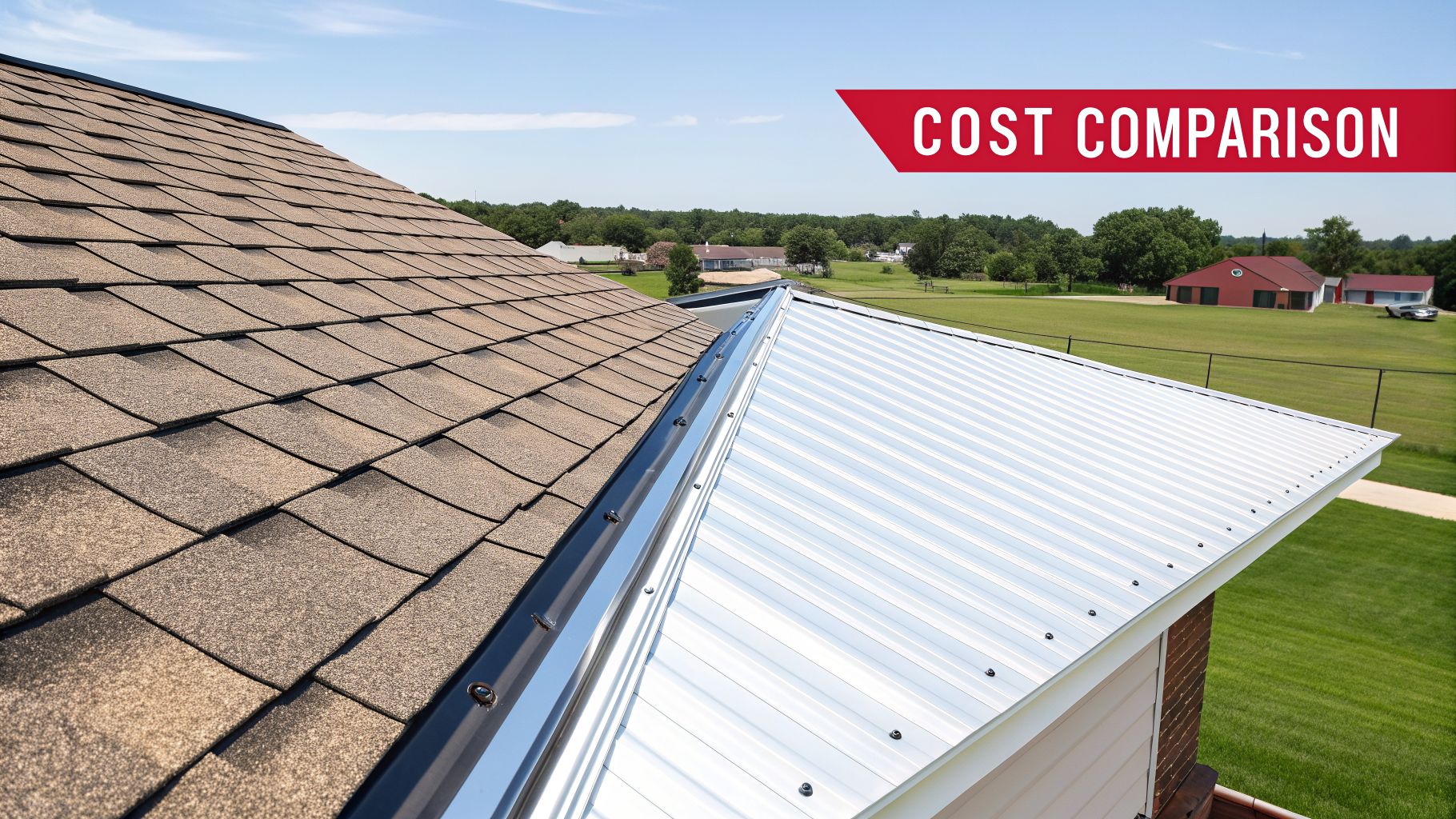
Let's talk real numbers. When you're just looking at the initial installation cost, asphalt is the clear winner for budget-friendliness. Based on 2024 local data, standard asphalt shingles installed run about $4.00 per square foot. The more popular architectural shingles, which offer better durability and aesthetics, typically land in the $5.00 to $6.00 per square foot range. For an average 2,000 sq. ft. home, you're looking at a total project cost of around $10,000-$12,000.
In contrast, metal roofing starts where architectural shingles leave off. Even budget-friendly metal options begin at $4.50-$6.50 per square foot. The premium standing seam metal systems that most people want jump to $10.00-$14.00 per square foot. That pushes the total for the same 2,000 sq. ft. home to $20,000-$28,000 or even higher. For more 2024 cost breakdowns, you can see this roofing cost comparison from The Roof Co.
Key Takeaway: It’s not an exaggeration to say a standing seam metal roof can easily cost double what you'd pay for a quality architectural shingle roof. This upfront price difference is often the single biggest factor for homeowners focused on their immediate budget.
This price gap comes from a few key areas: the raw material cost, the specialized labor involved, and your roof's unique complexity. Installing metal requires specific tools and a higher level of expertise, which naturally increases labor costs. But what you're buying with that extra upfront expense is a roof built for unmatched longevity and durability.
At-a-Glance Cost Comparison Asphalt vs Metal Roofing
To make things a bit simpler, here’s a high-level look at how these two popular roofing materials stack up when you consider both the initial cost and the long-term value.
| Factor | Architectural Asphalt Shingles | Standing Seam Metal Roof |
|---|---|---|
| Upfront Cost | Lower ($5 – $8 / sq. ft.) | Higher ($10 – $15+ / sq. ft.) |
| Typical Lifespan | 20-30 years | 40-70+ years |
| Long-Term Value | Requires 2-3 replacements over 50 years | Typically a one-time investment |
| Energy Savings | Moderate | High (Can reduce cooling costs up to 25%) |
| Resale Value | Standard | Can increase home value by 1-6% |
So, what’s the bottom line? Asphalt shingles offer a dependable and affordable solution for homeowners who need a great roof right now without a massive cash outlay. It’s a perfectly sound decision.
Metal roofing, however, is the hands-down winner for anyone planning to stay in their home for the long haul. If your priorities are minimal maintenance, extreme weather durability, and a "one-and-done" lifetime investment, the higher initial cost of metal is well worth it.
Breaking Down the Upfront Installation Costs
When you get a roofing quote, the final number boils down to two things: materials and labor. It's the interplay between these two that creates the major price difference you'll see between an asphalt shingle roof and a metal one. Let's dig into what's really behind those numbers for your Texas home.
Asphalt shingles are the familiar, go-to option for a reason. The material is mass-produced, readily available, and nearly every roofer out there knows how to install it. But that doesn't mean all shingles are the same.
Comparing Asphalt Shingle Tiers
For most homeowners, a standard architectural shingle hits the sweet spot between cost and durability. Here in the Dallas-Fort Worth and East Texas areas, you can expect a full roof replacement with these shingles to run somewhere between $5.00 to $8.00 per square foot. That price typically includes everything—materials, labor, tearing off the old roof, and hauling it all away.
But this is hail country. Upgrading to a Class 4 impact-resistant shingle is one of the smartest investments a Texas homeowner can make. These shingles are specifically designed to handle hailstorms, which can save you a world of headache and potentially lower your insurance premiums. Making this upgrade will nudge the cost up into the $7.00 to $9.50 per square foot range. While it’s a step up from standard shingles, it’s still a much lower upfront cost than almost any metal roof.
Unpacking Metal Roofing's Higher Price
There’s no getting around it—a metal roof costs more at the outset. The price tag has a lot more variables, though, depending heavily on the specific system you choose.
- Exposed-Fastener Panels: This is your entry point into metal roofing. The large panels overlap and are screwed directly to the roof deck, leaving the screw heads visible. It's an effective system, but those exposed fasteners can become weak points over time if they aren't checked periodically. Installed, you're looking at a cost between $7.50 and $11.00 per square foot.
- Standing Seam Systems: This is the top-of-the-line choice for residential metal roofing. The panels are connected with a hidden fastener system, creating a very clean, modern look with fantastic weather resistance and virtually no maintenance. The material is pricier, and the installation is a completely different ballgame—it’s a highly technical process requiring special tools and skilled installers. Because of this, a standing seam roof can range anywhere from $12.00 to $18.00+ per square foot.
The real driver behind the cost of a metal roof isn't just the metal itself—it's the labor. Installing a standing seam roof is true craftsmanship. It requires absolute precision, from custom-fabricating panels on-site to making sure every single seam is perfectly interlocked. That level of specialized skill simply costs more than a standard shingle job.
Why Quality Installation is Non-Negotiable
Whether you land on asphalt or metal, the single most important factor for your roof's survival against Texas weather is the quality of the installation. A bad install will cause even the most expensive material to fail. Trying to save money by cutting corners on labor is a surefire way to end up with leaks, wind damage, and a voided warranty, costing you far more down the road.
A professional quote from a contractor like Hail King Professionals will lay all these costs out for you. It covers not just the shingles or panels but the entire system: underlayment, flashing, ventilation, and most importantly, the skilled hands needed to put it all together. If you're curious about the technical side, you can learn more about what a proper job entails in our metal roofing installation guide. It really shows why expertise is so critical.
Ultimately, that upfront cost is a direct reflection of both the material's quality and the expertise required to install it right the first time.
Calculating Your True Lifetime Roofing Cost
When you get quotes for a new roof, the number you see upfront is just the starting point. To really understand the asphalt vs metal roof cost, you have to think like a long-term homeowner and calculate the total cost of ownership over the decades. What you find might surprise you.
Asphalt shingles have a lower initial price tag, but they're fundamentally a temporary roof. A standard architectural shingle roof will give you 20-30 years of service, which means you’re almost guaranteed to face a full replacement—maybe even two—over a 50-year timeframe. Metal roofing, on the other hand, is what we in the industry often call a "one and done" investment, built to last 40 to 70 years.
This infographic gives you a snapshot of how the initial material costs typically line up.
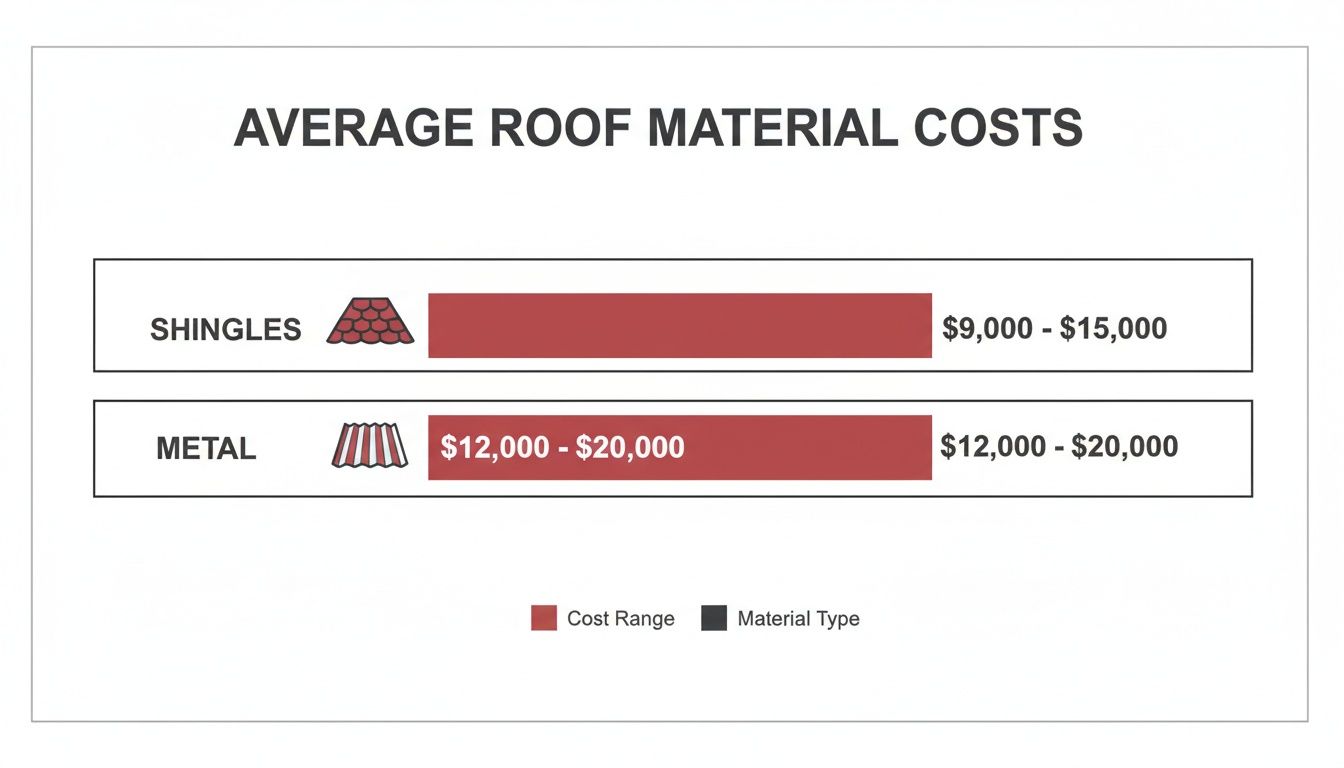
While metal clearly costs more out of the gate, this is only chapter one of the financial story.
Factoring in Replacements and Repairs
Let’s play this out over a 50-year timeline. If you install an asphalt shingle roof today, you can realistically expect to replace it entirely somewhere around the 25-year mark. Suddenly, you're not just paying for one roof; you're paying for two. And that second roof will come with its own inflated material and labor costs.
A metal roof’s superior durability simply erases that massive second expense from the equation. The longer lifespan isn't just about avoiding a hassle; it’s a huge financial advantage that only grows over time. For more detail, take a look at our guide on how long a new roof lasts in Texas.
The Breakeven Point: The real "aha!" moment comes when you find the breakeven point. This is the year when the total money spent on an asphalt roof (including the initial install, repairs, and the second full replacement) finally exceeds the single, one-time cost of a metal roof. For most homes in our area, this happens somewhere between year 22 and 27.
Some analyses show a conventional asphalt roof can rack up $85,000-$100,000 in total costs over 50 years with multiple replacements. A single metal roof installation, meanwhile, might total $60,000-$75,000 over that same period, usually with far fewer repairs. You can see a detailed 50-year cost comparison of roofing materials at MightyDogRoofing.com that breaks these numbers down further.
The Hidden Savings of Energy Efficiency
Another piece of the puzzle, and a big one here in Texas, is energy savings. With our blistering summer heat, your air conditioner is one of the biggest drivers of your utility bill.
- Asphalt Shingles: Your average asphalt shingle, especially in darker shades, acts like a sponge for solar heat. That heat gets transferred into your attic, forcing your HVAC system to run harder and longer just to keep up.
- Metal Roofs: Modern metal roofing with "cool roof" reflective coatings does the opposite. It reflects a huge amount of solar radiation away from your home, keeping the roof and the attic underneath it much cooler.
How much of a difference does this make? Studies have found that a reflective metal roof can slash your annual cooling costs by up to 25%. Over the 40+ year life of the roof, that adds up to thousands of dollars in real savings, chipping away at its total cost of ownership.
Boosting Your Home's Resale Value
Finally, don't forget how your roof choice affects your home's value when it’s time to sell. A new asphalt roof is often seen as a basic requirement—something that just needs to be in good shape. It rarely adds much to the sale price because buyers simply expect it.
A metal roof, however, is a genuine selling point. Its durability, modern look, and energy efficiency are marketable upgrades that can increase your home's resale value by 1% to 6%. Think about it from a buyer's perspective: knowing you won't have to touch the roof for decades is a powerful incentive that makes your home stand out and can justify a higher offer.
Navigating Insurance Costs and Hail Damage
Here in Texas, a roof is more than just a cover for your house; it's your home's front line against some seriously severe weather, especially hail. That simple fact completely changes the conversation around the long-term asphalt vs. metal roof cost. Suddenly, there's a third party with a major stake in your decision: your insurance company. How your roof holds up in a storm has a direct line to your premiums and any future claims you might file.
For a long time, metal roofing was the obvious king of durability. It could take a beating from hail that would leave a standard asphalt shingle roof in tatters. But roofing technology has come a long way, and now we have a serious contender that really levels the playing field: Class 4 impact-resistant shingles.
This rating, which comes from the respected Underwriters Laboratories (UL), means a shingle can withstand the impact of a 2-inch steel ball dropped from 20 feet without splitting or cracking. For any homeowner in the DFW or East Texas area, that’s a huge deal.
The Power of a Class 4 Rating
Choosing a roof with a Class 4 rating—whether it’s a top-tier asphalt shingle or a quality metal system—is one of the smartest financial moves you can make as a Texas homeowner. Insurance companies know these roofs are tougher, and they often reward homeowners for making that upfront investment.
The biggest perk is a substantial discount on your annual homeowner's insurance premium. We’re not talking about pocket change, either. These discounts often fall in the 15% to 35% range, depending on your insurance carrier. Over the 20- or 30-year life of your roof, those savings add up to thousands of dollars, which can go a long way toward covering the higher initial cost of a Class 4 product.
Your roof choice will absolutely affect what you pay for home insurance. It’s always a good idea to dig into your policy and do some understanding your insurance payments to make sure you have the right coverage at the best price. Installing a certified Class 4 roof is one of the surest ways to get the best rates possible.
Expert Insight: Many Texas insurance policies now include a separate—and much higher—deductible just for wind and hail damage. By investing in a Class 4 roof, you not only lower your annual premium but also reduce the odds of having to file a claim in the first place, saving you from paying that high deductible every time a storm rolls through.
Cosmetic vs. Functional Damage: A Critical Distinction
When a hailstorm eventually does hit, the kind of damage your roof takes is seen very differently by an insurance adjuster, and this is where asphalt and metal can really diverge.
Asphalt Shingles: When hail hits an asphalt shingle, it knocks off the protective granules, exposing the dark matting underneath to the sun's UV rays. This is considered functional damage. Why? Because it directly impacts the shingle's ability to do its job and shortens the roof's lifespan. Insurance will almost always cover this, which usually leads to a full roof replacement.
Metal Roofs: On the other hand, a metal roof might just get dented by hail. If those dents don't create a hole, crack, or break the metal's protective finish, many insurance policies will classify it as purely cosmetic damage.
This is a massive point of difference you have to be aware of. Some policies have specific exclusions for cosmetic damage, meaning your insurance company won't pay to replace a roof that's just dented, even if it looks terrible from the street. You could be left with a roof that’s technically still working but has lost all its curb appeal.
When you're looking at policies, you absolutely have to read the fine print about cosmetic vs. functional damage, especially if you’re leaning toward metal. The best bet is to find a policy that explicitly covers cosmetic damage or to choose a stone-coated steel product, which hides dents much better. This gives you crucial peace of mind and protects your home's value after a storm.
How Solar Panels Affect Your Roofing Costs
If you have solar panels on your roof, a future roof replacement comes with a significant—and often completely overlooked—expense. It's called a solar detach and reset (D&R), and it makes the asphalt vs. metal roof cost debate even more important, as this "hidden" fee can completely change the financial equation for your home.
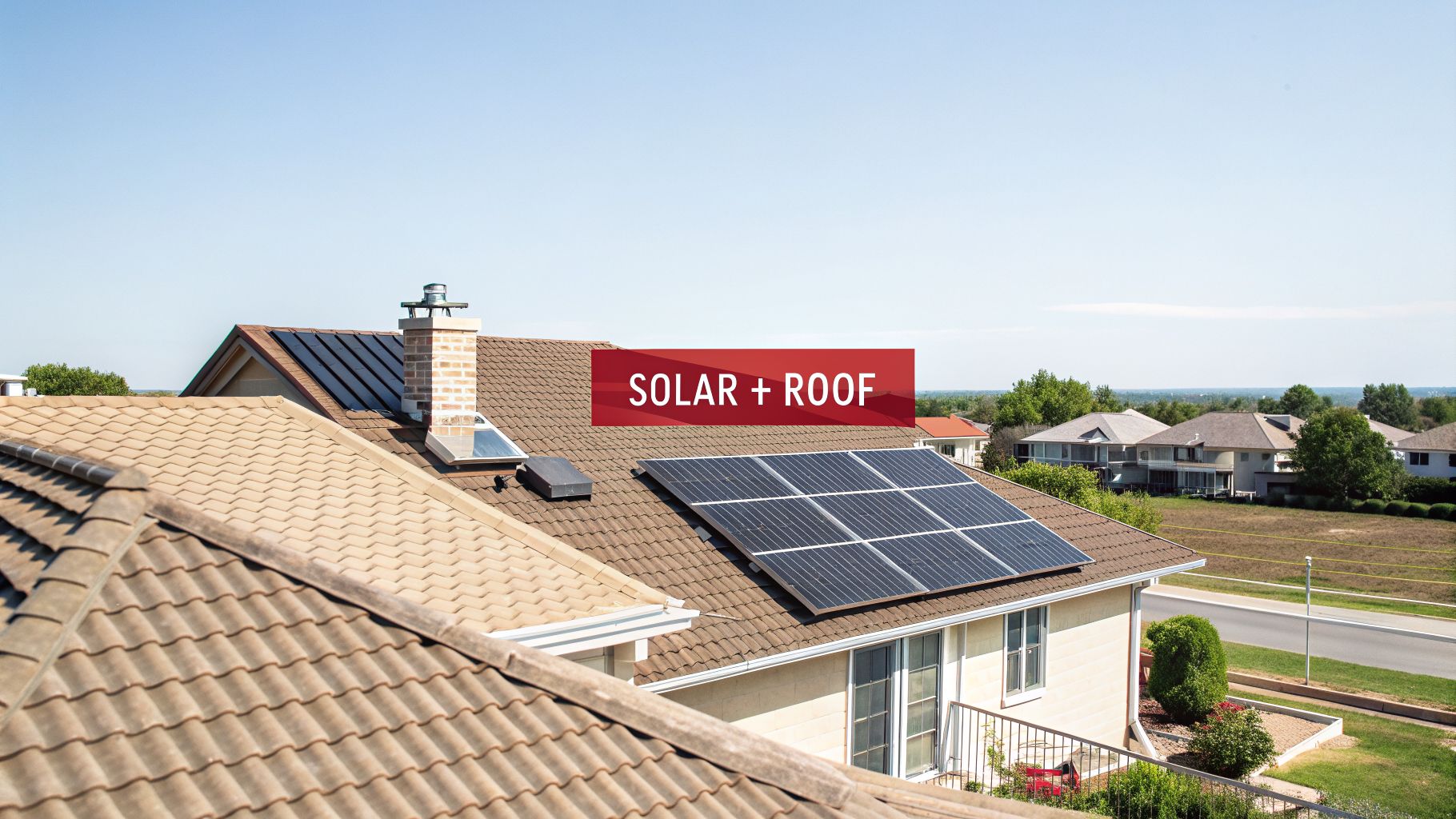
A D&R involves a specialized crew professionally removing your entire solar panel system, storing it safely while we re-roof, and then reinstalling and recommissioning everything once the new roof is on. Here in the Dallas-Fort Worth area, this service alone can run anywhere from $3,000 to over $10,000, based on the size and complexity of your solar array. Critically, this is an out-of-pocket expense that is almost never covered by an insurance claim for your roof.
Aligning Lifespans to Avoid Future Costs
Here’s the fundamental problem: the lifespan of your solar panels and the lifespan of a standard asphalt shingle roof are out of sync. Today’s solar panels have a productive life of 25-30 years. A typical architectural shingle roof, especially under the brutal Texas sun and hailstorms, is only going to last 20-30 years.
This mismatch practically guarantees that you’ll have to replace your roof right in the middle of your solar panels' useful life. That means paying for a full, expensive D&R service about 15-20 years into owning your solar system.
This is where a metal roof completely changes the calculation.
Key Insight: A metal roof's lifespan of 40-70+ years perfectly aligns with—and even outlasts—your solar panels. By choosing metal, you install the panels once on what is essentially a "forever roof," completely eliminating the cost and headache of a mid-life detach and reset.
While the upfront cost for a metal roof is higher, you sidestep a guaranteed future expense that could easily cost you thousands. For any homeowner who has solar or is even thinking about it, this factor makes the lifetime cost of a metal roof incredibly compelling. To get a better handle on what a solar investment looks like from the start, this guide on the average cost of solar panels for home provides some great baseline numbers.
The Importance of Bundling Roofing and Solar Services
Managing a re-roof that involves solar panels means coordinating two very different, highly specialized trades. It can get messy. If the roofer accidentally damages the solar equipment or the solar installer puts a hole in your brand-new roof, you get stuck in a frustrating blame game that can put your warranties at risk.
The smartest way to avoid this nightmare is to hire a single, expert contractor who handles both roofing and solar D&R services, like Hail King Professionals. Bundling these services under one company gives you a few major advantages:
- Seamless Coordination: You have one point of contact managing the entire job. The solar detach, the new roof installation, and the final solar reset all flow together without a hitch.
- Warranty Protection: There's no finger-pointing. One company is responsible for making sure both your roof and your solar system are in perfect condition.
- Project Efficiency: A unified team prevents costly delays. We get your home protected and your solar system back online making you money as fast as possible.
We walk through this entire process in our guide on what to do when you need a new roof under your solar panels. Protecting both your home and your energy investment starts with picking the right roof—and the right contractor.
Making the Right Roofing Choice for Your Home
At the end of the day, choosing between asphalt and metal roofing isn't just about spreadsheets and estimates. It's about matching the roof to your life. After weighing all the factors—upfront cost, long-term value, insurance, and even solar panels—it's time to decide what works for your specific situation.
There's no single "best" roof. The right answer is completely different for a family needing a fast, affordable fix after a hailstorm versus someone building their forever home. It all comes down to your priorities.
Decision Scenarios: Which Homeowner Are You?
Let's walk through a few common scenarios I see all the time with homeowners in Dallas-Fort Worth and East Texas. Find the one that sounds most like you, and you'll have a much clearer idea of the right path forward.
Scenario 1: The Budget-Focused Homeowner
You need a new roof, and you need it now—most likely thanks to a recent storm. Your main goal is getting a solid, reliable roof over your head without draining your savings. You might also be thinking of selling the house in the next 5-10 years.
- Recommendation: An architectural asphalt shingle roof is your best bet. I’d strongly suggest upgrading to a Class 4 impact-resistant shingle. This gives you fantastic hail protection and can earn you some serious insurance discounts, all while keeping the initial cost way below a metal system. It’s the smartest, most cost-effective way to get a great-looking, insurable roof on your home quickly.
Scenario 2: The Long-Term Investor
You're in your home for the long haul, planning to stay for 15 years or more—maybe forever. You value durability, low maintenance, and making a smart financial choice that pays off over decades. You want to install a roof and never think about it again.
- Recommendation: A standing seam metal roof is the clear winner here. Yes, the upfront investment is higher, but it's very likely the last roof you'll ever need to buy. When you factor in the energy savings, the boost to your home's value, and the pure peace of mind, it’s a sound investment that truly pays for itself over its lifetime.
Scenario 3: The Solar-Powered Homeowner
You either have solar panels already or plan on installing them. Your top priority is protecting that significant solar investment and avoiding the huge hidden cost of a "detach and reset" when your roof wears out before your panels do.
- Recommendation: A metal roof is practically a must. Its 40-70 year lifespan means the roof will outlive your solar panels, completely eliminating the need for a costly tear-off and re-installation project down the road. That single factor makes the higher initial cost of metal a financially savvy decision, protecting both your house and your energy investment for decades.
A roof is a complete system, not just the shingles or panels you see from the street. The best decision is about how every part works with your home, your budget, and your plans for the future.
Secure Your Personalized Roofing Solution
Understanding the asphalt vs. metal roof cost is just the first step. The next, and most important, is getting a professional on your roof to give you an assessment tailored to your home's unique needs.
At Hail King Professionals, we lay out all the options so you can make a confident choice. Whether you need a fast, affordable shingle replacement or want to invest in a lifetime metal system, we provide a clear path forward.
Contact us today for a free, no-obligation inspection. Our team will give you transparent quotes for both asphalt and metal, explain our flexible financing plans, and help you find the perfect solution to protect your Texas home for years to come.
Your Top Roofing Questions, Answered
When you’re weighing the asphalt vs. metal roof cost, the sticker price is just the beginning. Homeowners in DFW and East Texas always ask us the same practical questions, and the answers often make the decision much clearer. Let's tackle the big ones head-on.
One of the oldest myths about metal roofing is the noise. You’re probably picturing the loud drumming of a rainstorm on an old barn roof, and you’re not wrong—for a barn. Those structures have metal panels installed directly over open framing, which acts like an amplifier.
Residential roofing is a completely different world. Your new metal roof goes on top of solid wood decking and a high-quality underlayment. When you add your attic space and insulation into the mix, you get a sound-dampening system that makes a properly installed metal roof just as quiet as asphalt shingles.
What About Repairs, Style, and Affordability?
"Can a metal roof even be repaired?" That's another huge question we get. The answer is a definite yes, but the method is different from slapping a new shingle over a damaged one. If a standing seam panel gets seriously damaged, a professional can replace that single panel. It’s a more detailed job than a shingle swap, but it’s absolutely doable. Exposed fastener roofs are even simpler to fix locally.
Expert Insight: It's important to know that even minor scratches on a metal panel aren't just cosmetic. If they break through the protective finish, they can lead to rust. The good news is that these are easy to fix with a special sealant paint, which restores the panel's integrity and keeps your roof going for the long haul.
Finally, let's talk about looks and how to pay for it. The idea that metal roofs are only for industrial buildings is long gone. Modern metal roofing is available in a massive range of colors and profiles designed to mimic classic shingles, rustic wood shake, or even elegant clay tiles. There's a style for virtually any home.
To make this premium upgrade more accessible, we offer flexible financing options. This isn't about taking on a complicated loan; it's a smart way to invest in your home. Our partners typically offer:
- Soft credit checks that don’t impact your score.
- Zero penalties if you decide to pay the loan off early.
- No home-equity requirements to qualify.
This approach lets you get the incredible durability and energy savings of a metal roof right away, without the pressure of a huge upfront payment. You can spread the investment into comfortable monthly payments and focus on the long-term value you're adding to your property.
Ready to stop guessing and get real numbers for your home? The team at Hail King Professionals provides free, no-obligation inspections and transparent quotes for both asphalt and metal roofs. We're here to help you make the best choice, not just the fastest one. Schedule your appointment today and let's get started.