
Commercial Roofing Solutions: commercial roof replacement company for your property
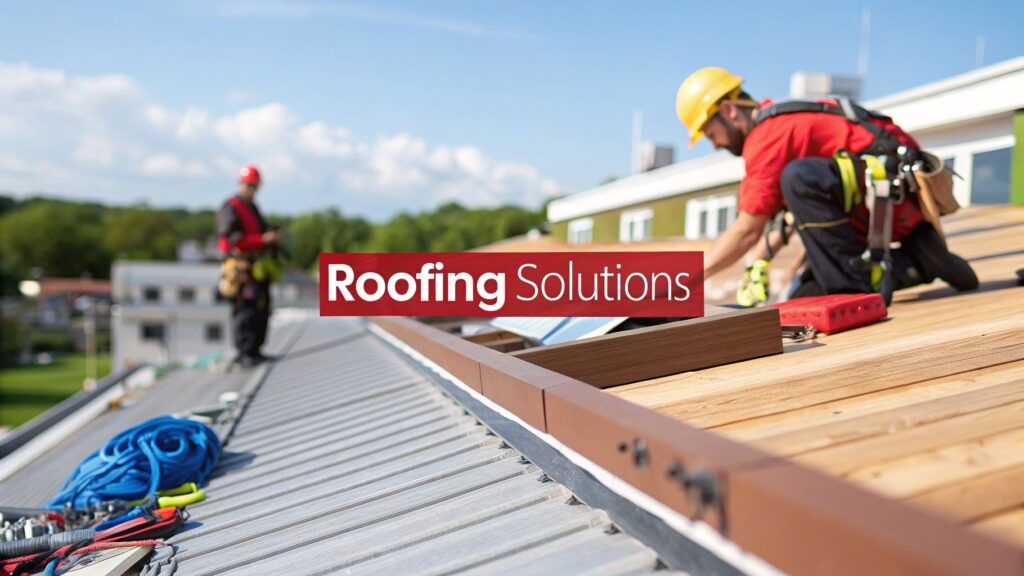
Choosing a commercial roofing company isn't just about swapping out old materials for new ones. You're hiring a partner to protect what is likely your most valuable physical asset. A true professional does more than just nail down shingles; they deliver a long-term strategy to safeguard your building, recommending the right system for our Texas climate and managing the project to keep your business running smoothly.
Why Choosing Your Commercial Roofer Has Changed
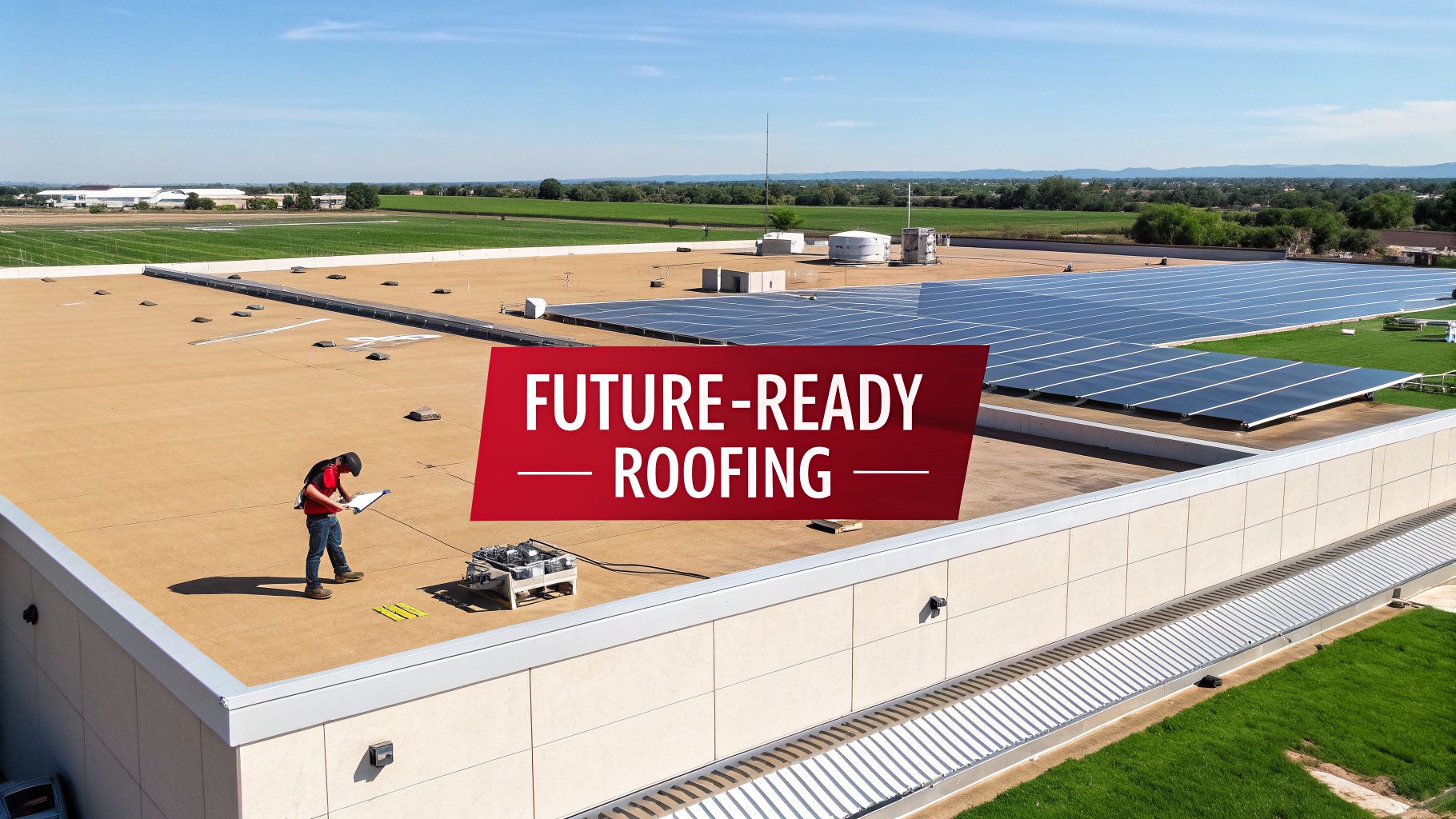
The stakes for a commercial roof replacement are higher than ever. What used to be a simple, reactive purchase when a leak appeared has become a major proactive investment in your building's future. We're seeing a massive shift in the industry, driven by new technology, economic realities, and a climate that keeps throwing curveballs.
This isn't just a feeling; the numbers back it up. The commercial roofing market is expected to balloon to $14.2 billion by 2026, which is a 6.1% annual growth rate. This isn't just because old roofs are failing. It's because smart business owners are demanding durable, energy-efficient roofs that can handle whatever the weather throws at them. You can dig into the data on these roofing industry trends to see just how much the priorities have changed for property owners like you.
What Modern Roofing Trends Mean for You
These industry-wide shifts directly affect what you should be looking for in a contractor. The old one-size-fits-all approach is dead. Today, you need a partner who gets it.
Energy Efficiency is No Longer Optional: With energy bills climbing, "cool roofs" are the new standard, not an upgrade. In the brutal Texas sun, materials with high solar reflectivity like white TPO or specialized coatings can drop your roof's surface temperature by 50-60 degrees Fahrenheit. That's a real, measurable impact on your building's cooling costs.
Resilience is a Must-Have: Here in Dallas-Fort Worth and East Texas, resilience isn't a buzzword—it's a requirement for survival. Hail, hurricane-force winds, and flash floods demand roofing systems built to take a beating. This means looking beyond the basics and asking about impact resistance ratings and wind uplift performance.
Your Roof is an Asset to Be Managed: The costliest strategy is waiting for a catastrophic failure. Smart facility managers now treat their roof like any other critical asset, with a plan for its entire lifecycle.
A planned roof replacement, scheduled before the old one fails, saves you a fortune by preventing interior damage, avoiding emergency call-out fees, and letting you control the timeline to minimize business disruption.
Why Your Contractor Choice Matters More Than Ever
Here's the bottom line: a high-performance roof is only as good as the crew that installs it. An improperly installed system will fail just as spectacularly as a cheap one.
A top-tier commercial roofing company brings far more than just a crew and some materials. They provide critical expertise in areas you might not even think about:
- Navigating Local Codes: They know the specific requirements for every city and county across DFW and East Texas, which can vary wildly.
- Material Science Know-How: They have firsthand experience with which systems hold up best under our specific weather patterns.
- Integrated Project Management: They can coordinate the entire project, including HVAC, plumbing, and solar contractors, so everything happens seamlessly.
Investing in a modern roofing system with the right partner is a serious financial decision. It’s about more than stopping leaks—it's about protecting your building, lowering your operating costs for years to come, and increasing your property's value. Choosing the right company is what ensures that investment actually pays off.
How to Properly Vet Your Roofing Partner
Choosing a commercial roofing contractor is one of the most critical decisions you'll make for your property. This isn't just about getting a new roof; it's about making a major capital investment. The difference between a smooth, successful project and a years-long headache often comes down to how well you vet your potential partners. A low bid on a fancy letterhead means absolutely nothing if the company behind it can't deliver.
Don't be afraid to dig deep into a contractor's background. A truly professional outfit will not only expect it—they'll have all their documentation ready to go. Think of it less as an interrogation and more as a detailed pre-project interview. You're looking for a partner, not just a vendor.
Beyond the License and Insurance
The basics, like checking for a valid license and adequate insurance, are just the entry ticket. The real vetting starts when you look for signs of a serious, professional operation that's built to last.
Here's what separates the true pros from the pack:
- Elite Manufacturer Certifications: Look for top-tier credentials like GAF Master Elite or CertainTeed SELECT ShingleMaster. These aren't just logos for a website; they mean the manufacturer has rigorously trained and audited the contractor. This is often the only way to get the best-in-class, long-term warranties on materials and labor.
- Deep Local Code Knowledge: Building codes across Dallas-Fort Worth and East Texas are a complex patchwork, changing from one city to the next. An experienced local contractor knows these nuances inside and out. They understand the specific wind uplift requirements in Tarrant County versus the drainage codes in Dallas, ensuring your project is compliant from day one. You can read more about why this matters in our guide to commercial roofing in Fort Worth.
- A Relevant Project Portfolio: Ask to see their work. And not just any work—you want to see projects similar to yours in size, material, and complexity. If you have a 100,000-square-foot TPO roof on a warehouse, you don't want a team whose experience is mostly in residential shingles.
Questions That Reveal Real Competence
Once you've confirmed their credentials, it's time to ask the questions that really show you who you're dealing with. The answers will paint a clear picture of how they run their business and how they'll manage your project.
A huge part of this is safety. Commercial roofing is inherently dangerous, and a contractor's approach to safety speaks volumes. Ask about their formal safety program, who provides on-site supervision, and what their safety record looks like (ask for their EMR, or Experience Modification Rate). Knowing the top health and safety risks in construction will help you ask smarter questions about how they plan to protect their crew, your staff, and your property.
Here are a few more pointed questions I always recommend asking:
- What project management software do you use? Professionals use tools like Procore or Buildertrend to keep everything—schedules, daily logs, photos, and communication—in one place. This gives you a transparent window into your project's progress.
- Who is my dedicated point of contact? You need one person—a dedicated project manager—who is accountable for your project from start to finish. If you're being passed around, it's a bad sign.
- How do you handle on-site supervision? The right answer is a non-working foreman or supervisor who is on-site every day. Their only job should be managing the crew, ensuring quality control, and enforcing safety protocols.
This level of scrutiny is more important than ever. The roofing industry is facing serious labor shortages, with 36% of commercial contractors reporting a lack of qualified workers. With nearly one in five roofers now over 55, finding a company with a stable, experienced, and well-managed team gives you a massive advantage.
Before you make a final decision, running each candidate through a consistent checklist can help you compare them objectively. This forces you to look at the same critical data points for every company, moving beyond a gut feeling to a fact-based choice.
Commercial Contractor Vetting Checklist
| Qualification Check | What to Look For | Why It Matters | Red Flag |
|---|---|---|---|
| Insurance & Bonding | Certificate of Insurance (COI) with adequate limits ($2M+ general liability). | Protects you from liability for accidents or property damage. | Minimum coverage, refusal to provide COI, or expired policy. |
| Manufacturer Certification | Elite-level certification from the manufacturer of your chosen system (e.g., GAF, Carlisle, Firestone). | Unlocks the best warranties, proves training and quality standards. | "We can install any brand" without specific certifications. |
| Safety Record (EMR) | Experience Modification Rate below 1.0. | A rate below 1.0 indicates a better-than-average safety record, leading to lower insurance costs and fewer on-site risks. | EMR above 1.0 or an unwillingness to share the number. |
| Local Portfolio | At least 3-5 completed projects of similar size and scope in the DFW/East Texas area. | Proves they can handle your project and are familiar with local conditions and inspectors. | Vague references or a portfolio of only residential or small repair jobs. |
| Financial Stability | Willingness to provide a bank letter or supplier references. | Ensures they can purchase materials and pay their crew without needing excessive upfront payments. | Heavy reliance on large down payments; poor credit with suppliers. |
| Project Management | A dedicated Project Manager and use of management software. | A single point of contact and transparent process prevent miscommunication and delays. | No clear PM assigned; disorganized communication (text messages, multiple contacts). |
Using a checklist like this ensures you're not just hiring a roofer; you're selecting a business partner who is equipped to protect your asset.
Key Takeaway: Vetting isn't about being difficult; it's about doing your due diligence. A contractor who is open and proud to share their insurance, certifications, and safety stats is showing you they're a professional before they even set foot on your property.
In the end, this process is about finding a partner you can trust with a critical piece of your building's infrastructure. Taking the time to properly vet your candidates protects your investment, minimizes your risk, and ensures you get a roof that will perform for decades. Don't settle for anything less.
Choosing the Best System for Your Commercial Roof Replacement
When it's time to replace your commercial roof, the material you choose is one of the most critical decisions you'll make. This isn't just about patching a leak; it's a major capital investment that directly impacts your property's value, operational costs, and energy consumption for decades to come.
What works for a low-slope office park in a shaded corner of Dallas might be a terrible choice for a sprawling, sun-beaten warehouse in East Texas. The best commercial roofing contractors don't just push one specific product. They act as consultants, analyzing your building's structure, daily use, and exposure to our brutal Texas weather to find the system that provides the best long-term value.
Let's walk through the most common systems we see on properties across the Dallas-Fort Worth area and what makes each one tick.
Single-Ply Membranes: The Modern Workhorses
For most flat or low-slope roofs, single-ply roofing membranes are the go-to solution. They are efficient to install and offer fantastic performance. The three main players you'll hear about are TPO, PVC, and EPDM.
A comprehensive comparison is the best way to see how these systems stack up against one another and other popular options.
Commercial Roofing Systems Comparison
| Roofing System | Typical Lifespan | Installation Cost (per sq. ft.) | Key Advantages | Best For |
|---|---|---|---|---|
| TPO | 15-25 Years | $7 – $13 | Highly reflective (energy savings), good puncture resistance. | Warehouses, big-box retail, most general commercial buildings in hot climates. |
| PVC | 20-30 Years | $8 – $14 | Resists chemicals, grease, and fire; very durable weldable seams. | Restaurants, manufacturing plants, buildings with rooftop exhaust. |
| EPDM | 20-30+ Years | $6 – $12 | Extremely durable, flexible in cold, proven long-term performance. | Colder climates, large roofs where durability is the top priority. |
| Modified Bitumen | 15-25 Years | $7 – $13 | Multi-layer redundancy, exceptional toughness against traffic & punctures. | Roofs with heavy foot traffic (HVAC), retail centers, high-traffic areas. |
| Standing Seam Metal | 40-70+ Years | $14 – $22+ | Unmatched longevity, superior wind & fire resistance, modern aesthetic. | High-value properties, architectural buildings, owners focused on lifecycle cost. |
| Roof Coatings | 5-15 Year Extension | $3 – $7 | Cost-effective life extension, high reflectivity, minimal disruption. | Structurally sound roofs with surface wear but no moisture in the system. |
This table gives you a snapshot, but the real decision comes down to your building's specific needs. For example, the chemical resistance of PVC makes it the clear winner for a restaurant with greasy vent hoods, while the reflective properties of TPO are a game-changer for cutting A/C costs on a massive distribution center.
EPDM, often called a "rubber roof," is the old guard for a reason. This stuff is tough and has been a reliable choice for decades. While traditionally black (which absorbs heat), newer formulations are available in white to offer better energy efficiency. A well-maintained EPDM roof can easily last over 30 years.
No matter which material you're leaning toward, the contractor's qualifications are just as important.
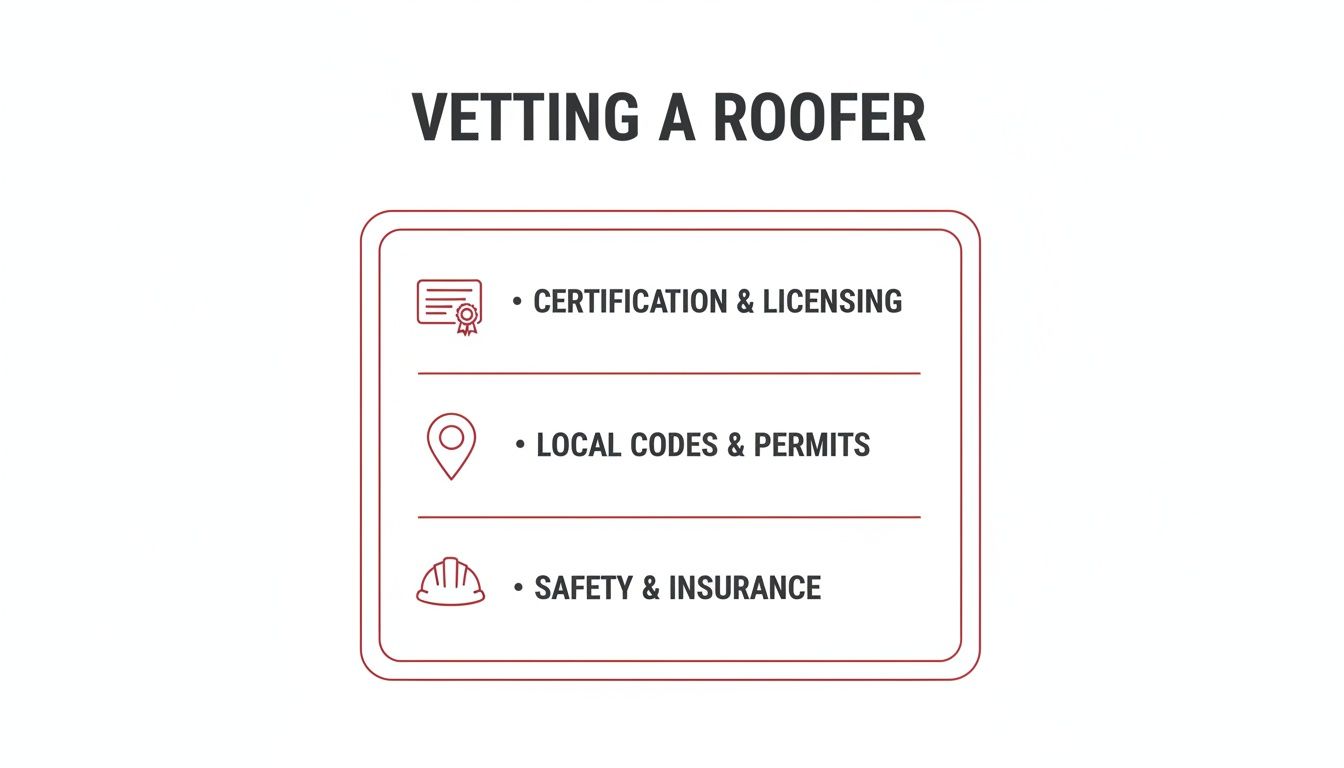
As the infographic shows, things like manufacturer certifications and a deep understanding of local building codes are non-negotiable. An expert installer ensures the system you choose actually performs to its full potential.
Built-Up Systems for Heavy-Duty Applications
Sometimes, a single layer of protection just isn’t enough. For roofs that see a lot of action—think constant foot traffic for HVAC maintenance or exposure to dropped tools—a multi-ply system is the only way to go.
Modified Bitumen is the leader in this category. Think of it as asphalt roofing, but supercharged. It's an asphalt-based system reinforced with tough fabrics and installed in multiple overlapping layers. This creates redundancy; a puncture in the top layer won't cause a leak because there are more protective layers underneath. You can learn more about how these are built in our complete guide to Modified Bitumen roof systems.
A retail center in Fort Worth with two dozen rooftop AC units serviced quarterly is a perfect example. All that foot traffic would tear up a less durable roof. A tough, multi-ply modified bitumen system is built to handle that kind of abuse year after year.
Roof Coatings: A Smart Alternative to Replacement
What if your roof's underlying structure is still in good shape, but the surface is worn, cracked, or weathered? This is where a roof restoration coating can be a fantastic, budget-friendly solution.
Applying a silicone or acrylic coating creates a seamless, bright-white, waterproof layer right over your existing roof surface. This can extend its life by 10-15 years for a fraction of the cost of a full tear-off and replacement. The process is also far less disruptive to your tenants and daily operations.
But here’s the critical part: a coating is not a magic fix. It’s only a viable option if your existing insulation is completely dry and the roof membrane is fundamentally sound. A thorough infrared scan and core analysis by a professional is the only way to know for sure if your roof is a candidate.
Standing Seam Metal: The Lifetime Solution
For property owners who prioritize longevity and curb appeal above all else, nothing beats a standing seam metal roof. With its clean lines and interlocking panels, it offers a modern aesthetic backed by unmatched strength and durability.
Yes, the upfront cost is higher. There’s no getting around that. But a properly installed metal roof can last 50 years or more with very little maintenance. It’s exceptionally resistant to fire, hail, and high winds—a major plus in North Texas. When you look at the total lifecycle cost, a metal roof is often the wisest long-term investment for high-value properties where performance and appearance are paramount.
Navigating Insurance Claims and Project Financing
For most Texas property owners, the conversation about a new roof doesn’t start in a budget meeting. It starts with a storm. Hail and high winds are often the real reason you’re suddenly looking at a full commercial roof replacement. Dealing with insurance companies can feel overwhelming, but having the right game plan—and the right roofing partner—makes all the difference.
Right after a storm, your first move is documentation. Once it’s safe to go outside, grab your phone and take plenty of high-resolution photos and videos. Get everything. Dented flashing, cracks in the membrane, hail dings on rooftop AC units—the more evidence you gather, the stronger your claim will be from the get-go.
An experienced commercial roofer is your best asset here. They’ve been through this dozens of times and can spot subtle damage that an adjuster, or even you, might otherwise miss.
Working With Your Insurance Adjuster
When the insurance adjuster schedules their inspection, you need to make sure your roofer is there with them. A good contractor isn't there to pick a fight; they're your advocate. They can point out the specific damage, explain technically how it compromises the entire system, and provide a detailed, code-compliant estimate for what a proper replacement actually entails.
This partnership is more critical now than ever. With the rise in extreme weather, U.S. roof-related insurance payouts are projected to soar to $31 billion in 2024. In hail-prone areas like East Texas, storm damage restoration makes up a staggering 80% of all roofing work. You can get more context on these roofing industry insurance statistics to see just how central storm work has become.
Having your roofer on-site helps ensure the adjuster’s report is complete and fair. It’s the best way to prevent a low-ball offer that only covers a few patches when what you truly need is a full replacement to protect your investment.
An adjuster's job is to assess damage based on your policy. A professional roofer's job is to make sure that assessment accounts for everything required to restore your roof to pre-storm condition or better, all while meeting current building codes.
Exploring Your Project Financing Options
Even with a solid insurance claim, you might face a gap between the payout and the final cost. Or, you might be funding the project entirely out-of-pocket. Many business owners think a traditional bank loan is the only path forward, but there are specialized financing options built specifically for this kind of capital improvement.
Look for a commercial roofing company that offers its own flexible financing solutions. These programs are often a much better fit for a business because they’re designed to protect your cash flow.
Here are a few key features to look for:
- No Home-Equity Requirement: The financing is secured by the commercial project, not your personal assets.
- Soft Credit Checks: You can explore your options without the initial application dinging your credit score.
- No Prepayment Penalties: If business is good and you want to pay the loan off early, you can do so without getting hit with extra fees.
When you're sorting out the financials, getting a clear commercial property insurance quote is a great first step to understand your coverage limits and potential out-of-pocket expenses. Armed with that knowledge and flexible financing, you can make a sound decision for your property without draining your operating budget.
By understanding both the insurance process and modern financing, you can move forward with confidence. For a deeper look at project expenses, check out our guide on commercial roof replacement costs. This approach lets you secure the best possible roof to protect your business for years to come.
Managing Your Project to Minimize Business Disruption
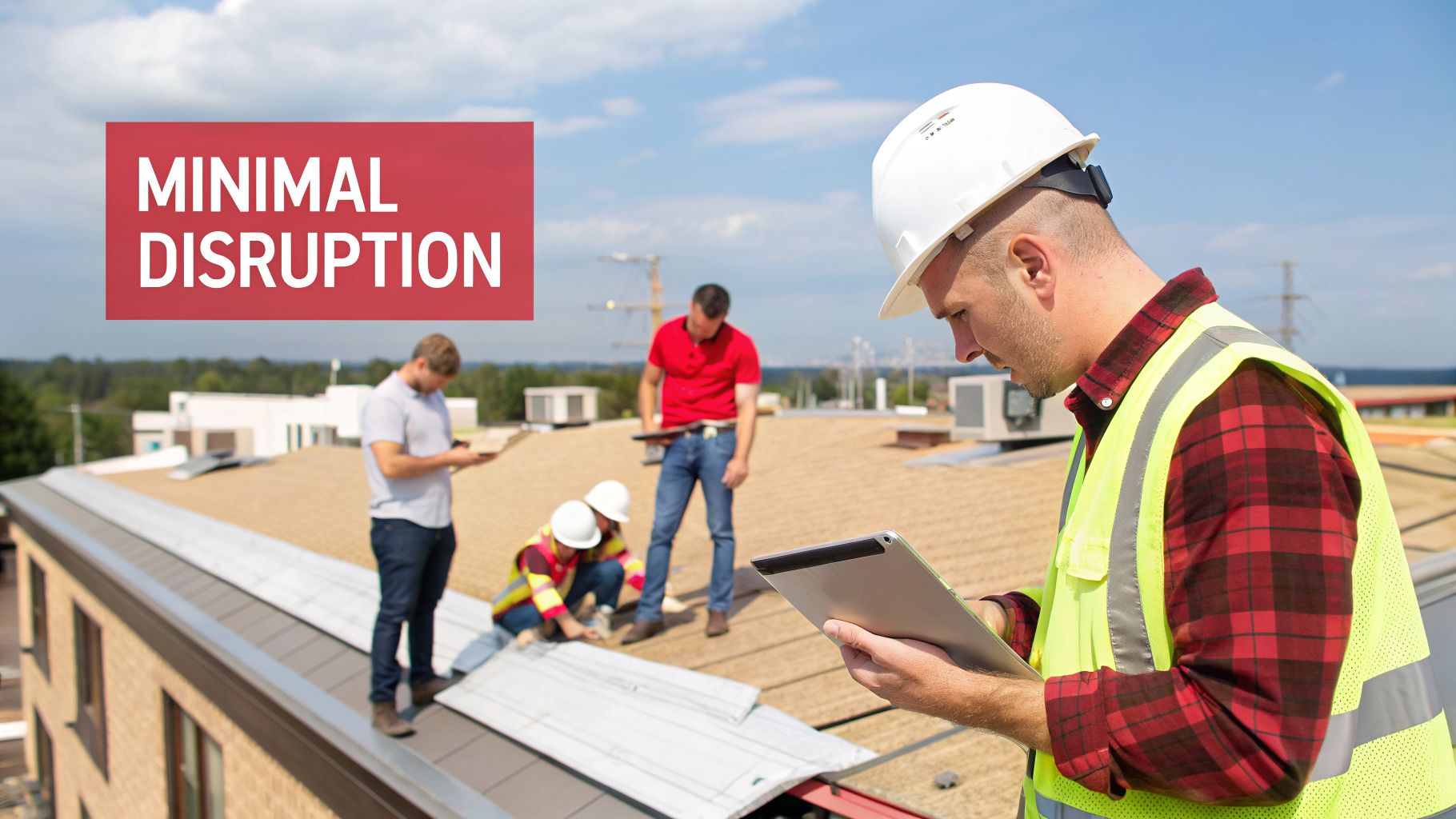
Let's be honest: a full commercial roof replacement is a huge undertaking. But it absolutely does not have to shut down your business. With the right contractor and a solid plan, you can keep your doors open and your operations running with surprisingly few hiccups.
The secret is all in the prep work. A seasoned roofing partner knows that protecting your business is just as critical as protecting the building. They should sit down with you before any work begins to map out every detail, from noise and debris to customer access, so there are no surprises for you, your team, or your clients.
Establishing the Game Plan
The first order of business is a comprehensive site logistics plan. This goes way beyond just figuring out where to park the trucks. It’s a detailed playbook for how the entire project will unfold safely and efficiently around your active business.
Your contractor should collaborate with you to define clear zones and daily procedures. Insist on a plan that covers:
- Designated Work Areas: Clearly marked-off zones for active roofing work. This is non-negotiable for keeping your employees and customers safely away from the construction.
- Debris Management: A specific strategy for getting old roofing materials off the roof and into a dumpster. This often involves chutes or scheduling the messy tear-off work after business hours to minimize disruption.
- Material Staging Zones: Pinpointing exactly where new materials and equipment will be stored so they aren't blocking fire exits, loading docks, or key walkways.
- Daily Communication Protocol: A quick daily meeting or email is a must. This keeps you in the loop on the day’s plan, any potential noise, and overall progress.
This level of detailed, upfront planning prevents the vast majority of headaches. It means that when the crew arrives, everyone knows the rules of engagement and how to work without getting in your way.
Navigating the Project Phases
A roof replacement project has a predictable rhythm. Knowing the sequence helps you anticipate what’s coming and when. It kicks off with the messiest part—the tear-off—and wraps up with a final inspection that secures your investment for the long haul.
The initial tear-off and substrate inspection is without a doubt the most crucial phase. This is where the old roof comes off, exposing the structural deck underneath. It’s loud and messy, and it’s where a contractor's debris plan really proves its worth. More importantly, this is the moment of truth when any hidden problems, like rotted decking or waterlogged insulation, come to light. A pro will immediately document any issues with photos and provide a clear change order before moving forward.
Insider Tip: Don’t panic if they find unexpected damage. On older roofs, it's more common than you'd think. A good roofer anticipates this possibility and has a clear process for addressing it without derailing your budget.
Once any substrate repairs are handled, the crew begins installing the new roofing system. This is when they lay down insulation, roll out the new membrane, and meticulously weld or seal every seam, pipe, and flashing. While the noise is generally much lower than during the tear-off, ongoing coordination is still key, especially around entrances and high-traffic areas.
Handling Modern Complexities
Today’s commercial roofs are busy places. HVAC units, satellite dishes, and especially solar arrays add significant complexity to a roof replacement. Getting the coordination right is essential to keeping the project on schedule and on budget.
Rooftop solar, in particular, requires careful management. Most roofing companies aren't licensed electricians, which means you need to schedule a separate solar company for a "detach and reset."
Here's how that workflow typically plays out:
- A qualified solar company comes in first to safely disconnect and remove the panels and their racking system.
- Your roofer now has a clear field to perform the complete roof replacement.
- After the new roof is installed and has passed inspection, the solar company returns to "reset," or reinstall, the entire array.
An experienced commercial roofer will manage this entire process for you, scheduling the teams to create a seamless hand-off that prevents delays. This proactive management is what separates a true professional from the pack. The project concludes with a final walkthrough and the handover of your warranty, marking the successful completion of a job that protected your business from start to finish.
Key Questions for Your Commercial Roofer
When you're facing a major roof replacement, the number of unknowns can feel overwhelming. I've been in this business for years, and I've found that most property owners are really looking for answers to the same core set of questions.
Getting straight answers is the only way to feel confident you're making the right call. So, let’s walk through the big ones. Use this as your guide when you start talking with contractors.
How Long Does a Commercial Roof Replacement Typically Take?
This is almost always the first question I get, and the only honest answer is: it depends. The size of your roof, the specific system we’re installing, and the wild card of Texas weather all play a huge role.
As a rough ballpark, a 20,000-square-foot flat roof job might take anywhere from one to two weeks, from the initial tear-off to the final walkthrough. But a good contractor won't just give you a vague timeline; they’ll provide a detailed project schedule before any work begins.
Of course, things can come up. It's important to know what might stretch that schedule:
- Hidden Damage: We never truly know what’s under the old membrane until we pull it back. If we find rotted decking or insulation that’s soaked with water, that has to be replaced before we can move forward.
- System Complexity: Putting down a simple TPO roof is a lot quicker than installing a multi-layered system that requires intricate detail work around vents and parapet walls.
- Outside Help: If your project involves things like a solar panel detach and reset, or you’re swapping out heavy HVAC units, we have to coordinate our work with other specialized crews.
The key to keeping everything on track, even with surprises, is constant communication. Your project manager should be giving you daily updates so you're never left in the dark.
When Is a Roof Coating a Better Option Than Replacement?
This is another common question. A high-quality roof coating can be a fantastic, cost-effective solution, but it’s a restoration tool, not a magic bullet. It’s the perfect move when your roof's underlying structure is still solid, but the top surface is just starting to show its age with weathering or minor leaks.
Think of it as giving your roof a new lease on life. We can apply a seamless, waterproof silicone or acrylic membrane directly over your existing roof, which can add another 10-15 years of performance. It saves you a ton of money and avoids the disruption of a full tear-off.
A coating is absolutely the wrong choice, however, if your roof is holding water. If core samples show the insulation is saturated, or the membrane is brittle and failing, a coating is just a band-aid on a bigger problem. In those cases, a full replacement is the only responsible long-term investment.
How Do I Know if My Roof Needs Replacement or Just Repairs?
It can be hard for a building owner to tell the difference between a roof that just needs a patch and one that's truly on its last legs. The biggest red flag is recurring leaks. If you're fixing a leak in one spot, only to have another spring up somewhere else a few months later, that’s a bad sign.
Get up on the roof (if you can do so safely) and look for widespread issues like large blisters, deep cracks that look like alligator skin, or seams that are clearly pulling apart. If you find your annual repair budget climbing, you're probably just throwing good money after bad. A rule of thumb I tell my clients: if you’re calling a roofer more than once a year for new problems, it’s time to talk about replacement.
Ultimately, the only way to know for sure is with a professional inspection. A thorough roofer will do more than just walk the surface; they’ll take core samples to see what’s happening with the insulation and decking underneath.
What Kind of Warranties Should I Expect?
This is a huge one, and the answer should always be "two." You absolutely need to get two separate warranties with any new commercial roof.
First is the contractor's workmanship warranty. This is our guarantee on the quality of our installation. It covers any issues caused by our labor and usually lasts for 2-5 years.
The second, and most important for your long-term protection, is the manufacturer's system warranty. This comes directly from the company that made the materials, like GAF or Carlisle SynTec. These can run anywhere from 10 to 30 years. You should specifically ask your contractor about getting a "No Dollar Limit" (NDL) warranty. This is the gold standard because it means the manufacturer covers both labor and materials if their system fails, offering you complete protection.
At Hail King Professionals, we know a new roof is a massive undertaking. Our team is here to give you a free, no-nonsense inspection and answer every single one of your questions. If you're ready to find a real, long-term solution to protect your commercial property, visit https://hailkingpros.com and schedule your assessment today.