
Affordable Roof Repair Near Me: Local Experts
When you type "affordable roof repair near me" into a search bar, you’re not just looking for a low price—you're looking for peace of mind. The real secret isn't finding the cheapest fix; it's understanding the difference between a true emergency and a minor problem. It all starts with a professional inspection, which should always be free. This simple step shifts you from making a panicked decision to making a smart investment in your home's future.
Finding Affordable Roof Repair in Dallas-Fort Worth
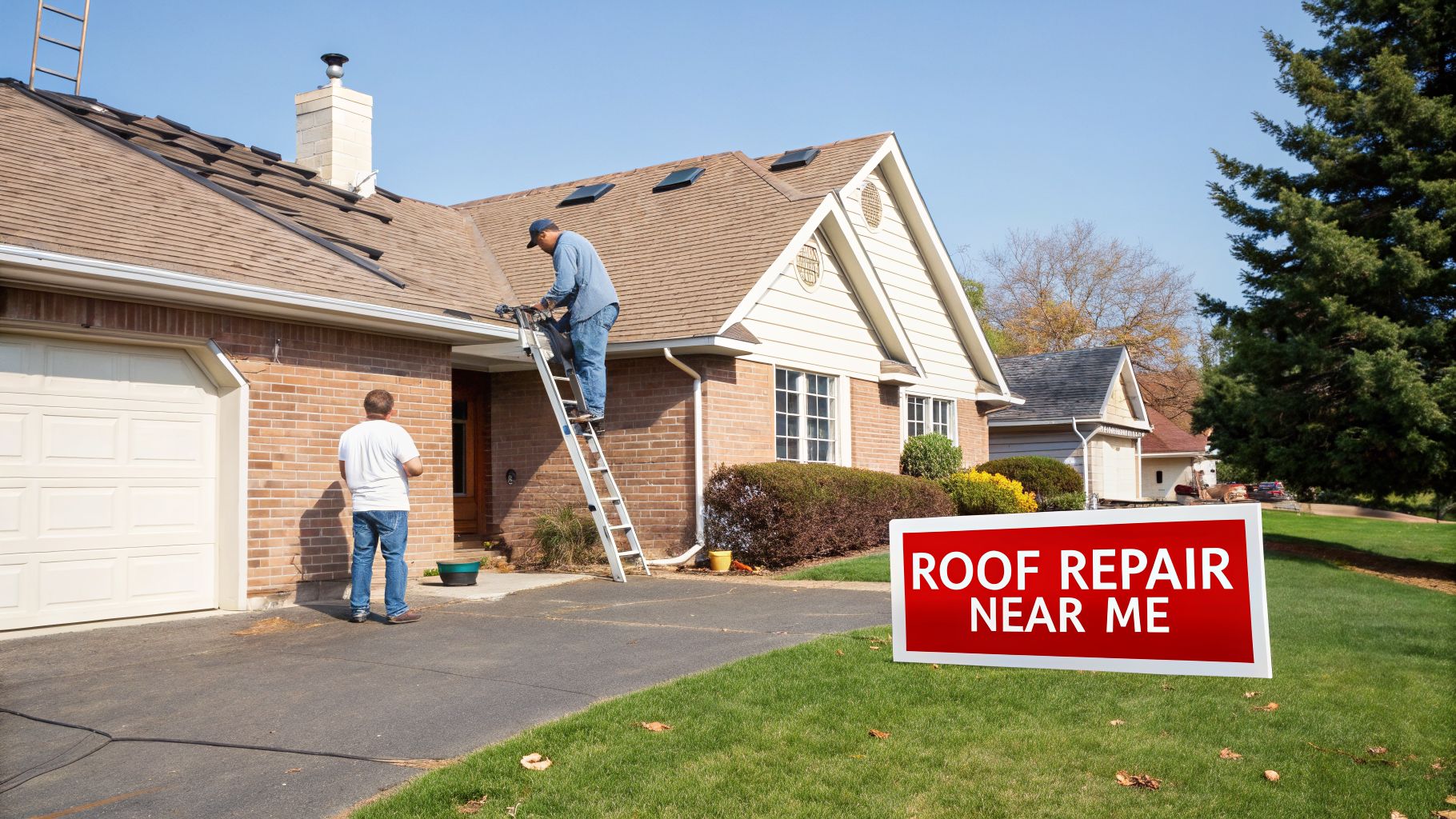
Here in Dallas-Fort Worth, we're no strangers to severe weather. Seeing a few shingles on your lawn or a new water stain on the ceiling after a storm can send your stress levels through the roof—pun intended. The first thing I tell homeowners is to take a deep breath and assess the situation from the ground, safely.
Is there water actively dripping into your living room? If so, that's a true emergency. You need to act fast to prevent serious interior damage. But if it's just a few loose shingles or some granules in your driveway, you probably have time on your side. Don't let a sense of urgency push you into a rushed decision.
Move From Panic to a Plan
This is where you shift from a reactive, stressed-out homeowner to a proactive, informed one. To do that, you need to understand what actually goes into the cost of a repair. The price isn't just a number a contractor pulls out of thin air; it’s a calculation based on very specific factors.
A truly "affordable" repair is one that fixes the problem correctly the first time. I’ve seen it a hundred times: a cheap, quick patch-up job that fails a few months later, leading to a much bigger and more expensive headache down the line.
Key Takeaway: An informed decision is always the most affordable one. A little time spent understanding your roof's condition and the factors driving repair costs will save you a ton of money and stress.
The roofing industry is a massive business, especially in storm-prone areas. In fact, roof-related insurance claims are projected to hit a staggering $31 billion in 2026 alone. With the average full roof replacement now costing between $21,050 and $30,680, it's easy to see why a targeted, quality repair is so appealing. A trustworthy contractor focuses on these targeted fixes, saving you from an unnecessary replacement.
What Actually Affects the Price?
Knowing what influences the final cost of a repair puts you in the driver's seat when talking to contractors. If you're navigating this for the first time, our guide on selecting the right roofing company can be a huge help.
Here are the main things that will impact your estimate:
- Your Roofing Material: Repairing standard asphalt shingles is much less expensive than working with slate, tile, or metal roofing.
- The Extent of the Damage: It's one thing to replace a handful of blown-off shingles. It's another entirely to discover and replace the rotted wood decking underneath them.
- Your Roof's Design: A simple, low-pitched roof is far easier (and cheaper) to work on than a steep, complex roof with lots of angles, valleys, and dormers.
Ultimately, a professional, no-obligation inspection is the only way to get a truly accurate price for your specific situation.
Repair or Replace? A Quick Guide
It can be tough to know if you need a simple fix or a whole new roof. This table breaks down common scenarios to give you a better idea of what to expect.
Quick Guide to Roof Repair Costs vs Full Replacement
| Issue | Likely Solution | Typical Affordability | Key Consideration |
|---|---|---|---|
| A few missing shingles | Targeted Repair | Very Affordable | Quick fix to prevent water from reaching the underlayment. |
| Localized leak around a vent | Repair & Reseal | Affordable | Often a simple flashing or sealant failure. |
| Widespread shingle curling/cracking | Full Replacement | High Cost | Indicates the roof is past its effective lifespan. |
| Significant granule loss | Replacement Likely | High Cost | Your shingles are losing their protective layer. |
| Rotted decking (soft spots) | Major Repair/Replace | Moderate to High | The underlying structure is compromised. |
While this guide helps, remember that every roof is different. Only a hands-on inspection can confirm the true extent of the damage and the best path forward.
What Really Drives Roof Repair Costs
Ever wonder why a "simple roof repair" can have such a huge price range from one house to the next? When you’re searching for an affordable roof repair near me, understanding what goes into a contractor's quote is half the battle. That final number isn't just pulled out of thin air; it’s a careful calculation based on a few key factors.
The most straightforward variable is your roofing material. Patching up standard asphalt shingles is a completely different ballgame than working on slate, tile, or metal. A metal roof repair, for instance, requires specialized tools, different skills, and more expensive materials than swapping out a few three-tab shingles. That difference alone is a major driver of your estimate.
Your roof’s complexity also plays a massive role. A simple, low-slope ranch-style roof is far easier and safer to work on than a steep A-frame loaded with valleys, dormers, and skylights. Every one of those features is a potential leak spot that demands meticulous flashing and sealing, adding significant time and labor to the job.
Beyond the Shingles You Can See
Here’s the thing, though: the biggest unknown, and often the biggest cost, is the damage you can't see from the ground. A few shingles blown off in a storm might seem like a quick fix. But if water has been seeping through that gap for weeks, you’ve got a much bigger problem on your hands.
This hidden water damage can escalate a simple patch into a more serious project. If the plywood or OSB decking underneath has gone soft and spongy, it absolutely has to be replaced. A roofer who just nails new shingles over rotten wood isn’t doing you any favors—they're just guaranteeing you'll have to call them again.
I’ve seen this countless times: a homeowner gets a rock-bottom quote that doesn’t include checking the decking. A year later, the same spot is leaking again, but now the rot is twice as bad. An honest roofer will always get on the roof, inspect the decking, and account for any necessary replacement in their quote.
Material Choices and Your Bottom Line
Your choice of materials has a direct impact on both the upfront cost and the long-term value of your roof. The global roofing materials market is enormous and constantly shifting, projected to climb from $123.2 billion in 2025 to $167.23 billion by 2032.
While standard asphalt shingles still cover 75-80% of homes in the U.S., many homeowners—especially here in North Texas—are upgrading. Choosing Class 4 impact-resistant shingles might cost more initially, but it can save you a fortune on future hail damage repairs and even lower your insurance premiums.
Understanding how a professional roofing company operates also provides some valuable context. Like any business, they have to manage their own costs for materials, labor, and insurance. To get a better feel for the business side of the industry, you can look into how companies secure funding through things like construction business loans. This insight helps you recognize that a detailed, transparent quote isn't just good for you—it's the mark of a professional who runs a tight ship and can price your job accurately.
How to Get a Genuinely Free and Honest Roof Inspection
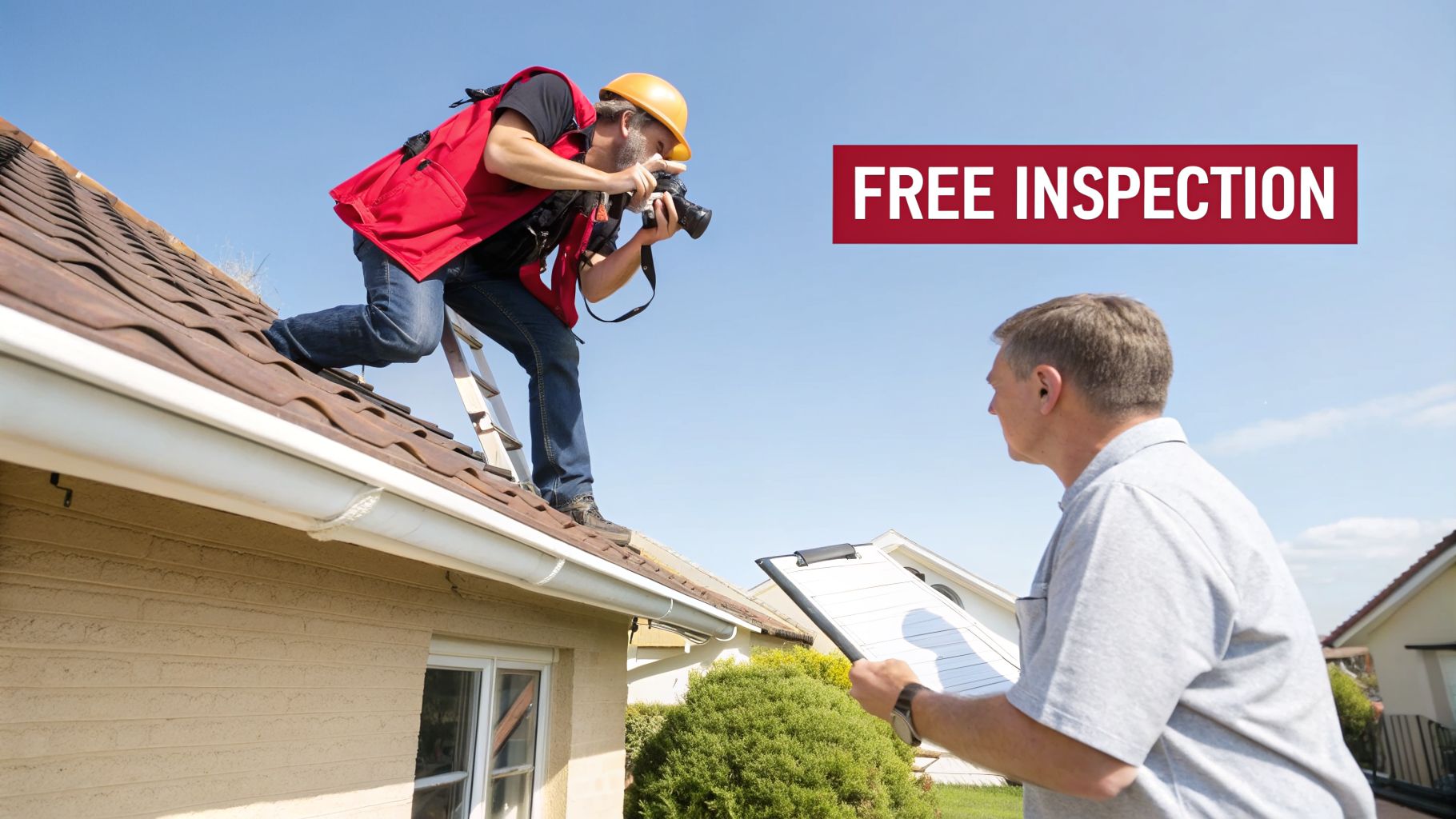
You see the phrase “free roof inspection” on every contractor’s truck and website. But what are you really getting? A truly valuable inspection isn’t just a quick glance followed by a high-pressure sales pitch. It’s an investigation. It’s about getting real answers so you can make a smart decision based on facts, not fear.
When you're searching online for affordable roof repair near me, the quality of this first step will dictate everything that follows. Let me be clear: a real inspection is never done from the street. If a contractor doesn’t physically get on your roof, they aren’t doing their job.
What a Thorough Inspection Looks Like
A proper assessment is a top-to-bottom process. A good roofer isn't just hunting for the one obvious leak; they're looking at the entire roofing system to see how every component is holding up. This is the only way to get a complete picture of your roof's health.
They should be hitting these key checkpoints every single time:
- Storm Damage Assessment: In North Texas, this is everything. We’re looking for specific impacts from hail (bruises and fractures on the shingles) and signs of wind-lift where shingles have been pulled up or torn away.
- Leak Source Detection: Finding where water is getting in can be tricky. The stain on your ceiling is rarely right below the actual entry point, so it takes a trained eye to trace it back to the source.
- Material Condition: We check for excessive granule loss, which looks like coarse black sand collecting in your gutters. This is a tell-tale sign that your asphalt shingles are nearing the end of their life.
- Component Check: The seals around flashing, vents, pipes, and chimneys are the most common weak spots on any roof. We examine each one for cracks and decay.
Here’s the biggest green flag you can look for: a roofer who walks your entire roof with a camera, taking clear pictures of every single issue they find. That documentation is non-negotiable. It’s your proof that the damage is real and serves as the foundation for an accurate repair plan.
On the flip side, a major red flag is any contractor who offers a firm quote without performing this detailed, hands-on evaluation.
From Pictures to a Plan
After the on-roof inspection is done, the contractor should sit down with you to review everything. This isn't the time for a sales pitch. It's a review session. They should walk you through the photos and explain what you're looking at in plain English—for example, showing you a picture of a cracked pipe boot and explaining how that small tear is letting water directly into your attic.
This kind of transparency does two things: it helps you understand what’s going on with your own home, and it builds critical trust. You’re not just taking their word for it; you’re seeing the evidence with your own eyes. This documentation also becomes invaluable if you decide to file an insurance claim.
To make sure no stone is left unturned, you can follow along with a guide. We’ve put together a resource you can use—check out our roof inspection checklist template to see what a comprehensive review should cover. An honest, detailed inspection from a company like Hail King Professionals gives you all the facts you need to find a solution that’s both effective and truly affordable.
When you're trying to find affordable roof repair near me, the most critical decision you'll make isn't about the materials or the price—it's about the contractor you hire. Let's be honest, the cheapest quote can quickly turn into your most expensive mistake if the work is subpar.
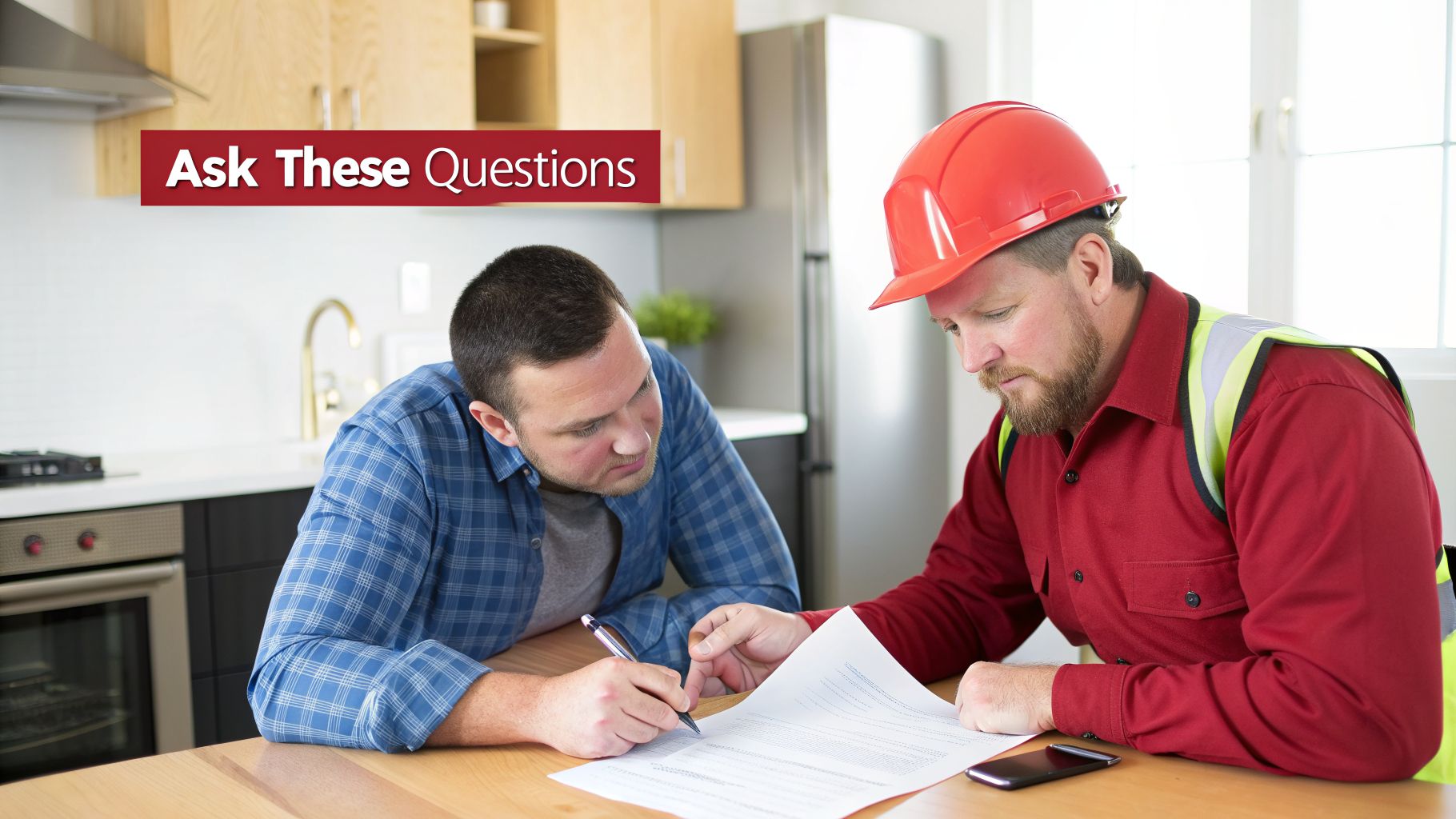
To truly vet a pro, you have to go beyond a simple "Are you insured?" The right questions will reveal a roofer's experience, their reliability, and whether they genuinely stand behind their work. This is how you find a real partner who will protect your home.
Verifying Insurance and Licensing
This is the absolute first hurdle. Don't just take their word for it—ask to see the paperwork. A legitimate, professional roofer will gladly provide a certificate of insurance showing both general liability and worker's compensation coverage.
Here's why both are crucial:
- General Liability covers damage to your property. If a crew member accidentally drops a tool through your skylight or a ladder crashes into your siding, this policy pays for the repairs, not you.
- Worker's Compensation protects you if one of their employees gets hurt on your property. Without it, you could be on the hook for their medical bills and lost wages. It’s a massive liability you don’t want.
Roofing is a tough job. The U.S. has over 135,000 roofing workers, and it's consistently ranked as one of the most dangerous professions. Proper insurance isn't a "nice-to-have"; it's a critical safety net that protects you from enormous financial risk. If you're curious, you can even get your own contractor liability insurance quotes to see what comprehensive coverage actually involves.
Discussing Warranties and Materials
A warranty is only as strong as the company backing it. You need to understand precisely what’s covered. There are two warranties to consider in any roof repair.
The first is the material warranty from the shingle manufacturer. The second, and frankly more important for a repair job, is the workmanship warranty. This is the contractor's personal guarantee on their labor.
A roofer who is confident in their work will offer a clear, written warranty on their craftsmanship. Ask them point-blank: "What's your warranty on labor, and how long does it last?" If they hesitate or get vague, that’s a major red flag.
Understanding the Process and Contingencies
A great contractor is a great communicator. You should have a clear picture of what will happen from the moment they arrive until the job is done.
So, what should you ask? Instead of a generic checklist, think about the real-world process. Ask them to walk you through it.
Who will be your main point of contact if you have a question mid-job? How, specifically, will they protect your garden beds, windows, and siding from falling debris? A pro will talk about using tarps and performing a thorough cleanup with a magnetic sweep to catch stray nails.
And the big one: how do they handle surprises? What's the plan if they pull up the old shingles and find rotten decking underneath? A seasoned contractor will have a contingency plan and pricing for these "what-ifs" already built into their contract and process.
The way a contractor answers these questions tells you everything about their professionalism. It’s how you separate the true experts from the rest.
Contractor Vetting Checklist Red Flags vs Green Flags
When you're interviewing potential roofers, it can be tough to know if you're talking to a seasoned pro or just a smooth talker. We've been in this business a long time, and we know the signs. Here’s a quick-reference table to help you spot the good, the bad, and the ugly.
| Area of Evaluation | Green Flag (Sign of a Pro) | Red Flag (Proceed with Caution) |
|---|---|---|
| Communication | Provides clear, written estimates and contracts. Eager to answer all your questions. | Vague answers. High-pressure sales tactics. "This price is only good for today!" |
| Insurance | Readily provides a current certificate of insurance for both liability and worker's comp. | Hesitates, can't find it, or says "It's in the truck." The insurance seems to have expired. |
| Local Presence | Has a physical office address and a strong history in the DFW / East Texas area. | Uses a P.O. Box or has no local address. They're a "storm chaser" who just showed up. |
| Pricing | The estimate is detailed, breaking down costs for labor, materials, and contingencies. | The bid is unusually low (or high) with no explanation. Demands a large cash deposit upfront. |
| Warranties | Offers a clear, written workmanship warranty in addition to the manufacturer's material warranty. | No workmanship warranty, or the terms are confusing and full of loopholes. |
| Online Reviews | Has consistent, positive reviews on multiple platforms (Google, BBB) over several years. | Has no online presence, a lot of recent negative reviews, or only brand-new, generic reviews. |
Think of this table as your gut-check guide. A contractor who hits all the green flags isn't just trying to make a quick sale; they're trying to build a lasting reputation and earn your trust. Those are the people you want working on your home.
Navigating Insurance Claims and Financing Options

A great estimate is only half the battle. The real question is how you'll cover the cost without wrecking your finances. Whether you're staring down storm damage and dealing with insurance or paying for a repair yourself, knowing your financial path forward is everything.
Here in Dallas-Fort Worth and East Texas, a hailstorm often means your first call is to your insurance agent. But your roofer is the critical second piece of that puzzle. A good one will show up with detailed documentation and be there to meet your insurance adjuster on-site, making sure nothing gets missed and the scope of work is right for a proper, code-compliant fix.
Making the Insurance Process Smoother
When it comes to an insurance claim, proof is king. Those photos and detailed notes from your roofer's inspection? They aren't just for show. They're your evidence.
Think of your contractor as your advocate. They’ve seen it all and can point out the subtle hail bruises, wind-lifted shingles, and other impacts an adjuster might overlook on a quick visit. An experienced roofer knows exactly what kind of language and documentation insurers need to see, which can be the difference between a fully approved claim and one that leaves you paying out-of-pocket for things that should have been covered.
An Expert's Tip: Never sign off on an insurance settlement until a roofer you trust has reviewed it. You need a professional to confirm that the payout is actually enough to cover all the necessary repairs with quality materials, not just a quick patch job.
What If Insurance Isn't an Option?
Even if your claim is approved, you’ve still got that deductible. Or maybe your roof is just old, and the cost is all on you. This is where financing can be a lifesaver, making a critical repair possible without having to empty your savings account.
The roofing industry is a massive part of the economy. Globally, it’s a market expected to grow from $316.27 billion in 2026 to $366.33 billion by 2030. In the U.S. alone, storm-related roofing claims hit $31 billion in 2024. That’s a staggering number, and with nearly half of all contractors concerned about inflation, flexible payment options are more important than ever. If you're interested in the numbers, you can explore the full roofing market research for a deeper dive.
Thankfully, you don’t have to resort to high-interest credit cards anymore. Companies like Hail King Professionals now offer financing plans built specifically for homeowners.
Look for a plan that includes features like these:
- Soft Credit Checks: You can see what you qualify for without dinging your credit score.
- No Prepayment Penalties: Get a bonus at work? You can pay the loan off early to save on interest, no strings attached.
- No Home Equity Required: Your home isn't used as collateral, which makes the whole process simpler and a lot less risky.
These options turn a large, stressful expense into predictable monthly payments. It means you can do what’s right for your home without the immediate financial hit. If you're weighing your choices for a bigger job, our guide on roof replacement financing options breaks it down even further.
Common Questions About Affordable Roof Repair
Once you start looking into getting your roof fixed, the questions can start piling up. It's totally normal. Your roof protects everything you own, so you want the job done right, but you also don't want to get taken for a ride.
We get it. After decades of helping homeowners in Dallas-Fort Worth and East Texas, we've heard just about every question in the book. Let's walk through the most common ones so you can move forward with confidence.
Can I Just Repair My Roof Myself to Save Money?
It’s a question we hear all the time, and we understand why you'd ask. A few missing shingles look simple enough, and the idea of saving a few hundred bucks on a service call is tempting. But honestly, this is one area where DIY can cost you far more than you save.
First, there's the safety issue. Getting up on a roof is dangerous work, plain and simple. A slip and fall can be life-altering. Beyond that, there's a huge risk of making the problem worse. Sealing a shingle incorrectly can trap water instead of shedding it, turning a small, easy-to-fix leak into a major structural issue with rotted wood decking.
Expert Insight: When you hire a professional, you're not just paying for shingles and sealant. You're paying for a correct diagnosis, a repair that meets building codes, and a workmanship warranty. That peace of mind is worth every penny, especially when a botched DIY job voids your roof's warranty.
How Can I Tell if a Low Bid Is Too Good to Be True?
That gut feeling you get when a price seems way too low? You should listen to it. An unbelievably cheap bid is almost always a red flag, signaling that corners are being cut somewhere important.
Your first step is to ask for their insurance certificates—both general liability and worker's compensation. If they hesitate or can't produce them on the spot, that's your cue to walk away. No insurance means if someone gets hurt on your property, you could be on the hook.
Next, scrutinize the quote itself. Is it just a single number, or is it an itemized list? A suspiciously low bid often uses vague terms for materials, which means they can slap on cheap, mismatched shingles that will look terrible and fail quickly. Also, what about a warranty? A reputable roofer will always back up their labor in writing. If there's no workmanship guarantee, you're the one taking all the risk.
How Long Should a Roof Repair Take?
The timeline depends entirely on what we find up there. Most minor repairs—like replacing a few shingles that blew off in a storm or resealing a vent pipe—are usually done in just a few hours. We can often get in and out without much disruption to your day.
However, if the damage is more extensive, it will naturally take longer. For instance, if we pull up the shingles and find a section of spongy, rotted decking underneath, that wood needs to be cut out and replaced. A job like that could take a full day or more. A good contractor will give you a clear schedule upfront and keep you in the loop if they uncover any surprises. They should also detail how they'll protect your plants and driveway and finish with a thorough magnetic sweep for nails.
Will a Repair Hurt My Home's Curb Appeal?
A professional repair should be practically invisible. The mark of a true craftsman is how well they can blend the new work with the old. This is something we take a lot of pride in. We go to great lengths to source shingles that are a perfect match for the color and style of your existing roof.
What if your roof is older and the exact shingle isn't made anymore? We have solutions for that, too. A common strategy is to "harvest" shingles from a less-visible area of your roof (like on the back) to use for the repair on the front. Then, we install the new (but closely matched) shingles on the back where no one will notice.
Ultimately, a seamless repair looks infinitely better than a missing shingle and sends a clear signal that your home is well-cared-for, protecting its value.
Are you ready to tackle your roof repair with a team you can trust? Hail King Professionals has been serving Dallas-Fort Worth and East Texas since 1991, offering free, same-day inspections and transparent solutions. Get your free, no-obligation estimate today and see the difference a pro makes.