

DFW & East TX Commercial Roof Repair Services Experts
A Texas storm usually announces itself twice. First with wind, hail, and driving rain. Then the next morning with a ceiling stain, a bucket in the hallway, a tenant email, or a maintenance tech telling you water is showing up nowhere near the leak source.
For a facility manager, that moment is never just about water. It is about protecting inventory, keeping offices open, answering ownership, documenting damage for insurance, and figuring out whether the roof needs a targeted repair, a larger restoration, or a replacement plan. In Dallas-Fort Worth and East Texas, that decision gets harder because hail damage is often uneven, rooftop equipment complicates access, and many buildings now have solar arrays that cannot be ignored during roofing work.
Your Guide to Protecting Your Commercial Property Investment
The toughest commercial roof calls usually start with incomplete information. Water appears inside Suite 200, but the failure may be at a curb, a seam, a fastener line, an edge metal transition, or ponding water fifty feet away. A hail event may leave obvious dents on metal components while also creating membrane damage that does not stand out from the ground.

Commercial roof repair services exist to bring order to that situation. The work includes inspection, leak tracing, moisture detection, emergency stabilization, membrane or metal repair, flashing correction, coating restoration where appropriate, and documentation that supports budgeting and storm claims.
Texas property managers usually need answers to five questions fast:
- What failed: Surface damage and leak source are not always the same thing.
- How urgent is it: Some issues can be scheduled. Others threaten insulation, electrical systems, or tenant operations.
- What will the repair involve: Patch, seam work, flashing rebuild, coating, section replacement, or broader reroofing.
- How do we document it: Good photos and scope notes matter before anyone disturbs the evidence.
- Who coordinates the moving parts: Roofing crews, tenants, adjusters, HVAC access, and sometimes solar detach-and-reset.
A leaking roof is rarely a single-line maintenance item. On commercial properties, it is an operations issue, a budgeting issue, and sometimes an insurance issue at the same time.
The goal is not to chase every drip. The goal is to make the right building-level decision, then execute it with minimal disruption.
The Critical First Step Professional Roof Inspection and Diagnosis
A proper repair starts before anyone opens a tube of sealant or cuts into a membrane. If the diagnosis is wrong, the repair can be neat, fast, and completely ineffective.
What a real inspection includes
On a commercial property, inspection should move in layers.
The first layer is interior evidence. That means ceiling stains, active drips, wet insulation, wall staining, odor, and any pattern tied to wind direction or recent storms. Good inspectors map these signs, but they do not assume the leak is directly overhead.
The second layer is the roof surface. The crew checks seams, penetrations, parapet transitions, coping, drains, scuppers, edge metal, fasteners, rooftop unit curbs, pitch pans, and obvious punctures. On metal roofs, they also look for loose fasteners, failed sealant lines, panel movement, and oxidation around details.
The third layer is moisture assessment. Many rushed inspections fall short at this point.
Why infrared matters on flat commercial roofs
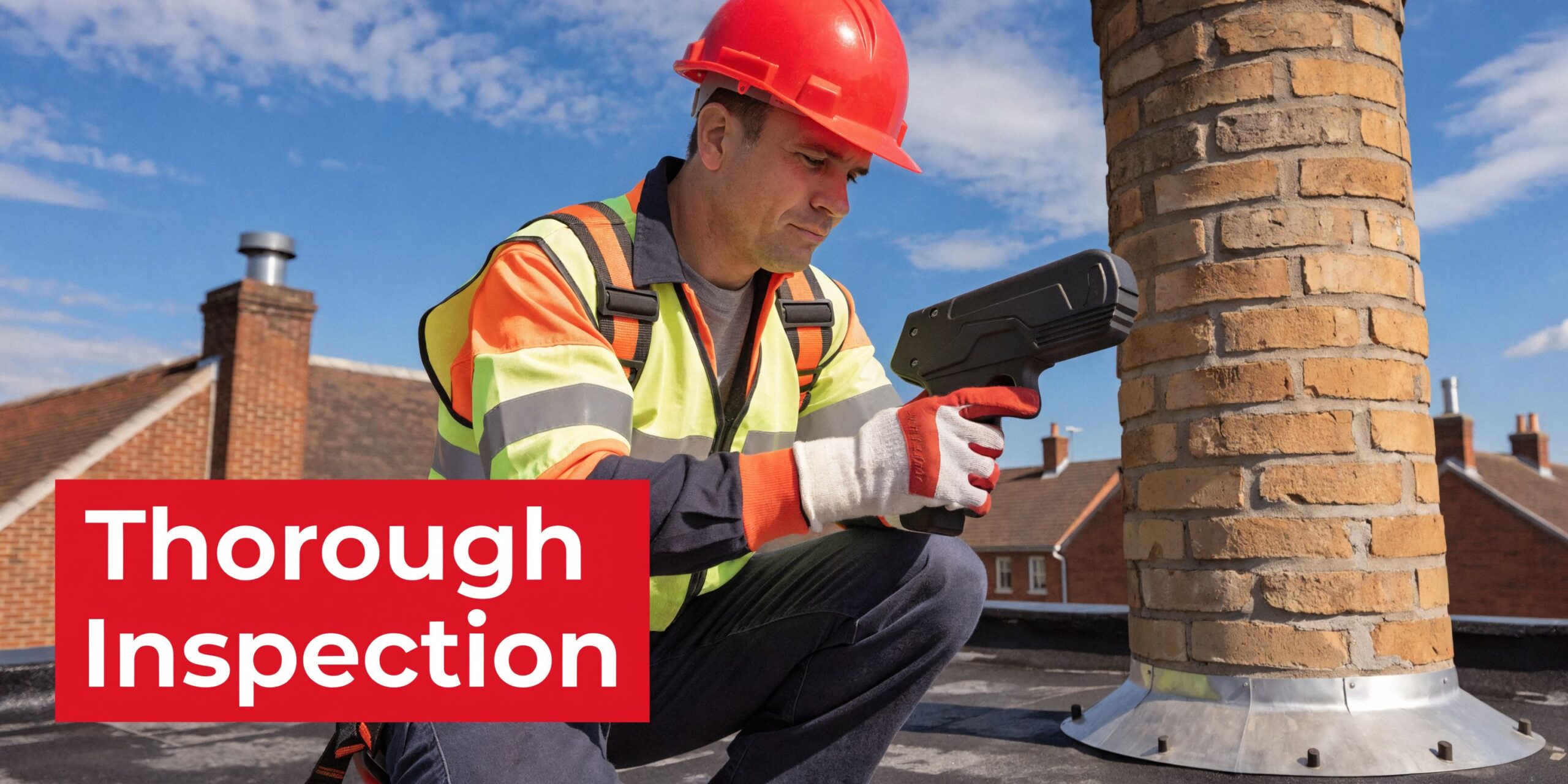
Infrared thermal imaging is one of the most useful tools in commercial roof repair services because it detects subsurface moisture that visual inspection alone can miss. The process works by identifying temperature differences that suggest trapped water beneath the membrane or within insulation.
Think of it as an MRI for the roof. The surface may look serviceable while wet insulation below is already losing performance and setting up a larger failure.
According to this commercial roof repair process guide covering infrared moisture detection, undetected moisture can raise repair costs by 3 to 5 times compared with early intervention. The same source notes that in high-risk areas like Dallas-Fort Worth, proactive thermographic inspection can extend roof life by 10 to 15 years and reduce long-term costs by up to 50% versus reactive repairs.
That matters most on low-slope systems such as TPO, EPDM, and built-up or modified roofs, where water can travel under the membrane and spread well beyond the visible entry point.
What the report should tell you
A useful inspection report does not bury the answer under generic photos. It should separate findings into categories such as:
- Active leak sources: Failures likely tied to current interior water intrusion
- Storm-related damage: Hail impacts, punctures, lifted seams, displaced components
- Age-related wear: Shrinkage, cracking, oxidation, open laps, membrane fatigue
- Maintenance items: Drain cleaning, debris removal, sealant touch-up, minor flashing work
- Strategic concerns: Widespread moisture, repeated failure zones, signs that repair may not be the durable option
A facility manager should also expect roof plans or marked-up photos that identify exactly where each issue sits. If you receive only broad statements like “roof needs repair” without mapped locations, quantities, or repair methods, the scope is not ready for pricing.
For teams that want a simple framework for documenting findings before contractor visits, this commercial roof inspection checklist template is useful as a field reference.
What does not work
Some habits create repeat leaks and wasted spend:
- Blind caulking: Smearing sealant over a suspect area without identifying the failure path
- Ground-level conclusions: Deciding severity from the parking lot after a hail event
- Single-photo reporting: One close-up image without context, scale, or roof location
- Skipping moisture detection: Approving a patch on a roof with wet insulation already spreading underneath
Later in the process, video can help explain this to ownership and operations staff who are not on the roof every day.
If a contractor cannot explain why the leak started, how far the damage extends, and why the proposed repair matches the roof system, keep asking questions.
Understanding Common Commercial Roof Repair Solutions
Different roof systems fail in different ways. A good repair solves the specific failure mode of that roof, not the symptom alone.
TPO EPDM and other low-slope membranes
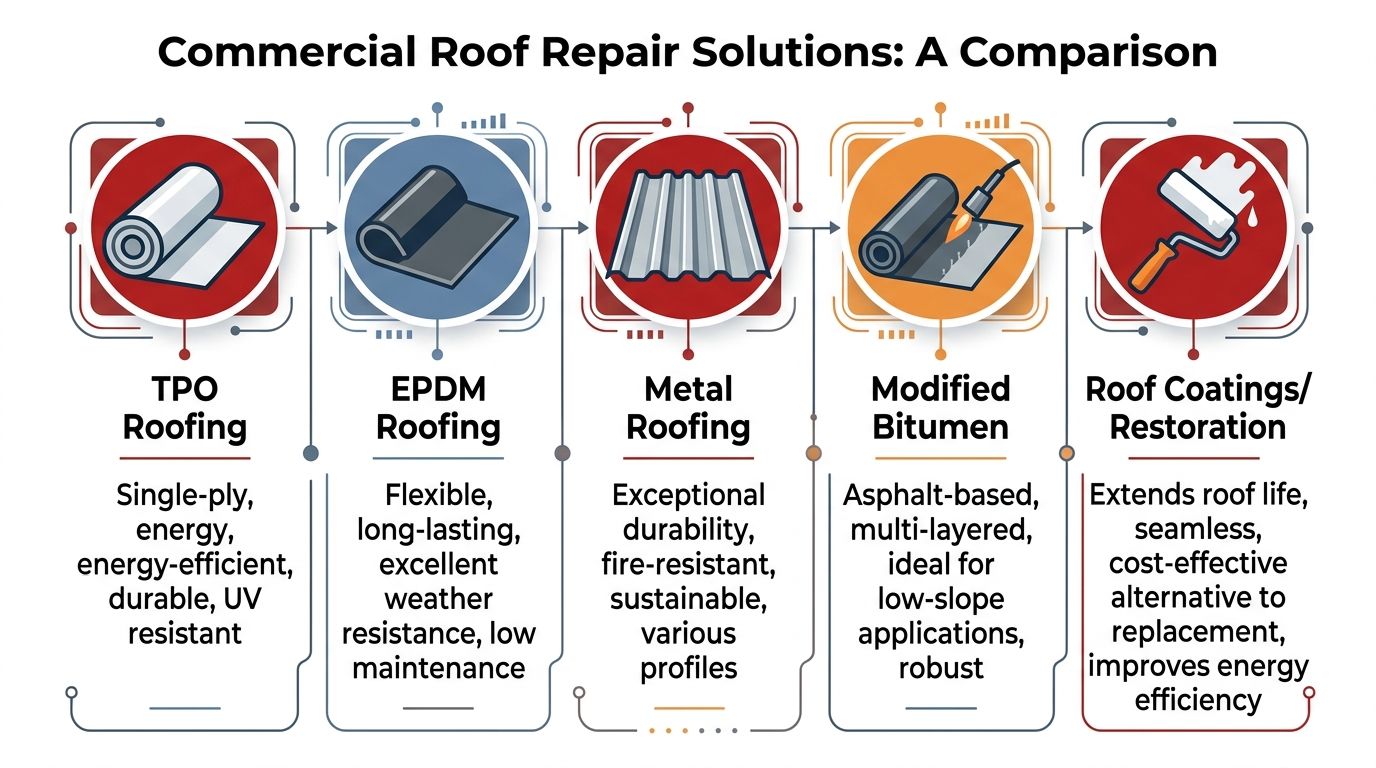
Single-ply roofs are common across retail, office, and light industrial properties in Texas. They are efficient and serviceable, but their weak points are usually concentrated at seams, penetrations, terminations, and traffic areas.
TPO repairs often involve heat-welded patches, seam repair, flashing replacement around curbs and pipes, and correction of edge details where movement or uplift has stressed the membrane. This is not a place for generic mastic as a primary fix. If the system was designed to be welded, the repair should usually respect that design.
EPDM repairs are different. EPDM is a synthetic rubber membrane, so repair methods often rely on manufacturer-approved tapes, primers, uncured flashing, and compatible adhesives. The repair may look simpler than TPO work, but surface prep matters a great deal. Dirty or poorly prepared EPDM repairs fail early.
Modified bitumen and built-up roofs need a different mindset again. Failures can include split plies, open laps, surface wear, blistering, and flashing fatigue. In some cases, a targeted patch works. In others, the roof needs a larger reinforced repair area because the surrounding plies are already weakened.
Metal roof repairs
Metal systems usually leak at the details before they fail in the field of the panel.
That means roofers look hard at fasteners, washers, side laps, ridge details, transitions, skylights, penetrations, and previous sealant work. Hail can complicate the picture because visible dents may be cosmetic while the leak path forms where movement, impact, and failed sealant overlap.
Typical metal roof repair methods include:
- Fastener correction: Replacing backed-out or failed fasteners and addressing enlarged holes where needed
- Detail resealing: Reworking panel laps, penetrations, and trim transitions with compatible sealants
- Localized metal replacement: Swapping damaged panels or trim pieces when sealing alone will not hold
- Rust treatment and restoration: Preparing oxidized areas before applying approved repair materials or coatings
What usually does not work on metal roofs is broad, messy sealant application over every joint. It can hide defects temporarily, trap water in places it should drain, and make later repairs more difficult.
Coatings and restoration work
Roof coatings can be a strong option when the underlying roof is still a good candidate for restoration. They are not magic, and they are not a substitute for fixing bad substrate conditions.
A coating project typically starts with repairs. Crews address seams, flashing, punctures, and wet areas first. Then they clean and prepare the surface, reinforce critical details, and install the coating system designed for that roof type.
This approach makes sense when the roof is weathered but structurally serviceable. It makes less sense when the deck is compromised, moisture is widespread, or previous failures keep showing up in multiple zones.
How repair choices compare
| Roof system | Common failure points | Typical repair approach | Where mistakes happen |
|---|---|---|---|
| TPO | Open seams, punctures, curb flashing, edge terminations | Heat-welded patches, seam rewelds, flashing rebuilds | Using incompatible patch methods |
| EPDM | Shrinkage stress, flashing splits, seam separation | Primer, seam tape, uncured flashing, compatible adhesive repairs | Poor cleaning and surface prep |
| Metal | Fasteners, laps, penetrations, trim, oxidation | Fastener replacement, resealing details, panel or trim replacement | Overusing sealant without fixing movement or failed components |
| Modified bitumen | Split plies, lap issues, surface wear, flashing fatigue | Reinforced patches, flashing repair, selective replacement | Patching isolated spots on broadly aged sections |
| Coating restoration | Weathered surfaces, minor seam issues, UV exposure | Prep, detail reinforcement, coating system application | Coating over wet substrate or unresolved leaks |
Matching the method to the building
The right scope depends on more than roof type. Use, access, and occupancy matter.
A medical office may need staged work around operating hours. A warehouse may tolerate larger repair zones but require careful coordination around loading. A retail center may demand visible cleanup every day because customers are walking under the work area.
The practical question is always the same. Will this repair stop the leak and hold up under Texas heat, hail, movement, and service traffic? If the answer depends on “for now,” that should be said plainly.
What to Expect During the Commercial Roof Repair Process
A well-run commercial repair project should feel controlled, not chaotic. Even small jobs need a clear sequence because tenant access, safety, deliveries, and weather can change the workday fast.
Mobilization and site setup
The first stage is logistics. The contractor confirms access points, loading areas, safety requirements, roof access procedures, and any building rules for noise or work hours. On occupied properties, this is also when tenant notices should go out.
Materials and tools are then staged so crews are not dragging equipment across the roof all day. Good setup reduces accidental damage and keeps pathways predictable for both workers and facility staff.
Surface prep and repair execution
The repair itself starts with preparation, not patching. Wet or failed materials may need to be removed. Existing seams may need to be cleaned and opened. Old sealant that has failed may need to come off entirely before compatible materials are installed.
The actual repair method depends on the system, but the sequence usually follows a pattern:
- Locate and expose the failed area
- Remove unsound material
- Dry, clean, and prepare the substrate
- Install the repair using the proper system-specific method
- Seal and reinforce details
- Test or recheck the area before demobilizing
Small isolated repairs can move quickly. Larger moisture-related scopes, especially where insulation replacement is involved, take longer because crews need to cut back to sound material and rebuild the assembly correctly.
Final review and closeout
The best commercial roof repair services do not end when the crew packs up. The final review matters.
That means verifying completed locations, documenting what was found once the roof was opened, and confirming that drains, rooftop units, and walk paths are left in good order. On larger jobs, the contractor should provide updated photos and a closeout summary that your team can keep with building records.
Ask for repair documentation before the next storm, not after it. It is easier to defend a scope, a budget request, or a claim when your file is complete.
If a project affects access, parking, or tenant operations, daily communication is part of the job. Silence creates frustration faster than noise.
Budgeting for Repairs and Navigating Insurance Claims
Roof budgets go sideways when owners try to price the problem before they define it. On commercial roofs, the same ceiling stain can lead to a small detail repair, a moisture remediation scope, or a much larger insurance-driven project depending on what inspection unveils.

What drives repair cost
A repair proposal is shaped by several factors at once:
- Roof type: TPO, EPDM, metal, modified bitumen, and coated systems each require different materials and labor methods
- Extent of damage: An isolated seam failure is different from widespread wet insulation
- Access and safety: Multi-tenant sites, restricted loading zones, and rooftop equipment slow production
- Urgency: Emergency response and active leak containment cost more than planned work
- Existing condition: A roof with years of layered patching often takes more labor to repair correctly
The commercial roof repair services market was valued at USD 12.5 billion in 2022 and is projected to reach USD 20.3 billion by 2030, while minor repairs typically range from USD 1,000 to USD 10,000 according to this commercial roof repair market analysis. The same source notes that proactive maintenance can reduce later costs by preventing larger damage progression.
Those minor-repair numbers are useful as orientation, not as a quote. Once moisture has spread, insulation is saturated, or multiple details have failed after a storm, the project quickly moves beyond “minor repair” territory.
Repair versus replacement in storm-prone Texas markets
Facility managers can waste money at this point if they focus only on short-term spend.
A roof can be technically repairable and still be the wrong repair candidate. According to this article discussing repair-versus-replacement thresholds, NRCA studies show repairs extend roof life by 5 to 10 years only if under 25% of the roof surface is affected. The same source says a 2024 FMI report found 40% of commercial owners over-repair, increasing cost, and notes a common decision threshold where repair is often viable if the work stays under $10 per square foot, while replacement can run $15+ per square foot.
That framework is useful in DFW and East Texas after hail events. If damage is limited, moisture is localized, and the roof still has serviceable life, a strategic repair can preserve capital. If failures are widespread, previous patches are stacking up, and affected area is no longer isolated, another repair cycle may only postpone a larger bill.
The cheapest scope is not always the lowest-cost decision. A low bid on the wrong repair can lock you into another leak season, another disruption cycle, and another mobilization cost.
Handling hail and storm claims
Texas managers also have to think about documentation discipline. Insurance discussions get harder once emergency patching has altered the roof and no one captured clear pre-repair evidence.
A practical claim workflow looks like this:
Document the event and the symptoms
Save weather timing, leak locations, ceiling damage photos, rooftop impact photos, and tenant incident reports.Get a detailed roof assessment
The report should distinguish hail impact, age-related wear, mechanical damage, and active leak points.Protect the building without erasing evidence
Temporary dry-in or stabilization may be necessary, but it should be documented carefully.Meet the adjuster with roof-specific notes
A contractor or owner’s representative should be prepared to point out test areas, damaged components, and why certain repairs or replacements are needed.Review scope gaps before work starts
On commercial projects, omitted edge metal, flashing details, insulation areas, or code-related components can become expensive change orders.
Building a realistic budget file
A strong budget package includes more than a proposal total.
Include the inspection report, roof plan, moisture findings if available, photos labeled by location, a written repair-versus-replacement rationale, and any operational notes tied to scheduling. If the building has rooftop solar, include detach-and-reset coordination in the first version of the budget, not as an afterthought.
That file helps with internal approvals. It also keeps ownership from comparing two numbers that are based on different scopes.
How to Choose the Right DFW Commercial Roofing Contractor
Contractor selection affects diagnosis, insurance support, jobsite control, and whether the repair lasts through the next storm cycle. In Texas, local weather experience is not a marketing line. It changes how crews inspect hail damage, sequence work around forecasts, and detail vulnerable roof edges and penetrations.
What to verify before you sign
Start with basics, but do not stop there.
- Insurance and legal standing: Confirm the company is properly insured for commercial work and can provide current documentation.
- System experience: Ask what roof systems they repair most often. A contractor who mainly does steep-slope residential work is not automatically ready for low-slope commercial leak diagnostics.
- Documentation quality: Review a sample inspection report or scope. If it is vague before the job, it will usually stay vague during the job.
- Repair philosophy: Ask directly when they recommend repair, restoration, or replacement. You want judgment, not automatic upselling and not automatic patching.
- Project communication: Find out who sends updates, who handles tenant coordination, and who is on point for change conditions.
A practical screening guide for owners and managers is this contractor selection checklist for roofing projects.
Solar coordination is no longer optional
One issue many property managers discover too late is rooftop solar. If the building has panels, wiring pathways, mounts, or related equipment on the roof, repair planning changes immediately.
A commercial roof repair discussion focused on solar coordination notes that reroofing or major repair work on solar-equipped buildings can create warranty and coordination risks if detach-and-reset is not handled correctly. For Texas properties in hail-prone areas, that matters because roofing scope and energy infrastructure often need to be managed together.
Contractor capability for this becomes more than craftsmanship. The team needs a process for scheduling panel removal, protecting components, sequencing the roof work, and reinstalling the solar system without turning one project into two separate disputes.
What a dependable partner looks like
You want a contractor who can explain the roof in plain language, not one who hides weak diagnosis behind jargon. The right partner should be able to point to the failure, state the repair method, identify the trade-offs, and document the work so ownership has a record worth keeping.
One option in this market is Hail King Professionals, which provides commercial roof inspections and repair or replacement options in DFW and East Texas, along with solar panel detach-and-reset when a reroof or major repair requires it.
That kind of coordination matters on occupied buildings. It reduces finger-pointing, shortens scheduling gaps between trades, and keeps the roof plan tied to how the property operates.
Implementing a Proactive Roof Maintenance Program
Emergency repair will always be part of commercial property management. It should not be the whole strategy.
A roof maintenance program works like oil changes for a fleet vehicle. It does not eliminate every breakdown, but it lowers the odds of paying for a major failure that started as a small, visible issue months earlier.
What should be in the program
A useful plan usually includes scheduled inspections, drain and gutter cleaning, debris removal, sealant review at penetrations and edges, and quick correction of minor defects before they become leak calls.
For Texas buildings, storm follow-up matters too. Hail and wind can shift conditions fast, especially around flashing lines, metal components, and rooftop equipment.
This matters at the market level as well. The global commercial roofing market is projected to reach USD 81.34 billion by 2032, driven in part by aging buildings and the growing recognition that maintained roofs help prevent leaks, reduce energy loss, and extend service life, according to this commercial roofing market outlook.
Turning maintenance into asset management
The best maintenance plans connect roof condition to budgeting. They help facility teams track recurring trouble spots, time larger capital decisions, and avoid being surprised by damage that was visible but undocumented.
For a practical framework, this commercial roof maintenance plan guide can help standardize what gets checked and when.
Maintenance is not separate from repair. It is the process that makes later repairs smaller, more targeted, and easier to justify.
Common Questions About Commercial Roof Repairs
Will a repair void my original roof warranty
It can, if the work is done with incompatible materials, by unauthorized parties, or without following the roof system’s approved repair method. Before authorizing work, verify what the existing warranty requires. On some systems, even a small repair should be documented carefully and tied to manufacturer-approved methods.
How do you reduce disruption for tenants and customers
Good contractors plan the work around access, not just labor efficiency. That means setting delivery windows, protecting entrances, managing noise by area, keeping walkways clean, and communicating daily if the property stays occupied. Most tenant frustration comes from surprise, not from the repair itself.
When does replacement make more sense than another repair
There is no single answer for every roof, but there is a useful threshold. According to the earlier-cited repair-versus-replacement framework, repairs tend to extend life by 5 to 10 years only when less than 25% of the roof surface is affected, and many owners over-repair instead of making a cleaner capital decision. If the roof is still a repair candidate, keeping the scope under the cited $10 per square foot benchmark can support that decision. Once replacement conditions push into the cited $15+ per square foot range and the roof has widespread deterioration, repeated patching often stops making financial sense.
What if my building has rooftop solar
Bring that into the first roofing conversation. Panel removal, protection, and reset affect schedule, labor, warranty exposure, and access to damaged roof areas. If solar coordination is missing from the initial scope, the project budget and timeline are both at risk.
How fast should I respond after a storm leak
Immediately. Start documentation, protect the interior, and arrange a professional assessment as soon as safe access is possible. Waiting usually expands the repair scope because water intrusion rarely stays confined to the first visible stain.
If your commercial property in DFW or East Texas is dealing with storm damage, recurring leaks, or a roof that needs a clear repair-versus-replacement decision, Hail King Professionals can inspect the roof, document the condition, and provide straightforward options that account for insurance, operations, and solar coordination where needed.