


Flat Sloped Roof Guide for Texas Homeowners
You look up after a Texas storm, see a roofline that seems almost level, and wonder how that thing is supposed to survive hard rain, hail, summer heat, and the next wind event. That question comes up a lot with modern homes, warehouses, retail buildings, detached garages, and additions that use a flatter profile instead of a steep shingle roof.
A flat sloped roof can work very well in Texas. It just has less margin for error. On a steep roof, gravity does a lot of the work. On a low-slope roof, the design, drainage layout, membrane choice, flashing details, and maintenance routine have to do that work. If any one of those is weak, leaks usually show up fast.
Property owners often get bad advice in this category. Some contractors treat low-slope roofs like oversized shingle jobs. Others focus only on the membrane and ignore the drainage path. In Texas, that is backwards. Hail, ponding water, wind uplift, rooftop equipment, and solar penetrations all influence the roof's performance. The roof that looks cleanest on day one is not always the one that holds up best after repeated storms.
Decoding the "Flat Sloped" Roof
A flat sloped roof works on a simple rule. The surface only needs enough pitch to keep water moving.
From the ground, many of these roofs look level. Up close, they are built with a slight fall that sends water toward drains, scuppers, or gutters. That sounds minor, but in Texas it is the difference between a roof that dries out after a storm and one that holds water, traps hail debris, and starts leaking around seams or penetrations.
The standard definition helps clear up the name. A flat roof is generally considered a roof with less than a 2:12 pitch, and low-slope roofing is the broader category most owners and contractors are talking about on commercial buildings, patio covers, additions, and modern homes. If you want a plain-English companion read on that broader category, What Is a Low-Slope Roof is a useful reference.
What makes it different
A steep roof sheds water quickly because gravity is doing most of the work. A flat sloped roof depends more on design discipline. The deck has to be built or tapered correctly. The drains have to be placed in the right spots. The flashing has to stay tight at walls, curbs, skylights, HVAC stands, and any future solar penetrations.
That lower margin for error is why these roofs can perform very well or fail early.
On Texas buildings, I pay close attention to four things:
- Drainage path: Water must have a clear route off the roof, especially after hard spring rain and wind-driven storms.
- Detail work: Corners, terminations, penetrations, and edge metal usually leak before the open field of the roof does.
- Surface abuse: Hail impact, service foot traffic, and dropped tools matter more on low-slope systems than many owners expect.
- Future use of the roof: Solar, mechanical upgrades, and added conduit all create new penetrations that need planning from day one.
Why owners keep choosing it
Owners choose low-slope roofs because they solve practical building problems. They simplify rooftop equipment placement, fit modern architectural lines, and often cost less than steep-slope assemblies on larger structures. They also make solar layouts easier in many cases because panel racks can be oriented for production instead of being locked to a steep roof face.
That said, the Texas trade-off is real. Flat sloped roofs are less forgiving after hail, clogged drainage, and sloppy penetrations. A clean-looking roof on install day is not enough. The system has to keep performing after heat cycles, wind uplift, service traffic, and repeated storms.
Some assemblies also give owners more options for reinforcement and repair over time. For example, modified bitumen roof systems for low-slope buildings are often chosen when an owner wants a tougher, multi-layer surface with a proven track record under foot traffic and weather exposure.
The short version is simple. A flat sloped roof is not flat in the way owners mean it. It is a low-slope water-management system, and in Texas, its success depends on how well it handles rain volume, hail impact, flashing stress, and the added demands of rooftop equipment or solar.
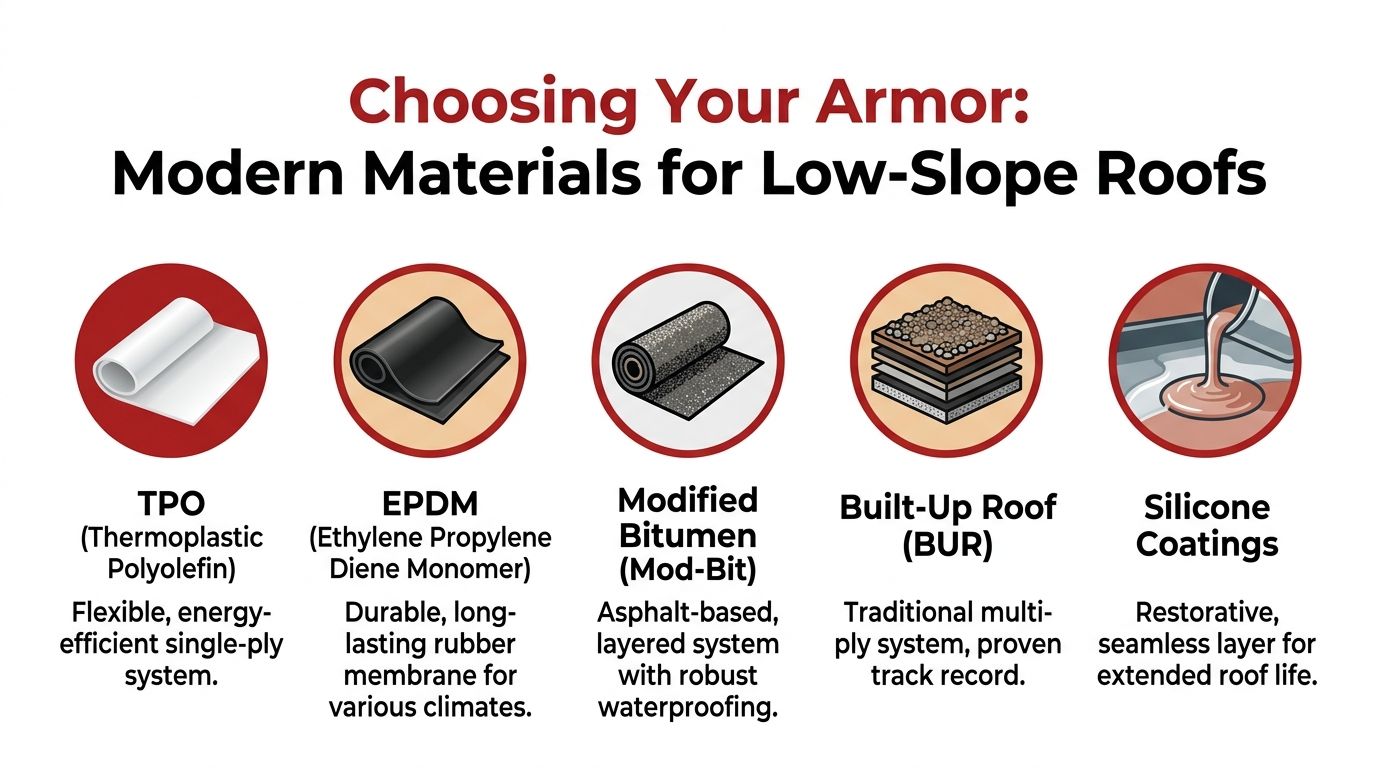
Choosing Your Armor Modern Materials for Low-Slope Roofs
Material choice shapes how a roof handles sun, hail, foot traffic, ponding risk, and future repairs. On a flat sloped roof, I tell owners to think in terms of armor, not just appearance.
Some systems are lighter and cleaner. Some are tougher around abuse. Some restore well with coatings. Some are a better fit for retail, offices, churches, patio covers, or modern homes.
Single-ply membranes
TPO is one of the most common low-slope systems in Texas. It is a single-ply membrane with heat-welded seams, which gives it a clean field appearance and a monolithic waterproofing effect when installed correctly. It is often chosen for commercial buildings and modern residential designs where reflectivity and a lighter-looking roof surface matter.
EPDM is a different animal. It is a rubber membrane, usually darker in color, with a long track record. Owners tend to choose it when they want a membrane known for flexibility and straightforward repairs. It is not the same look as TPO, but it can be a dependable option on the right building.
PVC also belongs in the single-ply conversation. It is often selected where chemical exposure or grease risk is a concern, such as certain restaurant or industrial applications. Not every property needs it, but some buildings do.
Where single-ply works best
- TPO: Good fit for many commercial roofs and contemporary homes where heat-welded seams and a bright surface appeal to the owner.
- EPDM: Good fit where a rubber membrane’s flexibility and repair familiarity matter more than appearance.
- PVC: Better suited to specialty use cases than general residential reroofing.
Asphalt-based systems
Modified bitumen, often called Mod-Bit, gives owners a more rugged-feeling assembly than many people expect from a low-slope roof. It is asphalt-based, installed in layers or rolls, and can be a smart fit where foot traffic, service access, or a tougher surface matters.
Built-Up Roofing, or BUR, is the old-school multi-ply system. It uses multiple layers and has a long history on commercial properties. It is not the sleekest-looking roof, but it has a reputation many facility managers still trust because it is familiar and proven.
If you want a closer look at where Mod-Bit fits in the decision, this overview of modified bitumen roof systems is useful for comparing it against single-ply options.
Coatings and restoration
Coatings are not a cure-all, but they can be a strong tool when the underlying roof is still a good candidate for restoration. Silicone coatings come up often on Texas low-slope roofs because they can create a seamless protective layer over an existing system.
That matters when the roof is weathered but not structurally spent. A coating can buy time, improve weather resistance, and postpone replacement if the seams, deck, insulation, and flashing are still serviceable.
Practical rule: If the roof already has trapped moisture, unstable flashing, or recurring movement at penetrations, coating over the problem usually hides failure instead of fixing it.
Standing seam metal on low-slope designs
Some owners want the visual lines and durability reputation of metal. That can work on the right low-slope design, but the roof has to be engineered for it. Metal is not a universal substitute for membrane roofing on every flat sloped roof. Details at laps, penetrations, and transitions have to match the pitch and drainage plan.
A simple decision table
| Roof system | Best fit | Main strength | Main trade-off |
|---|---|---|---|
| TPO | Commercial and modern residential | Heat-welded seams and energy-conscious design | Requires careful seam and edge installation |
| EPDM | Buildings needing flexible membrane performance | Durable rubber membrane with familiar repair methods | Different look and seam approach than TPO |
| Modified Bitumen | Roofs with service traffic or tougher-use conditions | Layered waterproofing and rugged feel | Heavier system with detail-sensitive installation |
| BUR | Traditional commercial applications | Proven multi-ply assembly | More labor-intensive and less common on some newer projects |
| Silicone coating | Restoring eligible existing roofs | Seamless protective top layer | Depends on roof condition underneath |
| Standing seam metal | Select low-slope architectural projects | Distinct look and long-term durability mindset | Not suitable for every low-slope geometry |
The right answer depends on how the building is used, how often people walk the roof, how much equipment sits on it, and how storm exposure affects the property. A warehouse with frequent HVAC service calls needs a different roofing strategy than a modern home with clean lines and solar plans.
The Critical Science of Drainage and Flashing
Low-slope roofing fails in boring places. Not in the middle of a pretty membrane sample. It fails at the drain bowl, the scupper throat, the parapet edge, the vent stack, the HVAC curb, and the transition where one trade cut a corner.
The code minimum matters here. The International Building Code requires a minimum pitch of ¼:12 on low-slope roofs to help water drain and reduce ponding, and tapered insulation is one accepted way to create that slope during a retrofit (Weyerhaeuser).
Drainage paths that work
Most low-slope roofs move water off the surface in one of three ways:
Interior drains
Common on commercial buildings. Water moves inward to drain bowls and down through the building’s drainage system. These work well when the roof is properly tapered, but they demand regular clearing.Scuppers through parapet walls
Water exits through openings in the wall at roof level. These are simple and effective, especially when paired with a clean slope pattern.Perimeter gutters
More familiar to homeowners. These can work on low-slope sections, but they still rely on the roof plane feeding them consistently.
If the water path is wrong, the membrane gets blamed for a design problem.
Flashing is the weak-link test
A flat sloped roof is only as reliable as its flashing package. Every penetration has to be sealed and terminated in a way that works with movement, sunlight, service traffic, and standing moisture.
The common leak points are predictable:
- Pipe penetrations
- Skylight curbs
- Wall intersections
- Parapet caps
- HVAC mounts
- Roof edges and term bars
When these details are sloppy, water enters long before the main field membrane wears out.
Tip: If a contractor talks mostly about the membrane brand and barely mentions drains, penetrations, or edge metal, ask harder questions.
What owners should look for
You do not need to become a roofer to spot warning signs. Look for stains below roof penetrations, debris clustered near drains, membrane wrinkles that interrupt flow, and areas where water remains after rain.
For roofs already showing symptoms, this guide to flat roof leak repair helps property owners understand where diagnosis usually starts and why surface patching alone often misses the true entry point.
Good low-slope work is detail work. The membrane is the visible layer. Drainage and flashing are the parts that decide whether the roof stays dry.
Flat vs Pitched Roofs A Head-to-Head Comparison
A Texas owner usually feels this decision after the first serious storm. One roof type gives you easy access for equipment, solar, and service work. The other sheds water and debris with less day-to-day fuss. The right choice depends on what the building has to do, how long you plan to hold it, and how much risk you want to manage after hail season.
For a broad homeowner-friendly comparison, Flat Roof vs Pitched Roof is a helpful outside perspective. In Texas, the bigger questions are simpler. How well does the roof handle hail, how easy is it to inspect after wind, and will it support future solar without turning the roof into a maintenance problem?
Where low-slope roofs win
Low-slope roofs make more sense when the roof has a job beyond keeping water out. Commercial buildings need room for HVAC, venting, walk paths, and service access. Solar layouts are often cleaner on a low-slope roof because panel placement is easier to control, and installers are not fighting steep angles during maintenance.
They can also reduce structural complexity compared with a framed pitched system, which matters on large footprints and modern designs.
That said, the lower upfront price some owners expect is not automatic in Texas. A simple low-slope design can save money. A storm-rated assembly with better insulation, thicker membrane, reinforced edges, and upgraded flashing can close that gap fast.
Where pitched roofs win
Pitched roofs are more forgiving. Water leaves faster. Leaves and small debris are less likely to sit in place and hold moisture. After a storm, damage is often easier for an owner to spot from the ground, especially on shingle systems where missing tabs, lifted areas, or impact hits stand out.
They also tend to give owners a longer service life when the design is straightforward and the attic ventilation is right. In residential work across Texas, that extra forgiveness matters because many leak problems start with neglected maintenance, not sudden roof failure.
The trade-off is access. Repairs, inspections, and solar work are harder on a steep roof, and usable rooftop space is limited.
Side-by-side practical differences
| Issue | Flat sloped roof | Pitched roof |
|---|---|---|
| Storm recovery | Easier to walk and inspect after hail, but hidden membrane damage can be missed without trained eyes | Damage is often more visible, but access is harder and steeper slopes slow inspection |
| Rooftop use | Better for HVAC, service access, and solar placement | Limited practical use beyond weather protection |
| Structural approach | Often simpler on larger commercial buildings | Often better fit for traditional residential framing |
| Maintenance style | Needs consistent attention to seams, penetrations, edge details, and drainage paths | Needs attention to shingles, flashing, valleys, and attic ventilation |
| Error tolerance | Lower. Small design or installation mistakes show up faster | Higher. The slope gives the system more forgiveness |
The Texas decision
Choose low-slope when rooftop access, equipment layout, and solar planning are part of the building's long-term use. It is often the better tool for commercial properties and modern homes, especially when the owner is willing to stay disciplined on inspections after hail and wind.
Choose pitched when you want more drainage forgiveness and a roof that generally handles neglect a little better.
Neither roof type wins on every building. In Texas, the better roof is the one detailed for local storms, installed by a crew that understands uplift and impact exposure, and matched to how the property will be used.
Texas Storms Protecting Your Flat Roof from Hail and Wind
A North Texas storm can leave a low-slope roof looking fine from the parking lot and still open the door to expensive leaks. Hail bruises the field membrane, wind tugs at the perimeter, and the next hard rain tests every seam, curb, and drain. That is why Texas owners cannot judge these roofs by appearance alone.
On a low-slope system, storm protection starts with accepting how failures happen here. Hail damage is often subtle. Wind damage usually starts at edges, corners, and penetrations. Debris from the same storm can block drainage, hold water in place, and give small defects more time to leak.
Hail damage on low-slope roofs
Hail does not have to punch a visible hole to shorten a roof's service life. On TPO, PVC, modified bitumen, and other low-slope assemblies, impact can bruise the membrane, split flashing, loosen granules, or weaken a seam enough that the problem shows up later instead of the same day.
That delayed failure is common in Texas.
Owners often spot shingle damage from the ground. Low-slope damage usually takes trained eyes on the roof. After a hailstorm, I look closely at drains, corners, walkway paths, equipment curbs, and any place where water tends to linger. If the roof also carries solar equipment, access routes and mounting points need the same attention. A damaged field membrane is one issue. A damaged mounting detail can create a much bigger repair.
Wind uplift is not just a coastal issue
Spring and summer storms across Texas can put real uplift pressure on a low-slope roof, even well inland. The PNNL Building America Solution Center notes that low-slope assemblies in high-wind regions rely on proper attachment, tested edge securement, and code-based uplift design to resist failure under severe wind loading (PNNL Building America Solution Center).
In practical terms, corners and perimeters usually fail first. Once wind gets under a loose edge metal, open lap, or poorly secured termination, the repair bill climbs fast. That is one reason cheap edge work costs so much later in Texas.
Here is a useful visual on storm-related roofing concerns:
What storm-resistant low-slope work looks like
Storm-ready low-slope roofing is built as a complete assembly. Membrane choice matters, but attachment, edge metal, flashing, and drainage details decide whether the roof holds together after hail and wind.
For Texas properties, that usually means:
- Membranes matched to impact exposure: Some systems handle hail and service traffic better than others. The right choice depends on building use, traffic, and how exposed the roof is.
- Stronger perimeter and corner detailing: These areas take the worst uplift forces and should never be treated like the middle of the roof.
- Drainage that stays open during storm season: A roof can survive hail and still leak because branches, gravel, or trash blocked the scuppers after the storm.
- Flashing that can handle movement: Curbs, pipe penetrations, and roof-to-wall transitions are common leak points after wind events.
- Service paths for equipment and solar crews: Roof damage often comes from foot traffic after the install, not only from weather. If solar is part of the plan, owners should understand how roof replacement and panel timing affect the project. This guide on solar panel roof replacement planning covers the coordination issues that matter.
One missed detail can undo a good membrane.
A short owner checklist after a storm
- Clear drains and scuppers: Remove leaves, branches, hail buildup, and trash before the next rain.
- Check edges from the ground where possible: Look for lifted metal, displaced coping, or loose flashing.
- Watch for wrinkles, blisters, or shifted laps: These are early signs that the assembly moved during the storm.
- Inspect inside the building: Ceiling stains, wet insulation, and wall discoloration often show up before a leak is obvious on the roof.
- Document conditions early: Good photos help separate fresh storm damage from older wear.
- Call a low-slope roofer, not a general inspector: Membrane and flashing damage is easy to miss if someone mainly works on steep-slope shingles.
Texas storms punish delay. On low-slope roofs, the cheapest repair is usually the one found before trapped water, repeated heat cycles, and the next thunderstorm turn a small defect into interior damage.
Costs Lifespan and Integrating Solar Panels
Owners want a straight answer on cost. On low-slope roofing, the honest answer is that price depends heavily on the assembly, tear-off condition, insulation needs, penetrations, edge details, access, and whether the building already has storm damage.
Without verified project pricing data for this article, the smartest way to judge cost is by total ownership, not just the initial proposal. A cheaper membrane on a roof with poor drainage, crowded penetrations, or weak edge attachment can cost more over time than a better-designed system that is easier to maintain and restore.
Lifespan is about the whole assembly
One low-slope roof lasts because the slope is right, the drains stay open, the flashing is tight, and the membrane matches the building’s use. Another fails early because water sits in the same spots, service crews abuse the traffic paths, or the original install cut corners at the parapets.
Coatings can extend service life on the right roof. Restoration can be a good financial move when the substrate and details are still sound. Full replacement usually makes more sense when trapped moisture, chronic ponding, repeated seam failure, or storm damage has already compromised the system.
Solar changes the conversation
Low-slope roofs are attractive for solar because they offer accessible workspace and flexible panel layout. But adding slope for drainage and setting solar for output are not always pulling in the same direction.
One cited source notes that retrofitting a flat roof to a 1:12 to 2:12 slope improves drainage, but solar panels in Texas tend to perform best around 15° to 30° tilt. A 2:12 pitch equals 9.46°, and that can reduce solar efficiency compared with an ideal angle (by 10% to 20%) (YouTube reference).
That trade-off matters. A roof can be improved for water management and still lose some panel performance if nobody plans the rack geometry, setbacks, penetrations, and drainage pathways together.
Common solar mistakes on flat sloped roofs
- Treating the roof and solar as separate jobs: They are one weather exposure system once installed.
- Blocking drainage paths with racking or conduit: Water should never have to detour around poor layout.
- Adding penetrations without a long-term reroof plan: Future replacement gets harder and riskier.
- Ignoring warranty coordination: Roof, membrane, flashing, and solar components all need to stay compatible.
For owners planning reroofing under an existing array, solar panel roof replacement explains the detach-and-reset side of the process and why sequencing matters.
The practical decision
If the property needs both better drainage and solar performance, treat the project as a design problem, not a product purchase. The right answer may be tapered insulation under the roof assembly, adjusted panel racking above it, or a staged approach that protects both drainage and output.
A flat sloped roof can work very well with solar in Texas. It just needs planning before crews start unbolting panels or laying membrane.
Hiring Your Low-Slope Roofing Expert in Texas
A Texas owner usually finds out who understands low-slope roofing after the first hard storm. The roof may look clean on bid day and still fail at a curb, edge, drain, or solar penetration once hail and wind start testing the details.
Shingle experience helps, but it does not automatically carry over. Low-slope work is its own discipline. The contractor needs to understand membrane seams, drainage correction, edge metal attachment, flashing transitions, and how hail damage shows up on different roof systems. In Texas, shortcuts show up fast.
Questions worth asking before you sign
Ask plain questions. A qualified roofer should answer them without sales language or guesswork.
How much of your work is low-slope roofing?
Look for real experience with TPO, PVC, modified bitumen, coatings, penetrations, and edge details. General roofing experience is not enough by itself.How do you confirm the roof drains the way it should?
Good answers include slope verification, drain and scupper review, trouble spots that hold water, and whether tapered insulation or crickets are needed.How do you handle curbs, walls, roof edges, and equipment penetrations?
Those areas decide whether a low-slope roof stays dry. Vague answers usually mean the crew relies on whatever looks right in the field.What does your hail inspection include?
In North Texas, that question matters. The contractor should be able to explain how they check seams, membrane bruising, punctures, flashing splits, displaced edge metal, and hidden damage around rooftop units after a storm.Can you coordinate with solar, HVAC, gutters, or other trades?
On many Texas buildings, the roofing job touches other systems. Poor coordination creates leaks, blocked drainage, and warranty disputes.
What separates a useful inspection from a sales visit
A useful inspection starts with diagnosis. The roofer checks where water is trying to go, where it goes, and where the assembly is under stress. That includes drain flow, seam condition, edge securement, ponding zones, hail impact areas, flashing defects, and signs of wet insulation or deck problems.
A sales visit usually skips that work and jumps straight to a number.
Ask for photos. Ask the contractor to mark the failure area and explain the repair sequence. On low-slope roofs, especially in Texas storm country, the owner should be able to see why the roof failed and what will keep it from failing the same way again.
One local option
For owners in Dallas-Fort Worth and East Texas, Hail King Professionals handles flat roofing, roof coatings, storm inspections, and solar detach-and-reset, along with related exterior work such as gutters and siding. That mix can help when a reroof involves hail damage, drainage correction, and rooftop equipment that cannot be treated as a separate job.
The decision standard
Hire the roofer who can explain the weak points on your specific roof, the repair options, and the trade-offs in cost versus service life. Low-slope roofing rewards planning and clean detail work. In Texas, that matters even more because hail, heat, and wind will test every shortcut.
Frequently Asked Questions About Flat Sloped Roofs
Can I walk on my flat sloped roof
Sometimes, yes. But that does not mean you should treat it like a deck.
Many low-slope roofs can handle normal service traffic for maintenance or inspections. The key issue is how traffic is managed. Random foot traffic near seams, flashings, skylights, or soft spots can shorten roof life. Ask your roofer where traffic pads or designated walk paths make sense.
How do I know if my roof has ponding water
Look after a rain, not during one. If water remains in the same areas well after weather clears, that is a sign the roof may not be draining as intended.
You may also notice dirt rings, membrane staining, algae, or repeated leaks in the same part of the building. Those patterns usually mean the roof is holding water longer than it should.
What is a cricket
A cricket is a small built-up slope that redirects water around an obstruction. You often see crickets behind curbs, chimneys, and equipment mounts.
On a flat sloped roof, a cricket can keep water from stalling at a dead spot. It is a small detail, but small details are where low-slope roofs either work or fail.
How long does replacement usually take
It depends on roof size, weather, tear-off condition, drainage modifications, material type, and how many penetrations are on the roof. A straightforward low-slope section can move quickly. A storm-damaged roof with wet insulation, solar equipment, or multiple mechanical curbs takes longer.
The right timeline is the one that allows proper dry-in, flashing work, and inspection. Fast is good only if the details stay right.
Are coatings always better than replacement
No. Coatings help when the existing roof is a good restoration candidate. They are not a substitute for replacing a roof with moisture problems, structural issues, major storm damage, or failing details.
Do flat sloped roofs work for homes in Texas
Yes, if the design fits the house and the roof is installed and maintained correctly. They are less forgiving than steep roofs, but they can perform well when the slope, drainage, material choice, and storm protection all work together.
If your low-slope roof has storm damage, recurring leaks, ponding concerns, or solar equipment that complicates replacement, talk to Hail King Professionals for a same-day inspection and a clear assessment of repair, coating, or replacement options for Texas conditions.