

Your Guide to a Commercial Roof Maintenance Plan
A commercial roof maintenance plan isn't just a checklist; it's a strategic system for inspecting, documenting, and servicing your roof to stop small problems from turning into budget-breaking disasters. Think of it as a living document—a schedule of routine checks, preventative repairs, and condition reports designed to maximize your roof's lifespan and protect your building's value.
Why a Maintenance Plan Is Your Roof's Best Defense
For anyone managing property in Dallas-Fort Worth or East Texas, a commercial roof is an asset constantly under siege. It faces an unrelenting barrage of intense sun, heavy downpours, and destructive hail. Simply waiting for it to break is a gamble you can't afford to take. That reactive approach almost always ends with an emergency call, tenants dealing with disruptions, and an invoice that's far higher than preventative care would have ever cost.
Taking a proactive approach to roof care, which is a core principle of any good proactive safety strategy, is the only way to shield your investment from serious damage. A formal commercial roof maintenance plan flips the script, moving you from a defensive, reactive posture to an offensive, protective one. It’s an investment in asset protection, not just another expense.
From Reactive Headaches to a Manageable Strategy
A well-documented plan takes the chaos and unpredictability out of roof management. Instead of a frantic Saturday morning call about a major leak flooding a tenant's space, you have a scheduled inspection that identified a deteriorating pipe flashing months ago—long before a single drop of water got inside. That foresight is everything.
The numbers don't lie. A solid plan can add 10-15 years to the life of your flat or low-slope roof. For a 20,000 sq ft commercial roof in the DFW area, annual maintenance might run you $2-$4 per square foot. While that's an ongoing cost, it pushes back a full replacement—which can easily hit $10-$20 per square foot—saving you a massive amount in the long run. We dive deeper into these budget dynamics over at The Roof Clinic.
I’ve seen it firsthand time and time again: a simple, documented plan is the difference between a $500 sealant repair caught in the spring and a $50,000 interior water damage claim after a summer storm. One is a minor task; the other is a full-blown business crisis.
The Pillars of a Strong Maintenance Plan
A truly effective commercial roof maintenance plan is more than just a single action; it’s a system where several key components work together. Each one adds a layer of protection, making sure nothing slips through the cracks and your asset is always ready to perform.
Here’s a quick overview of the core components we’ll be breaking down.
| Component | Key Objective | Primary Benefit |
|---|---|---|
| Scheduled Inspections | To identify potential issues before they cause damage. | Early detection of wear, debris, and developing leaks. |
| Proactive Repairs | To address minor deficiencies immediately and systematically. | Prevents small problems from becoming large, costly failures. |
| Detailed Documentation | To maintain a complete history of the roof's condition and all work performed. | Essential for warranty claims, insurance, and budget planning. |
| Lifecycle Budgeting | To plan financially for both routine upkeep and eventual replacement. | Eliminates surprise capital expenditures and ensures funds are available when needed. |
By building your strategy on these four pillars, you create a robust framework that guarantees your roof is monitored, maintained, and managed for its entire service life.
A solid commercial roof maintenance plan isn't just a document you file away—it’s a hands-on strategy that hinges entirely on consistent, high-quality inspections. It’s about knowing exactly what to look for, when to look for it, and how to document what you find. This is where theory meets the rooftop.
The best approach is a steady rhythm of proactive checks, not a frantic scramble when a leak appears. We recommend getting a professional on your roof for a comprehensive walkthrough at least twice a year, typically in the spring and fall. The spring inspection lets you catch any winter damage before the brutal Texas summer heat sets in. In the fall, you can clear away debris and brace your roof for whatever winter throws at it.
Being proactive is always cheaper than reacting to a failure. It’s the difference between a small, manageable repair and a catastrophic, budget-draining disaster.
This image perfectly illustrates the two paths a minor roof issue can take. One is the path of neglect, which almost always leads to bigger, more expensive problems. The other is proactive care, which protects your asset for the long haul.
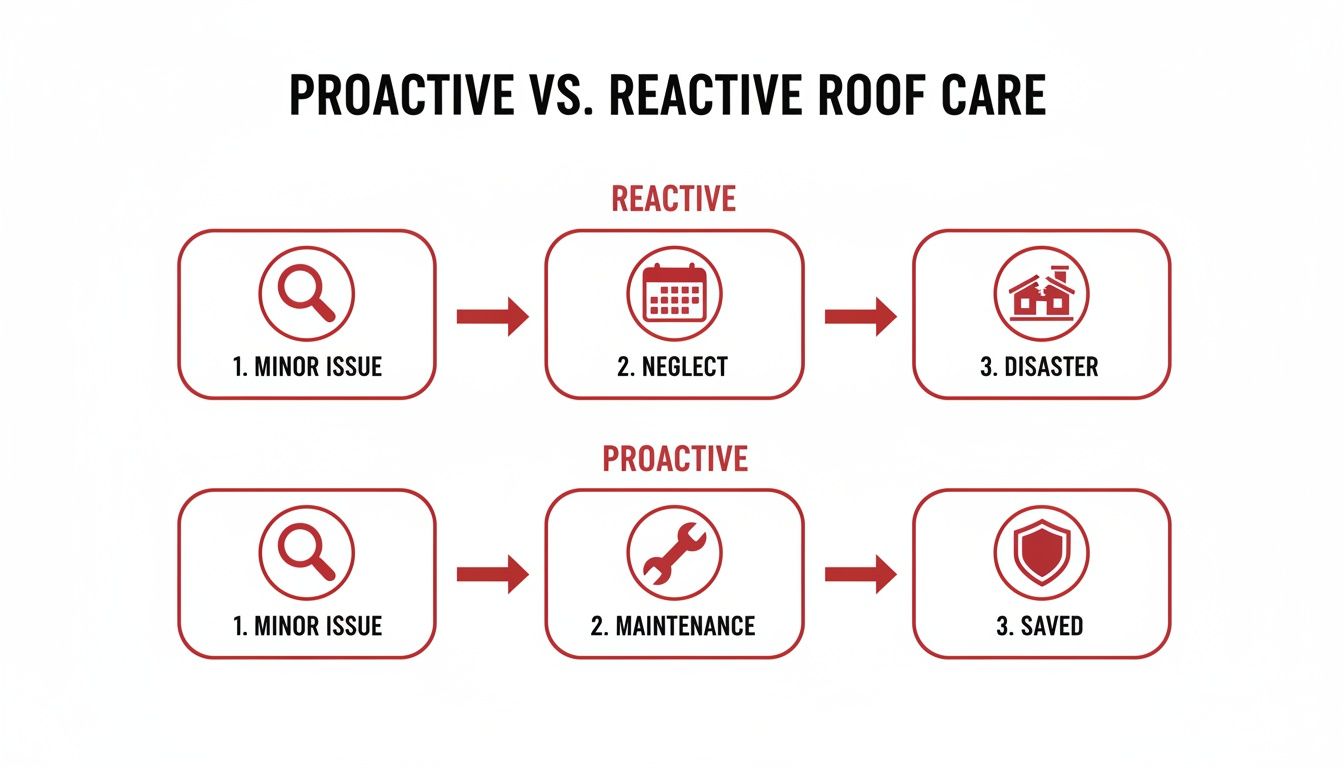
As you can see, catching that small problem early on stops it from escalating. This simple act saves your budget, prevents operational downtime, and protects the building itself.
Responding to Texas Weather Events
Here in DFW and East Texas, you can't just follow the calendar. Our weather is an unpredictable beast, so your inspection schedule has to be reactive, too. A post-event inspection is absolutely critical after any major weather event.
Get someone up there to check for damage immediately following:
- Hailstorms: Don't underestimate small hail. It can strip the protective granules from modified bitumen roofs or create tiny, hard-to-see fractures in TPO and PVC membranes that will become leaks later.
- High-Wind Events: We see it all the time—strong winds can lift single-ply membranes (called "roof chatter"), stressing the seams and fasteners. On metal roofs, it can peel back panel edges and lead to major problems.
- Heavy Rain: A sudden downpour is the ultimate stress test for your drainage system. It will quickly reveal any clogged drains, scuppers, or low spots where water is ponding.
Checking the roof immediately after a storm lets you document the damage while it's fresh for an insurance claim and patch any breaches before the next round of rain.
Roof-Specific Inspection Checklists
Every roof type has its own personality and its own weak spots. Using a generic checklist is a recipe for missing critical issues. You need to inspect your roof for its specific vulnerabilities.
For TPO/PVC Single-Ply Roofs
- Seam Integrity: The seams are the most common point of failure. Look closely for any place they appear to be separating, peeling, or cracking.
- Ponding Water: If you see water still standing on the roof 48 hours after it rains, you have a drainage issue. That standing water will bake in the sun and rapidly degrade the membrane.
- Punctures and Tears: Walk the roof and look for any holes or slices, paying special attention to areas around HVAC units, vents, and any other rooftop equipment.
For Modified Bitumen Roofs
- Blisters and Ridges: These look like bubbles or raised wrinkles on the surface. They're pockets of trapped air or moisture that will expand in the heat and eventually split open.
- Granule Loss: Look for "bald spots" where the top layer of granules has worn away. This exposes the raw asphalt to UV rays, which will break it down quickly.
- Flashing Deterioration: Check the seals around every pipe, vent, and skylight. This flashing is often the first thing to crack, shrink, or pull away from the curb.
For Metal Roofs
- Fastener Issues: Check for fasteners that are loose, backed out, or missing entirely. The rubber washers underneath them are notorious for dry-rotting, breaking the seal and letting water in.
- Panel Damage: Scan for dents from hail or scratches from wind-blown debris. Also, look for "oil canning," a term for visible waviness in the panels that can signal installation issues or stress.
- Rust or Corrosion: Focus on panel seams, cut edges, and any spots where different types of metal are touching. These are the first places rust will appear.
Here’s a pro-tip I share with all my clients: Create a simple roof map. Just sketch the layout, mark where the drains and HVAC units are, and use it to note the exact location of any issue you find. When you pair that map with good photos, you create a powerful historical record of your roof's condition over time.
Documenting Your Findings for Maximum Impact
An inspection is only useful if you document it properly. This is how your observations become actionable intelligence. Every single inspection, whether it's routine or after a storm, needs to end with a clear, straightforward report.
This report is the backbone of your maintenance plan. It allows you to track subtle changes over time, hold your roofing contractor accountable, and provides the hard evidence you’ll need for any warranty or insurance claims.
At a minimum, the report should include the date, weather conditions, inspector's name, and plenty of high-resolution photos of every single issue found. This consistent documentation is what turns a simple walkthrough into a powerful asset management tool.
Executing Smart Maintenance and Proactive Repairs
Your inspection reports are in. Now it’s time to move from observing to acting. A solid commercial roof maintenance plan isn't just about finding problems—it's about fixing them before they become costly emergencies that shut down your business. This is where you protect your asset by turning those inspection notes into proactive repairs.
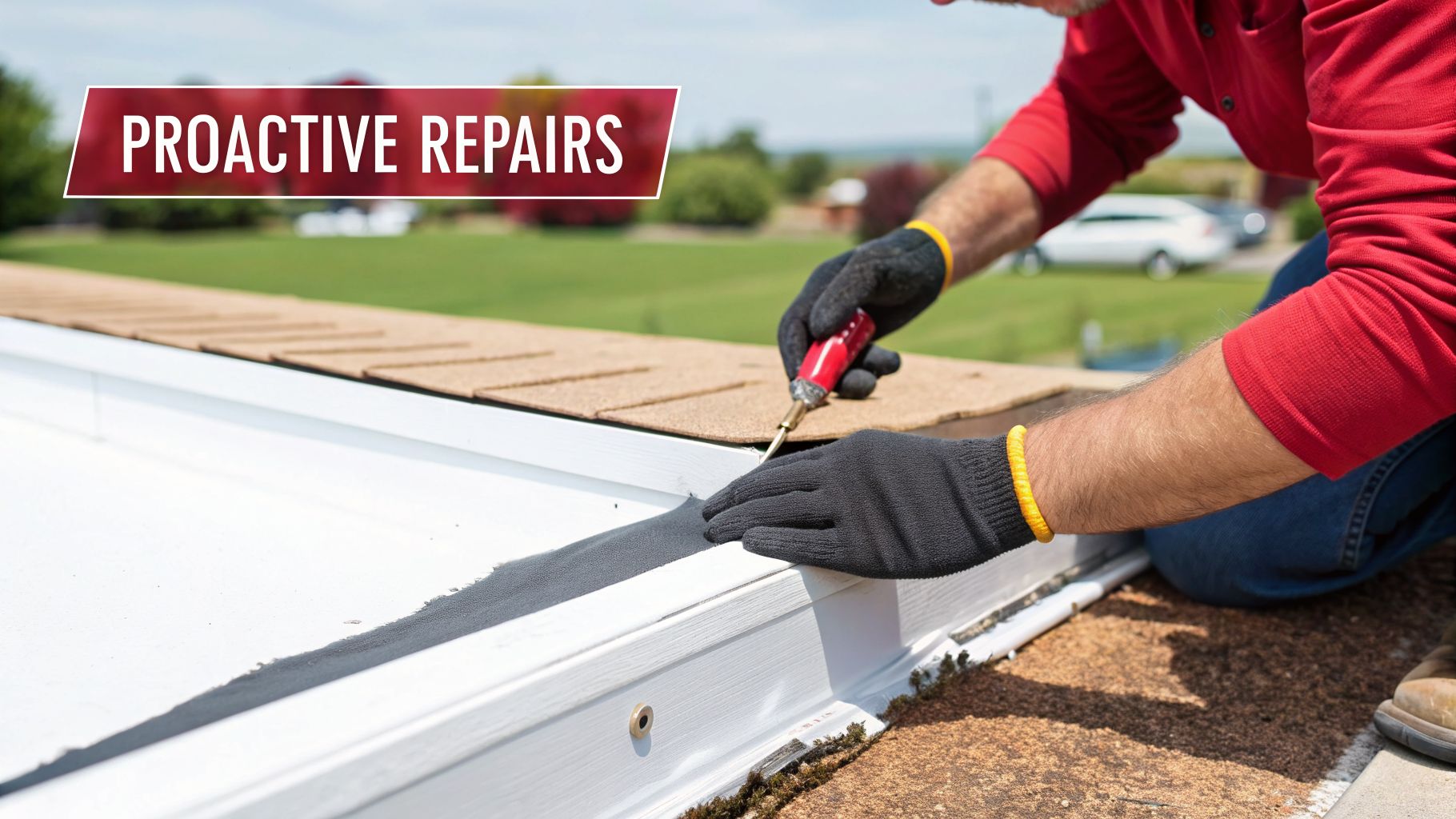
Honestly, many of the most critical maintenance tasks are surprisingly simple. They target the usual suspects behind roof failure, saving you from massive repair bills later on. These actions are the heart of your hands-on upkeep strategy.
Tackling High-Priority Maintenance Tasks
Some repairs deliver a much bigger bang for your buck by directly preventing the most common causes of leaks and premature aging. These are the jobs you want to prioritize in your commercial roof maintenance plan.
Your main focus should always be on managing water and sealing up any weak spots.
Drainage System Clearance: Debris is inevitable. Leaves, dirt, and wind-blown trash will find their way onto your roof and clog drains, scuppers, and gutters. This creates dams that cause ponding water—a flat roof’s absolute worst enemy. Keeping these pathways clear is non-negotiable.
Sealant and Flashing Upkeep: The seals around HVAC curbs, vents, pipes, and skylights are the Achilles' heel of any commercial roof. Under the intense Texas sun, sealants dry out, crack, and pull away. Finding and reapplying a fresh, high-quality sealant to these penetrations stops water intrusion right where it most often starts.
Minor Membrane Repair: Small punctures, tears, or blisters might look like no big deal, but they are open doors for water to get under your roof membrane. Once inside, water soaks the insulation, rots the roof deck, and can cause damage for months before you even notice. Patching these tiny breaches immediately is a quick fix that prevents a catastrophe.
I once worked with a property manager who found a tiny, one-inch slice in their TPO roof during a routine check. The patch cost less than a few hundred dollars. If they'd ignored it, the saturated insulation would have led to a $20,000 section replacement. That’s the real power of proactive repair.
Organizing and Tracking Your Repair Workflow
How you handle repairs is just as important as doing them. A scattered approach means missed tasks, wasted effort, and zero accountability. Every single repair, no matter how small, needs to be documented.
Start a repair log. It should track the date, the issue you found, its location (use your roof map), the fix you applied, and who did the work. Before-and-after photos are absolutely essential for documentation, giving you clear proof for any future warranty or insurance claims. This detailed record-keeping is the backbone of a truly effective program.
To really get a handle on your maintenance plan, think about using a specialized field service management software. These platforms help you schedule tasks, assign work orders, and keep a full digital history of everything you’ve done.

Knowing When to Call for Professional Help
While your maintenance crew can probably handle simple debris removal, most repairs really do need a professional roofer. A bad patch on a TPO membrane or using the wrong sealant can cause more damage than it fixes, and it could even void your roof’s warranty.
Here’s a quick guide on what you might handle in-house versus what needs a pro.
| Task | DIY-Friendly? | Why It Matters |
|---|---|---|
| Clearing Drains & Gutters | Yes | A basic but vital task to prevent ponding water. |
| Visual Inspection | Yes | Spotting obvious issues like debris or visible damage. |
| Minor Sealant Touch-Ups | Maybe | You have to know the exact material needed for your roof type. |
| Membrane Patches/Repairs | No | Requires specialized tools and skill to guarantee a watertight seal. |
| Flashing Replacement | No | This is critical work. If done wrong, a leak is guaranteed. |
| Structural Assessments | No | You need an expert to evaluate deck integrity and load capacity. |
When in doubt, always call a licensed and insured roofing contractor. The whole point of a commercial roof maintenance plan is to make your roof last longer, not to take risks that shorten its life.
For some older roofs, a more advanced solution might be a better fit. You might want to check out how a flat roof coating can restore an aging but still-functional roof, which we cover in another guide. Partnering with a professional ensures every repair you make actually adds to your roof's longevity and performance.
Building a Realistic Budget for Your Commercial Roof
A great roof maintenance plan is useless without the money to back it up. The real goal here is to stop treating your roof like an unpredictable emergency waiting to happen and start managing it like any other operational expense. When you do that, you take control.
This isn't about creating one giant, scary "roof fund." It's about breaking down the costs into three distinct, manageable buckets. This approach gives you a clear financial strategy that protects your building without torpedoing your budget.
Categorizing Your Roofing Expenses
If you want to get a handle on your roofing budget, you have to stop thinking of it as a single line item. We always advise our clients to split their funds into a few key areas. It brings clarity and makes planning for both the near and long term much easier.
Your annual budget should have funds set aside for:
- Routine Maintenance: These are your predictable, planned costs. Think semi-annual professional inspections, clearing away debris and leaves, cleaning out gutters, and other basic upkeep tasks outlined in your plan.
- Minor Repair Allowance: You need a rainy-day fund for small, proactive fixes. This is the cash you'll use to patch a small puncture found during an inspection or reseal a cracked flashing before it turns into a major leak.
- Capital Reserve Fund: This is your long-game savings account. You should be putting money into this fund regularly, year after year, to prepare for a major restoration project or an eventual full replacement a decade or more down the road.
As a solid rule of thumb, we tell building owners to budget between $0.15 and $0.50 per square foot each year for comprehensive maintenance and minor repairs. That small investment is your best defense against the staggering cost of a premature roof failure.
Calculating Your Roof's True Life-Cycle Cost
The price tag for a new roof is just the beginning. The real number you should care about is the life-cycle cost—that’s the initial installation, plus every dollar spent on maintenance and repairs, all the way through to its final replacement. A smart, consistent maintenance plan drastically lowers this number.
By spending a little bit on upkeep every year, you can stretch your roof's service life by 5, 10, or even 15 years. Every extra year you get is a year you can delay a massive capital expenditure, which has a huge impact on your overall return on investment.
It really comes down to two paths. You can make small, planned maintenance payments over 25 years. Or, you can do nothing for 15 years and then get hit with a sudden, massive bill for a full replacement a decade ahead of schedule. From a financial standpoint, the first path is always the smarter one. We break down the numbers in more detail in our guide to commercial roof replacement cost.
Case Study: A Smart Investment in Roof Restoration
We see this scenario play out all the time here in North Texas. Imagine a property manager overseeing a building with a 20,000-square-foot TPO roof that’s now 15 years old. It’s not failing yet, but our inspections are starting to find the classic signs of aging—weathered seams, some minor surface cracking, and the sealant around the HVAC curbs is getting brittle.
They have two options on the table:
- Do Nothing: They could just keep patching the occasional issue as it pops up. Within 3-5 years, that roof will almost certainly start to fail systemically, forcing a complete tear-off and replacement. The projected cost for that? A whopping $150,000.
- Invest Proactively: For about $15,000, they can have a professional roof coating applied now. This process restores the entire roof surface, seals every potential weak point, and essentially gives it a brand-new, reflective, and protective membrane.
By choosing option two, the property manager just bought another 10-12 years of life for that roof. They pushed a $150,000 expense way down the road for just a fraction of the cost. The ROI on that proactive $15,000 is enormous—it saves the building owner more than $130,000 in near-term capital outlay. That’s a perfect example of a maintenance plan working for your budget, not against it.
Choosing the Right Roofing Partner

Let's be blunt: your roof maintenance plan is just a piece of paper until the right people are on your roof making it happen. All the checklists and schedules in the world won’t matter if the team executing them isn't reliable. In a market as crowded as Dallas-Fort Worth, you have to be deliberate in finding a partner you can truly count on.
This is about more than just finding a crew to patch a leak. You're looking for a long-term partner who will treat your building's most critical asset like it's their own. The right roofing company essentially becomes part of your facility management team, giving you one less massive thing to worry about.
The Non-Negotiable Contractor Checklist
When you're vetting potential roofers, there are a few absolute deal-breakers. These aren't just bureaucratic boxes to check; they are your first and best line of defense against shoddy work, massive liability claims, and financial headaches.
If a contractor can't—or won't—provide proof of these, walk away. It's that simple.
- Proper Licensing: In Texas, many cities and counties have their own registration or licensing requirements. Your first step is to confirm the roofer is fully licensed and in good standing with all local authorities. It’s the baseline for a legitimate business.
- Proof of Insurance: This is non-negotiable. You need to see current, valid certificates for both General Liability Insurance and Worker's Compensation. If an uninsured worker gets hurt on your property, that lawsuit could land squarely on your desk. Don't take their word for it; get the certificate.
- Manufacturer Certifications: The best contractors are certified by the big names in the industry—think GAF, Carlisle, or Johns Manville. This certification is proof their crews are trained to install that specific roof system correctly, which is often a requirement to keep your manufacturer's warranty intact.
Look, if a contractor gets evasive or slow-walks providing these documents, it's a huge red flag. A true professional will have this information ready to go and will be happy to share it.
Decoding Safety and Compliance
A vague promise to "work safely" is not a safety plan. A professional partner will have a documented, OSHA-compliant safety program they implement on every single job. This is about protecting their people, your property, and your tenants.
You should be able to see this in action. When they're on your roof, are there clear safety perimeters marked off? Are workers using proper fall protection like harnesses and tie-offs? Is the site organized, or are tools and materials scattered everywhere? Discussing their safety protocols upfront shows them you’re a serious building owner who expects professionalism.
Understanding the Service Agreement
Once you’ve found a contractor who checks all the boxes, the service agreement is the final piece of the puzzle. This contract is the rulebook for your relationship, and a vague one is just asking for future arguments over costs and what was "supposed to be" included.
Your agreement should spell out the details in black and white:
- Scope of Work: What, exactly, is included in a routine maintenance visit? It should explicitly list tasks like debris removal, sealant inspection, and clearing drains and scuppers.
- Response Times: The contract needs to define their commitment. How quickly will they respond to an emergency leak call on a Saturday versus a non-urgent service request?
- Pricing Structure: It must be crystal clear. The agreement should outline the cost of scheduled maintenance visits and specify the hourly rates or pricing for any additional repair work discovered during an inspection.
Putting in the effort to get these details right ensures there are no expensive surprises. A transparent contract from a reputable commercial roof replacement company is what solidifies a great partnership and turns your maintenance plan into a powerful strategy that actively protects your investment.
Answering Your Top Questions About Commercial Roof Maintenance
Even the most thorough guide can leave you with a few lingering questions. That's perfectly normal. Over the years, we've heard just about every question in the book from property managers, and a few common themes always pop up. Let's tackle them head-on with some straight answers based on our experience in the field.
How Much Should We Budget for a Roof Maintenance Plan?
That's always the first question, isn't it? For budgeting purposes, a good rule of thumb is to plan for $0.15 to $0.50 per square foot each year.
So, if you have a 50,000-square-foot roof, you’re looking at an annual investment of roughly $7,500 to $25,000. This should cover everything from your twice-yearly professional inspections and basic debris removal to minor proactive repairs—like sealing a vulnerable pipe flashing before it can leak—and all the reports you'll need.
It might sound like a lot, but think about the alternative. Neglecting your roof can easily shave years off its life, forcing a replacement in year 15 instead of year 25. That’s a massive, six-figure expense you didn't need to have. The only way to get a firm number, of course, is to have a qualified roofer take a look at your specific building.
When Should I Choose a Roof Coating Instead of a Full Replacement?
This is a critical crossroads, and getting it right comes down to understanding the true condition of your roof system. A roof coating is a liquid-applied membrane that restores the existing surface, while a replacement means tearing everything off and starting from scratch.
A roof coating is an excellent, cost-effective choice for roofs that are structurally sound but are showing signs of age, such as widespread surface wear or minor, persistent leaks. It can add another 10-15 years of life for about half the cost of a full replacement.
Another big plus? The IRS often allows you to treat a coating as a maintenance expense, which can be a significant financial win.
But a coating isn't a magic bullet. If the insulation underneath your roof membrane is already saturated with water, or the system itself is failing, a coating is just a band-aid. A bad patch won't fix a waterlogged foundation. The only way to know for sure is with a professional assessment that includes a moisture survey and core sample analysis to see what's really happening under the surface.
How Does a Maintenance Plan Actually Help with Insurance Claims?
This is where a maintenance plan really pays for itself. A detailed, well-documented plan is the single most powerful tool you can have when filing an insurance claim. It gives you a clear, dated record of your roof's condition before a storm ever hit.
When you file a claim for hail damage, your reports, photos, and inspector's notes become undeniable proof that the damage is new and directly related to that event. This makes it incredibly difficult for an adjuster to fall back on common excuses like "pre-existing conditions" or "normal wear and tear."
Here’s the real-world difference it makes:
- It Establishes a Baseline: Your inspection report from six months ago shows a perfectly healthy roof. The photos you take after a hailstorm show obvious dents and fractures. The contrast is your proof.
- It Proves You've Done Your Part: It shows you're a responsible building owner who has actively cared for the property, not someone who let it fall into disrepair.
- It Speeds Everything Up: Handing your adjuster a complete file of maintenance records can cut weeks of frustrating back-and-forth arguments, getting your claim approved and your roof repaired much faster.
Simply put, a maintenance log changes the entire conversation from a subjective argument into an objective, evidence-based process. It puts you in a much stronger position to get the full and fair settlement you’re owed.
Can We Just Handle Maintenance In-House to Save Money?
The temptation to save a few bucks by using your own facilities team is understandable, but it's a move that's often filled with risk.
Sure, simple tasks like clearing a few leaves off the roof surface or from around a drain can probably be handled by a skilled maintenance person. But most roofing work requires a professional for some very specific reasons.
Think about it this way:
- Warranty Voids: Most roof manufacturers will void their warranties in a heartbeat if repairs are performed by anyone who isn't a certified installer using their specific materials.
- Safety & Liability: Commercial roofs are dangerous places. Professional roofers carry the extensive insurance needed to protect you from liability if an accident happens on your property.
- Technical Know-How: Does your team know the exact sealant formula that's compatible with a 12-year-old EPDM membrane versus a TPO membrane? A pro does. Using the wrong chemical can literally melt a section of your roof, causing far more damage than you were trying to fix.
A hybrid approach is usually the smartest path. Let your team handle the simple "housekeeping," but always bring in a qualified, insured roofing partner for any actual repairs, sealant work, and detailed inspections.
A proactive commercial roof maintenance plan is the most effective strategy for protecting your investment, controlling your budget, and ensuring peace of mind. If you're ready to partner with a team that has been protecting Texas properties since 1991, Hail King Professionals is here to help. We provide free, transparent inspections and build maintenance plans that deliver real value.
Start protecting your commercial roof today by scheduling a free inspection with our experts.