


Dallas Attic Insulation Your Guide to R-Values & Savings
You know the feeling. It is late afternoon in July, the thermostat says one number, and the house says another. The AC has been running so long you barely notice the sound anymore. One bedroom feels stuffy, the hallway is tolerable, and the room over the garage is where comfort goes to die.
Most Dallas homeowners start by blaming the air conditioner. Sometimes that is fair. But in a lot of homes, the bigger problem is sitting right above the ceiling drywall. Poor attic insulation lets brutal roof heat push down into the living space all day, then lets cooled indoor air escape right back up. In North Texas, that is not a small detail. It is a system problem.
Good dallas attic insulation does more than lower utility waste. It works with the roof, ventilation, flashing, decking, and moisture control to help the whole house perform better. If the roof is your first weather barrier, the attic insulation is the layer that helps your HVAC system stand a fighting chance.
That roofing connection gets missed in most insulation articles. In Dallas, it matters. Hail, wind-driven rain, high attic heat, and humidity all affect what insulation makes sense, when to install it, and how to tie the upgrade into a reroof or storm repair without creating new problems.
Is Your AC Bill a Summer Horror Story
A common Dallas scenario goes like this. The homeowner changes filters, sets the thermostat lower, and still cannot get the back half of the house comfortable. The upstairs rooms stay warm into the evening. The AC runs hard, but comfort never catches up.
That usually points people toward the equipment first. They call an HVAC company. They wonder if the unit is undersized, aging out, or low on refrigerant. Those issues can happen, but the attic often provides the full picture.
What homeowners usually notice first
The first clues are rarely technical. They are daily annoyances.
- One room never matches the thermostat: Bonus rooms, front bedrooms, and spaces under low-slope roof sections often feel warmer because heat is building above them.
- The AC seems nonstop: The system may be working exactly as designed, but it is fighting a losing battle if attic heat keeps loading the ceiling plane.
- Bills jump faster than comfort improves: Paying more without feeling better is a classic insulation complaint.
Ceiling fans can help rooms feel better by moving air across your skin, and this guide to energy-efficient ceiling fans as an eco-friendly choice is useful if you want a comfort upgrade that works alongside insulation. Fans help with perceived comfort. They do not stop roof heat from entering the house.
Why the attic matters so much in Dallas
North Texas roofs take a beating. Summer sun loads the roof all day. Hail season raises the stakes on roofing materials and repairs. Humidity adds another layer because warm, moist air and poorly sealed attic penetrations can lead to performance problems that never show up on a thermostat screen.
When the attic insulation is thin, uneven, compressed, or missing around penetrations, the roof assembly and the living space stop working together. The result is familiar. Hot spots. Longer run times. More wear on the system.
The cheapest cooling upgrade is often not more cooling. It is stopping the house from absorbing and leaking so much heat in the first place.
A healthy roof and proper attic insulation act like a thermal shield. One takes the weather hit. The other slows the heat transfer. If either one is weak, the house pays for it every day.
Understanding R-Value and Dallas Energy Codes
R-value is a measure of how well insulation resists heat flow. The easiest way to think about it is a blanket. A thin blanket does something. A thicker blanket does more. In an attic, higher R-value means the house has better protection from heat moving through the ceiling assembly.
That matters in Dallas because the attic is not dealing with mild conditions. It is dealing with roof heat, long cooling seasons, humidity, and occasional winter freezes. If the insulation level is too low, the ceiling becomes a weak point.
What R-value means in plain language
Homeowners sometimes hear R-19, R-30, or R-38 and treat those numbers like product names. They are not. They are performance targets.
A higher number means more resistance to heat flow. That does not automatically mean every home needs the same material or the same installation method. It does mean the attic has to reach a level that makes sense for local conditions and code.
Here is the local baseline that matters most: in Dallas, attics require a minimum R-38 under North Texas Climate Zone 3 energy code, and that level helps address roof-related heat loss that can account for up to 25-30% of a home's energy loss through the roof assembly according to Dallas attic insulation code guidance aligned with the IECC.
Why R-38 is the practical target
In practice, code minimums are not just about passing inspection. They are about performance that homeowners can feel.
Older Dallas houses were often built with far less insulation than current expectations. Even if the home feels "fine" in spring, the limits show up when summer gets serious. R-38 gives the attic enough thermal resistance to make the HVAC system's job more manageable and the indoor temperature more stable.
A good contractor also knows that the number alone is not the whole story. Uniform coverage matters. So does keeping insulation fluffed instead of compressed. So does protecting soffit airflow where required and sealing obvious openings before adding more material.
Code is the floor, not the whole strategy
Meeting code is important. Treating code as the finish line is where people leave performance on the table.
A smart attic plan usually asks a few questions first:
- Is the current insulation level even close to target
- Are there recessed lights, attic hatches, duct boots, or wiring penetrations leaking air
- Is the roof assembly dry and ventilating correctly
- Has hail damage or a reroof changed what makes sense in the attic
Insulation works best when the roof system, air sealing, and attic ventilation all support each other.
That is why roofing and insulation should not be treated as separate conversations in Dallas. If you are replacing a roof after hail, addressing attic insulation at the same time is often cleaner, more efficient, and easier to plan correctly.
Choosing Your Insulation Materials Pros and Cons
Not every attic needs the same insulation approach. Roof shape, existing insulation, budget, humidity exposure, and access all matter. In Dallas, the material choice also has to make sense for storm-prone roof systems. A good answer on paper can still be the wrong answer if it does not fit the house.
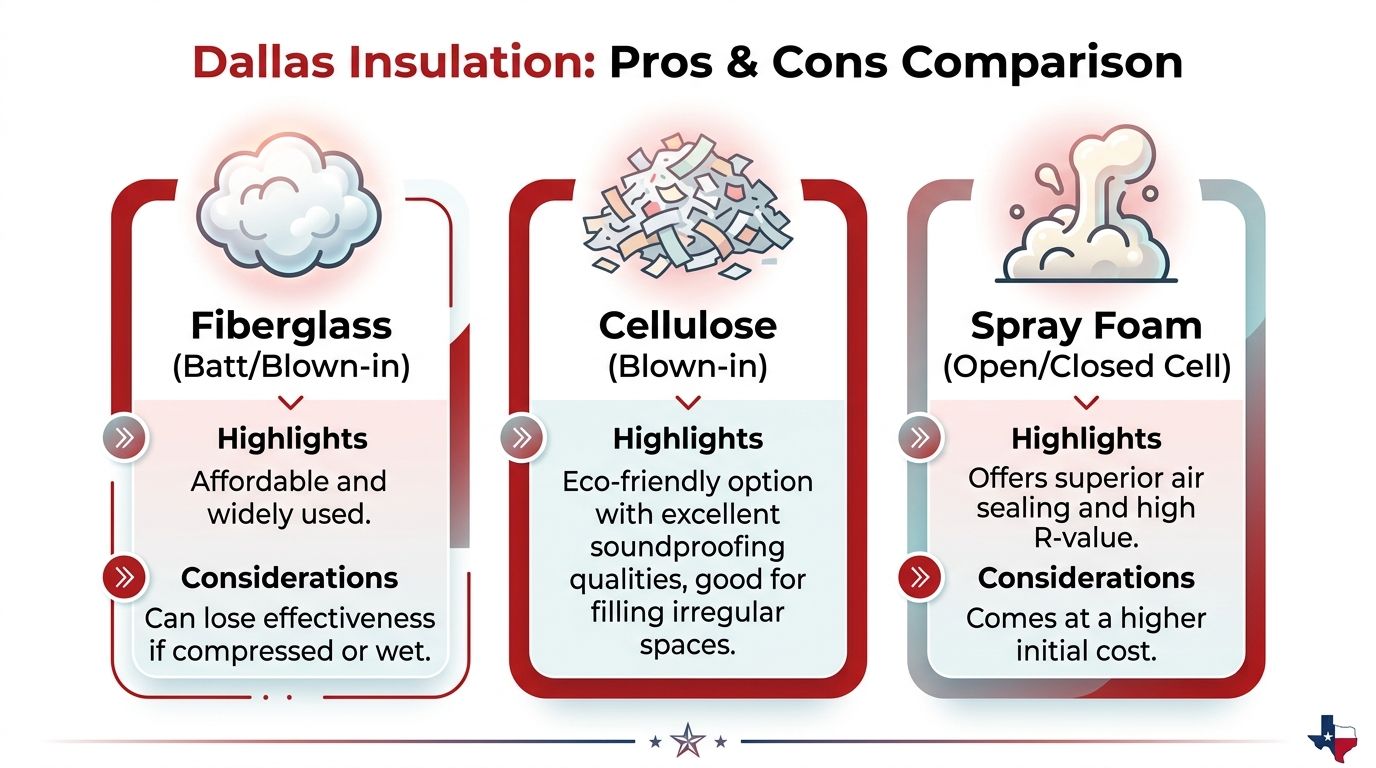
Blown-in fiberglass
Blown-in fiberglass is the workhorse option in a lot of Dallas attics. It is common for a reason. It installs relatively quickly, works well for topping off existing insulation, and spreads into irregular attic floor spaces better than batt insulation in many retrofit jobs.
For homeowners who want a practical upgrade without jumping to the highest material cost, this is often the starting point.
What it does well
- Covers broad attic floors efficiently: It is useful when the attic has many framing interruptions, wiring runs, and small voids.
- Keeps retrofit work straightforward: In many homes, crews can add it over suitable existing material after prep work and air sealing.
- Fits common vented attic setups: That makes it a familiar solution for many Dallas houses.
Where it falls short
It does not air seal by itself. If the attic has a lot of leakage around penetrations, fiberglass alone will not solve the draft path. It also loses effectiveness if it gets compressed or disturbed.
From a contractor's perspective, blown-in fiberglass makes the most sense when the attic floor is the right place to insulate and the roof deck is staying vented. It is less impressive when the problem is uncontrolled air movement.
Cellulose
Cellulose is another blown product, and it fills attic floor cavities and irregular areas well. Homeowners often like it because it settles into gaps more tightly than batts and can be a good fit for older homes with awkward attic layouts.
In practical terms, cellulose tends to be chosen by people who want a dense loose-fill material for a vented attic floor.
Where cellulose can be a strong fit
Cellulose can work well in homes with lots of little bypasses and framing oddities because it packs around them better than some alternatives. It is also a reasonable option when sound control matters and the house has existing insulation conditions that favor a loose-fill top-up strategy.
The trade-offs to think about
Moisture management matters. Any loose-fill product in a humid climate depends on the attic staying dry and ventilating as intended. If a roof has active leaks, poor flashing, or storm-related vulnerabilities, insulation choice becomes secondary. Fix the roof problem first.
That is where roofing experience matters. A contractor looking only at insulation may recommend adding material without fully evaluating whether the roof assembly is allowing water intrusion after hail or wind events.
Closed-cell spray foam
Spray foam changes the conversation because it is not just insulation. It is also an air-sealing strategy when installed correctly.
According to this Dallas spray foam overview, closed-cell spray foam delivers R-6 to R-7 per inch, compared with R-2.2 to R-2.9 per inch for traditional fiberglass, and it helps control infiltration that can account for 30-40% of energy loss in unconditioned spaces.
That performance difference is why spray foam gets attention in older Dallas homes with drafty attic conditions, irregular framing, and hard-to-seal roofline details.
When spray foam earns its price
Closed-cell spray foam is usually the premium option, and there is a reason for that. It can seal cracks, bond to irregular surfaces, and create a more continuous thermal layer in places where loose-fill materials are not enough.
It often makes sense in homes with:
- Complex rooflines: Valleys, low-clearance sections, knee walls, and hard-to-reach areas.
- Persistent air leakage issues: Especially in older homes where multiple small gaps add up.
- Roofing projects that expose opportunities: If major exterior work is already happening, it may be the right time to rethink the attic strategy.
Where spray foam is not the automatic answer
Spray foam is not a magic product. It costs more. It requires a skilled installer. It changes how the attic assembly behaves, so the roofing and ventilation details have to be considered carefully.
If a homeowner just needs to bring a straightforward vented attic floor up to a better insulation level, blown-in material may be the cleaner value. If the roof deck has moisture issues or the contractor does not understand the interaction between foam, ventilation, and roof assemblies, a premium product can still lead to poor results.
The best insulation is the one that fits the roof design, the moisture conditions, and the home's leakage pattern. The most expensive option is not always the smartest one.
A simple decision view
| Material | Best fit | Main advantage | Main caution |
|---|---|---|---|
| Blown-in fiberglass | Standard vented attic floors | Cost-conscious upgrade path | Does not air seal on its own |
| Cellulose | Older attics with irregular floor cavities | Good coverage in uneven spaces | Needs dry, well-managed attic conditions |
| Closed-cell spray foam | Complex or leaky attics | High R-value per inch plus air sealing | Higher cost and installation sensitivity |
The right call depends on whether the attic problem is mostly low insulation depth, air leakage, roofline complexity, or a combination of all three.
How Much Dallas Attic Insulation Costs and What Is the Payback
Homeowners usually ask the cost question in the first few minutes, and that is fair. Insulation is not a cosmetic upgrade. You do not see it every day, so the spending has to make sense.
In Dallas, professional blown-in attic insulation averages $1,384, with a typical range of $797 to $2,017. That same source states a typical ROI of 3-7 years through 20-30% reductions in energy bills.

Why the price moves around
Two houses on the same street can price differently. Attic insulation is not just a square-foot calculation. Contractors have to account for what they are walking into.
A few factors usually shape the final number:
- Attic size and layout: Wide open attic floors install differently than chopped-up spaces with low clearances.
- Material choice: Blown-in products and spray foam live in different price categories.
- Target insulation level: Reaching a stronger performance target takes more material and labor.
- Preparation work: Old damaged insulation, air sealing needs, or access issues can change the scope.
- Roof timing: If insulation is coordinated with roofing work, some logistics get easier.
Cost should be judged against the problem it solves
A lot of Dallas homeowners compare insulation quotes the way they compare paint prices. That usually leads to the wrong decision. The better comparison is this: what is the house doing right now that costs money every month and still leaves rooms uncomfortable?
If the attic is letting heat load the ceiling all afternoon, the HVAC system pays for that first. Then you do.
That is why payback matters more than sticker shock. When an upgrade improves comfort and lowers waste at the same time, it behaves more like a performance investment than a one-time repair.
If your AC runs hard and the house still has hot zones, the true cost is not just the insulation quote. It is the ongoing penalty of leaving the attic underperforming.
A quick explainer can help frame how homeowners think about insulation value:
The roofing tie-in that affects value
If a roof is being repaired or replaced after hail, that is often the best time to talk insulation. The house is already under evaluation. The contractor can look at decking condition, ventilation paths, penetrations, and moisture signs with fresh eyes.
That coordination matters because attic upgrades deliver the best value when the roof assembly above them is sound. A cheaper insulation job under a compromised roof is not a bargain. It is just delayed frustration.
Signs You Need New Insulation and What an Inspection Covers
Most homeowners do not go into the attic unless they have to. That is why insulation problems can sit for years before anyone connects the dots.
The odds are high that an older house needs attention. About 90% of Dallas-area homes are under-insulated, especially in neighborhoods with homes built 30 to 60 years ago and attics that still have only three to four inches of insulation, far below the modern R-38 target, according to this Dallas under-insulation report.
What you can notice before calling anyone
You do not need special tools to spot many warning signs. The house usually tells on itself.
- Rooms that drift uncomfortable by late afternoon: Especially upstairs or on the west side.
- A thermostat setting that never seems to satisfy the whole house: Some areas feel fine, others lag behind.
- Dusty, thin, or uneven insulation in the attic: If you can see joists too easily, coverage may be lacking.
- Insulation that looks matted or dirty: That can point to age, disturbance, air movement, or prior moisture issues.
- An attic hatch that feels hot and leaky: Access points are common weak spots.
Not every symptom means insulation alone is the culprit. Duct leakage, weak ventilation, and roof issues can mimic insulation problems. That is why inspection matters.
What a professional inspection should cover
A proper attic inspection is not just someone shining a flashlight around and saying you need more insulation. It should look at the attic as a system.
A solid inspection usually includes:
Current insulation depth and coverage
The inspector checks whether the material is evenly distributed and whether bare or thin spots exist around edges, penetrations, and access points.
Air leakage points
Gaps around can lights, plumbing penetrations, top plates, duct boots, and attic stairs can undermine an otherwise decent insulation layer.
Moisture or roof-related concerns
Water staining, damp insulation, and signs of previous leaks can point back to flashing failures, storm damage, or roof wear.
Ventilation conditions
Intake and exhaust have to work with the insulation plan, not against it.
If you are already evaluating the exterior, it helps to connect the attic findings with the roof condition. A roof inspection in Dallas can uncover whether the insulation issue is purely thermal or tied to storm wear, decking problems, or ventilation defects above it.
If an attic inspection skips roof condition and moisture signs, it is incomplete in North Texas.
What works and what does not
Adding insulation over active leaks does not work. Throwing more material onto badly compressed, contaminated, or poorly sealed conditions rarely works either. The homes that improve the most are the ones where the contractor identifies the core failure points first, then installs the right fix in the right order.
DIY vs Professional Installation A Texas Homeowners Guide
DIY attic insulation sounds simple from the driveway. Buy material, rent a blower, add more insulation, save labor. In a perfectly clean, open attic with no air sealing issues and easy access, that idea can look tempting.
Real Dallas attics are usually not that cooperative.
Where DIY can go sideways
Attics in North Texas are cramped, hot, dusty, and full of details that matter. Homeowners often focus on material depth and miss the parts that determine performance.
Common DIY mistakes include uneven coverage, blocked ventilation paths, buried fixtures that should be handled carefully, and skipped air sealing around penetrations. Another problem is judgment. Many homeowners do not know whether the existing insulation should stay, be topped off, or be removed in problem areas before new material goes in.
There is also the safety side. Attic framing is not forgiving. Missteps around wiring, recessed lights, and low-visibility walk paths turn a budget project into a bad afternoon quickly.
What professionals do differently
Professional crews do more than install material. They assess the attic condition, choose the right application method, and work toward the intended thermal result rather than just adding volume.
That matters because good insulation is not measured only by how much material was bought. It is measured by whether the house performs better afterward.
A pro is also more likely to flag related exterior issues. If the attic shows signs that roof drainage is part of the problem, it makes sense to address the whole water-shedding system, including components such as rain gutters in Dallas TX, instead of treating insulation like an isolated patch.
The practical verdict
DIY can make sense for very limited situations. Think small touch-up work by someone who understands attic safety and knows exactly what the house needs.
For most homeowners, professional installation is the better move because it improves the odds of getting all the important parts right:
- Correct material for the attic type
- Consistent depth and coverage
- Code-aware installation
- Attention to air leakage and moisture clues
- Safer work in a difficult environment
If the goal is real dallas attic insulation performance, not just a weekend project, professional installation is usually the smarter path.
Your Checklist for Selecting a Dallas Insulation Contractor
A good contractor should make the decision easier, not murkier. If the quote is vague, the inspection is rushed, or the crew cannot explain how the insulation plan relates to the roof and ventilation, keep looking.
Questions worth asking before you sign
Start with the basics, then push deeper.
Are you insured and experienced with Dallas-area attic work
Local experience matters because North Texas homes deal with heat, hail, and humidity at the same time.
How do you evaluate the roof and attic together
A contractor should be able to explain how leaks, decking condition, ventilation, and insulation interact.
What material do you recommend for my attic, and why
The answer should be specific to your house, not a canned pitch for one product.
Will you inspect for moisture, air leakage, and ventilation issues before installing
If not, the recommendation may be too shallow to trust.
What separates a strong bid from a weak one
A strong proposal usually includes a clear scope, notes on prep work, a defined material plan, and a reason for the recommendation. A weak one leans on generic promises and avoids details.
Look for contractors who can also think beyond one trade. In Dallas, insulation upgrades often overlap with roofing, gutters, siding, or storm restoration. If you are comparing providers, it helps to review what a qualified roofing contractor near me should already understand about exterior systems, code compliance, and weather-related damage.
The best contractor is not the one with the fastest quote. It is the one who can explain the house as a system and back the recommendation with a clear scope.
A short vetting list
| Check | Why it matters |
|---|---|
| Detailed attic inspection | Prevents one-size-fits-all recommendations |
| Roof and moisture awareness | Avoids covering up storm or leak issues |
| Clear material rationale | Shows the bid is specific to your home |
| Written scope and cleanup plan | Reduces surprises during the job |
| Familiarity with local code | Helps the finished work perform as intended |
A contractor does not need the flashiest presentation. They do need a disciplined process.
Frequently Asked Questions About DFW Attic Insulation
Do I need to remove old insulation before adding new insulation
Usually, no. In many attics, crews can add new material over existing insulation if the old layer is dry, reasonably clean, and not badly compacted or contaminated. Removal becomes more likely when there has been roof leakage, pest activity, heavy dirt from air movement, or material damage that would undermine the new installation.
Is insulation the same thing as a radiant barrier
No. They solve different parts of the heat problem. Insulation slows heat flow. A radiant barrier reflects radiant heat from the roof side. In some Dallas homes, they can complement each other, but one does not replace the other.
Will new insulation fix every comfort problem in the house
No. It can make a major difference, but some homes also have duct issues, air leaks, aging HVAC equipment, or room-specific design challenges. A good contractor should say that plainly instead of promising a cure-all.
Is attic insulation worth doing during a roof replacement
Often, yes. If the roof is already under review because of age or hail damage, that is a practical time to look at the whole assembly. It is easier to catch ventilation issues, moisture concerns, and system mismatches when the roof and attic are considered together.
Can I just add more insulation and ignore attic leaks
No. Insulation should not be used to bury a roof problem. If water is getting in, fix the source first. Wet or damaged insulation does not perform the way it should, and it can hide bigger issues if nobody addresses the cause.
If your home has stubborn hot rooms, long AC run times, or an attic that has not been checked in years, Hail King Professionals can help you evaluate the full picture. Their team understands how roofing, storm damage, ventilation, and attic performance work together in North Texas, so you can make a smart decision that protects comfort, durability, and long-term value.