

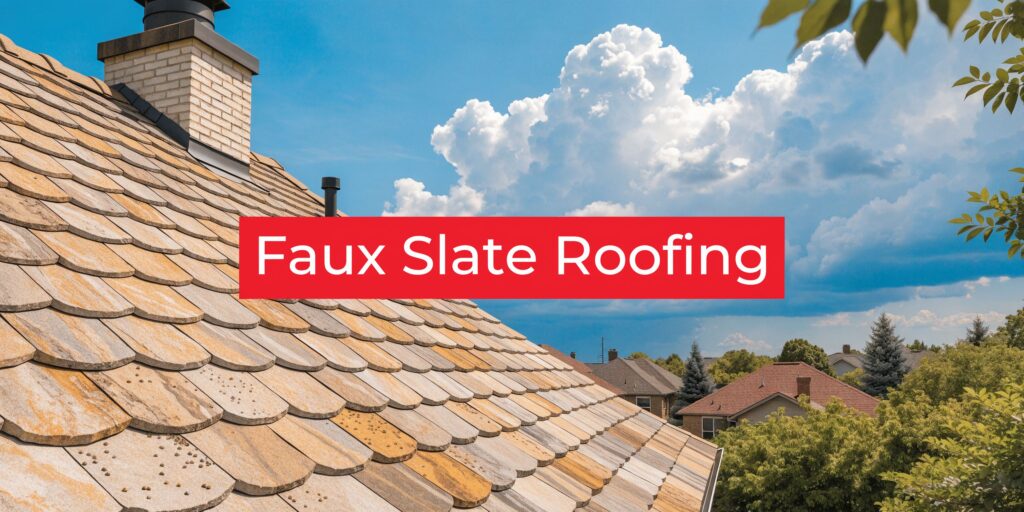
Faux Slate Roofing Tiles A Texas Homeowner’s Guide
The storm has passed. The yard is littered with small branches, the patio furniture is sideways, and now you are standing in the driveway staring at a roof that may or may not have made it through another Texas beating.
For a lot of homeowners in Dallas-Fort Worth and East Texas, that moment leads to the same question. If you are replacing the roof anyway, should you step up to something better looking and tougher than standard shingles without taking on the cost and structural burden of real slate?
That is where faux slate roofing tiles enter the conversation. They promise the look of slate, less weight, and in the better product lines, serious hail resistance. But this category has history, and not all products in it deserve the same level of trust. In Texas, that difference matters.
Is Faux Slate the Right Choice for Your Texas Roof
A homeowner usually does not start by asking for faux slate. They start by saying something more practical.
They want a roof that looks better than asphalt. They do not want the house framed for stone. They want something that can stand up to hail, heat, and wind without turning the next storm into another insurance headache.
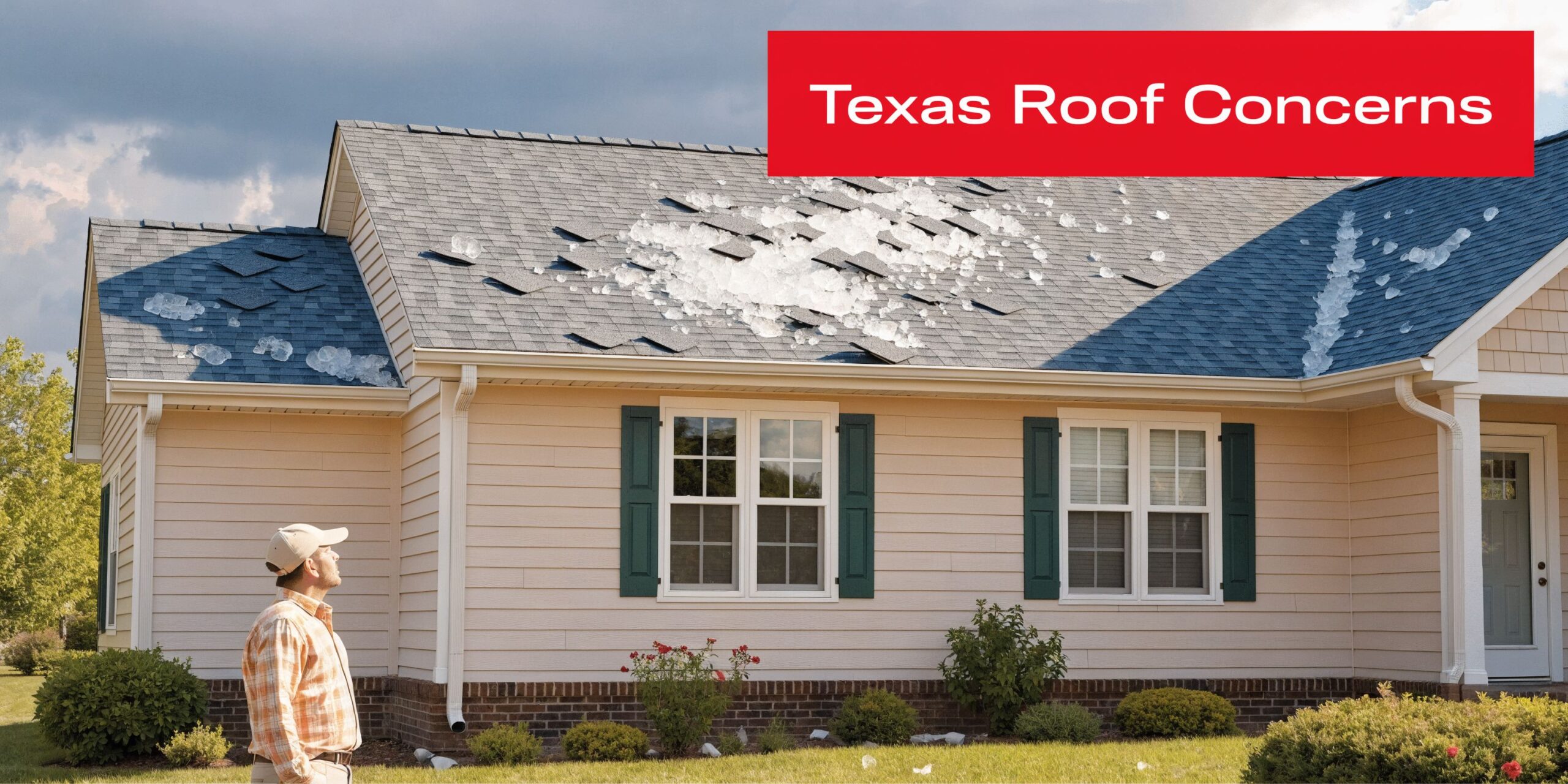
This is the segment where faux slate fits. It sits between luxury and practicality. If natural slate is the benchmark for beauty and lifespan, faux slate is the option many Texas homes can carry and justify.
When faux slate makes sense
For the right property, faux slate solves several problems at once:
- You want slate curb appeal: A good composite tile gives a steep roofline a custom look that asphalt cannot match.
- Your home was not built for stone: Natural slate is heavy. Many existing Texas homes are not set up for that load without structural work.
- Storm performance matters: In hail country, appearance alone is not enough. The product has to survive impact and still protect the house.
- You plan to stay put: Faux slate usually makes more sense for owners thinking beyond the next few years.
When it may not be the best fit
It is not the automatic answer for every roof.
A simple ranch with a tight replacement budget may be better served by a high-quality architectural shingle or metal system. A homeowner chasing the absolute longest service life, and willing to pay for structure and specialty labor, may still be better off with natural slate.
Texas reality check: A roofing upgrade has to be judged by what happens after hail, heat, and contractor foot traffic. Brochure looks do not keep water out.
The right question is not “Is faux slate good?” The right question is “Which faux slate product, installed how, on what house, in what part of Texas?” That is where good decisions get made.
What Exactly Are Faux Slate Roofing Tiles
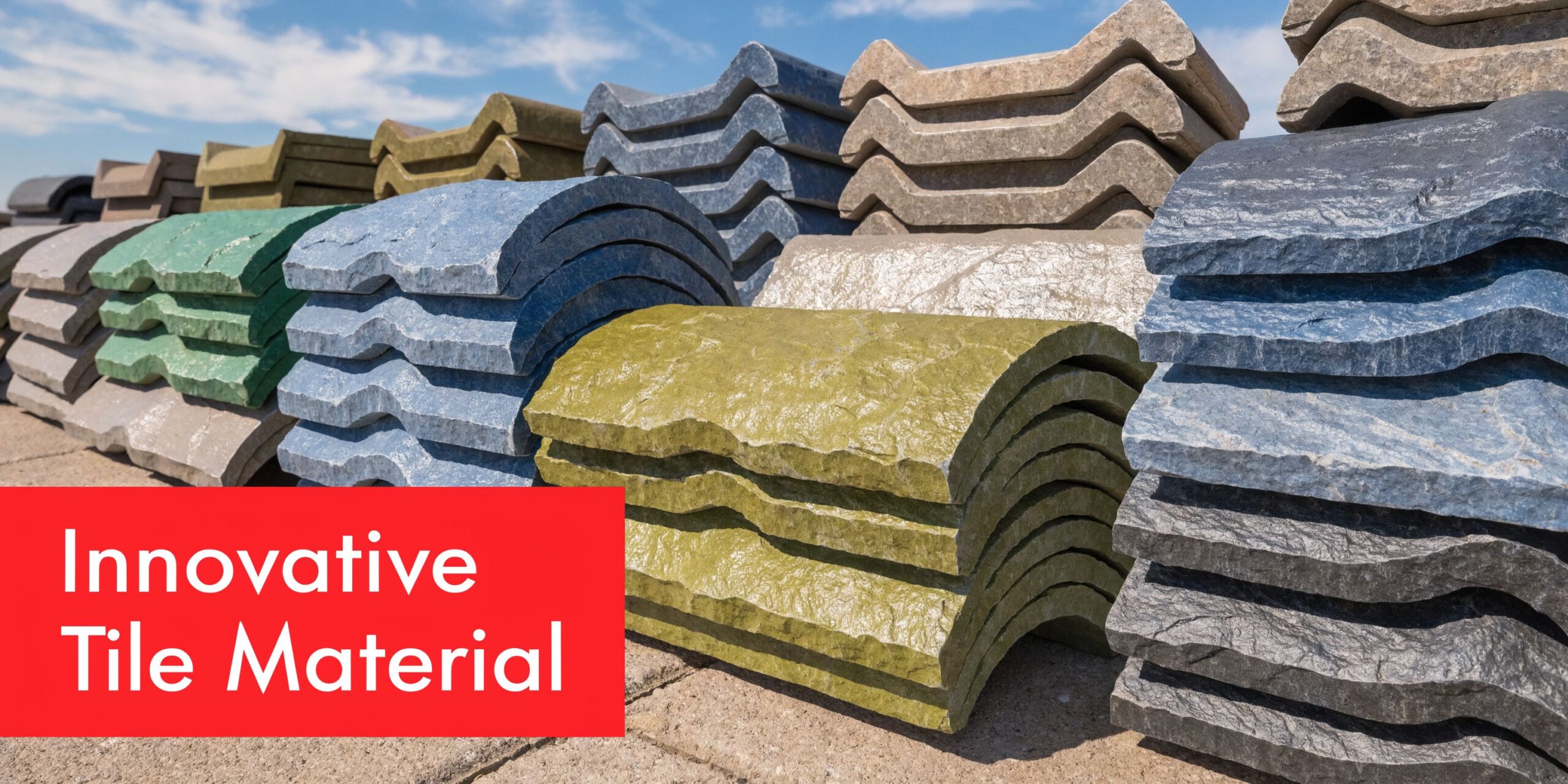
Modern faux slate roofing tiles are manufactured roofing pieces designed to imitate the shape, texture, shadow lines, and color variation of real slate. Most current products are made from blends of polymers, rubber, and composite materials rather than stone.
They are molded to look hand-split because that is what homeowners want from a slate roof. The good ones avoid the flat, plastic look that gave early synthetics a bad name.
What they are made to do
A modern faux slate tile is trying to combine several traits in one product:
- Slate appearance: Texture, thickness lines, and color blends that read like stone from the street
- Lower roof load: Enough visual depth without the dead weight of real slate
- Impact tolerance: Flex and energy absorption that stone cannot provide
- Easier handling: Less breakage in shipping, staging, and installation than fragile tile products
That design goal is one reason the category remains attractive in Texas. Homeowners want upscale appearance, but they also need a material that can live in a climate that punishes brittle roofing.
Why older faux slate products developed a bad reputation
This part matters because many homeowners have heard two opposite things. One person says synthetic slate is the future. Another says it failed badly in the past. Both can be true, depending on the product generation.
Before the 1980s, artificial slate was mostly made from asbestos-cement. Those products had a long record of durability in harsh weather. After asbestos was prohibited in the early 1980s, manufacturers rushed fiber-reinforced cement replacements to market, often without long-term weathering studies despite advertised lifespans of 30 to 50 years. Those products saw widespread failures in the early 1990s, including cracking, breaking, and blotchy color variation, as documented by the Vermont Slate Company’s history of artificial slate products (https://vermontslateco.com/artificial-slate-and-shake-products-history/).
That history is why experienced roofers do not lump all faux slate products together.
Why the current generation is different
Most of the better faux slate options on the market now are not those old fiber-cement products. They are composite systems built around flexible materials that handle movement and impact far better.
A quick product overview helps show what homeowners are looking at in the field:
That does not mean every current product is excellent. It means you should judge today’s faux slate by its composition, testing, installation requirements, and manufacturer track record, not by the failures of an earlier era alone.
What to ask a contractor: Is this tile a modern composite or a cement-based imitation product? That answer changes the whole conversation.
Comparing Faux Slate with Natural Slate Asphalt and Metal
Most Texas homeowners choosing a replacement roof are not deciding between one product and nothing. They are deciding between faux slate, natural slate, asphalt shingles, and metal roofing.
Those are not equal materials. Each one solves a different problem.
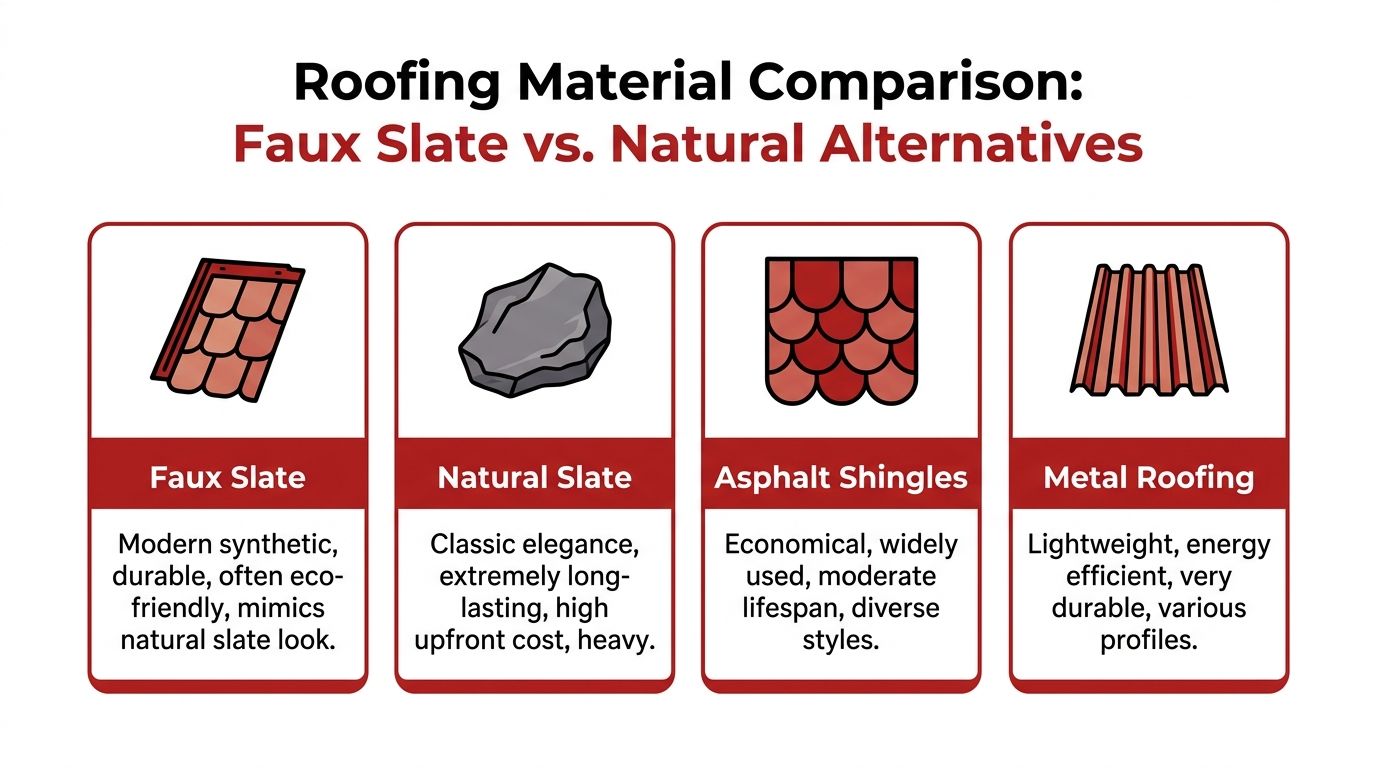
The big picture
Natural slate remains the benchmark because it has the longest proven service life and the most authentic appearance. The National Park Service notes that synthetics typically carry 30 to 50 year warranties, while natural slate has a proven durability range of 100 to 150+ years, with averages exceeding 80 years and some installations lasting centuries (https://www.nps.gov/articles/should-i-replace-my-slate-roof-with-a-synthetic.htm).
That sounds like an easy win for real slate until a homeowner looks at structure, labor, and replacement practicality in Texas. Faux slate exists because many homes want the look of slate without rebuilding the roof framing or paying for a specialty stone installation.
Asphalt remains the default because it is familiar and widely available. Metal stays in the conversation because it is lightweight, durable, and attractive in the right architectural style. But neither one gives the same visual effect as slate.
For more perspective on how long stone systems can perform when properly selected and maintained, this overview of slate roof longevity is useful background.
Roofing Material Comparison at a Glance
| Material | Typical Lifespan | Avg. Installed Cost | Weight | Hail Resistance |
|---|---|---|---|---|
| Faux slate | Often warranted 30 to 50 years in synthetic products, based on National Park Service guidance linked above | Higher than standard asphalt, usually below natural slate | Moderate and generally lighter than natural slate | Can be excellent in premium products |
| Natural slate | Proven 100 to 150+ year durability, with averages exceeding 80 years, per the National Park Service source above | Highest upfront cost | Heavy | Strong, but product and thickness matter |
| Asphalt shingles | Varies by product line and installation quality | Usually the lowest upfront cost among these four | Light to moderate | Varies widely |
| Metal roofing | Long-lived when properly installed | Mid to high upfront cost depending on profile and system | Lightweight | Usually performs well, but dents can be a concern in some systems |
Faux slate versus natural slate
This is a trade between authenticity and practicality.
Natural slate is quarried stone. It has depth, edge variation, and a look that molded products still chase. It is also a specialty roof. It takes a structure that can carry it and installers who know what they are doing. On the right historic or high-end home, there is nothing else like it.
Faux slate gets you much closer to that appearance than asphalt or most metal profiles. It also avoids the weight problem that stops many natural slate reroofs before they start.
If a homeowner tells me they want the “slate look” on a standard Texas house, faux slate is usually the realistic path. If they tell me they want the “real thing” and they are prepared for the weight, labor, and budget involved, that is a different conversation.
Faux slate versus asphalt shingles
This comparison is usually about appearance and holding period.
Architectural asphalt shingles remain a solid choice for many houses. They are easier on the budget, simpler to source, and familiar to most crews. If you need a clean, dependable replacement and resale timing is short, asphalt often wins on practicality.
Faux slate steps in when the homeowner wants a premium visual upgrade and is willing to pay more upfront to get it. It can also make sense for homes where standard shingles would undersell the architecture.
The mistake is comparing faux slate to bargain asphalt only on initial invoice price. They serve different ownership goals.
Faux slate versus metal roofing
Metal is one of the strongest alternatives to faux slate in Texas because it is light, durable, and often very effective in storm country.
Still, the visual style is different. Standing seam metal looks crisp and modern. Faux slate looks traditional, textured, and more at home on certain brick, stone, colonial, Tudor, and high-pitch designs.
The deciding factor often comes down to this:
- Choose faux slate if architectural character is driving the project.
- Choose metal if you want a lighter, cleaner-lined roof system and prefer that look.
Best use case for faux slate: Homes where appearance matters enough to rule out asphalt, but weight and cost rule out real slate.
How Faux Slate Handles Texas Hail Heat and Wind
Texas does not test roofs gently. It tests them all at once.
A roof in Dallas-Fort Worth or East Texas may face hail impact, long stretches of heat, hard UV exposure, and wind-driven rain in the same season. That is why faux slate has to be evaluated as a storm material, not just a style upgrade.
Hail performance is where premium faux slate can separate itself
The best-known benchmark here is UL 2218 Class 4, which is the highest impact-resistance rating used in roofing discussions. For example, Brava composite slate achieved UL 2218 Class 4 impact resistance by withstanding impacts from a 2-inch steel ball weighing 1.2 lbs dropped twice from 20 ft at two different sample locations without cracking, splitting, or other failure, according to product documentation published through ARCAT (https://www.arcat.com/sdspecs/htm04/07_31_00bra.htm).
That matters in practical homeowner terms. A tile that can take that kind of lab impact has a better shot at coming through hail without immediate fracture.
For homeowners sorting through material options after a storm, this guide to hail-resistant roofing materials is a helpful companion because it puts impact ratings into plain-English context.
Heat and UV matter just as much in Texas
Hail gets the headlines. Sun does more slow damage.
In a Texas summer, the roof surface absorbs relentless heat. That can expose weak materials fast. Lower-end products may dry out, distort, lose color consistency, or become brittle over time. Better composite faux slate products are designed to handle UV exposure and temperature swings without losing their core performance characteristics as quickly.
That does not mean every synthetic tile behaves the same way. It means the material chemistry matters. A roof that looks good on a sample board can perform very differently after years of hot weather.
Wind performance depends on the roof system, not just the tile
Homeowners sometimes focus so hard on the tile itself that they forget the assembly.
Wind resistance is tied to fastening, layout, underlayment, starter details, edge treatment, and how well the system is installed around hips, ridges, valleys, and penetrations. A premium faux slate product can still have a bad outcome if the installer treats it like commodity shingles.
Here is the practical view:
- Good product, weak install: You can still get lifted pieces, exposed fasteners, and water intrusion.
- Good product, correct install: The system has a much better chance of holding together under Texas storm pressure.
- Wrong product for the roof design: Even a reputable tile can struggle if roof pitch, deck condition, or accessory details are ignored.
Insurance angle: In Texas markets where carriers recognize impact-resistant roofing, a documented Class 4 product can support premium discounts. The exact savings depend on the carrier and policy, so ask before the contract is signed.
The takeaway is simple. Faux slate can perform well in hail country, but only if you choose a product with real impact testing and pair it with a crew that knows how to install composite roofing correctly.
Analyzing the True Cost of Faux Slate Roofing
Most homeowners see faux slate priced next to asphalt and immediately feel the jump. That reaction is fair. Faux slate is not a budget roof.
The mistake is stopping the analysis there.
Upfront price is only one part of the job
A roof replacement has layers of cost that do not always show up in a quick quote comparison:
- Material quality
- Installation complexity
- Waste from handling damage
- Future repair frequency
- Whether the house needs structural changes
- How soon the roof may need to be replaced again
That is where faux slate can either make sense or become a bad buy.
Cheap imitation slate can become expensive fast
A roofer with field experience noted that fiber cement artificial slates are often cheap and flimsy, with high breakage during handling and installation, and that they crack easily when walked on. The same source also notes that while premium synthetics can offer strong impact resistance, lower-cost options may warp from temperature cycles or fail prematurely (https://www.youtube.com/watch?v=6hgVHAOOJec).
That is a real-world cost issue, not just a product preference issue.
If installers are breaking pieces while unloading, staging, cutting, or walking the roof, waste goes up. If repairs later require careful matching or repeated service calls, ownership cost climbs again. A lower bid can stop looking cheap in a hurry.
Where faux slate can save money compared with natural slate
This is one of the most important financial advantages of faux slate. It gives a homeowner a slate-style roof without the same structural burden as stone.
That matters on reroofs. If the house would need reframing or reinforcement to carry natural slate, faux slate may avoid a major hidden cost before the first tile is even installed.
Think in ownership terms, not invoice terms
A better way to judge faux slate is to ask:
- How long do I expect to own this home
- How much do I care about curb appeal
- Am I trying to avoid another hail-driven replacement cycle
- Is my house a good candidate for premium materials
- Am I comparing premium faux slate to premium alternatives, or just to the cheapest roof available
If you are staying in the house and want a roof that upgrades both appearance and storm readiness, the higher upfront cost can be rational. If you are selling soon or keeping the project lean, the math may point elsewhere.
Practical buying rule: Do not shop faux slate by square-foot price alone. Shop it by product quality, breakage risk, storm rating, and the skill of the installer.
Good faux slate is not cheap. Bad faux slate can be costly anyway. Those are two different problems, and homeowners need to avoid both.
Key Installation and Maintenance Considerations
A faux slate roof is only as good as the system under it and the crew installing it. Homeowners often spend weeks comparing product brochures and very little time asking how the roof will be built.
That is backwards.
Installation details decide whether the roof performs
Composite slate has its own fastening patterns, layout rules, accessory requirements, and handling standards. A contractor who mainly installs basic shingles may not automatically understand those details.
The hidden work matters most:
- Deck condition: A premium tile should not go over a weak or uneven substrate.
- Underlayment choice: The underlayment has to match the roof design, climate, and tile system. Homeowners who want a clearer sense of what sits beneath the visible roof can read this guide on roof underlayment.
- Edge metal and water control: Eaves and transitions need to move water cleanly into the gutter system. If you want a straightforward explanation of what a gutter apron does at the roof edge, that resource is worth a look before your project starts.
- Ventilation: Texas heat can punish an under-ventilated attic. Roof life, attic comfort, and moisture behavior all tie back to ventilation.
Low-slope and specialty applications need extra scrutiny
Not every faux slate roof is a standard steep-slope residential project.
Since May 2019, products such as Britmet’s LiteSlate have been marketed with 94% recycled polymers and installation on pitches as low as 12°, which makes them relevant for certain low-pitch or commercial applications (https://www.roofstoreppltd.com/products/liteslate-low-pitch-synthetic-roof-slate-slate-grey).
That does not mean every low-slope roof is a good candidate. It means some products are expanding where faux slate can be used, provided the contractor follows the exact system requirements.
Solar changes the reroof conversation
A growing number of Texas homes now have rooftop solar, and that adds another layer of planning. Detach-and-reset work needs to be coordinated carefully so reroofing does not turn into panel damage, wiring issues, or delays.
Homeowners should ask direct questions:
- Who removes and reinstalls the panels
- Who is responsible if flashing details change
- How will roof penetrations be inspected before panels go back on
- Will the solar layout interfere with tile cuts, service access, or future repairs
Maintenance is lighter than many homeowners expect
One reason people like faux slate is that routine maintenance is generally simple. You are usually looking for displaced pieces, flashing wear, debris buildup in valleys, and any storm-related damage after severe weather.
Still, “low maintenance” does not mean “ignore it for decades.” Composite roofing should be inspected after major hail or wind events, especially in North and East Texas.
Best homeowner habit: After any serious storm, have the roof inspected before a small problem becomes interior damage or a claim dispute.
Making Your Final Roofing Decision
By the time most homeowners finish comparing roof materials, they are not looking for more opinions. They want a decision they can defend.
The cleanest way to get there is to match the roof to the house, the budget, and the way you plan to live in the property.
A simple decision checklist
If most of these statements fit your situation, faux slate is worth serious consideration:
- You want a higher-end look: Your home’s architecture deserves more visual depth than standard shingles.
- You need realistic weight: You like natural slate, but your house is not a natural-slate project.
- Storm performance matters: You live in hail country and want a product category with premium impact-rated options.
- You plan to keep the home: Long-term ownership makes it easier to justify paying more upfront for the right system.
- You are hiring for specialty experience: You understand that composite roofing is not a beginner install.
If most of these fit better, look harder at other materials:
- Tight budget and short ownership horizon: Asphalt may be the smarter move.
- You want the longest proven life and true stone: Natural slate remains the top end.
- You prefer a cleaner, more modern profile: Metal may align better with the house.
How to evaluate the roof after storm damage
Do not make the decision from the ground alone. Get a full inspection, ask what was damaged, and make sure the conversation covers decking, flashings, underlayment, ventilation, and accessories, not just the visible field material.
Many homeowners also want a clearer idea of how technology supports better documentation during inspections. If that interests you, this overview of drone roofing inspection software gives useful context for how contractors can capture roof conditions more clearly.
The final call
Faux slate roofing tiles are not a universal answer. They are a strong fit for a specific homeowner.
If you want the slate look, need lighter weight than stone, and care about impact resistance in Texas weather, premium faux slate deserves a place on your shortlist. If you shop carefully and insist on proper installation, it can be one of the most balanced upgrades available after storm damage.
If you want help sorting out storm damage, insurance paperwork, and whether faux slate is the right fit for your roof, Hail King Professionals can inspect the property, explain your options clearly, and build a replacement plan that matches Texas conditions instead of just selling you a product.