



Best Gutters for Heavy Rain: Your 2026 Guide
You hear the first hard drops on the roof, then the sky opens up. Within minutes, water is blasting off the eaves, the front flower beds are washing out, and one corner of the house looks like it has a waterfall running down the brick. That’s usually the moment homeowners stop thinking about gutters as trim and start seeing them for what they are: A drainage system.
In Dallas-Fort Worth and East Texas, that shift matters. These storms don’t test your gutters on a calm average day. They test them during sudden cloudbursts, hail, wind-driven debris, and the kind of runoff that exposes every weak point in the system at once.
The best gutters for heavy rain aren’t just bigger troughs nailed to the fascia. They’re part of a complete water-management setup that matches the roof, the slope, the downspouts, the hanger system, and the way water leaves the property. If one piece is undersized or poorly installed, the whole system shows it fast.
| System choice | Best fit for heavy rain | Main advantage | Main risk if chosen wrong |
|---|---|---|---|
| 5-inch sectional gutters | Mild to moderate rain on simple rooflines | Lower upfront cost | More likely to overflow or leak at joints |
| 6-inch continuous K-style gutters | Most DFW and East Texas homes | Strong water capacity and fewer leak points | Can still fail if pitch and downspouts are wrong |
| Half-round gutters | Historic or design-focused homes | Clean appearance and smooth interior | Lower capacity than K-style of equal width |
| Box gutters | Large homes and some commercial buildings | High-capacity drainage | Requires careful design and installation |
| Standard 2×3 downspouts | Smaller, lower-volume systems | Common and easy to source | Creates a bottleneck in heavy storms |
| Oversized 3×4 downspouts | Heavy-rain applications | Faster evacuation of water | Won’t help if gutter pitch is off |
Why Your Gutters Are Your Home's First Line of Defense
A failed gutter system rarely stays a gutter problem.
Overflow at the roof edge turns into stained brick, soaked soffits, rotted fascia, trenching around the foundation, and splashback against doors and window trim. On homes with steeper roof sections or major valleys, one bad runoff path can dump a surprising amount of water in the same spot every time it storms.
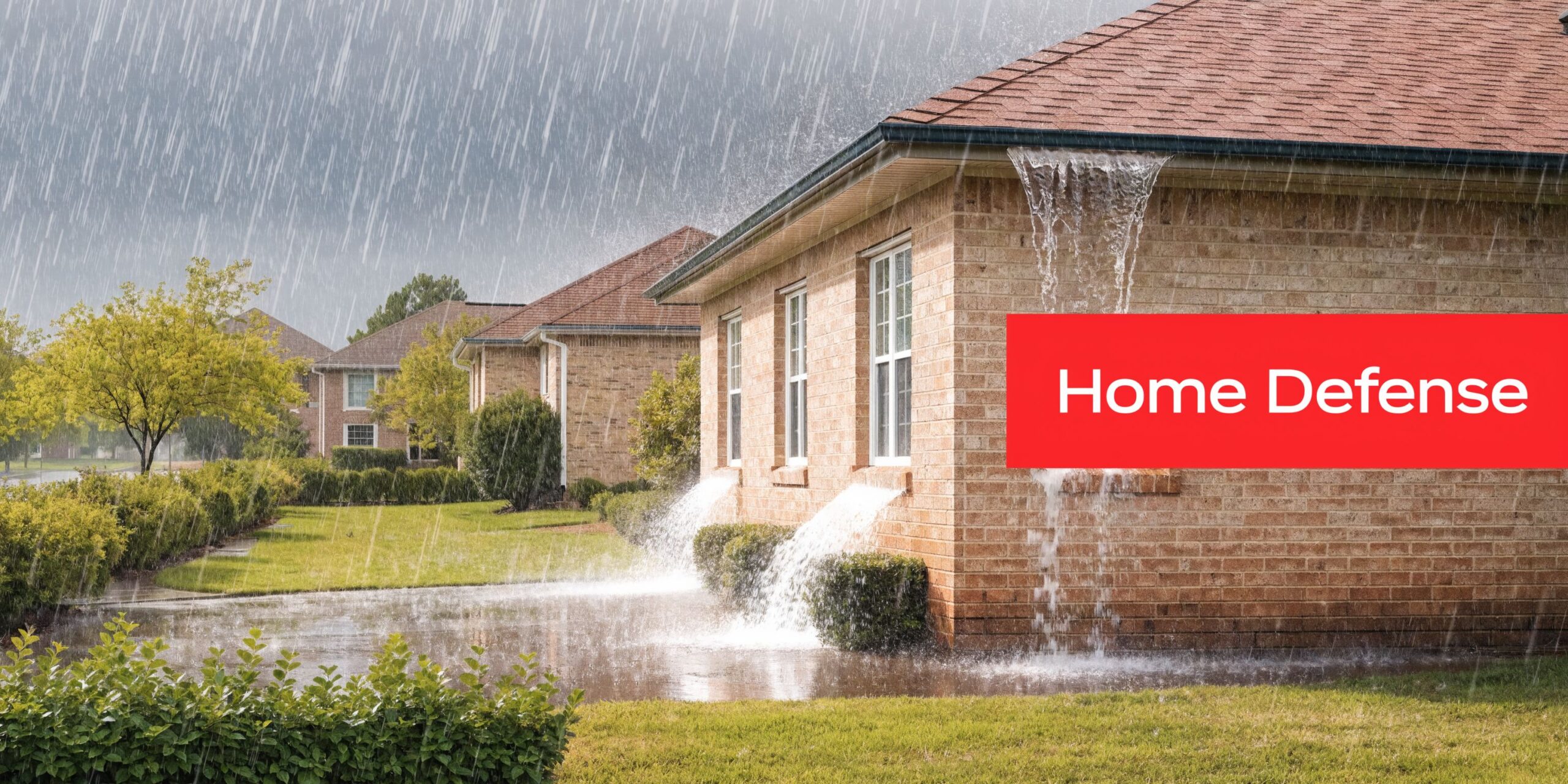
What heavy rain exposes fast
Texas weather doesn’t fail a weak system gently. It exposes bad pitch, undersized outlets, loose spikes, thin material, and clogged guard systems all at once.
The houses that stay dry usually have a gutter system designed for worst-case runoff, not average rainfall. That means thinking beyond color and curb appeal.
A lot of homeowners also ask whether they need gutters at all. In some situations, roof design, overhang depth, grading, and drainage layout can change the equation. If you want a broader look at alternatives to gutters, that resource is useful for understanding when another water-control approach may supplement or partially replace a traditional setup.
Gutters protect more than the edge of the roof. They protect the ground below it, which is usually where the expensive problems start.
Why cheap systems become expensive
The least expensive install often leaves out the parts that make a system survive a Texas storm. That usually means too few downspouts, weak attachment points, short splash discharge, or seams placed exactly where the water load is heaviest.
Homeowners who are still learning the basics of the system itself can get a solid primer from this overview of what a gutter is. The important point is simple. Gutters aren’t accessories. They’re infrastructure for the house.
If your roof sheds water faster than your gutters can collect and evacuate it, runoff will find its own route. It usually picks the wall, the foundation perimeter, or the lowest vulnerable corner of the property.
Gutter System Components Explained
Before choosing the best gutters for heavy rain, it helps to look at the system as a chain. Water hits the roof, enters the gutter, moves to the outlet, drops through the downspout, and exits away from the house. Failure at any step backs up everything upstream.
The gutter trough itself
The horizontal channel along the roof edge does the first job. It catches runoff before it sheets straight off the eaves.
Here, material, profile, and size matter most. A gutter can be made from aluminum, steel, copper, or vinyl. It can be shaped as K-style, half-round, or box. And it can be narrow, oversized, shallow, or deep.
Two gutters may look similar from the driveway and behave very differently in a storm.
Profiles you’ll hear contractors mention
K-style gutters are the standard on most modern homes. They have a flat back that mounts cleanly to the fascia and a shaped front that adds rigidity.
Half-round gutters are curved and often chosen for older architecture or a cleaner traditional look. They move water smoothly, but their shape usually gives up some capacity compared with K-style.
Box gutters are built for higher-volume drainage and are common on larger structures, some custom homes, and commercial work. They’re practical, not decorative.
Materials and what they change
Each material solves a different problem.
- Aluminum works well because it doesn’t rust, it’s light enough for residential fascia systems, and it’s available in many colors.
- Steel adds strength, which matters when debris loads get heavy or a long run needs more rigidity.
- Copper is a premium material chosen for long service life and appearance.
- Vinyl is easy to source and simple to install, but it’s usually the least forgiving choice when weather gets rough.
Downspouts perform the main evacuation
A gutter can collect a lot of water, but the downspout determines how fast the system can empty.
That’s where many installs come up short. A large trough feeding a small outlet is like a wide funnel with a pinched neck. Water stacks up, then spills over the front lip.
Practical rule: When a house has long runs, roof valleys, or steep sections, don’t judge the system by gutter size alone. Judge it by how quickly the downspouts can clear what the roof is dumping into it.
The pieces homeowners rarely think about
The small parts often decide whether the install lasts.
Those parts include:
- Hangers and brackets that keep the gutter attached under water load and debris weight
- End caps and outlets that need to stay watertight
- Seams or joints where sectional systems are most likely to leak
- Splash blocks or drain extensions that move discharge away from the foundation
- Proper pitch so water doesn’t sit in the run
A good system is balanced. Bigger gutters won’t rescue a bad slope. Better material won’t fix poor outlet placement. Fancy guards won’t help if the trough is undersized and the downspouts are choking the flow.
Comparing Gutter Materials and Profiles for Durability
A July storm in DFW can dump a lot of water on a roof in a hurry. Add hail, oak leaves, and the heat that bakes metal all afternoon, and the wrong gutter choice shows up fast at the fascia, soffits, and foundation.
Two decisions matter here. Material determines how well the gutter handles impact, expansion, corrosion, and years of service. Profile determines how efficiently it carries runoff during a hard storm.
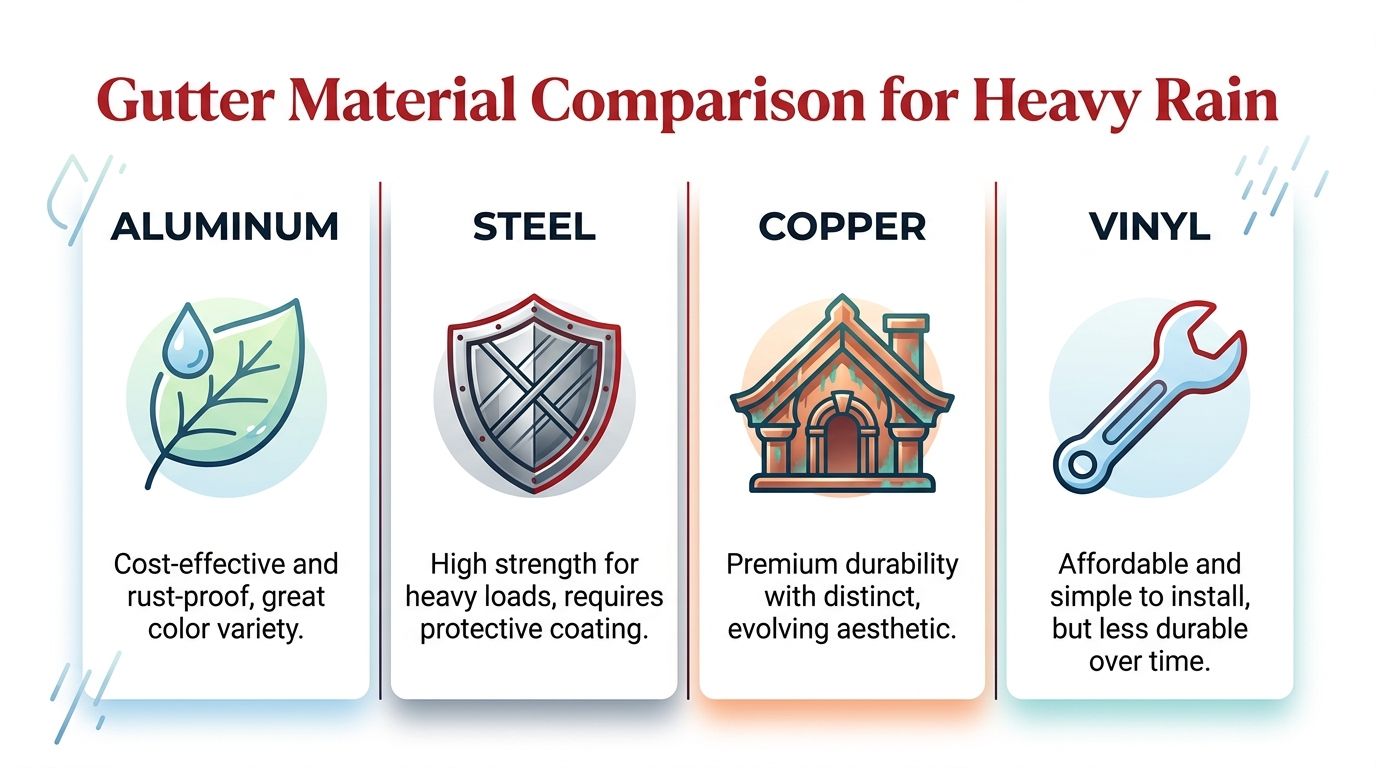
Gutter Material Comparison for Heavy Rain
| Material | Avg. Cost/Foot (Installed) | Lifespan | Pros | Cons |
|---|---|---|---|---|
| Aluminum | Varies by gauge, finish, and fabrication | Long service life with proper installation | Rust-proof, lightweight, wide color selection, strong residential value | Can dent from impact and can deform if poorly supported |
| Steel | Varies by coating and thickness | Long-lasting when protective finish is maintained | Strong, rigid, handles heavier loads well | Can rust if coating fails |
| Copper | Premium-priced option | Very long service life | Distinct look, durable, low-maintenance surface aging | High cost and specialized installation |
| Vinyl | Lower-cost option | Shorter service life in tough climates | Affordable, easy to replace, simple install | More prone to cracking, sagging, and heat-weather wear |
Aluminum fits most Texas homes best
For most homes I see in North Texas and East Texas, aluminum gutters formed on-site are still the smart baseline. It resists rust, comes in finishes that work with modern trim packages, and gives homeowners a practical balance of cost, service life, and repairability.
The big advantage is not just the metal itself. It is how the system is fabricated and installed. A properly formed continuous run has fewer joints to leak, fewer weak spots under debris load, and cleaner integration with updated roof systems. That matters on homes with Class 4 shingles, solar equipment, or fresh fascia wraps, where sloppy gutter work can undermine an otherwise strong exterior package.
Homeowners comparing options can also review this gutter installation guide for Texas homes to understand how material choice ties back to fabrication, hanger spacing, and outlet placement.
Steel works where strength matters more than maintenance simplicity
Steel earns consideration when the house puts more stress on the gutter body. Long runs, steep roof sections, heavy pine debris, and spots that collect wet leaf sludge can all justify a stiffer system.
That extra rigidity comes with a trade-off. Once the protective coating gets scratched or worn through, rust is no longer theoretical. It becomes a maintenance issue that needs attention before the gutter starts failing at seams, fasteners, or low spots.
On some homes, that trade-off is acceptable. On others, especially where the owner wants lower upkeep, aluminum is the cleaner answer.
Copper is a specialty choice
Copper performs well, but it is usually selected for appearance, historic fit, or a high-end custom build. It belongs on the right house with the right budget and an installer who knows how to detail it correctly.
For storm-driven value alone, copper is rarely the first recommendation. For a restoration project or a premium home where the exterior package is being built to last for decades, it can make sense.
Vinyl is the weak option for rough Texas weather
Vinyl can serve on light-duty applications and tight budgets. I do not recommend it for homes that have to stand up to heavy rain, hail exposure, falling limbs, and long periods of summer heat.
For heavy rain, hail exposure, and heat swings, vinyl is usually not the material I’d want protecting the house. It is more likely to get brittle, sag under load, and lose its shape over time. That is a poor match for the kind of storm cycles common across Dallas-Fort Worth and East Texas.
Profile changes performance more than homeowners expect
Material gets most of the attention, but profile often decides whether the gutter keeps up in a cloudburst.
K-style is the standard choice on Texas homes because it carries more water in a practical footprint and mounts cleanly against the fascia. That shape gives installers more capacity without pushing the gutter too far off the roof edge. On most suburban homes, that is the best mix of function and appearance.
Half-round gutters have their place. They look right on some historic, farmhouse, and custom designs, and they can perform well when sized properly. Their limitation is straightforward. They usually give you less water-handling margin for the same width, so the design needs to be deliberate.
Box gutters are a different category. They are better suited to large roof areas, concentrated drainage zones, and certain custom or commercial-style homes. They can move serious water, but only if the design, pitch, support, and discharge plan are handled correctly.
What I recommend on heavy-rain installs
If the goal is to bulletproof a house against Texas storms, I usually prioritize profile and system design first, then choose the material that fits the budget and maintenance expectations.
In plain terms, a well-installed K-style aluminum system will outperform a premium-looking gutter that is undersized, poorly supported, or mismatched to the roof’s runoff pattern. On homes with hail exposure, tree debris, solar, or upgraded roofing materials, the best result comes from treating gutters as part of the full water management system, not as a trim accessory.
Calculating Your Home's Gutter Capacity Needs
A North Texas thunderstorm can dump a roof load into one corner of the house in minutes. If that corner has a shallow gutter, one undersized downspout, and a valley feeding it, water will jump the front edge and start working on fascia, soffit, flower beds, and slab movement.
That is why gutter sizing starts with runoff, not with whatever is hanging on the house now.
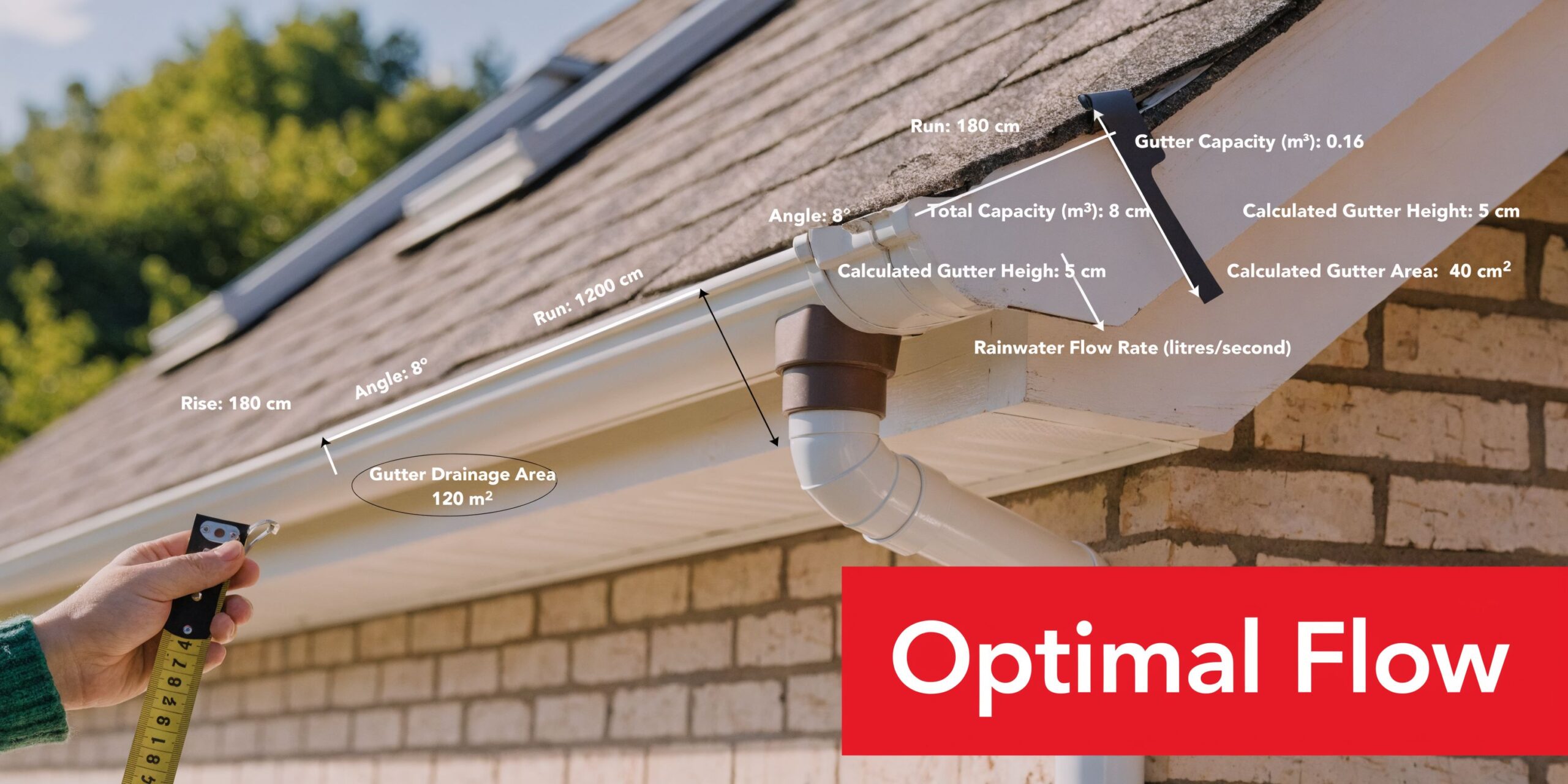
Start with the roof, not the old gutter
I see the same mistake on replacement jobs all the time. A crew copies the old layout, keeps the same outlet locations, and calls it an upgrade. If the original system overflowed during spring storms, duplicating it just preserves the failure.
Measure each roof section feeding each gutter run. Total house square footage does not tell you where the water piles up. Valleys, dormers, second-story drop-offs, steep pitches, and long uninterrupted runs matter more because they concentrate flow fast.
Use these checks before settling on size and layout:
- Measure the roof area draining to each run. Size by the section feeding that gutter, not by the whole house.
- Mark valleys and high-flow corners. Those spots often need more outlet capacity than the rest of the elevation.
- Check run length to the nearest downspout. Long travel distances slow drainage and raise the chance of overshoot in a hard storm.
- Study where the water goes after discharge. Downspouts that dump next to the foundation create a second problem even if the gutter itself performs.
What usually works in heavy Texas rain
On many Dallas-Fort Worth and East Texas homes, 6-inch K-style gutters with 3×4 downspouts are the safer starting point than a standard 5-inch system. That is especially true on steep roofs, homes with multiple valleys, large rear elevations, Class 4 shingle upgrades, or solar arrays that change how water sheds and where maintenance access gets tighter.
The trade-off is simple. Larger gutters and downspouts cost more, need stronger support, and look heavier on the fascia. But undersized systems cost more after the first overflow stains brick, rots trim, or trenches out mulch beds along the foundation.
I would rather explain a larger line item on install day than explain wood repair six months later.
Downspout layout matters as much as gutter size
A bigger trough helps, but the water still has to get out. One of the most common design errors is a long gutter run feeding a single small outlet at one end. In a hard storm, that section turns into a crowded highway with no exits.
Capacity improves when the run has enough downspouts in the right places. Corners below valleys often need added outlet capacity. Long straight sections may need another drop even if the gutter itself is adequately sized. That is why two houses with the same square footage can need very different layouts.
If one section always blows over during a storm and the gutter is clean, the fix is often an added downspout or a better outlet location.
Pitch matters too. A gutter can be large enough on paper and still fail in the field if the slope is lazy, the hanger spacing is weak, or the outlets are placed where debris piles up first.
A quick homeowner field check
Stand outside during a hard rain and watch how the system behaves. You are not looking for perfection. You are looking for where the design runs out of margin.
Signs the system is undersized or poorly laid out include:
- Front-edge overflow from a clean gutter
- Water blasting past an inside or outside corner
- Pooling in the run after the main burst has passed
- One downspout carrying nearly all the flow on a long roof section
- Splashback at the foundation because discharge is too concentrated in one spot
For a closer look at layout, pitch, hanger spacing, and discharge details, review this step-by-step gutter installation guide before approving a bid.
A properly sized system functions effectively without drawing attention. In the kind of storms we get across DFW and East Texas, that usually means treating gutters, downspouts, extensions, roof valleys, and drainage at grade as one water management system, not as separate parts.
Gutter Guards and Hangers for Texas Weather
A North Texas storm can dump water hard enough to expose every weak point at the roof edge in ten minutes. I’ve seen gutters sized correctly on paper still spill over because the guard choked the intake or the hanger package let the run sag under wet debris.
Marketing often makes gutter guards and hangers sound universal, but that’s not how it works in Texas.
Guards need to match the debris and the roof
Guards can help on the right house. They can also make a bad setup worse.
The common failure is a cheap flat screen installed under trees. Oak leaves, pecan debris, pollen, asphalt granules, and hail trash build up on top of the screen, not inside the trough. Once that surface mats over, water skips across it and dumps over the front edge. Homeowners assume the gutter is too small when the problem is reduced intake.
Micro-mesh guards usually perform better than basic screens or brush inserts, especially on homes that deal with fine debris. Even then, the install details decide whether the system works:
- The guard should shed debris off the face instead of holding it flat
- The front edge cannot choke water entry during a fast downpour
- The guard has to fit the roof edge correctly so runoff leaves the drip edge cleanly
- The system still needs service access because no guard eliminates maintenance
Brush inserts are one of the weaker options for this market. They catch larger debris, but they also trap smaller material inside the gutter where it stays wet and packs down fast.
A bad guard reduces the working capacity of the gutter you already paid for.
For homeowners comparing options by roof type, tree cover, and rainfall exposure, this guide to rain gutters in Dallas, TX is a good place to start.
Hangers carry the load that guards add
Heavy rain performance depends on support as much as water intake. During a Texas storm, the gutter is holding water, leaf slurry, and sometimes hail at the same time. If the attachment points are weak, the run loses pitch, the front lip rolls out, and water starts exiting where it should not.
I’d take a plain gutter with strong hidden hangers over a prettier system with weak support hardware every day of the week.
The trouble spots show up fast in the field:
- Wide hanger spacing on long runs
- Loose fasteners backing out of fascia
- Rotten or soft fascia boards that no screw will hold for long
- Old spike-and-ferrule systems that have worked loose over time
- Extra stress near valleys and corners where runoff hits hardest
On homes in DFW and East Texas, I prefer hidden hangers fastened securely into solid backing, with spacing tightened up in high-flow sections. That matters even more if the house has larger gutters, steep roof planes, or guard systems that add weight and wind resistance.
Treat guards and hangers as part of the roof edge system
The right question is not whether guards are good or bad. The right question is whether a specific guard and hanger package fits the house, the tree load, the roof edge detail, and the way Texas storms hit that elevation.
That gets even more important on newer roofs. Class 4 shingles, upgraded drip edge, reroof transitions, and solar equipment all affect how water leaves the roof and enters the gutter. A guard that sits wrong or a hanger layout that ignores those details can create overflow, fascia damage, and foundation splashback even when the gutter size itself is fine.
Special Considerations for Dallas-Fort Worth Homeowners
A North Texas storm can dump hard rain on a fresh roof, rattle the house with hail, and expose every weak decision at the roof edge in one afternoon. Gutters in DFW are not just a rain accessory. They are part of the storm-recovery plan, the reroof plan, and in many cases the solar plan too.
Too many installs fail because the gutter crew treats the job like a standalone add-on. On homes across Dallas-Fort Worth and East Texas, the gutter system has to match the roof assembly, the fascia condition, the runoff concentration, and the way local storms hit the structure.

Hail changes how the whole roof edge should be planned
For DFW and East Texas homes, the gutter conversation must include more than just rain. Hail claims often lead to reroofing, fascia repairs, drip edge changes, screen replacement, paint touchups, and sometimes gutter replacement or realignment at the same time.
That overlap matters. A gutter system that worked reasonably well before a storm can start overshooting or backflowing after roof work if the roof edge detail changes and nobody recalculates the water path.
I see this most often in three situations. The house gets new Class 4 shingles but keeps undersized gutters. The fascia gets repaired but the new gutter is fastened back into marginal wood. Or the roof pitch and valley discharge are stronger than the original design ever accounted for, so the first big storm exposes it.
Reroofing and gutters should be scoped together
A hail restoration job is the right time to inspect the full drainage layout, not just the shingles. If the home is already open for roof work, that is when to confirm whether the gutter size, outlet placement, apron flashing, and downspout discharge still make sense.
A coordinated plan helps prevent common post-storm problems:
- Water missing the gutter at the drip edge
- Overflow at valleys and inside corners
- Improper slope after fascia or decking repairs
- Staining, splashback, and erosion below new roof sections
- Warranty disputes caused by sloppy roof-edge tie-ins
Class 4 shingles are a strong upgrade for hail country. They do not fix bad drainage. In practice, a tougher roof often puts more attention on the gutter system because homeowners expect the whole exterior to perform better after the insurance work is done.
Solar homes need tighter coordination
Solar adds another layer of planning because the panels, mounts, wiring routes, and gutter line all occupy the same part of the house. If detach-and-reset work is part of the reroof, the gutter layout should be settled before crews start reinstalling equipment.
On solar-equipped homes, I look closely at access paths, roof edge clearances, future serviceability, and where concentrated runoff leaves the panel areas. A gutter that is fine on a standard roof can create headaches on a solar home if it blocks maintenance access or ignores new runoff patterns.
The best result comes from sequencing the work correctly. Roof first, drainage design checked against the new roof edge, then solar reinstalled with those details already resolved.
Local conditions vary block by block
North Texas is not one uniform drainage environment. A mature East Texas property under heavy tree cover carries a different debris load than a newer subdivision in Prosper or Frisco. Older neighborhoods in Dallas and Fort Worth often have more fascia wear, more retrofit work, and more irregular rooflines than newer homes farther out.
That is why local judgment matters. Roof shape, tree exposure, soil movement, overflow history, and foundation drainage all need to be looked at together.
If you want a local reference point for common system layouts and installation options, this guide to rain gutters in Dallas TX gives useful regional context.
The goal is simple. Build a gutter system that stands up to torrential rain, hail-related roof work, debris load, and modern upgrades without sending water back onto the house or down against the foundation.
When to Call a Pro and What to Expect from Hail King
Some gutter jobs are straightforward. Others are not.
If you have a one-story house with a simple roofline, clean fascia, easy access, and no known overflow issues, basic maintenance or a minor repair may be manageable. Once the house gets taller, steeper, or more complex, the risk of getting it wrong rises quickly.
Cases where professional installation isn't optional
A pro should handle the work if any of these apply:
- Multi-story rooflines where safe access and exact pitch control matter
- Heavy runoff concentration at valleys, inside corners, or long eave sections
- Visible wood rot on fascia or soffits
- Foundation splash issues where discharge is already damaging grade or beds
- Recent hail or roof replacement work that changes how water leaves the roof
- Solar-equipped homes needing coordinated exterior planning
These are design and execution problems, not just labor problems. You’re not paying only for someone to hang metal. You’re paying for proper slope, drainage balance, fastening, water exit planning, and compatibility with the rest of the exterior system.
What a good contractor should inspect
A good inspection should go beyond the gutter itself.
Expect the contractor to look at:
- Roof geometry and valley concentration
- Existing gutter size and outlet count
- Fascia condition and fastening substrate
- Signs of overshoot, staining, or soil erosion
- Downspout termination and where the water ends up
- Related roof, siding, or paint issues caused by runoff
If they only measure the roof edge and hand you a price, that’s not a full assessment.
What to expect from Hail King
Hail King Professionals serves Dallas-Fort Worth and East Texas with the kind of exterior experience that matters after storms. The team has been serving the market since 1991 and handles more than just gutters. That matters because runoff problems often connect directly to roofing, siding, fascia, paint, and storm restoration work.
Homeowners can expect a free, same-day inspection, a transparent review of what’s happening on the house, and clear options for repair or replacement. The company is licensed and insured, focuses on code-compliant solutions, and can coordinate related work such as roofing, siding, painting, and solar panel detach-and-reset when a project requires it.
That full-scope capability is useful when the gutter problem is only one symptom of broader storm damage. Instead of patching one edge of the issue, the property gets evaluated as a complete exterior system.
A solid contractor should also explain the trade-offs plainly. Not every house needs the same material. Not every guard system is worth installing. Not every overflow problem is solved by making the gutter bigger. Good advice sounds specific because the house is specific.
If your home has overflowing gutters, storm-related roof damage, or a drainage setup that clearly isn’t keeping up, contact Hail King Professionals for a free inspection. They serve Dallas-Fort Worth and East Texas with code-compliant gutter, roofing, siding, and exterior solutions built for real Texas weather.