
Expert Commercial Flat Roof Repair DFW 2026
A tenant emails before 8 a.m. about a brown ceiling stain. Your maintenance lead puts a trash can under the drip. By lunch, you’re calling vendors, fielding questions from ownership, and trying to figure out whether this is a quick patch, an insurance issue, or the start of a much bigger capital expense.
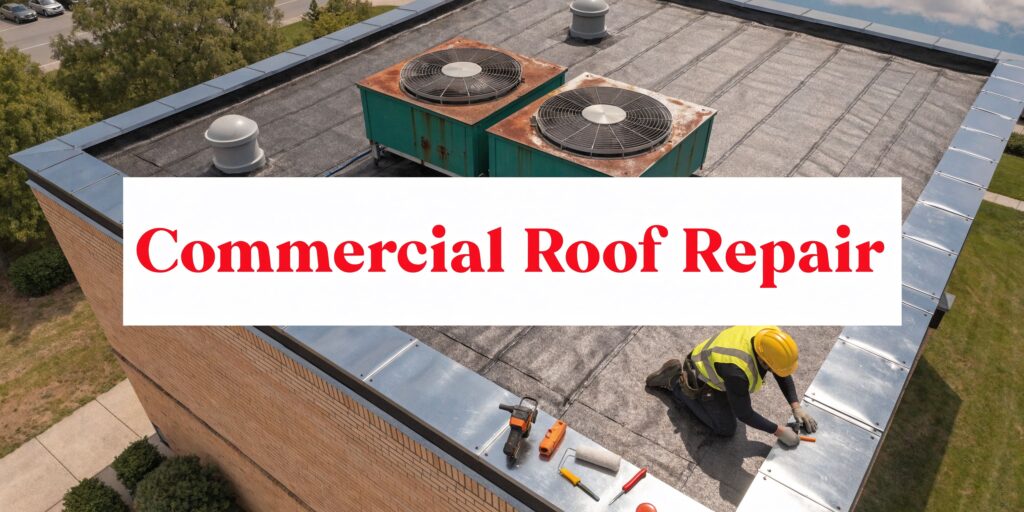
That’s how commercial flat roof repair enters the conversation. Not as a line item on a clean spreadsheet, but as an interruption. A leak over a retail suite, wet insulation above office space, a seam failure after hail, or ponding that keeps getting ignored until the deck starts telegraphing trouble.
In DFW, flat roofs take a beating. Heat, UV, hail, foot traffic, rooftop equipment, clogged drains, and rushed prior repairs all stack up. The facility managers who stay ahead of it don’t wait for obvious interior damage. They treat the roof like an operating asset that protects rent, equipment, schedules, and insurance position.
Why Your Flat Roof Is Your Most Critical Asset
A flat roof doesn’t get much attention when it’s doing its job. That’s normal. The problem is that once it stops doing its job, everything under it gets involved fast.
A water stain is rarely just a stain. It can mean wet insulation, compromised seams, failed flashing, interior disruption, and a contractor trying to trace water that may have entered far from where it showed up inside. On a commercial property, that turns into tenant complaints, work orders, risk to inventory or electronics, and pressure to make a decision before you have the full picture.
That pressure is why commercial flat roof repair matters. This isn’t a niche maintenance category. The flat roof repair segment accounts for nearly 60% of total revenue in the commercial roof repair services market, and the overall market was estimated at $15 billion in 2025 with a projection to reach $25 billion by 2033, expanding at a 6% CAGR according to commercial roof repair market data.
What that means on the ground
Older commercial buildings are staying in service longer. Roof systems are expected to last, be repaired, be reconditioned, and keep businesses operating while all of that happens.
For a facility manager, the roof is tied directly to:
- Operational continuity because leaks don’t stay isolated for long
- Budget control because early repair is usually cheaper than delayed failure
- Risk management because storms and insurance documentation are part of the job in Texas
- Tenant retention because people remember recurring leaks
Practical rule: If water is inside the building, the roof problem is already older than the stain.
Good roof management isn’t reactive hero work. It’s inspection discipline, accurate diagnosis, smart repair timing, and knowing when a “small issue” is the first sign of a bigger system failure.
Decoding Your Commercial Flat Roof System
Most facility managers inherit a roof before they fully understand it. That’s common. One building has white single-ply. Another has black rubber. Another has a layered asphalt system that’s been coated twice and patched by three different contractors.
Think of flat roof systems like vehicle tires. They’re all meant to keep the vehicle moving, but they’re built differently for different conditions. If you use the wrong repair method on the wrong roof type, you waste money and sometimes make the leak worse.
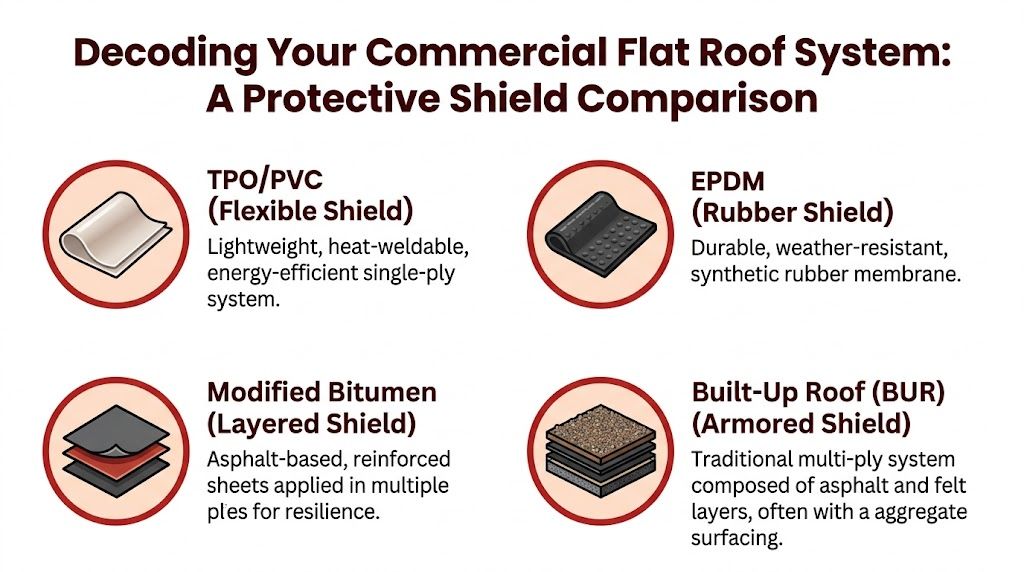
TPO and PVC
These are the smooth white membranes you see on many commercial buildings. In practice, they’re the all-season tires of the flat roofing world.
They’re lightweight, reflective, and heat-weldable. That last part matters. A proper repair on a TPO roof often depends on clean membrane prep and a sound heat weld, not just smearing sealant over the problem.
TPO is common on newer properties, and the verified market data notes that TPO holds 41% market share in installations within the context of commercial roofing systems and repairs discussed in the market overview. In Texas, these roofs can perform well, but they still get stressed by hail, punctures, failed details around penetrations, and standing water.
EPDM
EPDM is the black rubber membrane roof. It’s more like a durable work-truck tire. It’s flexible, proven, and straightforward to identify.
Its weak points are often at seams, terminations, flashing transitions, and rooftop traffic areas. Repairs have to match the material and attachment method. A contractor who treats EPDM like TPO will miss the point. The membrane may look simple, but the repair details aren’t interchangeable.
Modified bitumen
Modified bitumen is the layered option. It’s more like a heavy-duty off-road tire built for abuse, but it needs the right installation and maintenance approach. Torch-applied, self-adhered, or cold-process assemblies each come with different repair implications.
These roofs are common on many Texas commercial properties because they handle foot traffic and service access reasonably well. But when they age, you’ll often see splits, surface wear, failed laps, and flashing issues. If your property has this system, it helps to understand the basics of modified bitumen roof systems.
BUR
Built-up roofing, or BUR, is the armored shield. It’s the older multi-ply system with asphalt layers and often aggregate surfacing.
BUR can be tough, but it’s also harder for some owners to evaluate because the visible top surface doesn’t always tell the whole story. Moisture can travel. Old repairs can hide weak substrate conditions. These roofs often need experienced diagnosis instead of quick assumptions.
Why system type changes the repair strategy
A leak is never just a leak. On one roof it calls for a welded patch. On another, it may require plies to be cut back, wet material removed, and flashing rebuilt.
Here’s the practical takeaway:
- Single-ply roofs reward precision. Bad seam work fails.
- Rubber roofs need compatible repair materials and careful edge work.
- Modified systems often fail at laps, penetrations, and transitions.
- BUR roofs demand patience because hidden moisture can spread laterally.
If you know what system is on your building, you ask better questions, approve the right scope, and avoid paying for repairs that were never likely to hold.
Diagnosing Common Flat Roof Problems and Failures
Most flat roof failures follow a pattern. The visible symptom gets attention, but the underlying cause has been building for a while.
Facility managers often get handed the symptom. Water on a floor. A stained ceiling tile. A complaint about odor after rain. The job is to trace that symptom back to the source, then decide whether you’re dealing with isolated damage or a larger system issue.
Ponding water
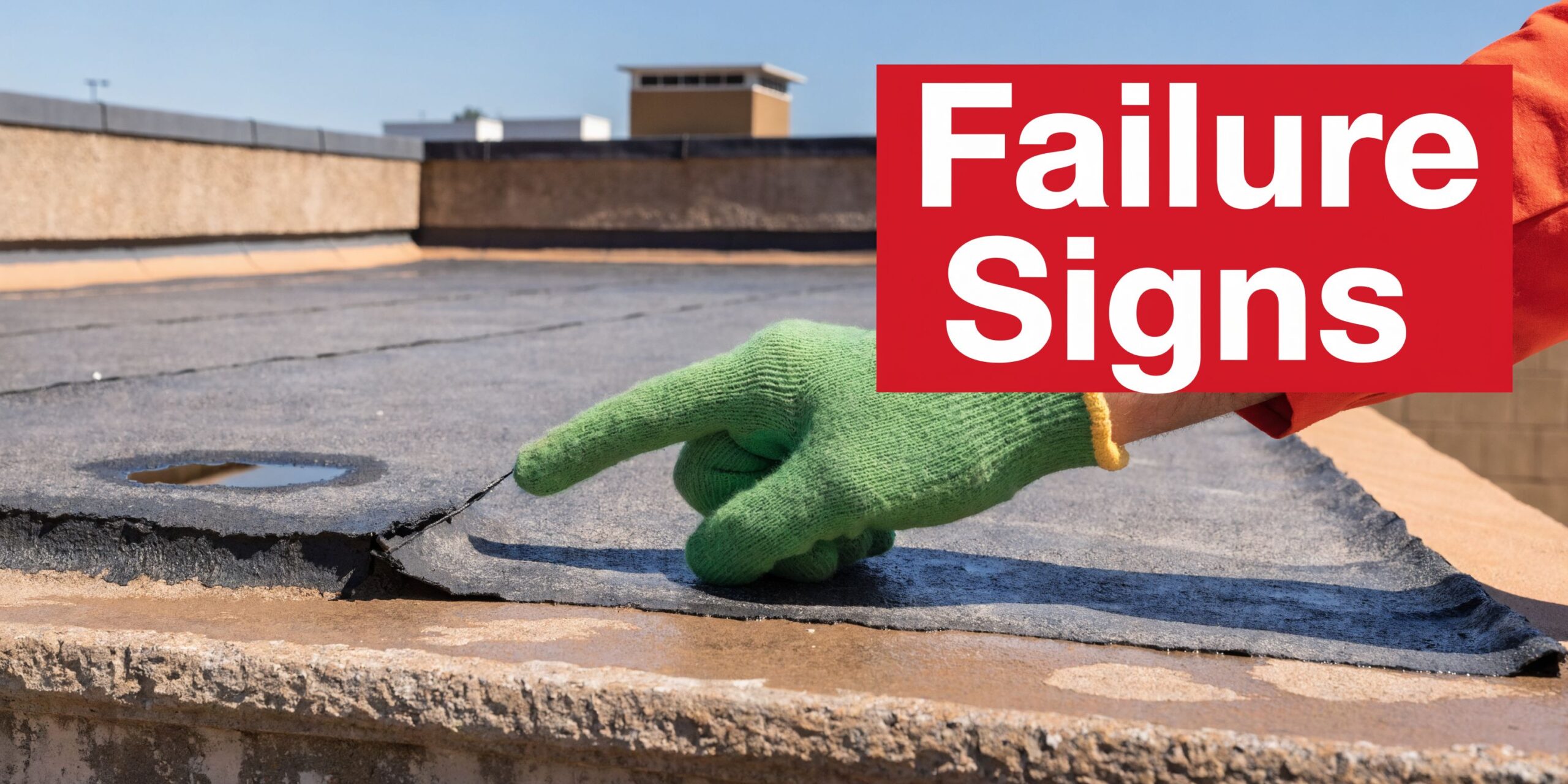
Ponding is one of the most misunderstood issues on a commercial roof. Some owners see standing water and assume it’s cosmetic. It isn’t.
If water keeps sitting in the same area, something is off. It may be drainage design, a clogged drain, structural sag, compressed insulation, or a tapered system that’s no longer performing as intended. On a flat roof, standing water puts stress on seams, flashings, and membrane surfaces that were never meant to stay submerged for long periods.
What doesn’t work is repeatedly caulking around the low spot and hoping the next storm drains differently.
Flashing failures
Many leaks don’t start in the field membrane. They start where the roof stops being simple. Curbs, parapet walls, pipe penetrations, drains, edge metal, and equipment supports are where repair quality matters most.
Common warning signs include:
- Open laps where the edge starts to lift
- Sealant fatigue around penetrations and termination bars
- Movement cracks where roof components expand and contract at different rates
- Rust or staining at metal details that suggest ongoing water movement
A failed flashing detail can let water travel a long way before it shows up indoors. That’s why a leak over Suite 104 may originate near rooftop mechanical equipment much farther upslope.
Punctures and splits
Flat roofs get damaged by traffic more often than owners think. HVAC techs, electricians, signage crews, satellite installers, and other trades can all leave behind punctures, dropped tools, displaced pads, or stressed membrane near equipment.
On older roofs, thermal movement and material fatigue can also create splits. These failures may look minor from the surface. The problem is what happens underneath once water gets into the insulation package.
Hidden moisture is where budgets get hurt
A visual inspection only tells part of the story. On commercial roofs, the expensive damage is often below the membrane.
According to infrared thermography guidance for commercial flat roof repair, infrared thermography can detect subsurface moisture with up to 95% accuracy. That matters because undetected moisture can reduce a TPO or EPDM roof’s lifespan by 30% to 50% if it’s left unaddressed, and industry standards call for bi-annual scans to prevent premature failures.
Hidden wet insulation changes the repair conversation. What looked like a patch may require tear-out, substrate drying, and rebuild of the affected area.
Experienced contractors distinguish themselves here. They don’t just point at the hole. They determine whether the surrounding assembly is still dry and stable enough to support a lasting repair.
A quick explainer on field diagnosis helps:
The failure chain to watch for
One missed puncture can set off a chain reaction:
- Water enters through a small breach.
- Insulation gets wet and loses performance.
- Membrane adhesion weakens or substrate stability changes.
- Surface movement increases around seams and details.
- Interior leak symptoms finally show up after the damage has spread.
That’s why the cheapest-looking repair is often the wrong one. The underlying issue isn’t always where you first see water.
Effective Repair Techniques for Lasting Results
The right repair method depends on the failure, the roof type, and the condition of the assembly under the membrane. Good commercial flat roof repair isn’t about using the most material. It’s about using the right method on a clean, dry, stable surface.
When a patch is the right answer
A targeted patch works well when the damage is localized and the surrounding membrane is still sound. That usually applies to punctures, isolated splits, small seam failures, and some penetration issues.
On single-ply roofs, that often means membrane prep, cleaning, and a heat-welded patch sized beyond the damaged area. On modified systems, it may mean cutting out compromised material and rebuilding the affected section with compatible plies.
What doesn’t work is treating all patches like sealant jobs. Sealant has a place, but it isn’t a universal fix for failed membrane conditions.
Flashing repair is detail work
Flashing failures need more than a surface smear. If a penetration or parapet detail is leaking, the repair has to deal with movement, attachment, and water path. Sometimes that means replacing deteriorated boots or rebuilding the flashing configuration rather than chasing leaks with mastic.
The most durable repairs usually share the same traits:
- Clean substrate
- Dry conditions before application
- Compatible materials
- Proper tie-in to the existing system
- Attention to corners, edges, and terminations
A lot of callbacks come from repairs that looked sealed on day one but were applied over contamination, moisture, or unstable material.
Coatings can help, but Texas changes the math
Coatings are useful in the right situation. They can protect aging surfaces, improve weathering resistance, and buy time when the roof is still a candidate for restoration.
But coatings aren’t magic. They don’t fix saturated insulation, bad drainage, loose flashings, or open seams by themselves. The prep work determines whether a coating project helps or disappoints.
There’s also a regional trade-off that matters in DFW. A 2025 NRCA study found that silicone coatings can extend TPO life by 10 to 15 years in moderate climates but can degrade 25% faster under intensified Texas hail, according to this discussion of flat roof coating performance and hail exposure.
That’s the part many generic guides skip. In storm-prone areas, a coating may be smart on one building and the wrong move on the next. If the roof takes repeated hail impact or has active problem areas, targeted membrane repair may deliver a cleaner return than coating over unresolved weaknesses. If you’re evaluating that option, it helps to understand what elastomeric roof coating is and where it fits.
Drainage corrections matter more than owners expect
Some leaks keep coming back because the repair addressed the opening but not the water load. If drains are blocked, strainers are missing, crickets are inadequate, or insulation has settled, the roof remains under stress after every storm.
In those cases, the lasting fix may include:
- Drain and scupper correction
- Localized slope improvement
- Rebuilding crushed insulation areas
- Reworking details around curbs and penetrations
What usually fails early
The repair itself often isn’t the weak point. The prep is.
Bad results usually trace back to one of these:
| Failure cause | What it looks like later |
|---|---|
| Surface wasn’t fully dry | Delamination or recurring leak |
| Wrong material for roof type | Poor adhesion or split repair edge |
| Wet insulation left in place | Continued moisture migration |
| Repair too small | Water gets back under the perimeter |
| Detail wasn’t rebuilt fully | Leak shifts to adjacent area |
A lasting repair should lower future uncertainty, not just stop the next rain event.
Repair vs Replace The Critical Decision Framework
Owners often ask the wrong first question. They ask, “Can you repair it?” The better question is, “Does repairing it still make business sense?”
Every commercial roof can be patched in some form. That doesn’t mean it should be.
Start with the pattern, not the latest leak
One leak after a storm is one thing. A roof that keeps generating work orders from different areas is telling you something else.
Look at the history:
- Are leaks isolated or recurring in new locations
- Have multiple trades patched the roof over time
- Are repairs starting to overlap
- Has water intrusion reached tenant spaces, equipment, or finished interiors
A roof with scattered failures often costs more in disruption than the repair invoices alone suggest.
Evaluate the assembly, not just the surface
A surface can look acceptable while the insulation or substrate below is in poor shape. That’s why core cuts, moisture mapping, and hands-on review matter.
If the roof system underneath the visible membrane is still dry and stable, repair remains a strong option. If wet insulation is widespread, fastener pull-through is showing up, or large sections have lost integrity, replacement becomes easier to defend.
Replacement is usually the right call when you’re no longer fixing defects. You’re managing decline.
Match the roof decision to the property plan
This part gets missed all the time. The right roofing decision depends on how long you plan to hold the asset and what the building has to support.
If the property is being repositioned, refinanced, sold, or leased to demanding tenants, a replacement may solve more than just leaks. It can reduce uncertainty during due diligence and make future capital planning cleaner.
If the building is stable, the roof has localized issues, and the assembly is otherwise sound, repair may be the better use of cash.
Consider these business questions:
| Question | Lean toward repair | Lean toward replacement |
|---|---|---|
| Damage scope | Localized | Broad or recurring |
| Building hold period | Short to medium | Long-term hold |
| Interior risk | Limited | High-value occupancy or equipment |
| Roof history | Predictable | Escalating failures |
| Future upgrades | Minimal | Solar, coatings, major tenant demands |
Don’t let sunk cost decide for you
Facility managers sometimes keep repairing a bad roof because they’ve “already spent so much on it.” That logic usually traps owners in another year of invoices, emergency calls, and interior damage exposure.
Past spend is useful history, but it shouldn’t drive the next decision. The key question is whether the next dollar goes into a roof that still has a stable future.
A practical threshold
A good contractor should be able to explain all three of these plainly:
- What can be repaired now.
- What will still be vulnerable after that repair.
- What a replacement would solve that repair will not.
If the answer to number two is long and expensive, you’re probably near the tipping point. If the answer to number one addresses the issue cleanly and the roof still has usable life, repair is the smart move.
The best decisions in commercial flat roof repair aren’t emotional. They’re operational and financial.
Navigating Costs Insurance Claims and Project Planning
Most owners don’t struggle with the idea of repairing a roof. They struggle with the sequence. What will it cost, what should go through insurance, and how do you get the work done without disrupting tenants or operations more than necessary?
What repair work usually costs
Verified cost benchmarks put typical commercial flat roof repairs at $600 to $4,500+, while full replacements average $8 to $14 per square foot, according to this breakdown of commercial roof repair costs. That’s why repair is usually the first move when damage is limited and the system is still a candidate for continued service.
The exact number depends on access, roof type, wet insulation, detail complexity, and whether storm damage affected only the membrane or also flashings, edge metal, rooftop equipment supports, or adjacent systems.
Here’s a practical planning table based on the verified ranges provided.
Example commercial flat roof repair costs in DFW 2026
| Repair Type | Typical Cost Range | Common Cause / Notes |
|---|---|---|
| Minor flashing repairs | $1,200 to $1,800 | Separation at wall flashings, penetrations, or terminations |
| Full penetration rebuilds | $2,600 to $3,500+ | Failed detail around pipes, curbs, or equipment supports |
| Deteriorated pipe boots | $1,800 to $2,600 | UV exposure, movement, seal failure |
| Parapet flashing repair | $450 to $900 | Edge detail separation or aging wall transition |
| General flat roof repair incident | $600 to $4,500+ | Scope varies based on membrane, insulation, and access |
Those numbers help frame the decision, but field conditions still decide the final scope.
How to handle a storm damage claim without making it harder
In North Texas, hail claims are part of roof management. The mistake I see most often is waiting too long to document the condition or letting the conversation start with opinions before anyone has assembled the facts.
A cleaner process looks like this:
- Document first. Photograph membrane damage, punctures, displaced flashing, interior staining, wet ceiling tiles, and rooftop equipment impacts.
- Protect the building. Temporary mitigation matters. Stop active water intrusion before secondary damage spreads.
- Separate known old issues from storm-related damage. Adjusters notice when everything gets lumped together.
- Build a repair map. Mark slopes, penetrations, drains, HVAC areas, and visible hail or uplift patterns.
- Meet the adjuster with roof-specific observations. Generic statements don’t help. Detail does.
- Keep records organized. Photos, date-stamped notes, proposal scopes, and prior repair history all matter.
If you want a plain-English resource on how contractors and owners approach that workflow, this roofing contractor insurance claims guide is useful because it focuses on documentation and process rather than hype.
The strongest insurance position usually comes from clear evidence, consistent records, and a contractor who can explain damage in roof-system terms.
What to expect during project planning
Commercial roof work goes better when the roof scope and the operational plan are built together. A technically correct repair can still create headaches if nobody planned for access, tenant communication, material staging, noise windows, or water shutoff coordination around penetrations.
Key planning points include:
- Access routes for crews, lifts, and material delivery
- Tenant notifications if noise or odors may affect occupied spaces
- Safety controls around entries, parking, and service alleys
- Weather windows for membrane work and detail tie-ins
- Coordination with other trades if HVAC, electrical, or solar equipment sits in the repair area
A repair over an occupied medical office is not planned the same way as a repair over warehouse space. The roof system matters, but the building use matters just as much.
Where owners lose money
It usually happens in one of three places.
First, they approve a cosmetic patch without confirming whether moisture has spread below the visible damage.
Second, they file a storm claim with weak documentation and spend the next few weeks trying to reconstruct what happened.
Third, they schedule roof work without coordinating rooftop equipment access, tenant communication, or follow-up inspection.
A disciplined project plan avoids all three. It keeps the repair focused, supports the insurance file if storm damage is involved, and reduces the chance that a manageable roof issue turns into an operations problem.
Finding Your Expert DFW Roofing Partner
A good commercial roofer does more than stop a leak. They should be able to diagnose the failure, explain the repair options in business terms, document storm damage properly, and work around the operational aspects of your building.
That’s especially true in DFW, where hail changes priorities fast.
What to verify before you sign anything
A contractor should be able to show you, clearly and without deflection, that they have the basics covered.
Look for:
- Insurance and compliance that fit commercial work, not just small residential jobs
- Local storm experience because hail claims and membrane damage interpretation are regional skills
- System familiarity across TPO, EPDM, modified bitumen, BUR, flashings, coatings, and drainage details
- Clear scopes that define what gets repaired, what remains excluded, and what conditions could expand the scope after tear-out
- Warranty awareness because the wrong repair method can create problems with existing roof or component coverage
Ask direct questions. Who will inspect the roof. Who writes the scope. Who meets the adjuster if insurance is involved. Who coordinates rooftop trades. Who documents hidden moisture if it’s found.
Why solar changes the repair conversation
Solar is where many commercial roof conversations get messy. The roof may need repair, but the panels, racking, wiring paths, and warranty issues add another layer of risk.
That matters because U.S. commercial solar capacity grew 28% year over year, and there’s still a significant gap in practical guidance on coordinating roof repairs with solar systems, according to this discussion of flat roof repair and solar detach-and-reset needs.
If a contractor isn’t comfortable around rooftop solar, problems show up quickly:
- Panels get treated like obstacles instead of protected equipment
- Repairs get delayed because nobody owns the detach-and-reset sequence
- Warranties get put at risk by poor coordination
- Future leak tracing gets harder because documentation is weak
One option to consider in DFW
For owners dealing with both flat roof issues and solar equipment, commercial roof repair services from Hail King Professionals include repair work for commercial roofs, storm damage assessment, and a specialized solar panel detach-and-reset service intended to keep repairs code-compliant and low-disruption while avoiding preventable panel handling issues.
That’s a practical service category, not a luxury add-on. On a solar-equipped property, somebody has to manage sequencing correctly or the roof and the solar system start working against each other.

What a strong contractor relationship looks like
It’s not just a bid and a repair date. It’s a contractor who gives you usable information.
That usually includes:
| What you need | What a capable contractor provides |
|---|---|
| Leak diagnosis | Source analysis, not guesswork |
| Budget visibility | Clear scope with repair boundaries |
| Insurance support | Photo documentation and roof-specific observations |
| Operations planning | Scheduling around tenants and access constraints |
| Future planning | Honest repair-versus-replace guidance |
If a contractor can’t explain why the roof failed, they probably can’t explain why their repair will last.
The right DFW roofing partner doesn’t promise that every roof can be saved forever. They identify what’s repairable, what’s risky, and what your next move should be based on the building, not a sales script.
Frequently Asked Questions About Flat Roof Repair
How often should a commercial flat roof be inspected
At minimum, inspect it on a scheduled basis and after major storms. In Texas, don’t wait for interior leaks to decide when the next inspection should happen. Flat roofs hide damage well, especially around seams, flashings, drains, and rooftop equipment.
Can my maintenance team handle small flat roof repairs
Your team can help with observation, documentation, drain checks, and leak response inside the building. Actual membrane repair is different. Using the wrong material, trapping moisture, or patching over unstable substrate can make a minor issue more expensive.
How long does a typical repair take
That depends on roof type, weather, access, and whether hidden moisture is found. Some localized repairs move quickly. Others expand once the crew opens the assembly and finds wet insulation or failed details below the visible surface.
Is a roof coating the same as a repair
No. A coating can be part of a roof restoration strategy, but it doesn’t replace proper repairs. If seams are open, flashing is failing, or the insulation is wet, those conditions need to be addressed first.
What should I do first after discovering an interior leak
Document the location, protect interior contents, and get the roof evaluated. Don’t assume the leak source is directly above the stain. Water often travels.
When should I involve insurance
If storm damage is a realistic factor, start documenting early. Don’t wait until conditions change or temporary mitigation erases the evidence pattern. Good photos and organized notes help.
Does rooftop solar make flat roof repair harder
Yes, if the repair team and solar handling aren’t coordinated. It adds sequencing, access, attachment-point review, and warranty considerations. That doesn’t make repair impossible. It just means planning matters more.
If your building has an active leak, recurring ponding, hail damage, or a repair decision that’s getting harder to justify, talk to Hail King Professionals. They serve Dallas-Fort Worth and East Texas with commercial roof inspections, flat roof repair, storm damage assessment, coatings, and solar detach-and-reset coordination so you can make a clean decision before a manageable roof issue turns into a bigger facility problem.