


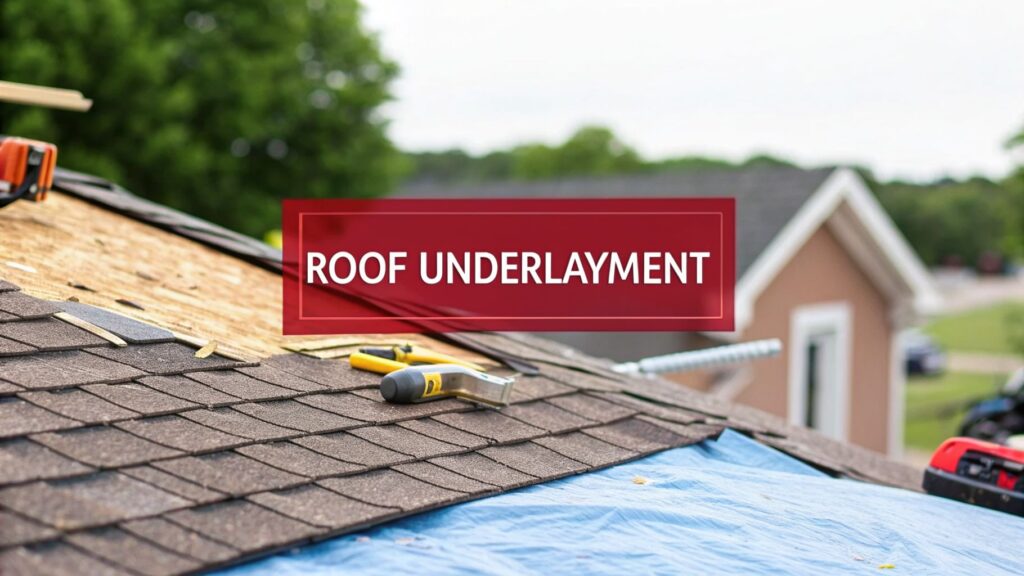
What is roof underlayment? A Simple Guide to Protection and Longevity
When you look at a roof, you see the shingles, tiles, or metal panels. But one of the most important parts of your entire roofing system is completely hidden from view: the underlayment.
So what is it? Simply put, roof underlayment is a layer of water-resistant material that gets installed directly onto the wooden roof deck before your shingles go on. It’s your roof's last line of defense, a crucial safety net that protects your home's structure if water ever gets past the main roofing.
Your Roof's Unseen Shield

Here’s a good way to think about it: imagine wearing a high-quality rain jacket. The jacket is like your shingles, shedding the vast majority of the water. The underlayment is like the shirt you wear underneath. If a little moisture gets through the jacket's zipper during a downpour, that shirt keeps the water off your skin.
Without underlayment, any water that sneaks under a cracked, loose, or wind-lifted shingle would soak directly into your roof's wooden sheathing. That's a recipe for disaster, leading to wood rot, leaks inside your attic, and expensive structural damage.
The Three Essential Jobs of Underlayment
It might seem like a simple sheet of material, but underlayment is a multi-tasking workhorse. It actually performs three vital jobs that are critical for your roof's health and longevity.
Protection During Installation: A new roof isn't built in a day. The underlayment provides a temporary shield against rain and sun, protecting the exposed wood decking for the days or weeks before the shingles can be installed.
A Secondary Weather Barrier: This is its main purpose. Shingles are great at shedding water, but they aren't completely impenetrable. Wind-driven rain, in particular, can force water uphill and underneath the shingles. Underlayment is the waterproof barrier that stops that moisture in its tracks.
Helps Achieve a Class A Fire Rating: Safety is paramount. Many modern roofing systems rely on a specific underlayment as part of a complete assembly to earn a Class A fire rating. This is the highest level of protection against external fire threats and is often mandated by local building codes.
While your shingles get all the credit, the underlayment is the unsung hero working behind the scenes. Any experienced roofer will tell you that using a quality underlayment isn't just an option—it's the key to building a roof that lasts and giving you true peace of mind.
From Old-School Tar Paper to Modern Synthetics
To really get a feel for what roof underlayment does, you have to look at where it came from. The story doesn’t start with high-tech materials, but with a simple, tar-coated paper that completely changed the game for builders way back in the mid-1800s.
This early material, which everyone just called tar paper, was a basic but brilliant idea. Its real moment to shine, though, came when asphalt shingles were invented. Roofers started noticing a huge problem: the natural saps and resins in the wood roof decking—usually pine or cedar—were literally eating away at the new asphalt shingles, causing them to fail way too early.
A Clever Fix Becomes an Industry Standard
So, roofers came up with a fix. They started laying a sheet of tar paper down between the wood deck and the shingles. This simple barrier stopped the sap from reaching the asphalt, and suddenly, roofs were lasting a whole lot longer. It worked so well that it quickly became a standard part of just about every roofing job.
When coal tar was developed around 1847, this tar-saturated paper became the first real, widely used underlayment. Looking back, studies have shown that those early roofs built without it failed up to 30-50% faster, especially in humid climates. Fast forward to today, and in hail-prone regions, using modern underlayment is an absolute must for any replacement. It helps prevent the 15-20% leak claims that were so common with old tar-paper roofs after a big storm. You can see how materials have evolved to solve real-world roofing problems over time.
The Headaches with Early Materials
While tar paper was a huge step up, it was far from perfect. It was incredibly heavy, would get brittle and crack in the cold, and could turn into a soft, sticky mess in extreme heat—a massive problem for anyone roofing in the Texas sun.
It also came with a handful of other issues:
- Tearing: The paper ripped easily, whether during installation or just from someone walking on the roof, leaving the deck vulnerable.
- Rotting: Because it was an organic-based paper, it could absorb moisture and eventually rot away after years of service.
- Wrinkling: It rarely laid perfectly flat. Those wrinkles could telegraph through to the shingles, creating a bumpy, unprofessional look.
The bottom line was simple: a roofing system is only as strong as its weakest link. As shingles and installation methods got better, the industry needed an underlayment that could actually keep up.
This gap in performance is what pushed manufacturers to innovate. They went to the drawing board to develop stronger, more reliable materials, which led directly to the synthetic underlayments we use today. These new products solved nearly all of tar paper's problems and were a huge leap forward in building the tough, long-lasting roofs we expect now.
Choosing the Right Shield for Your Home
Picking the right roof underlayment isn't just a minor detail—it's about choosing the right level of defense for your home. Think of it like dressing for the weather. You wouldn't wear a light windbreaker in a blizzard, and you shouldn't use a basic underlayment if you live somewhere prone to severe storms.
Each type offers a specific kind of protection tailored to different climates, roof designs, and budgets. Getting to know the three main players in the underlayment game is the first step toward building a roof that's truly built to last.
Just as roofing materials have improved over the years, so have the options for protecting the wood deck underneath. This timeline gives you a quick visual of how far underlayment has come, from its humble beginnings to the high-tech materials we trust today.

You can see the jump from simple tar paper to modern synthetics is huge. The next frontier is developing materials that can stand up to even the most intense weather, like Texas-sized hail.
To make it easier to see the differences at a glance, this table breaks down the key features of the three main underlayment options. It’s a great starting point for figuring out which one makes the most sense for your home and your budget.
Roof Underlayment Comparison: Felt vs. Synthetic vs. Ice & Water Shield
| Feature | Asphalt-Saturated Felt | Synthetic Underlayment | Self-Adhered (Ice & Water Shield) |
|---|---|---|---|
| Material | Paper or fiberglass mat saturated with asphalt | Woven polypropylene or other plastics | Rubberized asphalt with adhesive backing |
| Water Resistance | Moderate (water-resistant, not waterproof) | High (sheds water effectively) | Excellent (waterproof and self-sealing) |
| Durability | Low (tears easily, becomes brittle) | High (very tear-resistant) | Very High (flexible and tough) |
| Weight | Heavy and bulky | Lightweight and easy to handle | Moderate weight |
| Safety | Can be slippery when wet | Often has a non-slip surface | Very tacky surface, requires careful handling |
| Cost | $ (Least Expensive) | $$ (Mid-Range) | $$$ (Most Expensive) |
| Best Use Case | Budget projects, sheds, or outbuildings | Standard on most modern residential roofs | Valleys, eaves, and around penetrations |
As you can see, there's a clear trade-off between cost and performance. While felt is cheap, synthetic offers a massive upgrade in protection for a moderate price increase, making it the best value for most homeowners.
Asphalt-Saturated Felt (Tar Paper)
This is the old guard, the traditional choice that’s been around for over a century. It's essentially a thick paper that has been saturated with asphalt to give it a basic level of water resistance. For a long time, it was the only option available.
But "traditional" doesn't always mean "best." Felt underlayment has some serious downsides. It’s incredibly heavy, tears easily during installation, and doesn't stand up well to the elements. Under the brutal Texas heat, it can dry out, become brittle, and crack long before your shingles give out. It also tends to absorb moisture, which can cause it to wrinkle and telegraph those lines through your finished roof.
Synthetic Underlayment
This is the modern workhorse of the roofing industry and what we install on the vast majority of our projects. Synthetic underlayment is an engineered product made from woven plastics like polypropylene. It's designed from the ground up to be tough, lightweight, and far more water-resistant than old-school felt.
Here’s why it has become the standard:
- Incredible Tear Resistance: It can handle roofers walking on it and resists tearing in high winds during the installation process, which is a common point of failure for felt.
- Lightweight and Safer: A roofer can carry a roll of synthetic that covers 10 times the area of an equally heavy roll of felt. This makes the job safer and more efficient. Plus, many synthetics have a non-slip texture for better footing.
- UV Stability: Unlike felt, which degrades quickly in the sun, synthetic underlayment can be left exposed for weeks or even months without breaking down. This provides crucial protection if the shingle installation gets delayed.
For the money, synthetic underlayment delivers the best performance and peace of mind. It acts as a far more reliable secondary water barrier, ready to protect your home if a shingle ever blows off in a storm. It’s our go-to recommendation for nearly every roof replacement.
Self-Adhered (Ice and Water Shield)
Now we get to the specialist. If synthetic is your all-weather jacket, think of a self-adhered membrane as the rubber-sealed cuffs and waterproof zippers. This premium material is a rubberized asphalt sheet with a simple peel-and-stick backing.
Its superpower is its ability to create a waterproof gasket around every single nail driven through it. The sticky, rubberized asphalt literally melts around the fastener, leaving no path for water to follow. This is why we use it as a critical component in the most vulnerable areas of a roof:
- Eaves and rakes (the roof edges where ice dams can form)
- Valleys where large volumes of water are channeled
- Around all penetrations like chimneys, vents, and skylights
Because it's the most expensive of the three, it’s not practical to cover an entire roof with it. The best practice is a "belt-and-suspenders" approach: install a self-adhered ice and water shield in the high-risk zones, then cover the rest of the roof with a high-quality synthetic underlayment. This hybrid system, when paired with the best roofing shingles for Texas, creates a nearly foolproof defense against leaks.
How Underlayment Stands Up to Severe Weather
Your shingles are your roof's armor, but what happens when that armor gets breached? This is where your roof underlayment proves its worth. It’s the last line of defense, a critical safety net that protects your home when high winds, driving rain, or nasty hail get past your primary roofing.
Think of it as your roof’s secret service agent. During a Texas hailstorm, the underlayment won’t stop shingles from getting pummeled. But if a big hailstone cracks or even punches a hole through a shingle, a quality underlayment creates a crucial secondary water barrier. It stops a leak dead in its tracks, protecting your attic and everything inside your home from immediate water damage.
After a big storm rolls through, that tough layer of underlayment is what separates a simple shingle repair from a full-blown interior renovation. It buys you the time you desperately need to call a professional and get things fixed before water starts ruining your ceilings, insulation, and belongings.
This hidden protection is just as important when the wind starts howling. When powerful gusts tear shingles right off the roof, it's the underlayment that's left exposed and holding the line against the elements.
The Role of Underlayment in High Winds and Hail
I’ve seen it a hundred times—old-school asphalt felt paper just gives up. It tears away almost as easily as the shingles, leaving the wooden roof deck completely exposed to rain. Modern synthetic underlayment, on the other hand, is a different beast entirely. Its woven polymer design is incredibly tough and tear-resistant, so it stays put even when shingles are gone.
This durability is precisely why it’s become the standard, especially here in Texas where severe thunderstorms are a fact of life. It’s designed to keep that roof deck covered and prevent a catastrophic leak until a roofer can get out there.
- Hail Impact: If hail shatters a shingle, a good underlayment is the only thing preventing water from pouring into your house. A tough synthetic layer can take that direct exposure without failing.
- Wind Resistance: When shingles are blown off, synthetic underlayment’s exceptional tear strength is what keeps your roof deck sealed and prevents widespread water damage.
- Driving Rain: Intense, wind-driven rain can push water uphill, right under the overlaps of your shingles. The underlayment’s job is to catch that water and direct it safely back down into your gutters.
Meeting Building Codes for Maximum Protection
It's not just roofing contractors who understand this; local building codes are written with this in mind. These codes, which are usually based on the International Residential Code (IRC), recognize how vital this secondary barrier is.
In high-wind zones or areas prone to severe weather, codes often get very specific. They might mandate a certain type of underlayment or require reinforced installation methods, like using extra nails in a specific pattern to make sure it holds fast in extreme conditions.
Following these codes isn't just about checking a box for an inspector. It’s about making sure your roof is built to handle the weather you know is coming. It also makes a huge difference if you ever need to file an insurance claim. An adjuster will see a properly installed, code-compliant roof system—complete with high-quality underlayment—as a sign of a well-maintained home, which can make the claims process much smoother.
To learn more about strengthening your entire roof system, you can explore our guide on hail-resistant roofing materials. This ensures your home is not only protected from the next storm but is also set up for long-term durability.
Signs Your Roof Underlayment Is Failing

Since it’s buried under your shingles, the roof underlayment is a classic "out of sight, out of mind" part of your home. The trouble is, most homeowners don’t know there’s a problem until water is already dripping into the living room. Spotting the early warning signs can be the difference between a standard roof replacement and a massive interior repair bill.
It's important to understand that underlayment is almost never replaced on its own. Its lifespan is directly linked to the shingles protecting it. So, if your underlayment is failing, it’s a sure sign your entire roof system is due for a professional inspection.
Think of it like the brake pads on your car. You don't wait for them to completely disintegrate before getting them checked. You listen for the warning squeal—and with your roof, that "squeal" comes in the form of subtle but significant clues.
Interior Warning Signs
Often, the first clues that your underlayment has failed won't be on the roof at all—they'll be inside your house. These are direct symptoms of water getting past both your shingles and that critical secondary barrier.
- Water Stains on the Ceiling: Those brownish, discolored spots on your ceilings or walls are the number-one sign of a roof leak. If you see them, your underlayment has already been compromised for some time, so it's a good idea to learn how to fix water stains on your ceiling while you get the root cause addressed.
- Peeling Paint or Bubbling Drywall: When moisture gets trapped behind drywall, it forces the paint to bubble and peel away. This usually points to a slow, persistent leak that's gone unnoticed.
- A Musty Smell in the Attic: If your attic has a damp, earthy odor, you're likely dealing with moisture intrusion and possible mold growth. That’s a classic sign that your roof’s secondary water barrier isn’t doing its job.
Exterior Clues You Can Spot
You can’t see the underlayment directly, but the condition of your shingles tells a story about what’s happening underneath.
If you can safely see your roof from the ground (or a second-story window), look for large patches of "bald" shingles where the granules have worn off. Those tiny granules are what shield the shingle from UV rays. Without them, the shingle becomes brittle, cracks, and exposes the underlayment to sun and rain it was never meant to endure.
Another huge red flag is feeling soft or spongy spots when walking on the roof. This is a serious problem, indicating that the wood decking underneath has started to rot from long-term water exposure. It means the underlayment completely failed a long time ago. Because of the extreme danger, this kind of hands-on inspection should only ever be done by a licensed and insured roofing professional.
Navigating Your Roof Replacement and Insurance Claim
Getting a new roof is a huge deal, whether it's from old age or storm damage. You're not just hiring some guys with nail guns; you're making a major investment in your home's safety and value. The best way to protect that investment is to ask the right questions from the very beginning.
Don't ever feel like you're being pushy by digging into the details with a contractor. Frankly, a great roofer loves an informed customer. It means you both want the same thing: a top-quality roof that lasts.
Before you sign anything, get straight to the point with questions like these:
- "What kind of underlayment do you recommend for a house like mine in this climate, and why?"
- "How will you make sure the entire roof system is code-compliant for our area?"
- "Are you planning to install an ice and water shield? Where exactly will it go?"
A contractor’s answers will tell you everything you need to know. You'll quickly see if they're focused on quality or just trying to offer the lowest bid by cutting corners.
Underlayment and Your Insurance Claim
Now, if a storm is the reason you're replacing your roof, the insurance claim adds another layer to the process. Many homeowners don't realize that their policy is meant to cover a full, proper roof replacement—and that absolutely includes the underlayment.
Your insurance policy exists to restore your home to its pre-storm condition or better. That doesn't just mean new shingles. It means replacing the entire system with the proper, code-compliant materials needed for real protection, like a high-performance synthetic underlayment.
When you get an estimate from your roofer, look it over with a fine-tooth comb. It should clearly itemize every single material, including the specific brand and type of underlayment. If you see a vague line item like "roofing materials," that's a major red flag.
Insist that high-quality synthetic underlayment is listed on the quote. It’s the modern standard for a reason, and having it documented is critical for proving to your insurance carrier that you’re getting the resilient, long-lasting roof you're paying for. This paperwork is your best tool for a smooth claims process.
For a complete walkthrough, we've put together a guide on navigating the storm damage insurance claim process. Arming yourself with this knowledge lets you handle both your roofer and your insurance adjuster with confidence.
Frequently Asked Questions About Roof Underlayment
It's completely normal to have questions when you're digging into the details of a roof replacement. We get it. Here are some of the most common questions we hear from homeowners, with straightforward answers from our years of experience.
How Long Does Roof Underlayment Last?
The lifespan of your underlayment really depends on the shingles sitting on top of it. For a typical roof with architectural asphalt shingles, you can expect the underlayment to hold up for 20 to 30 years.
But that's just a number. The real-world performance comes down to the quality of the material and, just as importantly, the quality of the installation. Modern synthetic underlayments are engineered to stay flexible and resist breaking down far longer than old-school felt, giving your home a much more reliable safety net for decades to come.
Can You Install New Underlayment Over the Old Layer?
We get this question a lot, and the answer is always a firm no. Any reputable roofer will tell you the same. The only way to truly know the condition of your roof deck is to tear everything off—shingles and old underlayment included.
Laying new underlayment over an old, failing layer is like painting over rust. You're just hiding a ticking time bomb. A full tear-off is the only way to find and fix hidden damage like rot, soft spots, or water-soaked decking. This ensures your new roof is built on a solid, secure foundation.
Is Synthetic Underlayment Always the Best Choice?
For the vast majority of modern sloped roofs, the answer is a clear yes. Its incredible durability, water resistance, and even the added grip it provides for installers make it the superior choice over traditional felt for most homes. When you're dealing with a roof replacement, checking your home insurance policies often shows that using high-quality, compliant materials is essential for maintaining full coverage.
Now, there are rare exceptions. Some historic homes or specialty architectural designs might require a specific type of material to maintain their integrity. These are unique cases that absolutely need to be discussed with an experienced roofing contractor who understands the subtle differences between roofing systems.
At Hail King Professionals, we believe an informed homeowner is a protected homeowner. If you're looking at a roof replacement because of age or recent storm damage, our licensed team is here to help. We offer a free, no-obligation inspection to give you a clear picture of what your home needs. We'll answer all your questions and make sure your roof is built right with the best materials for Texas weather. Learn more about our services.