

Summer in Fort Worth has a way of turning an ordinary electric bill into a wake-up call. You run the AC hard, the attic bakes, and by late afternoon the house feels like it’s fighting the grid and the weather at the same time.
That’s usually when homeowners start looking up solar panels fort worth texas. Not because solar is trendy, but because North Texas gives you a lot of sun and a lot of reasons to think long-term. The catch is that Fort Worth isn’t just a solar market. It’s a hail market, a reroof market, and a storm-restoration market too.
If you’re weighing solar for the first time, or you already have panels and are staring at roof damage after a storm, the right decision isn’t just about panel output. It’s about how the whole system holds up over the life of the roof.
Is Solar Right for Your Fort Worth Home
A common Fort Worth scenario looks like this. A homeowner gets through another long summer, opens the power bill, and starts doing the same math they’ve done before. Keep paying the utility every month, or put that money into equipment that offsets part of the load on the house.
That question makes sense in this market. Texas ranks second nationally in solar capacity with 51,902 MWdc installed as of 2026, enough to power over 6.2 million homes, and the Fort Worth metroplex is part of that growth, helped by 2,850 annual sunshine hours and peak electricity demand that rose 16% from 2021 to 2023 according to Eagle Solar Power’s DFW solar market overview.
When solar makes practical sense
Solar usually fits best when the home has a roof with decent sun exposure, enough remaining roof life, and an owner who plans to stay put long enough to benefit from the system over time.
In Fort Worth, it also fits homeowners who are tired of rate shopping and summer bill swings. The local sun resource is strong. That part works in your favor.
What doesn’t work is treating solar like an add-on with no connection to the roof below it. In North Texas, the roof and the solar system have to be planned together.
Questions worth asking before you sign
Some homes are obvious candidates. Others need a harder look first.
- Roof age matters: If the roof is already nearing replacement, installing panels first can create an expensive sequencing problem later.
- Shade needs a real review: Trees, chimneys, nearby roof lines, and vent locations can all affect layout and production.
- Storm exposure changes the conversation: Fort Worth homeowners don’t just buy solar. They inherit a future maintenance and reroofing strategy.
Practical rule: If your roof may need replacement before the solar system reaches mid-life, solve the roofing question first.
The best solar decisions in DFW aren’t made by looking only at utility savings. They’re made by looking at the roof, the electrical setup, the panel layout, and what happens when the next hail claim shows up.
The Real Cost of Solar Panels in Fort Worth
Solar pricing in Fort Worth is local, not theoretical. Material choices matter. Roof complexity matters. Crew quality matters. But there’s still a useful baseline for what homeowners are paying in this market.
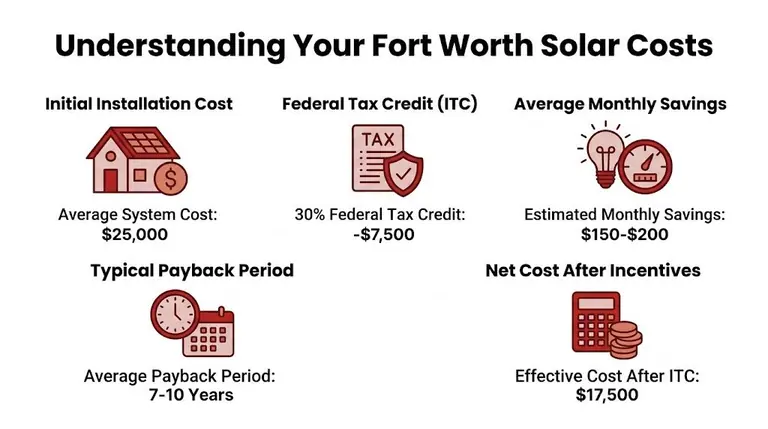
In Fort Worth, the average solar panel system costs $2.19 per watt including installation as of April 2026, or about $29,354 for a typical 13.75 kW system before incentives based on Fort Worth solar cost data from EnergySage.
What that price actually includes
That average isn’t just panels on a roof. It reflects the installed system, which typically means equipment, labor, and permitting.
A simple roof with clean access is different from a steep cut-up roof with multiple faces, tight attic conditions, and limited mounting areas. That’s why one quote can look reasonable and another can look inflated, even in the same neighborhood.
Here’s the useful way to think about it.
| Cost view | What it means |
|---|---|
| Price per watt | A quick way to compare proposals on a similar basis |
| Total system price | The full installed number before incentives |
| Net cost after incentives | What you may actually carry after the federal credit, if eligible |
| Long-term value | The savings over the life of the system, not just the upfront invoice |
The return side of the equation
The upfront price gets attention first. It should. But solar works financially because you’re effectively pre-buying a chunk of future electricity instead of renting it from the utility every month.
EnergySage’s Fort Worth data shows that after the federal tax credit, a 5 kW system averages $9,905, with a payback period of about 5 years and average savings of $93,632 over 25 years in the local market.
Solar isn’t cheap equipment. It’s a long-life building component tied to energy production, and that’s a different kind of purchase than a monthly bill.
What helps and what hurts the economics
A few decisions improve the financial outcome. Others undermine it.
- Right-size the system: Bigger isn’t always better. The best design matches actual household usage and the available roof area.
- Don’t ignore the roof condition: Installing on a roof that may need replacement soon can force you into avoidable labor later.
- Compare proposals by scope, not headline price: One bid may include stronger racking, better workmanship standards, or cleaner service coordination.
- Check the post-install ownership terms: A lower monthly payment can still be a worse long-term deal if it limits your benefit from the system.
What homeowners often miss
In Fort Worth, the solar sale is easy. The lifecycle planning is where mistakes happen.
If the system is designed well, mounted correctly, and paired with a roof that can support it for the long haul, the numbers can make sense. If the project is rushed, the “cheap” quote often stops looking cheap once service calls, roof work, or reset labor enter the picture.
That’s why the full cost of solar panels fort worth texas isn’t just the installation figure. It’s the installation figure plus every decision that follows.
Navigating Fort Worth Solar Incentives and Permitting
The money side of solar doesn’t end with the proposal. Fort Worth homeowners also need to get through city review, utility coordination, and the paperwork that determines when the system can operate.
The process is manageable when it’s organized early. It becomes frustrating when installers treat permitting like an afterthought.
What the local approval path looks like
For residential systems, Fort Worth’s permitting process typically takes 2 to 4 weeks for approval, requires a licensed electrician and structural engineering review, and the Oncor interconnection process adds another 3 to 5 weeks after installation before activation according to the City of Fort Worth Development Services permit information.
That timeline matters because homeowners often assume installation day is the finish line. It isn’t. Panels can be on the roof while you’re still waiting on the final utility-side steps.
The order that usually works best
A clean solar project usually follows this order:
Site review and system design
The installer evaluates roof structure, layout, and electrical service.Engineering package
Structural review confirms that the roof framing and attachment plan meet requirements.City permit submission
The permit package goes to Fort Worth for review and approval.Installation
Crews complete the roof-mounted and electrical work once approvals are in place.Interconnection and activation
Oncor documentation and utility approval finish the process before the system is turned on.
Incentives and value protection
Fort Worth homeowners also look at the federal tax credit and the value impact on the home. In Texas, that property-value angle matters because solar can improve marketability without automatically becoming a tax headache in the same way many owners expect.
Another practical piece is the deregulated electricity market. In Oncor territory, homeowners can shop for electricity plans and compare buyback terms. That matters because a good plan can make excess production more useful, while a poor plan can leave value on the table.
The paperwork side of solar doesn’t make headlines, but it decides how smooth the project feels and how quickly the system starts earning its keep.
Where projects usually get delayed
Permits rarely become a problem on their own. Delays usually come from missing details.
- Incomplete engineering documents: If the structural review package is thin, review can stall.
- Electrical mismatch issues: Main panel upgrades or service changes can change the timeline.
- Late interconnection steps: Homeowners sometimes find out too late that utility approval isn’t automatic.
- Roof questions discovered mid-project: If the installer didn’t properly assess roof condition upfront, everything slows down.
The practical takeaway is simple. Ask who handles permitting, who prepares engineering, and who manages interconnection before you sign. If the answer is vague, expect friction later.
Protecting Your Solar Investment from Texas Storms
Fort Worth homeowners don’t need a lecture on severe weather. They need to know whether rooftop solar is fragile, whether the roof can still be serviced, and what happens when hail season shows up again.
The short answer is that modern solar equipment is built to live outdoors, but durability depends on two things. The hardware has to be appropriate, and the installation has to be disciplined.
Panels are only part of the storm story
Homeowners often focus on the glass surface of the panel. That’s understandable, but the storm story also includes attachment points, flashing details, wire management, racking alignment, and the condition of the roof beneath the array.
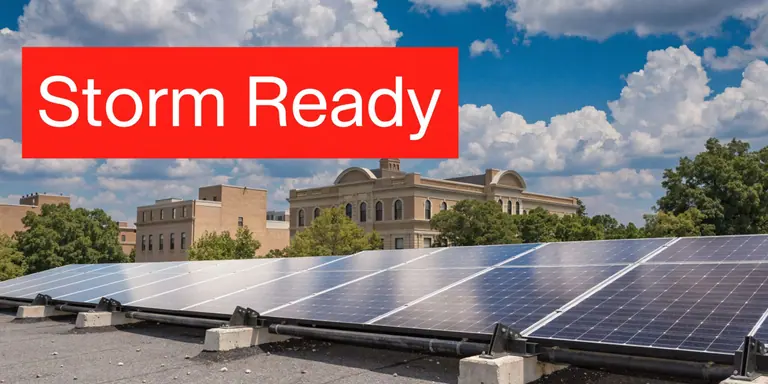
In other words, a “storm-ready” solar system isn’t just about the panel brand. It’s about the whole roof assembly.
For Fort Worth homes, that means the roofer and the solar crew can’t work like strangers on the same project. If one side ignores what the other side needs, leaks and service issues usually follow.
Insurance questions come up early for a reason
Storm-prone homeowners should review how their policy handles roof and solar-related damage before a claim ever happens. A practical starting point is comparing home insurance options so you understand coverage language, deductibles, and how exterior systems may be treated.
If storm damage is already part of the conversation, it also helps to review how policy response can work in real-world situations. This guide on whether homeowners insurance covers storm damage gives a useful homeowner-level overview.
What helps systems hold up better
The strongest outcomes usually come from disciplined installation choices, not marketing claims.
- Attachment planning: Mounts should be placed with the roof structure and waterproofing in mind, not just the fastest layout.
- Racking compatibility: Hardware should fit the roof type and remain serviceable if the roof ever needs repair.
- Roof-first thinking: An aging roof under a new array creates future headaches.
- Clear documentation: Homeowners should have panel maps, equipment records, and install details available when service is needed.
A solar system that survives a storm well is usually one that was installed with reroofing and future service in mind from day one.
What does not work
Two approaches cause trouble in DFW over and over again.
The first is chasing the lowest bid with no serious discussion about roof condition or future detach-and-reset needs. The second is assuming a good roof contractor can “figure out” a solar system later without qualified solar handling.
That’s where many homeowners lose time, money, and warranty protection. The durable choice in Fort Worth is a coordinated one.
The Solar Detach and Reset Process for Reroofing
This is the part most solar articles skip. In Fort Worth, they shouldn’t.
Homes here take sun well, but they also take hail, wind, and repeated storm cycles. Fort Worth’s 4 to 6 annual hail events often necessitate reroofs, and improper handling during solar detach-and-reset can void warranties or extend a system’s ROI by 2 to 3 years based on Palmetto’s Fort Worth solar market page.
What detach and reset actually means
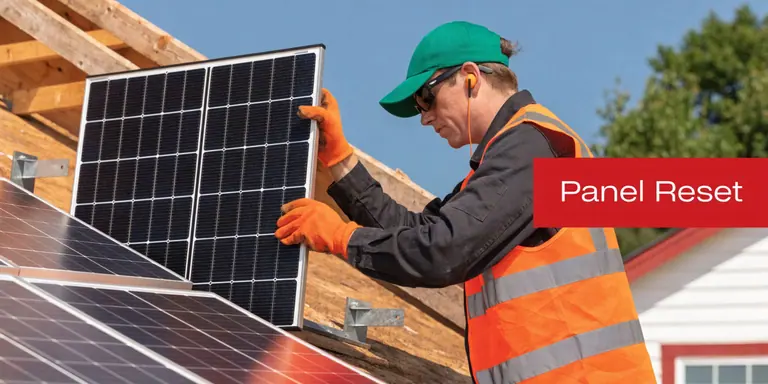
Detach and reset means the solar array is professionally removed so the roofing crew can replace or repair the roof, then the array is reinstalled after the roof work is complete.
That sounds simple on paper. On the roof, it isn’t.
The crew has to document the array layout, disconnect components safely, remove modules and mounting hardware in the correct sequence, protect equipment during storage, preserve roof penetrations properly, and then rebuild the system so it performs the way it did before the reroof. If that chain breaks at any point, the homeowner can end up with leaks, electrical faults, poor production, or warranty disputes.
Why homeowners get into trouble here
A lot of homeowners assume their original installer will handle future roof work, or that any roofer can move panels out of the way. Neither assumption is safe.
Solar equipment is tied into both the roofing system and the electrical system. That means detach-and-reset is not just labor. It’s coordination.
Common failure points include:
- Skipping documentation: If no one maps the original layout, reinstallation can become guesswork.
- Mixing trades loosely: Roof crews and solar crews need a shared schedule, not two separate promises.
- Reusing compromised components: Damaged flashing, rail hardware, or seals create future leak risks.
- Ignoring post-reset testing: The system needs verification after reinstall, not just visual completion.
The practical sequence that works
A competent detach-and-reset usually follows a predictable order.
Pre-roof inspection and documentation
Before removal starts, the system should be photographed and mapped. Equipment locations, wiring paths, attachments, and roof condition all need to be recorded.
This is also the time to identify issues that pre-date the reroof. If a panel, inverter component, or section of racking already had a problem, that needs to be clear before the roof project begins.
Safe removal and storage
The modules come off first, followed by the racking and attachment hardware as needed for the roofing scope. Components should be labeled and handled carefully so the reinstall isn’t slowed by confusion or damage.
The goal isn’t just to get the roof clear. The goal is to make reassembly accurate.
Roof replacement and penetration planning
Once the roof is open, the roofing crew does its work. Here, integrated planning matters most.
The new roof system needs clean attachment points, proper waterproofing details, and a reinstallation plan that doesn’t fight the finished roof. Homeowners dealing with this situation can get a straightforward overview from this page on solar panel roof replacement.
Reinstallation and system checks
After the roof is complete, the array is reset. That includes mounting, wiring, equipment verification, and performance checks.
If a solar reset ends with “the panels are back on,” the job is incomplete. The finish line is a watertight roof and a working system.
Why this matters so much in Fort Worth
In a mild-weather market, detach-and-reset can feel like an edge case. In North Texas, it’s part of lifecycle planning.
That’s why homeowners shopping for solar panels fort worth texas should ask about reroofing before installation day, not after the first hail claim. If the installer has no clear answer for detach-and-reset, the system may be financially attractive up front and difficult to manage later.
Hail King Professionals is one local option that provides solar panel detach-and-reset as part of reroof coordination for solar-equipped homes. That type of combined roofing-and-solar service model matters because it reduces the handoff problems that often show up when two separate companies try to solve one storm-driven project.
Financing Your Fort Worth Solar Installation
The best financing option depends less on the sales pitch and more on what you want from the project. Some homeowners want maximum long-term value. Others want the lowest upfront burden. Those are not always the same path.
This part of the decision should be slow and deliberate. Solar contracts are easy to sign and harder to unwind.

Cash, loan, or third-party agreement
Here’s the straightforward comparison.
| Option | Usually works best for | Main trade-off |
|---|---|---|
| Cash purchase | Homeowners focused on ownership and long-term value | Highest upfront cost |
| Solar loan | Owners who want the system benefits without paying all at once | Financing terms affect overall value |
| Lease or PPA | Homeowners prioritizing lower initial outlay | Less control and less ownership benefit |
Cash purchase
Paying cash is the cleanest structure. You own the system outright, there’s no lender involved, and you avoid the complexity of monthly financing terms.
The downside is obvious. Not every homeowner wants to tie up that much capital in one project, even if the long-term math looks good.
Solar loan
Loans keep ownership with the homeowner while spreading the cost over time. That can make solar workable without a large upfront payment.
The details matter more than the headline monthly number. Ask about dealer fees, interest structure, prepayment terms, and whether the payment still makes sense if you sell the house sooner than expected.
Lease or PPA
A lease or power purchase agreement can reduce the entry barrier, but it changes the relationship. You may get lower upfront friction, yet you usually give up much of the ownership upside.
That can complicate resale conversations and limit how much direct value you keep from the system over time. It’s not automatically wrong. It’s just a different objective.
The right financing choice isn’t the one with the smoothest presentation. It’s the one that still looks sensible five years from now.
One more financing point Fort Worth owners should care about
If the roof needs replacement in the near future, don’t finance the solar project as if the roof doesn’t exist. A weak sequence can turn a manageable payment into a much more frustrating ownership experience.
Some roofing and exterior contractors offer financing that can help homeowners tackle related storm or reroof work without forcing all costs into one immediate out-of-pocket decision. When available, useful features are things like soft credit checks and no prepayment penalties, because they give the homeowner more flexibility instead of less.
How to Choose the Right Solar Installer in DFW
A Fort Worth homeowner can get two solar proposals that look nearly identical on price and panel count, then have two very different ownership experiences over the next ten years. The difference usually shows up after the install. It shows up during permit delays, service calls, hail claims, and roof replacement.
That is why installer selection in DFW has to go beyond equipment brands and projected production. North Texas roofs take real abuse. Any company you hire should be able to explain how the solar system attaches to the roof, how those penetrations are flashed, who services the system later, and what happens if the roof has to be replaced before the panels are at end of life.
Questions that expose whether the company is built for real field conditions
Use these in every estimate meeting.
How do you inspect the roof before finalizing the design?
A good answer includes roof age, shingle condition, decking concerns, drainage areas, and whether the roof has enough remaining life to justify installing solar now.Who handles Fort Worth permitting and Oncor interconnection, and who updates me if something stalls?
Homeowners need one clear point of responsibility, not finger-pointing between sales, installers, and utility paperwork teams.What is your detach-and-reset process if the roof is replaced later?
In Fort Worth, this question matters more than many homeowners realize. Hail damage and reroofing are part of the ownership cycle here. If the company has no defined process for panel removal, storage, roof coordination, and reinstallation, the problem has been postponed.Who does the installation and later service work?**
In-house crews, subcontractors, or a mixed model can all work, but the answer should be specific. Ask who carries responsibility if there is a roof leak or equipment issue after commissioning.What documents do I receive at handoff?
Ask for panel layout, equipment list, permit records, warranty information, shutdown instructions, and photos of key attachment points if available.
Judge the installer with a roofer’s eye
In this market, solar is partly a roofing job. An installer who treats the roof as a flat platform is missing the hardest part of the work.
Look at how they talk about flashing, attachment spacing, attic conditions, and water management around penetrations. Ask what they do if they find brittle shingles, soft decking, or storm damage during pre-install inspection. A company that works cleanly on paper but gets loose around roof details can leave the homeowner with a much more expensive problem than underperforming panels.
Homeowners who want a stronger screening process should review this guide on how to choose a roofing contractor. The same standards apply here. Clear scope, written responsibility, responsive service, and workmanship discipline matter.
Good hardware still needs good installation
Panel and inverter quality matter, but they do not rescue careless field work. This article on understanding the value of quality installations is worth reading because it makes the point plainly. Strong equipment on a weak install is still a weak result.
In Fort Worth, I would add one more filter. Ask whether the installer is prepared for the full lifecycle of ownership in a hail-prone area. That includes post-storm inspection, coordination with roofers, and detach-and-reset planning during reroofing. Many solar sales conversations skip that part. It becomes very important the first time the roof needs work.
The right installer shows how the system will be mounted, documented, serviced, removed if needed, and put back into operation after the roof work is done right.
Frequently Asked Questions About Fort Worth Solar
Will my solar system keep working during a power outage
Usually, a standard grid-tied solar system shuts down during an outage unless it’s designed with battery storage or other backup capabilities. Homeowners should ask specifically what the system does when grid power goes down, not assume the panels alone provide backup.
Do solar panels still work on cloudy days
Yes, but output drops compared with clear, sunny conditions. That doesn’t make solar a poor fit for Fort Worth. It just means production varies with weather, season, roof orientation, and system design.
How much maintenance do rooftop solar panels need
Routine ownership is usually light, but “light maintenance” doesn’t mean “ignore it forever.” Panels should be visually checked after major storms, and any sudden change in system behavior should be evaluated promptly. Roof penetrations and attachment areas also deserve attention over time.
Can my HOA stop me from installing solar
Texas homeowners generally have meaningful protections related to solar access, but HOA rules can still affect how projects are reviewed, documented, and presented. It’s smart to get the association’s requirements in writing before installation begins.
Should I replace my roof before going solar
If the roof is already near the end of its service life, that’s usually the cleaner move. Installing solar and then removing it for reroofing a short time later creates added labor, scheduling complexity, and avoidable risk.
What should I do if I already have solar and now need a new roof
Start with an inspection that looks at both systems together. The question is no longer just “Does the roof need replacement?” It’s also “How will the array be removed, stored, reinstalled, and tested without harming the roof or the solar equipment?”
If you’re dealing with storm damage, planning a reroof, or trying to install solar without creating a future roof problem, Hail King Professionals handles the roofing side and the solar detach-and-reset side with a practical North Texas focus. Start with an inspection, get the roof condition verified, and make the solar decision with the full lifecycle in view.