
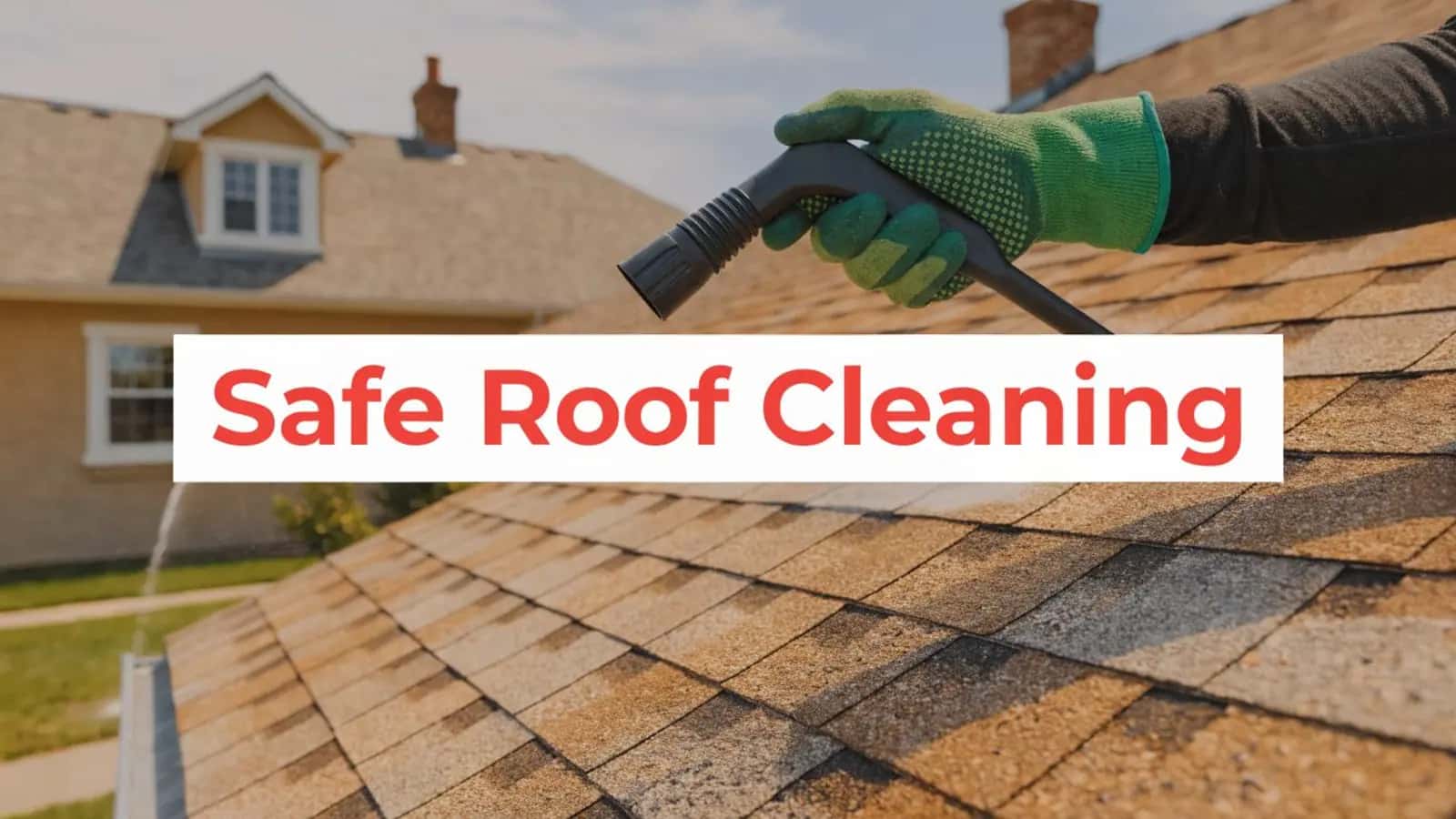
You look up from the driveway and finally notice what's been creeping across the roof for months. The shingles aren't just “dirty.” They're streaked, blotchy, and darker on the shaded side of the house. In Dallas-Fort Worth and East Texas, that usually shows up after a stretch of humidity, tree cover, and long warm seasons.
A lot of homeowners make the same first move. They think about renting a pressure washer, climbing a ladder, and blasting the roof clean in an afternoon. That's the fastest way to turn a maintenance job into roof damage.
If you want to know how to clean asphalt shingle roof surfaces safely, the method matters more than the cleaner. The right approach removes algae without grinding away the shingles that protect your house. The wrong approach can shorten the roof's life, complicate hail claims, and create extra risk if you've got rooftop solar.
Those Black Streaks on Your Roof Are Not Just Dirt
In North Texas, this usually starts on the shaded slope over the garage or the side facing a fence line. In East Texas, it often spreads faster because the roof stays warm and damp for long stretches, and long periods without a hard freeze give algae more chances to keep growing instead of dying back seasonally.
What you're seeing is usually algae staining, not simple surface grime. On asphalt shingles, those black streaks are commonly linked to biological growth that holds on to the shingle surface. That matters because a roof can look worn out from the street even when the issue is staining, not failed shingles.
Why the stain keeps returning
A garden hose rinse may lighten the roof for a week or two. It rarely fixes the cause.
Algae is established on the shingle surface, so a quick wash only removes what is loose at the top. Aggressive cleaning creates a second problem. It can strip granules, shorten shingle life, and leave you with a roof that looks cleaner for the moment but ages faster afterward. On homes in Dallas-Fort Worth, that trade-off is especially risky after hail season. If a carrier inspects the roof later, you do not want cleaning damage mixed in with storm impact marks.
The pattern on the house usually gives it away. If the north or east side of the siding has the same dark film, this guide on how to remove algae from siding is a useful companion because the growth behaves similarly even though the cleaning method changes by surface.
Why Texas homeowners should pay attention early
In East Texas, humidity and tree cover keep roofs damp longer into the morning. In Dallas-Fort Worth, heat, dust, and storm cycles can make staining harder to read from the ground because algae, hail bruising, and normal weathering can overlap visually. Waiting too long turns a simple cleaning decision into a diagnosis problem.
That matters more on roofs with solar panels. The panel edges create shade bands, slow drying, and limit where you can safely walk, so algae often builds in strips around the array. Runoff control also matters more because cleaning solution can contact panel hardware, conduit, painted metal, and landscaping below.
A stained roof is not automatically a worn-out roof, but it should be evaluated with local conditions in mind. If you're comparing maintenance costs against replacement timing, it helps to review the best roofing shingles for Texas so you can separate a cleaning issue from a material-choice issue.
Assemble Your Safety and Prep Toolkit
Don't even climb the ladder until the setup is right. Roof cleaning goes wrong in two places first. Under your boots, and at the downspouts.
A wet asphalt roof gets slick fast, especially where algae is already active. Then add bleach-based solution, runoff on concrete, ladder movement, shrubs below, and electrical equipment around the house. The prep work is the job.
What belongs in your kit
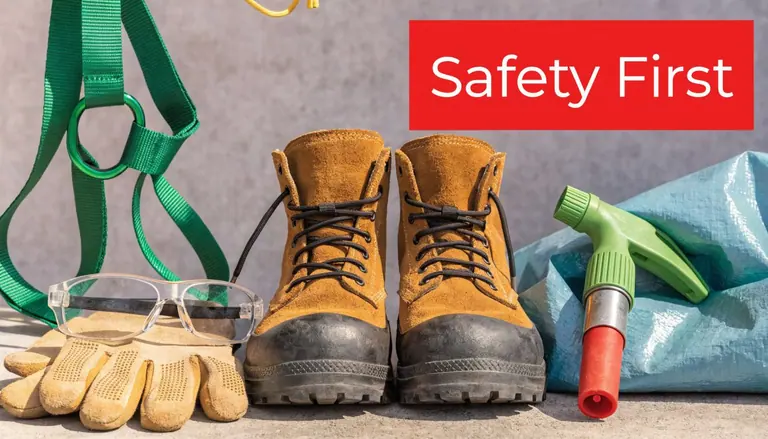
A safe setup starts with the basics:
- Rubber-soled footwear: You need traction that stays predictable on damp shingles. Worn-out sneakers are a bad choice.
- Chemical-resistant gloves: Roof cleaners can irritate skin fast, especially during mixing and spraying.
- Eye protection: Overspray and splash-back happen more than people expect.
- A properly fitted harness: If the roof has noticeable pitch, this stops a slip from becoming a fall.
- A stable ladder with good footing: Set it on firm ground, not mulch, loose gravel, or soft beds.
- Pump sprayer and hose control: You need deliberate low-pressure application, not improvised blasting.
If you handle tools around the house often, this guide on mastering power tool safety on site is worth reading because the same principle applies here. Most injuries come from routine shortcuts, not dramatic mistakes.
Protect the property before you spray
The roof isn't the only surface at risk. Anything below the eaves can catch runoff.
Use this checklist before mixing solution:
- Soak landscaping first: Pre-wet shrubs, flower beds, and grass thoroughly.
- Move outdoor items: Grills, patio cushions, door mats, and anything porous should be out of the splash zone.
- Cover delicate plants: Use light protective covering where needed, but don't trap heat around plants for long.
- Plan runoff paths: Know where the water will drain before you start. Bleach runoff pooling by a foundation wall or walkway creates another problem.
- Keep the hose active on the ground: A second person can keep rinsing plants and splash areas as you work.
Practical rule: If you haven't thought through where every gallon of runoff is going, you're not ready to spray.
Inspect before cleaning
A quick visual inspection can save you from cleaning over damage. Look for curled tabs, cracked shingles, exposed nail heads, loose flashing, or soft decking feel underfoot. If you're not sure what to check, a roof inspection checklist template helps you document the roof before any cleaning starts.
That matters in Texas because once the roof is wet and chemically treated, subtle problem areas can be harder to evaluate accurately.
The Right Cleaning Solution for Your Roof
The cleaner matters because asphalt shingles are a roofing product, not a patio surface. The wrong mix can bleach metal, burn landscaping, leave uneven streaks, or shorten the life of the roof by pushing homeowners toward aggressive scrubbing after a weak result.
For black algae streaks, the standard starting point is a simple mix of laundry-strength liquid chlorine bleach and water. As noted earlier, that manufacturer-backed approach is the baseline many roofers use for asphalt shingles because it kills the growth instead of relying on force to remove it.
In Texas, timing matters almost as much as the recipe. A roof in Dallas-Fort Worth can heat up fast, even on a day that feels mild at ground level. If the shingles are hot, the solution dries too quickly, dwell time drops, and the cleaning gets patchy. East Texas adds a different problem. Higher humidity supports faster regrowth, so a weak cleaner that only lightens the stain often means you will be back on the roof sooner than you want.
When the standard bleach mix makes sense
A 50:50 bleach-and-water mix fits the typical asphalt shingle roof with algae staining and no special material restrictions. It is straightforward, available at any hardware store, and familiar to roof cleaners for a reason.
Some contractors add a small amount of TSP for stubborn organic buildup. That can help, but restraint matters. More chemical is not better. On an older roof, or one with nearby painted surfaces, window screens, or sensitive landscaping, stronger mixes raise the chance of collateral damage without giving you a better roof.
A few practical rules keep the solution safer and more predictable:
- Use fresh bleach: Old product loses strength sitting in the garage.
- Mix only what you need that day: Leftover roof mix should not sit around in unmarked containers.
- Do not combine random cleaners: That is how homeowners create dangerous fumes and stain exterior finishes.
- Test a small area first: One section tells you how the roof, gutters, and runoff areas will react before you treat the whole slope.
Commercial cleaners and gentler alternatives
Premixed roof cleaners appeal to homeowners who want labeled instructions and less measuring. That convenience has value. The trade-off is performance can vary, and the label still needs to say it is safe for asphalt shingles.
Oxygen-based cleaners are the gentler option many homeowners ask about, especially around flower beds, koi ponds, or tight side yards. They can work on light staining. On a heavily streaked roof in humid East Texas, they often underperform compared with a bleach-based soft wash. Homeowners then repeat the job, scrub harder, or decide the roof needs replacing when it really just needs the right treatment.
If the house has solar panels, be more selective. Runoff can leave residue on panel glass, and overspray around wiring, mounts, and sealants is a bad place to experiment with homemade mixes. In that situation, the safest choice is often a conservative roof cleaner and tighter application control, even if the cleaning takes longer.
Roof Cleaning Solution Comparison
| Solution Type | Best For | Pros | Cons / Cautions |
|---|---|---|---|
| Bleach and water 50:50 | Typical algae streaks on asphalt shingles | Proven baseline for asphalt roof algae cleaning, widely understood in the trade | Requires careful plant protection, safe handling, and low-pressure application |
| Bleach mix with a small amount of TSP | Stubborn organic staining | Better penetration on tough buildup when used correctly | Needs careful mixing and restraint, more isn't better |
| Premixed commercial roof cleaner | Homeowners who want convenience and product labeling | Easier measuring, often straightforward instructions | Must confirm compatibility with asphalt shingles, results vary by product |
| Oxygen-based cleaner | Lighter staining or homeowners prioritizing a gentler product profile | Often viewed as less harsh on surrounding areas | Usually slower and less effective on embedded algae staining |
What about dish soap or surfactant
A small amount of surfactant can help the solution cling on steeper slopes, which improves contact time. The keyword is small. Too much soap creates excess runoff and more residue in gutters and downspouts.
Dish soap is where homeowners get into trouble. It sounds harmless, but improvised mixes create inconsistent results and can leave a film behind. On a roof, simple and controlled beats creative every time.
One last trade-off matters in hail country. If your shingles may have storm damage, avoid any recipe or method that could muddy the insurance conversation later. A basic, recognized cleaning solution used gently is easier to defend than a harsh mix, heavy scrubbing, or visible granule loss after cleaning.
Applying the Cleaner with a Soft Wash Technique
Homeowners either protect the roof or ruin it at this stage. The safe method is soft washing, not pressure washing.
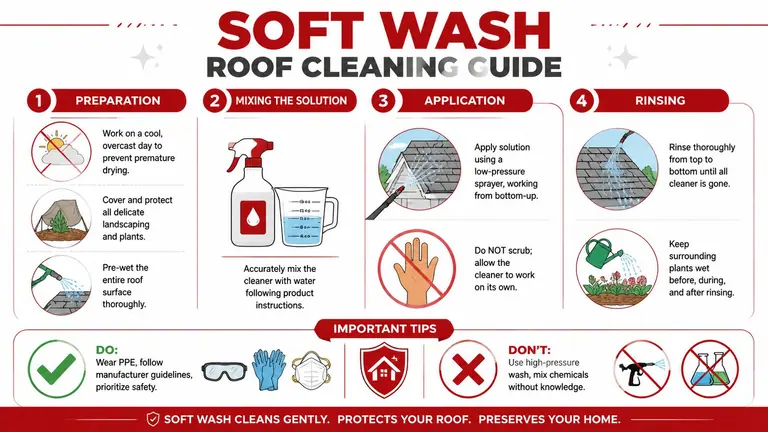
Start on a cool, overcast day so the solution has time to work. If the roof is hot and the cleaner flashes off, you lose dwell time and increase the chance of uneven results.
Step one, wet and protect the area
Before spraying cleaner, wet the surrounding landscaping again. Keep the hose ready on the ground. If one side of the house drains toward flower beds or decorative shrubs, pay extra attention there.
Then check the roof surface for loose debris. You're not scrubbing. You're just removing branches, leaves, or anything that blocks the cleaner from reaching the shingles evenly.
Step two, apply with low pressure
Use a garden pump sprayer or similar low-pressure setup. The goal is coating, not force.
Apply the cleaning solution evenly, working in manageable sections. Many roofers work carefully to avoid streaking and overlap marks. The main point is consistency. Every treated section needs enough solution to stay wet through the dwell period.
Don't chase a “like new” look with pressure. On asphalt shingles, force is the enemy.
Let the cleaner dwell for the recommended period used in the ARMA-style process. Don't let it dry fully on the roof. If a section starts drying too quickly, conditions aren't in your favor and you need to adjust.
A video demonstration helps if you've never seen the sequence in motion:
Step three, rinse from the top down
Once the solution has had time to work, rinse thoroughly with a standard garden hose using low pressure. Start high and let gravity do the work. You want a steady rinse that clears residue without forcing water up under the tabs.
Don't stand there trying to peel every dark mark off in one pass. Some staining lightens immediately, and some continues to improve after treatment. The mistake is getting impatient and switching to brute force.
What never to do
The biggest error is using a pressure washer on shingles. Pressure washing at over 1,500 PSI can dislodge 30-50% of a shingle's protective ceramic granules in a single pass, and the NRCA attributes 65% of premature shingle failures to improper cleaning methods, primarily granule loss from high-pressure washing, as summarized in Owens Corning's asphalt shingle cleaning guidance.
That damage isn't always dramatic in the moment. Sometimes it shows up as excessive granules in the gutters, shiny exposed spots, accelerated aging, or leaks later on.
High-pressure roof cleaning often “works” visually. That's why people keep doing it. The roof pays for it afterward.
Avoid these common DIY mistakes as well:
- Aggressive scrubbing: Stiff brushes grind away the surface.
- Spot treating with random household chemicals: You can bleach one patch differently from the rest of the roof.
- Walking the roof more than necessary: Foot traffic itself can scuff warm shingles.
- Ignoring runoff: Cleaner on brick, painted trim, or plants can create a second cleanup job.
If you remember one thing from this section, it should be simple. Clean with chemistry and patience, not with impact.
Special Considerations for Texas Hail and Solar Country
A common North Texas mistake goes like this. A storm drops pea-size or golf-ball hail overnight, the roof looks dirty the next morning, and the homeowner decides to clean it before anyone documents the condition. That can create a bigger problem than the algae ever did.
Humidity in East Texas and shaded roof planes around Dallas-Fort Worth keep algae active longer than many homeowners expect. That raises the urge to clean fast. In hail country, fast is not always smart.
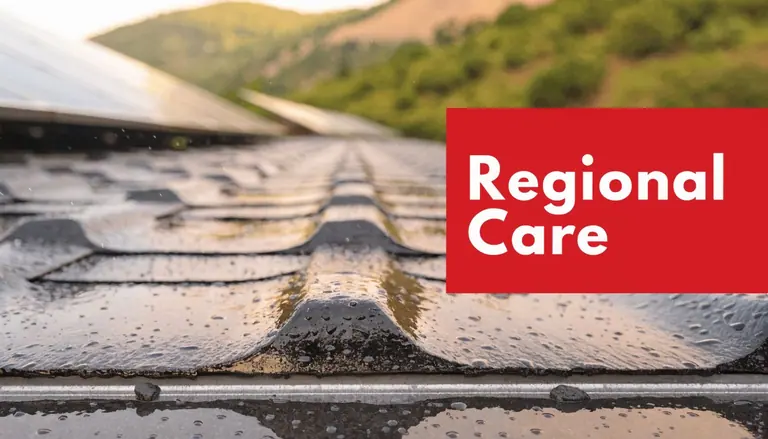
Hold off if a storm may have damaged the roof
If hail moved through recently, leave the roof alone until it has been checked. Cleaning can disturb loose granules, blur fresh impact marks, and give the carrier one more angle to argue wear versus storm damage. That is a bad trade in Texas, where claim timing and documentation matter.
The same roof-cleaning guidance cited earlier notes two related risks in hail-prone areas and on solar homes. Cleaning before an adjuster or roofer documents the roof can complicate hail claims, and amateur work around solar equipment raises the chance of moisture-related problems under and around the array, according to American Remodeling's roof-cleaning guidance for hail-prone homes with solar.
A cleaner roof does not help if the photos, granule condition, and shingle bruising are no longer easy to read.
Solar changes access, runoff, and liability
Solar panels make simple roof cleaning less simple. The field under the panels stays shaded, which often means heavier staining. At the same time, mounts, wiring paths, and tight working space limit where you can stand, where you can spray, and where runoff goes.
I treat those roofs differently for one reason. Small mistakes are harder to reverse. Push solution under a panel skirt, soak a poorly flashed penetration, or force water toward electrical components, and the cleaning job turns into a repair job.
If you hire this out, ask whether the contractor has worked around solar arrays before, how they protect panel wiring and mounts, and what insurance they carry. Homeowners often assume "insured" covers everything. It does not always mean the same thing as bonding, and this quick explanation of the difference between being bonded and insured is worth reading before you sign anything.
A Texas-specific order of operations
For Dallas-Fort Worth and East Texas homes, the safest sequence is usually:
- After a hailstorm: Check the roof from the ground and photograph what you can see.
- If you suspect damage: Get a roofer to inspect before any cleaning.
- If the roof has solar panels: Confirm whether the work needs roofing and solar coordination instead of a standard wash.
- If the issue is only algae staining: Clean during a stretch of mild, dry weather so the solution can work predictably.
- If you are hiring help: Use this guide on how to choose a roofing contractor and ask direct questions about soft washing, runoff control, storm-damage documentation, and solar experience.
Texas roofs deal with heat, humidity, hail, and long insurance timelines. Cleaning has to fit that reality, not just the stain pattern you see from the driveway.
Know When to Call a Roofing Professional
Some roofs shouldn't be DIY cleaned. That's not fear-based advice. It's the practical line between manageable maintenance and unnecessary risk.
Call a professional if the roof is steep, high, visibly damaged, heavily mossed, or partially blocked by solar equipment. The same goes for two-story homes where ladder setup, hose management, and runoff control get harder fast. Once you're balancing on a slope while handling chemical solution, “simple” changes meaning.
Signs the job is bigger than it looks
A few red flags should stop a DIY plan:
- Steep pitch: If the roof feels sketchy to stand on, that's your answer.
- Visible shingle damage: Cracking, curling, missing tabs, or exposed areas need evaluation before cleaning.
- Thick moss or lifted shingle edges: Cleaning may expose underlying issues or make the surface unstable.
- Solar arrays, skylights, or complex valleys: These details raise the skill level of the job.
- Recent storm concerns: A roof with possible hail damage shouldn't be cleaned first.
Hiring a roofer isn't admitting defeat. It's choosing not to gamble with a roof system that protects the whole house.
Vet the contractor, not just the price
When you do hire out the work, ask how they clean asphalt shingles, what pressure they use, how they protect landscaping, and how they handle storm-damage documentation. Also verify insurance and credentials. If you want a quick primer on contractor protections, this explanation of the difference between being bonded and insured is a useful read.
For a broader hiring checklist, this guide on how to choose a roofing contractor will help you sort serious pros from low-bid shortcuts.
If your asphalt shingle roof in Dallas-Fort Worth or East Texas needs a safe evaluation before cleaning, storm documentation after hail, or coordinated work around rooftop solar, Hail King Professionals can help. Their team handles inspections, roof repair and replacement, and solar detach-and-reset with a Texas-specific understanding of humidity, hail exposure, and insurance-sensitive roof conditions.