
A lot of North Texas homeowners don’t start thinking about gutters until the first hard storm exposes every weakness at once. Rain hits the roof fast, water jumps over the front edge, corners drip like a faucet, and the mulch bed below turns into a trench. By the time the storm passes, the siding is streaked, the flower beds are washed out, and the soil around the slab is soft.
That’s usually when people realize the gutter system wasn’t a small trim detail. It was part of the drainage system protecting the whole house.
In Dallas-Fort Worth and East Texas, that matters more than most homeowners expect. Sudden downpours, hail, wind, heat, and long dry stretches all punish weak gutter installations. A quick patch may stop one visible leak, but it won’t fix bad slope, poor downspout layout, undersized runs, or loose attachment into compromised fascia. That’s where the difference shows between a basic install and the kind of work people mean when they search for experts in continuous gutter systems.
Your Home's First Defense Against Texas Weather
If your gutters sound like they’re losing a fight every time a thunderstorm rolls through, the problem usually isn’t the rain. It’s the system trying to handle more water than it was built or installed to move.
In this part of Texas, a failing gutter system leaves clues fast. Water spills over entryways. Corners stay wet long after a storm. Soil pulls away in one area and piles up in another. You may even see small cracks, splashing against brick, or dark lines on fascia boards. None of that is harmless. It means runoff isn’t being controlled.
A lot of homeowners focus on the gutter itself and miss the bigger drainage path. Gutters have to collect water, downspouts have to move it, and discharge points have to carry it away from the house. If that last part is weak, you can still end up with foundation trouble even after replacing the gutter runs. That’s why it helps to understand broader effective foundation drainage solutions before you sign off on any exterior water-management work.
Water doesn’t need a major opening to cause damage. It just needs a repeatable path.
The other issue is timing. Many homeowners wait until the gutters detach, rust through, or visibly leak. By then, the damage may already involve fascia, soffit, landscaping, paint, or movement around the slab edge. If you’re still deciding whether your house needs a full gutter upgrade or just maintenance, this guide on why a house needs gutters is a useful place to start.
What works in Texas is simple in principle, not always simple in execution. You need a gutter system that fits the roofline correctly, sheds water predictably, and holds up after repeated storms instead of just looking straight on install day.
What Exactly Makes Seamless Gutters Superior
In North Texas, gutter failures usually start in the middle of the run, not at the downspout. The weak spots are the joints, the sealed corners, and the places where short sections were pieced together fast to hit a price point. A custom-formed continuous run removes most of those trouble spots before the first hard rain or hail season.
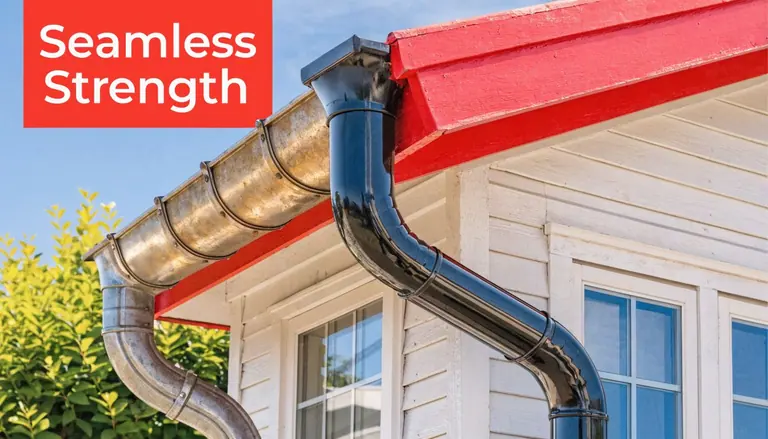
That matters more in Texas than it does in milder climates. Heat expansion works fast on metal. Sudden downpours expose every bad slope and every weak connection. Then hail season adds another layer. If the roof sheds granules after a storm or an insurance claim leads to partial exterior work, the gutter system needs to keep performing as part of the whole water-shedding assembly, not as an afterthought.
Why continuous runs hold up better
Sectional systems depend on more connectors and more sealant. Those are maintenance points. The longer they sit in sun, debris, and standing water, the more likely they are to dry out, separate, or catch buildup that slows flow.
A single formed run cuts down on those failure points. It also gives the installer better control over pitch, outlet placement, and overall appearance along the fascia. Homeowners comparing seamless vs regular gutters usually notice the cleaner look first, but the primary benefit is fewer places for water to get out where it should not.
Where pieced-together systems usually fail
The pattern is predictable.
- Joint separation: Seasonal movement and storm vibration stress the connectors first.
- Sealant fatigue: A clean bead on install day does not mean much after repeated UV exposure and backed-up water.
- Debris catch points: Leaves, grit, and shingle granules hang up at transitions more than they do in a single formed run.
- Uneven flow: More parts usually means more chances for a low spot, especially on longer elevations.
That last point gets missed a lot. Overflow is not always caused by undersized gutters. Sometimes the profile is adequate, but the run was assembled with too many interruptions to move water efficiently during a Texas cloudburst. That is why homeowners dealing with intense runoff should review options for gutters built for heavy rain before choosing based on price alone.
What better performance looks like on a real house
A good system stays quiet and boring. Water drops in cleanly, moves without pooling, exits where it should, and clears the foundation zone without washing out beds or splashing mud onto brick. After a hail event, it should still line up straight, stay tight to the fascia, and work with the roofing and drainage plan the insurance adjuster or contractor is documenting.
That is the bigger advantage. A continuous gutter run is not just a nicer trim detail. It is a more dependable part of a storm-ready exterior, especially on homes where roofing, fascia, soffit, and drainage all have to work together through repeated North Texas weather cycles.
Choosing the Right Materials and Design for Your Home
Most homeowners start by asking which gutter material is best. The better question is which material fits your house, your storm exposure, and your tolerance for maintenance. In North Texas, material choice isn’t just about looks. It affects how the system handles hail, heat, and long-term wear.
The materials most homeowners consider
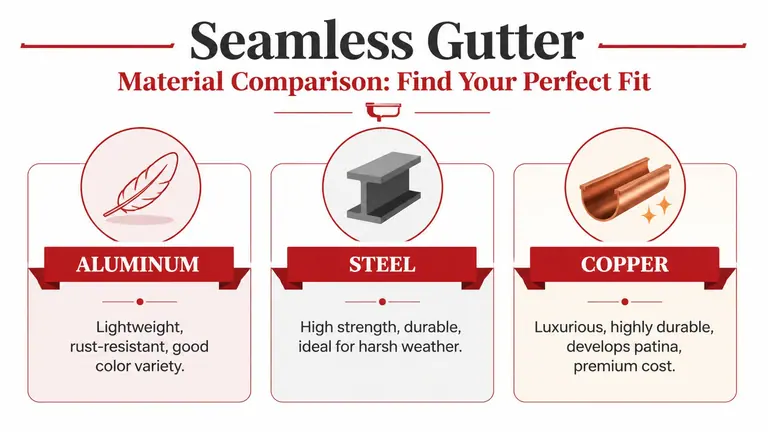
Aluminum is the common choice for a reason. It’s lighter, resists rust, and offers broad color availability. For many homes, it’s the right balance of durability, appearance, and manageable cost. In tougher weather exposure, heavier aluminum matters. The verified installation data notes that continuous-run gutters are typically formed from .027-inch aluminum or .032-inch material for premium installations, and that .032-gauge aluminum is often specified where greater impact resistance is needed.
Steel gives you more rigidity, but that added strength comes with trade-offs. It’s heavier, can be harder on poor fascia if the attachment is sloppy, and demands more attention to coating condition over time. If a contractor pushes steel as automatically better without talking about your roof edge condition, that’s not careful planning.
Copper is the premium lane. It’s durable, distinctive, and chosen as much for appearance as performance. It also requires a homeowner who wants the patina and understands that repairs or additions need matching craftsmanship.
Shape matters too
Material gets the attention, but profile matters. K-style gutters fit most Texas homes because they move water efficiently and blend well with standard residential trim lines. Half-round systems can look great on the right architecture, but they aren’t the default answer for every roofline.
If your roof dumps a lot of water into concentrated valleys, broad eaves, or long straight runs, sizing and downspout layout matter more than decorative style. Homeowners sorting through heavy-rain performance questions can also review gutter options for heavy rain before deciding on profile and size.
Seamless Gutter Material Comparison
| Material | Average Cost (Per Foot) | Lifespan | Best For |
|---|---|---|---|
| Aluminum | Varies by thickness, finish, and local labor | Long service life with proper installation and maintenance | Most Texas homes needing rust resistance and color flexibility |
| Steel | Typically higher than aluminum | Long-lasting when coating remains intact | Homes exposed to tougher impact or where added rigidity is preferred |
| Copper | Premium cost | Very long-lasting with skilled installation | High-end homes where appearance is part of the investment |
What I’d tell a homeowner in DFW
If the house has normal residential architecture and the owner wants practical long-term value, aluminum is usually the conversation. If the property gets repeated hail and the owner is already investing in impact-resistant roofing, heavier-gauge aluminum deserves serious attention.
Don’t let a contractor reduce the decision to color and price. Thickness, profile, attachment, and discharge planning affect performance more than showroom samples do.
The design should fit the roof geometry, not just the front elevation. Good-looking gutters that overflow at the first valley discharge aren’t good gutters.
The On-Site Gutter Installation Process Explained
A crew pulls up to a North Texas house the morning after a stormy week. If they start feeding coil through the machine before checking fascia, roof valleys, and discharge paths, the job is already headed toward callbacks. Good installation work starts with inspection, layout, and water control planning.
What happens before the first gutter run is formed
The best-looking jobs often begin slower than homeowners expect. The crew measures each run carefully, checks whether the fascia is straight and solid, and marks the areas where roof valleys dump a heavy volume of water. They also plan where downspouts can discharge without soaking flower beds, splashing by entry walks, or adding water near the foundation.
That early inspection matters even more in Texas because gutter work often follows hail or wind damage. A house may already have loosened drip edge, swollen trim, or roofline irregularities left behind by the last storm. If those problems are covered up instead of corrected, the new system inherits the same failure points.
How the on-site forming works
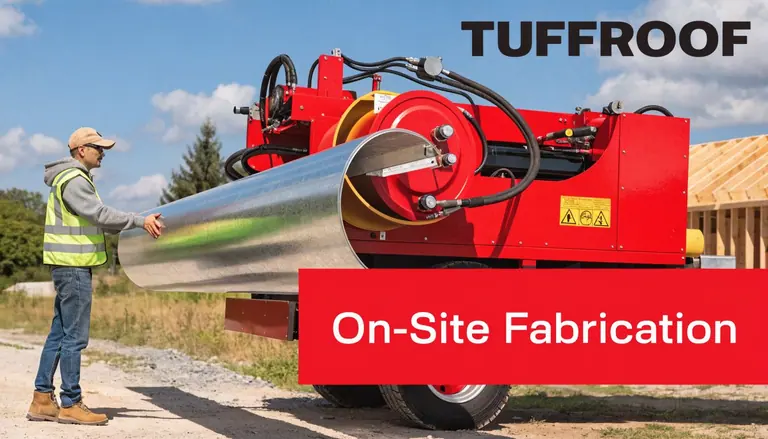
These gutters are formed on-site with a truck-mounted roll-forming machine. The benefit is simple. Each run is made to the exact length of the house, which cuts down on joints and reduces the weak spots where leaks usually start.
The machine is only part of the story. Workmanship shows up in the details:
- Accurate measurements: Each run should land cleanly at the corners and ends without field fixes that look forced.
- Proper pitch: Installers typically set a slight fall, often around 1/4 inch for every 10 feet, so water moves toward the outlet instead of sitting in the trough.
- Solid fastening: Hidden hangers need even spacing and they need to bite into sound wood, not soft fascia wrap or rotted backing.
- Clean outlets and end caps: Sloppy cuts, heavy sealant, and rough miters are the signs I watch for first.
A fast install can still be a bad install.
Downspouts decide whether the system actually works
A lot of overflow problems start with poor downspout planning, not the gutter profile itself. Long runs need enough exits, and those exits need to be placed where water can leave the house area efficiently. If a contractor treats downspouts like an afterthought, the whole system is being set up to hold more water than it should during a hard Texas rain.
That matters after hail events too. Once roofing, flashing, and edge metal have taken a hit, the next storm exposes every weak point. Gutters and downspouts should be planned as part of the same exterior drainage strategy, especially if the homeowner may be documenting storm damage for an insurance claim. Adjusters notice obvious overflow staining, fascia rot, and drainage patterns that suggest long-term neglect.
If water has to travel too far before it can exit, the gutter turns into a temporary trough under peak rainfall. That is a poor setup in DFW storm season.
For homeowners who like seeing the fabrication process in action, this short video gives a useful visual of what a field setup can look like.
What you should watch on installation day
Homeowners can spot a careful crew without knowing every trade term.
- Look at the fascia first: If the backing is soft, warped, or split and they install over it anyway, expect sagging later.
- Watch how they handle corners: Tight miters, neat outlets, and controlled sealant application usually mean the installer cares about the rest of the job too.
- Check the downspout exits: Water should be directed away from the slab, not dumped beside the house where it can wash out beds or load the foundation.
- Ask whether they test drainage: A crew that runs water through the system before leaving is checking its work, not guessing.
Crews in other storm markets deal with the same basic rule. Water has to leave the structure fast and in a controlled path. For another regional example, this guide on protecting Flagstaff homes from monsoons shows how climate-specific planning changes installation decisions.
Protecting Your Home from Hail and Storm Damage
A North Texas storm rarely ends when the hail stops. The next hard rain is what exposes weak spots fast. If roof edges are damaged and the gutter system cannot carry water out cleanly, runoff starts soaking fascia, spilling at corners, and loading soil around the house.
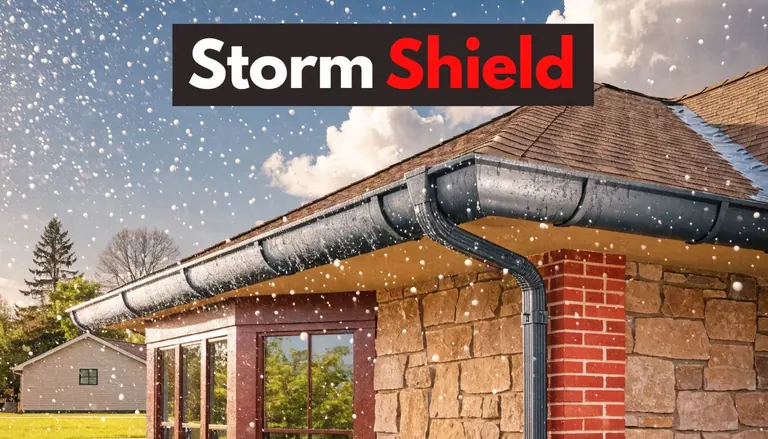
That sequence is common in Dallas-Fort Worth. Hail bruises shingles, dents metal, and loosens roof accessories. Wind can lift tabs and disturb the edge where water is supposed to drop into the gutter. Then the next storm tests the whole exterior at once. A loose, undersized, clogged, or badly pitched gutter run turns roof damage into trim rot, soffit stains, splashback, and erosion near the foundation.
Roof and gutter work need to be planned together
Storm repair gets cleaner when the roof, gutters, and downspouts are treated as one exterior system. A new roof can change drip edge alignment, flashing relationships, and how fast water reaches certain sections. If that roof is upgraded to a hail-resistant shingle and the drainage edge is left weak, the house is still exposed to secondary water damage.
This is also where good contractors separate themselves from crews chasing quick insurance work. They do not just replace visible damage. They check whether the gutter size still matches the roof area, whether downspout locations make sense, and whether discharge is being pushed far enough from the slab. Homeowners comparing pricing can get a clearer picture by reviewing typical gutter installation cost per linear foot before approving storm-related scope.
Insurance claims go smoother with full exterior documentation
Claims often get messy when one company writes up the roof and another looks at gutters weeks later. Photos are missing. Damage dates get harder to tie together. Overflow staining, fascia damage, and washout around the home may never make it into the file even though they are part of the same storm event.
The better approach is simple. Document the exterior as a connected system:
- Roof condition: hail hits, lifted shingles, damaged flashing, dented vents, and edge metal issues
- Gutter condition: dents, loose attachment, separation at joints or corners, sagging, and overflow marks
- Downspout discharge: where stormwater is landing and whether it is being carried away from the foundation
- Collateral effects: fascia staining, soffit moisture, washed-out beds, and soil movement near the house
One practical option in this market is Hail King Professionals, which handles roofing, gutters and downspouts, storm inspections, and insurance-related exterior work for homes in Dallas-Fort Worth and East Texas. The main advantage in that setup is coordination. One inspection can connect hail damage, drainage failure, and repair scope before the claim gets fragmented.
How to Hire a True Gutter Professional in North Texas
A North Texas storm can dump a lot of water on a house in a short window. If the installer gets the slope wrong, undersizes the outlets, or fastens into rotted fascia, the system can fail the first time a hard rain hits. Hiring the right contractor is less about the sales pitch and more about whether the crew knows how to build for Texas weather and tie that work into the rest of the exterior.
Start by looking for proof that the company is stable, local, and accountable. A clean estimate helps, but the better signal is whether they can explain attachment method, runoff path, fascia condition, and what happens at roof valleys where water volume spikes. In storm country, that matters as much as the metal itself.
What to verify before you hire anyone
Check the basics first, then push deeper.
- Confirm legal standing: Verify business registration and ask who will perform the work.
- Ask about insurance coverage: A legitimate contractor should clearly explain liability coverage and worker protection.
- Look for North Texas storm experience: Crews in this market need to account for hail, fast runoff, summer heat, and seasonal wood movement.
- Review the full scope: Bids should spell out fascia repair, downspout extensions, haul-off, and any leaf protection so you can compare apples to apples.
- Read the warranty language: Find out what is covered for leaks, finish failure, loose attachment, and service callbacks.
One example of the paper trail a contractor should have is Gutter Masters, Inc., a Florida company founded on July 17, 2008 by owner Elbyn Del Rio, with BBB accreditation achieved on July 12, 2012 and an active Florida business license listed as 11-AL-17275-X, set to expire on June 30, 2026, according to the company’s Florida corporate record. The point is simple. Any contractor asking to work on your Texas home should be just as easy to verify.
The questions that expose a quick fix
Ask where the downspouts will terminate and how water will be carried away from the foundation. If the answer is vague, the planning is vague too.
Ask what they do when they find soft fascia behind the existing gutter. Good crews see that issue often, especially after years of overflow or after hail claims where the roof got attention but the trim did not. You want a repair plan in writing, with pricing or unit costs spelled out before work starts.
Ask how they size the system. A real professional will talk about roof area, valleys, long runs, outlet count, and where heavy water concentration occurs. That discussion also affects price, which is why it helps to review typical gutter installation cost per linear foot before comparing bids tied to storm repairs or insurance scope.
One more question matters in this market. Ask whether the contractor can coordinate the drainage work with roofing and storm damage documentation. In North Texas, gutters, drip edge, fascia, and roof damage often show up in the same claim. A contractor who understands that connection can help you avoid scope gaps and missed items.
What good workmanship sounds like
Good installers sound specific. They talk about pitch, hanger spacing, outlet placement, fascia condition, and discharge location. They also explain trade-offs. Bigger systems move more water but cost more. More downspouts improve drainage but can create ugly terminations if the layout is careless. Guards can reduce debris buildup, but they do not eliminate maintenance.
They also do not use sealant as the answer to every problem.
If a contractor says every house needs the same profile, promises zero maintenance, or brushes past rotten wood and storm damage so they can keep the bid low, keep looking. In this part of Texas, quality work means building a water-control system that holds up under hail season, hard rain, and the insurance paperwork that often follows.
Investing in Your Home's Long-Term Value and Safety
Good gutters protect more than the roof edge. They protect fascia, siding, landscaping, entry areas, and the soil around the foundation. They also reduce the small repeat problems that turn into expensive exterior repairs.
That’s why this decision is bigger than replacing old metal with new metal. The right system is sized correctly, formed on-site, installed with proper slope, and tied into a discharge plan that fits Texas weather. When hail and heavy rain show up together, that planning pays for itself in fewer weak points and less water where it doesn’t belong.
For homeowners comparing bids, the smartest move is to treat gutters as part of the whole storm-protection system. If the roof, drainage path, and installation details are handled together, the house performs better and the repair process gets simpler.
Turn the Gutter Bid Into a Complete System
A seamless run is only one part of a durable installation. Hail King also plans slope, fastening, outlets, downspouts, discharge, and appearance around the property. Review its complete approach to gutter installation in Dallas, TX.
If your gutters overflow, pull away from the fascia, or you’re replacing a storm-damaged roof, Hail King Professionals can inspect the full exterior and help you understand what needs repair, replacement, or drainage correction. A clear inspection gives you a practical plan before the next storm tests the house again.