
Most homeowners in DFW and East Texas end up somewhere around $9,000 to $25,000+ for a full residential roof replacement. A simple shingle roof can land near the lower end, while larger roofs, premium materials, hail-resistant upgrades, and any needed deck repairs can push the final number much higher.
That’s usually the point where people start feeling stuck. You find shingles in the yard after a storm, spot a ceiling stain, or get an insurance adjuster scheduled, then a contractor hands you a quote full of terms like squares, synthetic underlayment, starter, ridge cap, and flashing. The number is large, but the bigger problem is not knowing whether it’s reasonable.
In North Texas, roof pricing isn’t just about size. Hail risk changes material choices. Insurance claim work changes timing and paperwork. Solar panels, steep slopes, multiple roof lines, and code-related updates all change labor. The residential roof replacement cost for two houses with similar square footage can still come out very different.
A national average is useful for context, but it won't tell a Dallas, Fort Worth, Tyler, or Longview homeowner what really drives the final contract price. Texas roofs live through hail, wind, heat, and fast weather swings. That means the right question isn’t only “What does a new roof cost?” It’s “What am I paying for, what should I upgrade, and what can I avoid?”
Your Guide to Understanding Roof Replacement Costs in Texas
A North Texas roof can look fine from the driveway and still be one storm away from a full replacement. Homeowners usually find themselves here after hail, lifted shingles, a ceiling stain, or an adjuster appointment is already on the calendar. The first question is cost. The harder question is what that price should include in Texas.
Texas pricing has its own rules. Hail exposure changes which materials make sense. Insurance claim timing can affect how quickly work gets approved and scheduled. Heat, wind, and sudden weather swings also punish cheap details, especially around vents, valleys, flashing, and ridge lines. That is why two homes with similar size can end up with very different replacement totals.
The primary issue is scope.
One proposal may include full tear-off, code-required components, upgraded underlayment in vulnerable areas, new flashing where needed, ventilation corrections, and a clean magnet sweep at the end. Another may show a lower price but leave decking repairs, chimney flashing, or permit-related items open. Homeowners often compare the total at the bottom before confirming whether both quotes cover the same roof system.
That mistake gets expensive fast in DFW and East Texas, where hail claims are common and insurers look closely at line items.
What homeowners need to know before signing
A good roof replacement quote should answer four basic questions clearly:
- How much roof area is being replaced: Roof pricing is based on measured roof surface, not interior square footage.
- Which material is being installed: Architectural shingles, Class 4 impact-resistant shingles, and metal all carry different upfront costs, insurance implications, and hail performance.
- How difficult the labor will be: Steep slopes, multiple facets, second-story access, detached structures, and solar panels all affect labor time and safety setup.
- What could change after tear-off: Rotten decking, hidden flashing failures, and storm damage below the shingles are common change-order items in Texas.
Class 4 shingles deserve special attention here. They cost more up front, but in hail-prone areas they can reduce repeat damage, lower the chance of another deductible-sized repair cycle, and sometimes help with insurance discounts depending on the carrier. That is not the right choice for every homeowner, but it is often worth pricing side by side with standard architectural shingles before signing a contract.
The goal is not to chase the cheapest number. The goal is to understand what you are buying, what risk you are keeping, and which upgrades pay off in a Texas climate.
The Anatomy of a Professional Roofing Quote
A homeowner in DFW gets three bids after a hailstorm. One is a one-page number. One is packed with line items the homeowner does not recognize. One sits in the middle on price but explains the work. The third quote is usually the one worth studying, because a roof estimate should show where your money goes and what risk stays with you if something is left out.
A roofing quote starts with measurement. Roofers price by squares, and one square means 100 square feet of roof surface. That matters because your roof area is usually larger than your home’s interior square footage. Pitch, overhangs, hips, valleys, dormers, and attached sections all add surface area, which is what gets torn off, dried in, and installed.

What a square means in real life
If a roof measures 18 squares, the contractor is pricing roughly 1,800 square feet of roof surface. That does not mean the house is 1,800 square feet inside. I have seen single-story homes with simple footprints come in close to interior square footage, and I have seen cut-up two-story roofs run much higher because of steep sections, garage tie-ins, and waste from complex cuts.
That is why a serious contractor measures the roof instead of guessing from county records or interior floor plan size. Good companies usually use aerial measurement reports, then confirm key details on site. If someone gives you a firm number from the driveway without measuring, treat that as a warning sign.
Where the money actually goes
A professional quote usually breaks into two big buckets. Materials and labor. In Texas, labor is not just the crew installing shingles. It also covers tear-off, jobsite protection, steep-slope safety setup, haul-off, flashing work, vent work, and the extra time detail areas require.
That labor scope gets more expensive fast on storm jobs.
A simple walkable roof in mild weather is one thing. A two-story roof in August, with high ridges, brittle old shingles, chimney flashing, and landscaping that needs protection, is a different job entirely. After major hail events in North Texas, labor pricing can also tighten because qualified crews are booked up and project scheduling becomes harder to control.
A proper labor scope usually includes:
- Tear-off: Removing the existing roofing down to the deck
- Protection setup: Covering shrubs, siding, windows, pool equipment, and driveways from debris
- Deck inspection: Checking for soft, delaminated, or storm-damaged wood after tear-off
- Installation work: Underlayment, flashing, starter, field shingles or metal panels, ridge components, and pipe boot replacement
- Safety setup: Harnesses, ladders, staging, and crew procedures based on pitch, height, and access
- Cleanup and haul-off: Dump fees, trailer loading, magnetic sweep, and final debris pickup
What to look for on the estimate
A good quote reads like a scope of work. It should tell you what is included, what is allowed for, and what could change once the old roof comes off. In hail-prone parts of Texas, that last point matters more than many homeowners expect, because hidden deck damage, compromised flashing, and code-related upgrades often show up after tear-off.
Look for these terms:
| Quote item | What it means |
|---|---|
| Tear-off | Removal of existing roofing materials |
| Underlayment | Water-shedding layer beneath the finished roof |
| Flashing | Metal waterproofing around chimneys, vents, walls, and penetrations |
| Starter | Edge shingles that help seal the first course |
| Ridge cap | Material installed along roof peaks |
| Decking | The wood surface the roof system attaches to |
| Ventilation | Intake and exhaust components that help the attic perform correctly |
The best estimates also answer a few practical questions in writing. How many layers are being removed? Is synthetic underlayment included or felt? Are pipe boots and step flashing being replaced or reused? Is there an allowance for rotten decking? Will the contractor meet the insurance adjuster if claim scope needs to be reviewed?
Practical rule: If the quote does not clearly list flashing, underlayment, cleanup, permit responsibility if required, and decking contingencies, you still do not have the full price.
This is also where cheap bids usually fall apart. Two contractors can name the same shingle brand and still be selling very different roofs. One may include full flashing replacement, upgraded ventilation, and documented cleanup. The other may be pricing the minimum needed to get a signature, then relying on change orders or vague exclusions later. In Texas hail country, clarity in the quote is part of the value.
Decoding Your Material Options and Their Costs
A homeowner in Frisco or Arlington usually starts with one question: “What’s the cheapest roof I can put back on?” After the next hail season, the better question is often, “What roof gives me the fewest surprises over the next ten years?” In Texas, material choice affects more than the contract price. It affects how the roof holds up to hail, how your insurer views the risk, and whether you are paying for another replacement sooner than expected.
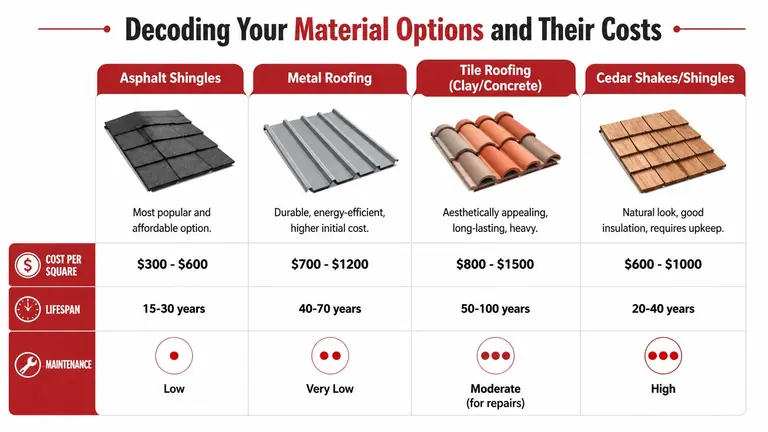
Standard asphalt shingles
Standard architectural asphalt shingles are still the default on a lot of Texas homes for one simple reason. They usually give homeowners the lowest upfront price while still offering a clean look and broad contractor availability.
That does not automatically make them the best value.
On a home with moderate storm exposure and a shorter ownership horizon, standard asphalt can make sense. If the homeowner plans to sell in a few years, or if the budget is already stretched by deductible, gutters, fencing, and interior repairs after a storm, keeping the roof scope simple is a reasonable call.
In heavier hail corridors across DFW, standard shingles are often the material I ask homeowners to compare more carefully. They can perform well when the system is installed correctly, but they generally give you less impact resistance than an upgraded shingle. That matters in a region where roof damage is often cumulative, not just tied to one dramatic storm.
Roof shape also changes the value equation. A simple walkable roof keeps asphalt more attractive on price. A steep, cut-up roof with multiple valleys, dormers, and transitions raises labor enough that some homeowners start looking harder at upgraded materials.
Class 4 impact-resistant shingles
For many North Texas homes, Class 4 shingles are the most practical upgrade. They cost more than standard architectural shingles, but they are built for the kind of hail exposure that drives repeat claims in this part of the state.
The main benefit is straightforward. A Class 4 shingle is designed to handle impact better than a standard shingle. That does not mean hail proof. It means better odds of avoiding the bruising, granule loss, and shortened service life that often follow Texas storms.
This is also one of the few upgrades that can change the insurance conversation, not just the roof itself. Some carriers offer discounts for qualifying impact-resistant products, while others have stricter documentation requirements or limited savings. Homeowners should verify the exact product approval, the policy language, and the paperwork needed before assuming the premium difference will pay for itself.
I usually frame Class 4 as a middle path. You spend more upfront, but you may reduce future storm vulnerability without stepping all the way up to metal pricing. For homeowners planning to stay put in hail country, that trade-off is often easier to justify than a bare-bones shingle replacement.
Premium metal roofing
Metal roofing appeals to a different type of buyer. These are usually homeowners planning to stay in the house for a long time, owners who are tired of frequent storm-related roof discussions, or clients who want stronger performance in both hail and extreme summer heat.
The upside is real. Metal can offer long service life, lower maintenance over time, and better resistance to many of the failure points that shorten the life of traditional shingle roofs. It also sheds heat well when the product and color choice are right for the home.
The trade-offs are real too. Upfront cost is higher. Detail work matters more. The contractor’s experience matters more. On some homes, noise concerns are overstated because attic insulation and decking play a big role, but aesthetic preference is personal and resale fit varies by neighborhood. In some Texas subdivisions, a premium metal roof stands out in a good way. In others, it may cost more than the surrounding market fully rewards.
Metal also is not one thing. Standing seam, exposed fastener panels, stone-coated steel, and stamped metal products all price and perform differently. Homeowners comparing “a metal roof” need to make sure they are comparing the same system, not just the same word on a proposal.
How to choose based on your actual situation
Material selection gets easier when the decision matches the house and the ownership plan.
- Standard asphalt shingles fit best when upfront budget is the primary concern and the home is not a long-term hold.
- Class 4 shingles fit best when the house is in a hail-prone Texas market and the owner wants a stronger balance of price, durability, and insurance value.
- Metal roofing fits best when the owner plans to stay for years, accepts a higher initial investment, and wants fewer replacement cycles.
A simple comparison
| Material | Upfront cost position | Storm focus | Long-term ownership |
|---|---|---|---|
| Standard asphalt | Lowest of the common options | Fair for typical exposure | Often the shortest replacement cycle |
| Class 4 shingles | Mid-range upgrade | Better fit for Texas hail exposure | Stronger case for longer-term value |
| Metal roofing | Highest upfront cost | Strong performer in hail and heat | Often the best fit for long ownership periods |
Beyond the Shingles Uncovering Common Add-On Costs
A Texas homeowner agrees to a roof price based on shingles and labor, then tear-off starts and the full cost picture sharpens. That is normal on reroofing jobs, especially in DFW where hail, heat, and older ventilation setups expose problems that were hidden under the old system.

The shingles get the attention. The add-ons often decide whether the roof performs well for 20 years or starts giving trouble in the first big storm season.
Decking and hidden wood damage
No contractor can verify the full condition of the roof deck until the old materials come off. If the plywood or board decking is soft, rotten, swollen, or separating in layers, it has to be replaced before the new roof goes on.
This affects both cost and warranty. Shingles nailed into weak decking do not hold fasteners the same way, and that can show up later as loose tabs, blow-offs, or uneven areas. On homes with past leaks, poor attic airflow, or multiple old roof layers, decking replacement is more common than homeowners expect.
Ask for the approval process in writing before the job starts. A solid contractor documents bad decking with photos, marks the affected areas, gives a per-sheet price, and gets authorization before replacing more wood than the original scope included.
Flashing and detail metal
A lot of roof leaks start at transitions. Chimneys, sidewalls, valleys, pipe penetrations, skylights, and dead valleys are the places I watch closest on Texas homes because they take concentrated water flow and often show age before the field shingles do.
Cheap bids often keep old flashing in place to make the proposal look lighter. That can save money today and cost far more after the next wind-driven rain. If the roof is older, if the metal is rusted, or if sealants have already been patched several times, replacement usually makes more sense than reuse.
This is one of the easiest places to compare bids. If one proposal includes new step flashing, valley metal, pipe boots, and chimney flashing, and another says "reuse as needed," those are not equal quotes.
Tear-off, haul-off, and disposal
Removing an old roof costs real money because it takes labor, dump fees, property protection, and cleanup discipline. Crews need to protect windows, siding, landscaping, pool equipment, and driveway surfaces before they ever start loading debris.
Cleanup quality matters more than homeowners think. If the contractor rushes this part, you can end up with nails in the lawn, scraps behind shrubs, and damaged flower beds.
On larger homes and on heavier systems, disposal charges may appear as a separate line item. That is not a red flag by itself. Hidden disposal costs are the bigger problem.
A low bid with vague cleanup language usually means the contractor left room to cut corners where the homeowner notices it last.
Solar panel detach and reset
If the house has solar, get this sorted out before you sign. Roofing crews need full access to the roof surface, and that usually means the panels, rails, and related components have to come off and go back on in a coordinated sequence.
The exact cost depends on roof height, system layout, panel count, and who handles the work. The larger issue is responsibility. Confirm who removes the panels, who stores and protects components, who reinspects the system after reset, and whose warranty applies if a leak or solar performance problem shows up later.
Homeowners should confirm four points in writing:
- Who is doing the detach and reset: the roofer, a solar subcontractor, or the original installer
- Who documents pre-existing condition: photos of panels, wiring paths, and mounting points
- Who coordinates scheduling: the roof should not sit exposed waiting on a separate crew
- Who carries liability for damage or performance issues: this should be spelled out before work begins
If budget is already tight, review roof replacement financing options for Texas homeowners before the project starts, not after surprise add-ons hit the final invoice.
Permits, ventilation, and code-related updates
Permits vary by city, and in North Texas that can change from one municipality to the next. Never assume permit fees are included unless the quote states that clearly. The same goes for code items that only become obvious once the roof is opened up.
Ventilation is another frequent add-on. Many older Texas homes were under-ventilated from day one, or they had pieced-together intake and exhaust that never worked as a system. Replacing the roof is often the best time to fix that because the crew already has access to the key components. Better ventilation can help shingle life, attic temperatures, and moisture control, but it does add material and labor cost.
Insurance documentation also matters here. Good photo records, written change orders, and clear damage notes make claim support easier if covered storm damage overlaps with uncovered wear-related items. The process principles are similar to the documentation habits outlined in SnapFixNow Dubai property claim advice, even though Texas roofing claims follow different local rules and policy language.
A clean quote separates required roofing components from optional upgrades. Underlayment, flashing, decking repairs, and code-driven items belong in the core scope. Decorative upgrades should be listed separately so you can see what protects the house and what changes the look.
Navigating Insurance Claims and Financing Your Project
A lot of Texas roof replacements start the same way. A hailstorm rolls through at night, the neighborhood wakes up to dented gutters and torn screens, and by noon homeowners are trying to figure out whether they need a repair, a full replacement, or an insurance claim.

In DFW and other hail-prone parts of Texas, the money side of a roofing job often matters as much as the installation itself. Homeowners are usually balancing claim deadlines, deductibles, upgrade decisions, and payment timing at the same time. That is why a clear process matters.
How to handle a hail claim without creating extra problems
Start before anyone gets on the roof. Take date-stamped photos of anything the storm hit, including shingles visible from the ground, gutters, downspouts, metal vents, window screens, fence stain splatter, and any interior water spots. Those details help show that the damage came from a specific weather event instead of long-term wear.
Then get the roof inspected by a contractor who knows how Texas carriers evaluate storm damage. Hail hits, wind creases, thermal cracking, blistering, and plain aging can look similar to a homeowner. They are not priced or covered the same way. A weak inspection can cost you real money if the adjuster misses slope damage, accessory damage, or code-related items tied to the loss.
A clean claim process usually looks like this:
- Document the storm-related evidence early: Photos are stronger when they are taken soon after the event.
- Get a professional inspection: The contractor should separate storm damage from maintenance issues.
- File only if the inspection supports it: A claim with weak evidence can create headaches without helping pay for the roof.
- Have your contractor present for the adjuster meeting if possible: That helps catch missed line items and damaged components.
- Review the scope line by line: Insurance paperwork often uses carrier shorthand that leaves homeowners guessing.
- Separate covered work from elective upgrades: Insurance may pay for comparable replacement, while upgrades are usually owner-paid.
Texas homeowners should also understand depreciation and deductibles before work starts. If your policy pays actual cash value first, part of the claim may be withheld until the roof is completed and documentation is turned in. If the roof is old, recoverable depreciation can be a large part of the total payment. Your deductible is your responsibility and should be budgeted from day one, not treated like a surprise at the end.
The process habits in SnapFixNow Dubai property claim advice still apply here. Document thoroughly, keep records organized, and know what you are approving before materials are ordered.
Financing without putting the whole project on a credit card
Insurance does not always cover the full bill. Some homeowners are replacing a worn roof with no storm claim at all. Others have claim money coming in but still need to cover the deductible, better materials, or uncovered repairs such as rotten decking.
That is where financing can make sense, especially on Texas homes where a storm-resistant upgrade may reduce future hassle. Class 4 shingles usually cost more up front, but in hail country they can be a practical long-term decision if the premium difference fits the budget and the insurer offers a discount. I tell homeowners to compare the added monthly payment against the expected insurance savings and the likelihood of another hail cycle over the next few years.
Before signing financing papers, ask four direct questions. What is the interest rate after any promo period? Is there a prepayment penalty? When does the contractor get funded? What happens if insurance supplements change the final invoice after work starts?
For homeowners comparing loan structures, this guide to roof replacement financing options gives a useful breakdown of what to review before you commit.
Here’s the video I’d want a homeowner to watch before committing to the payment side of the job:
Where a contractor should help, and where you still need to pay attention
A good contractor helps line up the inspection findings, insurance scope, supplements, and payment schedule so the job does not stall. That matters on storm claims, because missed paperwork can delay material orders and final payment.
Hail King Professionals handles residential replacement work in DFW and East Texas, including inspections and financing support. Homeowners still need to read every document themselves. The contractor should explain the scope, but the policy, deductible, upgrade cost, and financing terms are still your responsibility to approve.
Sample Roof Replacement Estimates for Texas Homeowners
A Frisco homeowner calls a week after a hailstorm. The neighbor got a roof approved through insurance. Their carrier approved the claim too, but the first estimate still feels vague. That is normal in Texas. The actual cost does not come from one price-per-square number. It comes from roof shape, material choice, code items, and storm-related extras that show up once the scope is written correctly.
Example one with a hail-focused upgrade
Start with a larger Dallas-area home that has a cut-up roof, several penetrations, and a recent hail loss. The carrier has agreed to full replacement. The homeowner plans to stay in the house for years, so the upgrade question matters.
In that case, Class 4 shingles often make sense. They cost more up front than a standard architectural shingle, but in North Texas they can reduce repeat storm damage and may qualify for a policy discount, depending on the insurer. I usually tell homeowners to judge that upgrade on three things: how often their area gets hit, how long they plan to keep the home, and how much premium difference their agent will confirm in writing.
A quote for that house usually reads like a real construction scope, not a one-line number:
- Measured roof replacement with Class 4 shingles: Higher material cost, but better impact resistance for hail-prone areas
- Full tear-off and disposal: Includes labor, dump fees, and site cleanup
- Synthetic underlayment, starter, ridge, and ventilation components: Part of the roofing system, not optional filler
- Flashing work at vents, walls, and chimneys: A common place where cheaper bids cut corners
- Decking allowance or contingency: Used only if rotten or broken decking is found after tear-off
- Detach and reset for solar, satellite, or other rooftop equipment: Separate coordination item on many storm jobs
- Gutter or screen repair tied to the same hail event: Sometimes included in the broader restoration scope
That kind of project lands on the higher side of Texas pricing for good reason. Complexity adds labor. Better shingles add material cost. Attached systems create coordination work. None of that is fluff if it is needed on the house.
Example two with a standard architectural shingle roof
Now look at a single-story home in East Texas with a simple ranch layout. Fewer valleys. Fewer penetrations. No solar. No steep sections that require slower production and extra safety setup.
That estimate is usually easier to read and easier to control. The homeowner may choose a standard architectural shingle because the budget matters more than impact resistance, or because the insurance claim did not leave much room for elective upgrades. The quote still needs tear-off, disposal, underlayment, flashing, ridge components, ventilation details, and cleanup. It just has fewer moving parts.
These are the jobs homeowners tend to compare against a neighbor's price, and that is where confusion starts. A simple ranch and a storm-damaged two-story in DFW are not the same project, even if the houses look similar from the street.
One more factor gets missed all the time. Schedule affects cost pressure. If tarping, interior leak protection, or material rush ordering is involved after a storm, the job can tighten up fast.
I also tell homeowners to read outside the roofing space once in a while. The screening logic in this article about finding house flipping contractors applies here too. The contractor who explains scope clearly, documents change orders, and manages subs tightly usually protects your budget better than the one with the lowest opening number.
The practical takeaway is simple. Sample estimates are useful only if they show what is included. In Texas, especially in hail territory, the gap between two bids usually comes from scope quality, not just markup.
Your Contractor Checklist and Project Timeline
A roof can be priced correctly and still go badly if the contractor runs a sloppy project. Homeowners usually focus on the number first. I’d focus on the process right alongside it.
The contractor checklist that actually matters
Use this checklist before you sign:
- Local experience: Ask how often the contractor works in DFW or East Texas conditions, especially with hail claims and code-driven reroofs.
- Proof of insurance: Don’t accept verbal reassurance. Ask for current documentation.
- Detailed written scope: The quote should identify materials, tear-off, flashing, cleanup, and how hidden damage is handled.
- Claim experience if insurance is involved: Adjuster meetings and supplement conversations take real project experience.
- Solar coordination if needed: Homes with panels need a contractor who can manage detach-and-reset logistics clearly.
- Communication standards: You want to know who your point of contact is before work starts.
- References for similar projects: Not generic references. Ask for homes with similar roof type or storm scope.
If you’ve ever looked at broader contractor hiring advice for renovation or investment properties, the screening logic is similar. This guide on finding house flipping contractors is helpful because it highlights the same core issue: the right contractor is the one who can define scope, control process, and communicate clearly.
A realistic project timeline
Most homeowners want to know how disruptive the job will be. The answer depends on weather, complexity, and whether the roof hides damage, but the flow tends to be predictable.
A typical schedule often looks like this:
- Pre-job stage: Final measurement, material ordering, permit handling if required, scheduling, and property prep.
- Tear-off day: Old roofing is removed and the deck is inspected.
- Installation phase: Underlayment, flashing, field material, ridge work, and detail areas are installed.
- Final detail and cleanup: Site cleanup, magnetic sweep, punch-list items, and final walkthrough.
Ask the contractor what can delay the project before the project starts. Weather, supplements, material availability, and solar coordination are normal answers. Silence is not.
Frequently Asked Questions About Roof Replacement
How long should a new roof last in Texas weather
A roof in Texas lasts as long as the material, the installation, and the storm history allow. In DFW, two roofs with the same shingle can age very differently if one takes repeated hail hits and the other does not.
As a practical rule, asphalt systems usually give homeowners a shorter service life than metal. Ventilation, attic heat, flashing quality, and whether the installer replaced worn components at the penetrations all matter. A roof that looks fine from the street can still be aging early around pipe jacks, valleys, and ridge lines.
Can I roof over old shingles to save money
Roofing over existing shingles lowers the upfront bill, but it also hides problems. The contractor cannot fully inspect the deck, soft spots can go unnoticed, and flashing details are harder to correct properly.
In North Texas, I rarely see this option make sense on a home that has been through hail. A full tear-off gives a cleaner install and a more honest view of the roof structure before new materials go on.
What kind of warranties should I expect
Ask for two separate warranties in writing. One covers the material from the manufacturer. The other covers installation from the contractor.
Those are not the same thing. A manufacturer may replace defective product but not poor workmanship, interior damage, or labor beyond limited terms. A contractor workmanship warranty matters because many leak calls come from flashing details, ventilation errors, or accessory installation, not from the shingle itself.
What’s the best upgrade for a DFW homeowner after hail
For many homeowners, the best value upgrade is a Class 4 impact-resistant shingle. It usually costs more than a standard architectural shingle, but it can reduce future hail damage and may help with insurance premium discounts, depending on the carrier.
That does not mean it is the right choice for every house. If the home has a complex roofline, long-term ownership plans, or repeated storm losses, metal may still deserve a serious look. The right choice depends on budget, deductible exposure, and how much future claim risk you want to reduce.
Should I replace gutters at the same time
Replace gutters when they are storm-damaged, improperly sloped, leaking at joints, or pulling away from the fascia. On many Texas homes, the gutter system is part of the same water-control problem as the roof.
If the roof is being replaced because of hail, inspect the gutters during the same scope review. That helps avoid finishing a new roof only to keep old drainage problems that dump water near the foundation or stain the brick.
If you need a clear answer on your own residential roof replacement cost, Hail King Professionals can inspect the roof, explain the scope in plain language, and help you compare standard shingles, Class 4 upgrades, and metal options for DFW and East Texas conditions. The useful first step is a documented inspection and a quote that shows exactly what’s included, what could change after tear-off, and how the project would be handled if insurance is involved.