Asphalt shingle roof cost per square foot in Texas typically falls around $3.50 to $12.00 installed. Your final price depends mostly on the shingle you choose, how complex the roof is, and the job conditions that make installation faster or slower.
If you're reading this after a North Texas storm, you're probably in one of two situations. You found shingles in the yard, or you spotted a ceiling stain and realized the roof problem isn't going away on its own. Both situations send most homeowners to the same search: how much is this really going to cost?
The frustrating part is that roof quotes can swing hard, even when two homes look similar from the street. In DFW, that gap often comes down to more than roof size. Hail exposure, insurance considerations, steep sections, old roof tear-off, and whether you stick with a basic shingle or move up to an impact-resistant product all affect what you pay now and what you may pay again later.
A cheap roof can be expensive in Texas if it leaves you with more storm damage, more claim headaches, and another replacement sooner than expected. A more expensive roof can also be the wrong move if the upgrade doesn't match your home, neighborhood, or insurance situation. The goal is to understand where the money goes and which upgrades prove their worth.
Your Guide to Understanding Roof Replacement Costs
A common DFW scenario starts the same way. A hailstorm rolls through at night, the yard is littered with granules or a few torn shingles, and by morning a homeowner is trying to figure out whether the next quote will be $8,000 or $25,000.
That question matters, but the better question is what the roof will cost you over time.
In North Texas, a roof is not just a line item priced by square foot. It is part storm protection, part insurance issue, and part long-term maintenance decision. Two roofs can look similar from the driveway and carry very different ownership costs if one is more likely to bruise in the next hail season, trigger another claim, or need replacement sooner.
That is why a wide price range by itself is only a starting point. A simple roof with basic architectural shingles may be the right fit for one home. On another house, paying more for a stronger shingle class can make sense if the neighborhood gets hit often, the carrier offers a discount, or the owner plans to stay put long enough to benefit from fewer repairs and less disruption.
Homeowners usually do not need more roofing jargon. They need clear answers to a few practical questions that affect both the bid and the years after installation:
- What product is being installed: 3-tab, standard architectural, and impact-resistant shingles belong in different budget conversations because they perform differently in Texas storms.
- What work is included in the contract: Tear-off, flashing replacement, ventilation adjustments, underlayment, cleanup, and warranty coverage all change the actual value of the quote.
- What could raise the price after work starts: Rotten decking, extra layers, steep sections, and difficult access are common change-order items.
- How the choice affects long-term ownership cost: A lower upfront number can still cost more if it leads to more hail damage, more deductible exposure, or shorter service life.
For a broader budgeting framework, review this residential roof replacement cost guide.
Practical rule: The best roof quote is the one that makes sense today and still makes sense after the next hail claim, the next premium review, and the next five to ten Texas storm seasons.
Decoding Roofing Prices Per Square Foot and Per Square
Roofing estimates confuse homeowners because contractors often use two pricing languages at once. Homeowners think in square feet. Roofers often price by the square.
A roofing square is 100 square feet, and the term still drives how many roofing bids are built. Current pricing guides show asphalt shingles at about $150 to $600 per square for materials, while installed cost commonly runs $350 to $1,600 per square when labor and demolition are included, according to CMB Roofing's explanation of asphalt shingle cost per square.
The simple conversion
The math is easy once you know the rule:
| Roofing unit | What it means |
|---|---|
| 1 square | 100 square feet |
| $350 per square | $3.50 per square foot |
| $1,600 per square | $16.00 per square foot |
If a contractor says your roof is 20 squares, that means the roof area is about 2,000 square feet. If another contractor gives a square-foot price instead, you can still compare them directly by multiplying or dividing by 100.
Why contractors still use squares
Squares are useful because roofing materials are ordered, loaded, and estimated around roof sections rather than tiny units. It's similar to buying flooring by a larger measurement instead of counting each tile one by one.
That also means your home's living area and your roof area may not match. A house with hips, valleys, dormers, porches, or steep pitches often has more roofing area than the home's interior square footage suggests.
If you can't tell whether a quote is per square or per square foot, stop there and ask before comparing anything else.
How to read the quote without getting lost
When you review an estimate, look for these terms:
- Per square foot pricing: Easier for most homeowners to understand at a glance.
- Per square pricing: Common in contractor-facing estimates and supplier math.
- Installed price: Usually includes labor and often tear-off, but you should verify what's included.
- Material-only price: Useful for comparison, but it doesn't tell you the actual project cost.
If two bids use different units, convert them to one format before judging who's expensive. The jargon isn't the hard part. The hard part is making sure both bids include the same scope.
Anatomy of a Roof Replacement Bid What You Pay For
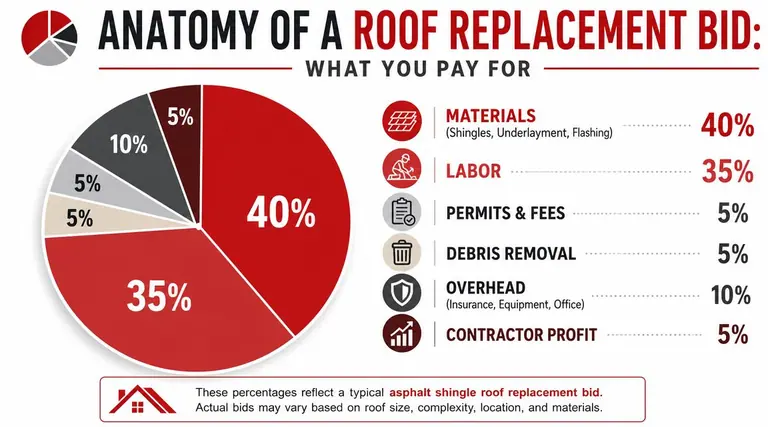
Most homeowners focus on the shingle color and the bottom-line number. The better question is what the proposal includes. A roof replacement bid isn't just a stack of shingles. It's demolition, prep, installation, weatherproofing details, cleanup, and the contractor's ability to manage the whole job without creating new problems.
Installed asphalt shingle pricing in major U.S. benchmarks often clusters around $3 to $5 per square foot, with materials at $1 to $2 per square foot and labor at $2 to $3 per square foot. HomeGuide's asphalt shingle roof cost overview also notes that labor makes up roughly 60% to 70% of the total project cost, which is why roof complexity changes bids so quickly.
The parts of a solid estimate
A professional bid usually includes more than one or two lines. At minimum, you should expect to see the scope broken down clearly enough to understand what crew, materials, and prep work you're buying.
- Tear-off and disposal: Removing old shingles, underlayment, nails, and debris. This matters more if the existing roof has aged badly or has multiple problem areas.
- Shingles and accessory materials: The visible shingle gets the attention, but the system also includes underlayment, starter, ridge components, flashing details, and ventilation-related parts where needed.
- Labor: Quality is heavily influenced by the work performed. Crew skill affects valley work, flashing tie-ins, ridge install, cleanup, and whether the roof looks neat and sheds water properly.
- Jobsite protection and cleanup: Tarps, magnet cleanup, debris hauling, and protecting landscaping are part of doing the work responsibly.
- Permits and code-related items: Some projects need permit handling or code-specific upgrades.
What low bids often leave fuzzy
A thin estimate can hide risk. If the quote is only a lump sum with no description of materials and no line for tear-off, disposal, or accessory components, you're being asked to trust what isn't written down.
Here are the phrases that deserve follow-up:
- "Replace roof" with no material details
- "Synthetic felt included" with no mention of valleys, flashing, or starter
- "As needed" language without defining who decides and how pricing changes
- No mention of cleanup or haul-off
A roof can fail at the details long before the field shingles wear out.
What works and what doesn't
What works is a bid that names the shingle type, identifies prep work, and spells out how change orders are handled if hidden damage shows up. What doesn't work is choosing a contractor based only on the lowest total without checking scope. In roofing, the cheap number often comes from omitted work, not from a miracle.
Why Roof Quotes Vary The Key Cost Factors
Two houses can have similar footprints and still receive very different roofing prices. In Texas, the biggest driver after size is usually the level of shingle system being installed. The second is how difficult the roof is to work on safely and cleanly.
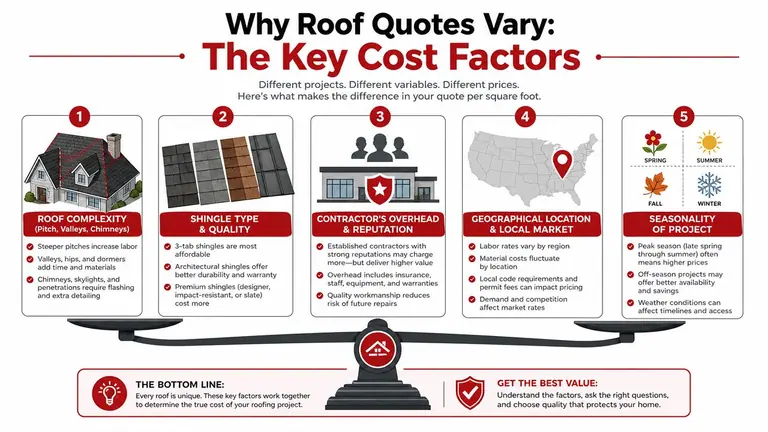
The biggest product gap shows up between budget shingles and higher-performance options. In hail-prone markets, Pitch Roofing's cost comparison for asphalt shingle tiers places 3-tab shingles around $3.50 to $5.00 per square foot, architectural shingles around $5 to $9 per square foot, and impact-rated shingles around $7 to $10 per square foot.
Good better best for North Texas
Here is the practical version homeowners can use.
| Shingle tier | Typical installed range | Best fit |
|---|---|---|
| 3-tab | $3.50 to $5.00 per sq. ft. | Lowest upfront price, basic replacement situations |
| Architectural | $5 to $9 per sq. ft. | Most common choice for balanced appearance and durability |
| Impact-rated | $7 to $10 per sq. ft. | Storm-exposed homes where hail resistance matters more |
A lot of DFW homeowners start with architectural shingles because they offer a more substantial roof system than older budget products. Impact-rated shingles cost more upfront, but they're often the first upgrade worth discussing if your neighborhood sees frequent hail claims.
A roof system also depends on what's below the shingles. If you're comparing estimates and one mentions upgraded protection layers while another doesn't, this guide on what roof underlayment does and why it matters helps clarify the difference.
Later in the buying process, it helps to see product categories explained visually.
The non-material factors that swing a quote
Not every price difference comes from the shingle itself. Roof geometry and working conditions matter a lot.
- Steep pitch: Slower install, more safety setup, and tougher material handling.
- Complex roof lines: Valleys, dormers, skylights, and chimney flashing take more labor.
- Access around the home: Tight driveways, landscaping, fencing, and pool areas can slow tear-off and cleanup.
- Existing roof condition: A roof with soft decking, bad flashing, or ugly prior repairs takes more correction work.
Where homeowners misread the numbers
Many homeowners assume the lower quote is the more efficient company. Sometimes it's just the skinnier scope. If one bid is based on 3-tab and another is based on an impact-rated architectural shingle, the comparison isn't honest until both products are aligned.
Putting It All Together Sample Roof Cost Scenarios
A DFW homeowner with a simple ranch house and a homeowner with a steep two-story in the same ZIP code can get very different roof numbers. The square-foot price matters, but it does not tell the whole story. In North Texas, the better question is what that roof is likely to cost over the years you own it.
Scenario one with a simple ranch home
Take a single-story ranch with about 1,800 square feet of roof area, a basic layout, and easy access around the house. This is usually a cleaner job for the crew. Fewer valleys, a walkable pitch, and less setup time often keep pricing closer to the lower or middle part of the ranges discussed earlier.
That puts this home in a category where upgrades are often easier to justify. The total bill is still significant, but the jump from a standard architectural shingle to a Class 4 impact-resistant product is usually easier to absorb on a smaller roof than on a large, steep one.
For this homeowner, I would not focus only on the first invoice. I would ask three practical questions. Does the neighborhood get hit often? Does the insurance carrier offer any meaningful discount for impact resistance? How long does the owner plan to stay in the home? If the answer to all three points in the same direction, the higher-grade shingle can make financial sense even with the higher install cost.
Scenario two with a larger two-story roof
Now look at a 3,000-square-foot two-story home with steeper sections, more cuts, and more visible slopes. This roof takes more labor, more staging, and more material waste. It also tends to be more expensive to revisit after a storm, whether that means repairs, partial slope replacement, or a full claim process.
On a house like this, every upgrade costs more in raw dollars. So does every shortcut.
A budget shingle may save money up front, but the long-term math gets tougher if the home sits in a hail-prone part of DFW and the owner expects to keep it for several years. A stronger shingle can help reduce the odds of cosmetic and functional damage from the kind of storms that hit this market regularly. It may also improve the insurance side of the ownership equation, depending on the carrier and policy terms.
What these examples actually tell you
These scenarios are useful because they show how roof size and complexity change the decision. They also show why per-square-foot averages can be misleading if you treat them like the final answer.
Here is the practical takeaway:
- Smaller, simpler roofs give homeowners more flexibility to upgrade shingles without pushing the total project cost as high.
- Larger, steeper roofs increase labor cost, waste, and the financial pain of getting storm damage more than once.
- Impact-resistant shingles tend to offer the best return where hail exposure, insurance incentives, and longer home ownership all line up.
- Total ownership cost includes the install price, likely storm repairs, claim friction, and possible insurance savings.
One more point gets missed in a lot of roofing articles. Roof spending affects the broader cost of owning the house. If a stronger roof lowers claim frequency and helps you avoid repeated out-of-pocket repairs, that can matter just as much as shaving a little off the initial bid. Homeowners looking at the full housing budget sometimes pair those decisions with other savings opportunities, such as ways to reduce property taxes in Texas.
If your quote lands far outside the ranges discussed earlier, ask the contractor to explain the specific reason. On a good estimate, the price difference should trace back to clear line items such as shingle grade, roof complexity, ventilation changes, decking repairs, or upgraded accessories.
Special Considerations for Texas Homeowners
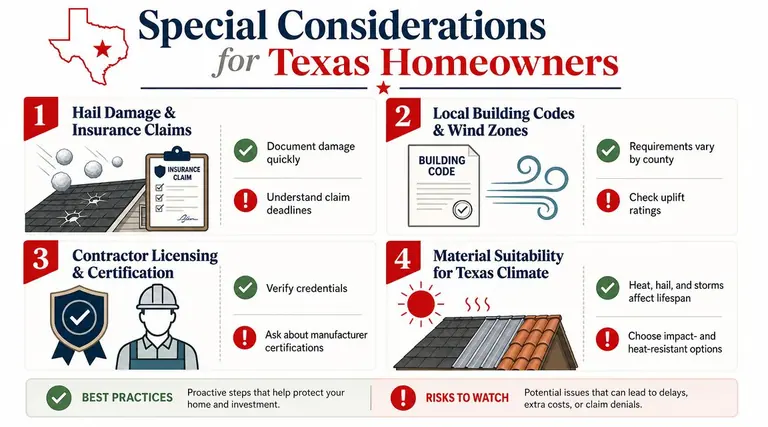
North Texas changes the roof conversation. National averages are useful, but they don't capture what repeated hail, strong wind events, and insurance friction do to the total cost of ownership. In this market, the cheapest roof often wins the first invoice and loses the long game.
Why impact resistance matters more here
Impact-rated shingles cost more upfront than budget products. That part is obvious. The part many homeowners miss is that DFW roofs don't live in a calm environment. They live in a storm cycle where hail can turn a low-cost roof into a repeated expense.
That doesn't mean every home needs the most expensive shingle available. It means you should compare products based on how often the roof may need attention, how your insurer treats storm claims, and whether a tougher shingle could help reduce claim frequency or lower insurance-related friction over time.
A good Texas roof decision usually balances four things:
- Storm resilience: Especially in hail-prone neighborhoods.
- Insurance practicality: Whether your carrier recognizes or rewards stronger products.
- Home tenure: The longer you plan to stay, the more long-term performance matters.
- Resale confidence: Buyers in Texas often ask about roof age and storm durability.
Solar panels make reroofing more technical
If your home has rooftop solar, reroofing gets more sensitive. Panels usually need a proper detach-and-reset process so the new roof can be installed correctly and the solar investment isn't put at risk. This isn't a place for improvisation or split responsibility between trades that aren't coordinating well.
The same logic applies to insurance work after hail. Documentation, scope clarity, and accurate storm damage assessment all matter. Homeowners often get in trouble when they rush into the first promise of "free roof" language instead of understanding what their policy covers and what the final settlement supports.
In Texas, roof value isn't just the install price. It's the mix of durability, claim resilience, and how many headaches the system helps you avoid.
Think bigger than just the roof invoice
Monthly housing cost matters too. If you're reviewing home expenses after a roof replacement, insurance and property tax planning often sit in the same budget conversation. For homeowners trying to lower the overall burden of ownership, this guide on how to reduce property taxes in Texas is a useful resource alongside your roofing decisions.
What works in Texas is buying a roof system that matches the climate, not just the spreadsheet. What doesn't work is treating DFW like a mild-weather market where any asphalt shingle will perform the same over time.
Choosing a Contractor and Securing Your Investment
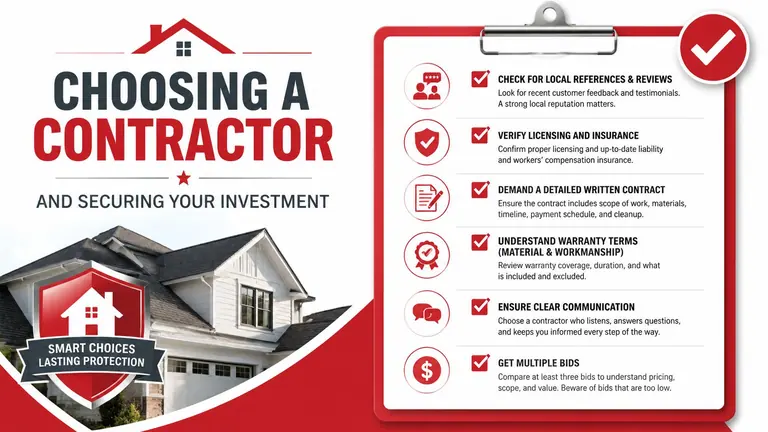
The contractor matters as much as the shingle. A premium product installed poorly is still a bad roof. A clear, disciplined installer can make a standard product perform the way it's supposed to.
A roofing square equals 100 square feet, and installed asphalt shingle pricing is often quoted as $200 to $700 per square depending on grade. CGR Wholesale Roofing's overview of shingle cost per square also notes wind-performance tiers ranging from 60 mph for basic 3-tab products to 130 mph for premium and Class 4 options. That's a reminder that the proposal isn't just about price. It's about what performance level you are purchasing.
The checklist that separates solid bids from risky ones
Use this when reviewing proposals:
- Verify insurance and local presence: A storm-chasing sales team can disappear fast. A local company has to live with its work.
- Demand a detailed written scope: Material type, tear-off, disposal, flashing approach, and change-order handling should be in writing.
- Ask about workmanship and manufacturer warranties: Both matter, and they cover different things.
- Compare apples to apples: Convert unit pricing if needed and make sure the shingle class matches.
- Watch how they communicate: Good contractors answer direct questions directly.
For homeowners who want a broader hiring framework that applies well beyond roofing, this checklist on how to hire a reliable cleaning contractor asks many of the same smart vetting questions.
Red flags worth taking seriously
Some warning signs show up before the work even starts:
- Pressure to sign immediately
- Vague one-page bids
- No discussion of ventilation, flashing, or underlayment
- Unclear change-order language
- Promises that sound bigger than the written contract
If you want a roofing-specific checklist, this guide on how to choose a roofing contractor is worth keeping open while you review proposals.
The best contractor usually isn't the one with the lowest number. It's the one whose scope, communication, and execution reduce your risk.
A roof replacement is a major purchase, but it shouldn't feel mysterious. Once you understand unit pricing, product tiers, and contractor scope, the decision becomes much clearer.
If you want a roof assessment from a team that understands DFW hail exposure, insurance-driven replacements, solar detach-and-reset coordination, and long-term roof value, Hail King Professionals is a practical place to start. They serve Dallas-Fort Worth and East Texas with inspections, repairs, replacements, and storm-focused roofing solutions built for Texas conditions.