
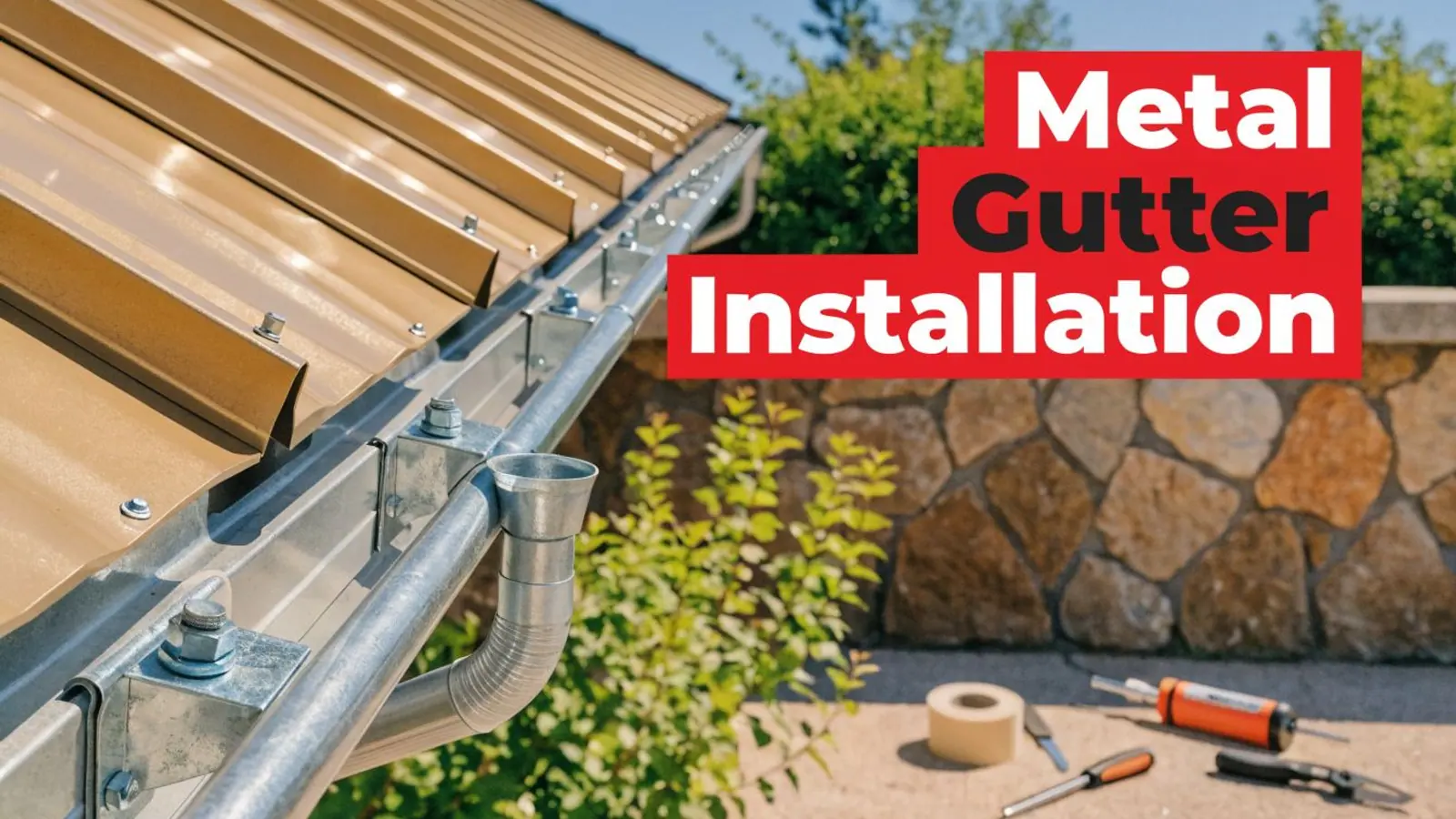
You've got a metal roof, a hard rain just rolled through North Texas, and now you're seeing water overshoot the gutter, splash near the foundation, or streak down fascia that ought to be dry. That usually means the roof isn't the problem. The drainage setup is.
Metal roofs move water fast. They also expand and contract in ways that punish sloppy gutter work. A gutter system that might limp along under asphalt shingles can fail early on a metal roof, especially in Dallas-Fort Worth where hail, wind, heat, and sudden downpours all show up in the same season. Good metal roof gutter installation is less about hanging troughs and more about matching materials, attachment method, slope, and seal details to the roof profile.
Why Your Metal Roof Needs a Specialized Gutter System
A lot of homeowners assume gutters are universal. They're not.
A metal roof sheds water with surprising speed, especially once the panels are clean and the finish is still in good shape. On a steep roof, runoff reaches the edge with more speed, so undersized gutters or badly placed gutters let water jump right past the front lip. That's why homes that just got a beautiful new metal roof sometimes start showing drainage problems they didn't have before.
The other issue is movement. Metal expands in heat and tightens up when temperatures swing back down. If the installer treats a metal roof gutter installation like a basic shingle job, the gutter can bind against the roof edge, pull on fasteners, or split at seams over time.
Practical rule: On a metal roof, the gutter has to work with the roof system, not just hang below it.
North Texas adds another layer. Hail can dent weak sections, wind can stress bad hanger spacing, and heavy rain exposes every shortcut. A setup that looks clean on a dry afternoon can still be wrong if it can't control runoff in a real storm.
That's also why homeowners dealing with repeated overflow problems usually need more than a patch. They need better sizing, better attachment, and better material matching. If you're comparing options built for intense runoff, this guide on gutters for heavy rain is a useful companion.
What makes metal roofs different
Three details separate this from ordinary gutter work:
- Runoff speed matters: Metal's slick surface sends water to the edge fast.
- Material compatibility matters: The wrong metal combination can start corrosion where fasteners, hangers, or gutter bodies touch.
- Roof profile matters: Standing seam, corrugated, and exposed-fastener panels each call for a different attachment approach.
If those pieces are handled correctly, the system stays quiet, drains clean, and holds up under Texas weather. If they're not, leaks show up at seams, behind the gutter, and around fastener penetrations.
Planning Your Gutter System for a Metal Roof
A lot of gutter failures are decided before the first hole is drilled. On a metal roof in North Texas, bad planning shows up fast. You see overflow at valleys, dented front edges after hail, water shooting past undersized troughs, or brackets fighting the roof profile instead of supporting it.
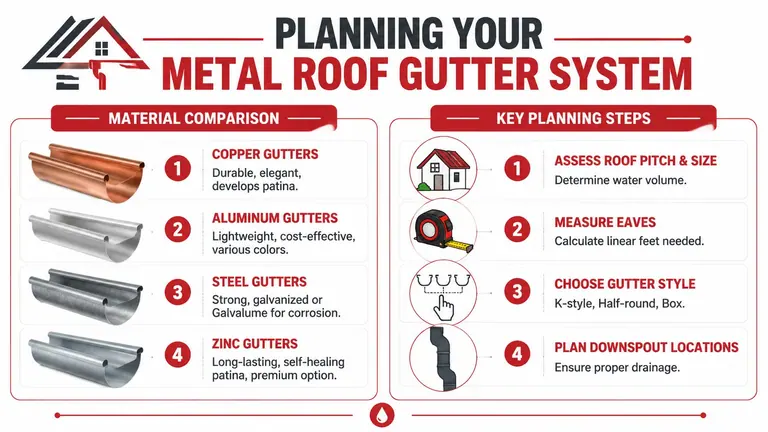
Start with material compatibility
For many DFW homes, aluminum is the practical starting point. It is light, easier to form on site, and usually easier to pair with common residential metal roof systems than a heavier steel setup. That does not make it perfect. Hail can dent aluminum, especially on long unsupported runs or cheaper stock, so hanger spacing and coil thickness matter.
Steel works in the right application. It feels stiffer and takes abuse better during ladder work, but once the coating gets scratched, North Texas weather starts working on it. Copper and zinc can last a long time, but they only make sense when the whole roof-edge assembly is designed around them. Mixed metals at the drip edge, straps, screws, or outlet can create corrosion problems that start small and get expensive.
That is why material matching needs to be checked at every contact point, not just on the gutter body. The same principles used in protecting structural steel from corrosion apply here. Keep dissimilar metals separated where needed, and do not assume a coated fastener solves everything.
| Material | Pros | Cons | Best For |
|---|---|---|---|
| Aluminum | Lightweight, cost-effective, widely available in gutters formed on-site, compatible with many metal roof systems | Can dent from hail or ladder impact | Most residential metal roof gutter installation in Texas |
| Steel | Strong, rigid, better resistance to jobsite abuse | Heavier, harder to handle, corrosion risk if coating is damaged or metals are mismatched | Specific applications where strength is prioritized and compatibility is confirmed |
| Copper | Long service life, premium appearance | Expensive, requires extra precautions around dissimilar metals | High-end homes with a full compatible design |
| Zinc | Durable, premium option | Less common, compatibility still has to be checked carefully | Specialty builds with the right detailing |
If you want to compare fabrication options before ordering, this guide to gutters formed on-site for custom rooflines gives a useful overview.
Match the hanger style to the roof profile
The roof profile decides the attachment method.
On standing seam metal roofs, the cleanest approach is usually a non-penetrating clamp system or a fascia-mounted gutter setup that does not interfere with the panel seams. The main goal is simple. Do not turn the roof panel into the weak point. If a crew starts screwing through the wrong place on a standing seam roof, they may create a leak path and void a roof warranty at the same time.
On corrugated or exposed-fastener roofs, there is less room for guesswork. Fascia attachment is often the safer route, but the apron, drip edge, and panel overhang all have to be checked so runoff drops into the gutter instead of curling behind it. Strap hangers can work, but they need to follow the panel shape correctly and be sealed where required.
Solar adds another wrinkle. Rooftop solar can dump concentrated sheets of water and debris at the eave, especially below lower panel edges. Plan outlets and downspouts with that in mind, and make sure future gutter cleaning is still possible once the array is in place.
Measure the roofline like a foreman, not a salesperson
Ground estimates are where bad layouts start. Measure each run, each corner, each return, and each area where a valley or solar discharge point increases flow.
Use this checklist on site:
- Measure total linear footage: Include side runs, garage returns, porch sections, and short offsets.
- Mark high-flow areas: Valleys, dead-end roof sections, and spots below solar arrays usually need extra capacity.
- Set downspout locations early: Put them where water can move away from the slab, doors, walkways, and flower beds.
- Check fascia condition: Rotten or undersized fascia will not hold a good gutter system for long.
- Confirm roof pitch and panel overhang: Fast runoff from steep metal roofs changes sizing and placement.
- Note service access: Leave room for cleaning around leaf screens, elbows, and areas under solar equipment.
One inch off on outlet placement can turn a clean install into field improvisation.
Choose size based on runoff, not habit
A standard 5-inch gutter is not automatically wrong. It is just overused. On steep metal roofs, long runs, and roof planes that dump into one valley, 6-inch gutters and larger downspouts are often the better call because metal sheds water fast and storms in North Texas hit hard.
I have seen plenty of homes where the gutter itself was installed straight and tight, but the system still failed because it was undersized for the roof above it. That is common on standing seam roofs with long uninterrupted slopes. It also shows up under solar arrays, where runoff concentrates instead of spreading evenly across the eave.
Good planning looks plain on paper. The right metal is paired with the right roof. The hanger method matches the panel profile. The downspouts are placed where they can move water. Then the install goes a lot smoother, and the system has a much better chance of holding up through hail season and the next hard spring storm.
Gathering the Right Tools and Corrosion-Proof Fasteners
A metal roof gutter installation goes bad in small ways first. The wrong screw. The wrong sealant. A mixed-metal contact point that looks harmless on day one and stains the panel months later. That's why tool prep and hardware selection deserve more attention than most crews give them.
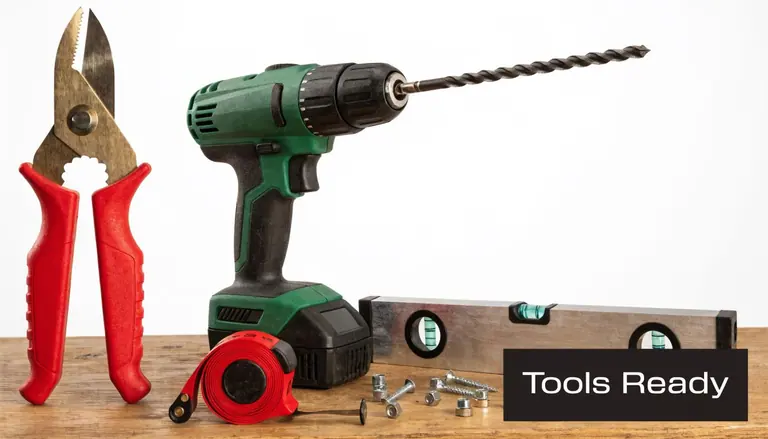
The core tool kit
Most crews will need:
- Chalk line: For laying out the gutter slope cleanly
- Tape measure: For run lengths, outlet placement, and bracket spacing
- Drill or impact driver: For brackets, screws, and outlet work
- Rivet gun: For end caps, outlets, and splices
- Tin snips: For controlled cuts without tearing the metal
- Level: To verify the chalk line and final run
- Clamps: To hold sections and caps in place during assembly
- Caulk gun: For metal-grade sealants and mastic
- Step bits: Helpful when cutting clean outlet openings
- Ladders and roof safety gear: Stable setup matters as much as the hand tools
Fasteners are not a detail
Galvanic corrosion starts when dissimilar metals touch in the presence of moisture. On a roof edge, you've always got moisture at some point. That means rivets, screws, straps, and hangers all need to be selected with the roof and gutter material in mind.
According to McElroy Metal's guidance on metal roof gutters, Kynar-coated aluminum gutters can reduce galvanic reactions by 70% compared to standard steel gutters on zinc or Galvalume roofs, and applying dielectric mastic at seams and fastener points can cut leak risks by 50%. That's not small. It directly affects how long the system stays clean and serviceable.
Use compatible screws and rivets. If you're unsure about the broader principles behind protecting structural steel from corrosion, that resource gives a solid plain-language overview of why coatings, separation, and surface prep matter.
Sealant choice separates durable work from patch work
Skip generic painter's caulk. It won't hold up.
Use a metal-grade butyl, silicone, or dielectric mastic intended for exterior metal assemblies. These products stay flexible, bond better to clean metal, and handle movement more reliably. On a metal roof, every seam and fastener sees temperature movement. Brittle sealants crack. Once they crack, water gets in and works behind the gutter before anyone notices.
Use the same mindset you'd use on roof flashing. If the sealant can't move with the metal, it doesn't belong on the job.
Shopping list before install day
Don't start until you've staged the full system:
- Gutter sections or continuous run
- End caps and outlets
- Downspouts and elbows
- Brackets, straps, or seam clamps
- Compatible screws and rivets
- Butyl, silicone, or dielectric mastic
- Touch-up materials for cut edges if the system calls for them
Crews waste time when they improvise. Roof edges punish improvisation.
Executing a Leak-Proof Gutter Installation
A North Texas storm will show you fast whether the install was done right. I have seen gutters hold through hail, wind-driven rain, and a hard roof dump off standing seam panels. I have also seen brand-new runs overflow or leak at the first outlet because the crew rushed the layout and guessed at the attachment.
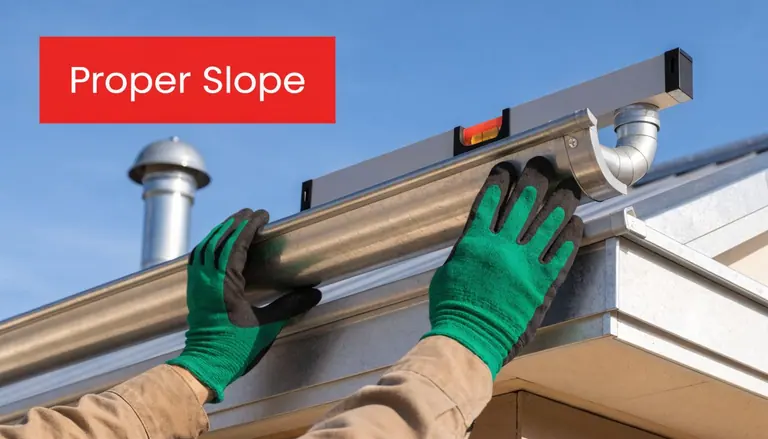
Start with the water path, not the metal
Set the high point, set the outlet, then strike the line. According to installation guidance for metal roof gutters, a good target is 1/4-inch drop per 10 feet, with brackets spaced every 24 to 36 inches and fasteners driven at least 1 inch into solid wood.
That slope is a starting point, not a substitute for judgment. On a long front elevation, the gutter still has to look straight from the driveway. On a metal roof, it also has to sit where sheet flow lands, especially during the kind of pounding rain that sends water racing off slick panels in DFW.
Standing seam roofs need controlled attachment
Standing seam changes the job. Water leaves the panel edge fast, and the roof system is built to move. If the detail calls for seam-mounted support, use clamps made for that exact seam profile and torque them correctly. A crooked clamp or a substitute bracket can scar the seam, shift under load, or throw the gutter line out just enough to trap water.
Bracket placement matters here more than many crews realize. Set the gutter far enough out to catch runoff during a hard storm, but leave room so the roof edge is not bearing on the gutter as the metal expands and contracts. If the house has solar, check where panel drip lines and rail supports concentrate runoff before locking in outlet locations. A clean-looking install can still overflow if one solar section dumps half a roof plane into the wrong stretch of gutter.
Corrugated and exposed-fastener roofs need a different approach
These profiles do better with attachment into solid fascia or rafter tails whenever possible. If the system design requires roof-side support, place fasteners on the high ribs and detail every penetration so it sheds water instead of collecting it.
Low channels are where water travels. Put a screw there and you create a leak point and a debris catch point at the same time.
Corrugated edges also throw water less uniformly than standing seam. The runoff breaks around the profile, which means the gutter position has to be checked from more than one angle before final fastening. In hail country, that matters. A dented corrugated panel can change the discharge path enough that a gutter set too tight to the roof ends up letting water run behind it.
Assemble joints like roof details
Dry-fit first. Mark outlets, end caps, and splice locations before you commit to rivets or screws. On sectional systems, lap joints with the direction of flow, seal clean metal, compress the joint fully, and fasten it evenly so one side is not carrying the whole seam.
Cut edges and outlet openings deserve extra care. Burrs hold water and tear sealant. A rough opening around a drop outlet usually leaks long before the gutter body does.
Good joint work also means respecting movement on long runs. Leave room where the system detail requires it. A gutter that cannot move will eventually force the issue at a seam, an end cap, or a strap connection.
For broader leak control principles around roof penetrations and edge transitions, Vivid Skylights roof protection tips line up with what shows up on service calls. Water gets through at stressed joints, bad sealant work, and places where runoff was not mapped correctly before installation.
Set outlets and downspouts after the run is true
Get the gutter straight and properly supported first. Then mark and cut the outlet so it sits where water naturally collects, not just where the downspout looks convenient from the ground.
That sequence prevents a common problem on metal roofs. Crews often cut the outlet early, then adjust the run to improve the line, and the outlet ends up slightly off-grade. In a Texas thunderstorm, that small miss is enough to leave water standing in the gutter, backing up at seams and throwing overflow against fascia and soffit.
Downspouts need the same level of discipline. Strap them into solid backing, keep elbows tight, and discharge water well away from the foundation. If the roof has solar above, account for the heavier runoff at those drops and avoid undersizing the outlet or downspout just to simplify the layout.
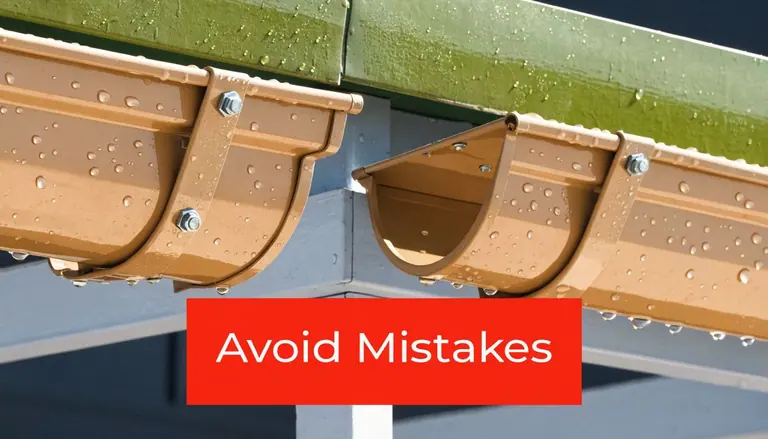
Avoiding Common Metal Roof Gutter Installation Mistakes
A lot of gutter callbacks in North Texas happen after the first real storm. The gutter looked fine on install day. Then a hard rain, hail strike, or a week of summer heat exposed every shortcut in the job.
Mistake one is locking the system too tight
Metal roofs move. Gutters move too. If the installer builds long runs with no allowance for expansion and contraction, the stress shows up at the seams, end caps, straps, and outlets.
In Dallas-Fort Worth, that problem gets worse because the system has to handle both summer heat and sudden temperature swings during storm season. A gutter can look straight in March and start pulling itself apart by August. On a hail-damaged roof, even slight distortion at the edge can make that movement harder on the gutter system.
Mistake two is mixing incompatible metals and cheap hardware
This one causes slow failures that turn into expensive repairs. The wrong screw or hanger may hold at first, then start rusting, staining the fascia, and loosening under load.
Watch for these jobsite mistakes:
- Mixed metals with no isolation: Steel fasteners against aluminum parts, or copper tied into the wrong components, can start galvanic corrosion.
- Undersized hangers: Heavy North Texas runoff, plus debris and occasional hail impact, can rack a lightly supported gutter out of line.
- Hardware substitutions: If the specified fastener is not available, stop and get the right one.
- Fasteners into weak backing: Rotten fascia or thin trim stock will not hold a loaded gutter through storm season.
Mistake three is treating sealant like the fix for bad fit-up
Sealant belongs on a properly assembled joint. It does not rescue a sloppy cut, a warped outlet, or a seam that was forced together out of alignment.
That matters even more on metal roofs because water comes off fast. Standing seam panels can dump concentrated runoff into a short section of gutter. Corrugated panels can break the flow differently and create splash or overshoot if placement is off. If the joint is weak, high-volume runoff finds it quickly.
Mistake four is using one layout for every metal roof profile
Standing seam and corrugated roofs should not be treated the same.
With standing seam, runoff can accelerate between panel ribs and hit the gutter hard at specific points. The gutter placement has to catch that flow without sitting so high that water backs toward the roof edge. With corrugated roofing, the profile can kick water outward and create more splash in heavy rain, so front-edge position and gutter width matter more than many crews expect.
This is also where solar gets ignored. Rooftop solar panels change drainage patterns. They can concentrate discharge at the lower edge of the array, drop more water into one section of gutter, and increase the chance of overflow if the outlet and downspout sizing were based on the roof without panels. On homes with solar, I want to see the gutter layout checked against the panel layout, not guessed from the ground.
Mistake five is underbuilding for North Texas weather
A gutter that survives a light shower may still fail in a Texas storm. Hail can dent the front lip, loosen marginal hanger spacing, and open up weak joints that were barely holding. Wind-driven rain tests alignment in a way a garden hose never will.
Good installation accounts for impact, runoff volume, and service access after a storm. That includes keeping the line straight, supporting corners well, and making sure the system can be repaired without tearing up adjacent roof components.
Homeowners comparing repair risk against install cost can use tools that calculate fair prices for home repairs and review a practical breakdown of gutter installation cost per linear foot before deciding whether a low bid is worth it.
The pattern behind almost every failure is the same. The crew rushed layout, used whatever hardware was on the truck, and installed the gutter as if every metal roof drains the same. That approach does not hold up in this climate.
Estimating Costs and Knowing When to Hire a Pro
A DFW homeowner usually asks the same two questions after the first hard storm. What will this cost, and is this a job I can handle myself without creating a leak at the roof edge?
Start with the house, not a generic price chart. A straight one story with open access is one thing. A two story metal roof with standing seams, long downspout runs, solar near the eaves, and fascia damage from past overflow is another. On metal roofs, labor often swings more than material because layout, attachment method, and roof access have to be right the first time.
If you want a ballpark before scheduling estimates, tools that help homeowners calculate fair prices for home repairs can help set a baseline. For a more specific look at gutters, this breakdown of gutter installation cost per linear foot is a better starting point.
When DIY stops making sense
A capable homeowner can handle a basic gutter replacement on a simple structure. The trouble starts when the roof system adds risk or the water volume leaves very little room for error.
Bring in a pro for these conditions:
- Steep metal panels: Morning dew, dust, and light drizzle make metal slick fast.
- Two-story or higher eaves: Safe ladder setup and material handling become a real problem.
- Standing seam roofs: Hangers and attachment details must work with the panel system, not fight it.
- Corrugated or exposed-fastener profiles: Bracket fit, edge alignment, and closure details take more care.
- Heavy runoff zones: Valleys and long roof sections can overwhelm undersized gutters and poorly placed outlets.
- Existing storm damage: Hail can distort edge metal, loosen fasteners, and turn a gutter job into roof-edge repair.
- Solar at the lower roof edge: Access, wiring protection, and drainage concentration all need to be checked before anyone starts hanging gutter.
That last point gets missed a lot in North Texas.
Solar changes the job
Solar can dump more water into a shorter section of gutter, especially where panel layout concentrates runoff near one corner or one downspout. If the original gutter sizing was based on the roof before panels were added, the system may be underbuilt during a hard rain.
It also changes access. Crews need room to work at the eave without damaging wiring, mounts, or panel frames. On some homes, gutter replacement and solar detach-and-reset need to be planned together so the roof edge can be corrected safely and the drainage path can be reevaluated before everything goes back in place.
Quick homeowner FAQs
Do I need gutter guards
Sometimes. They help on homes with tree debris, but they are not a cure-all. On a metal roof, the wrong guard can slow water entry during a downpour and push runoff over the front lip. Match the guard style to the roof profile, tree load, and the rain intensity you get in this part of Texas.
How long should installation take
A basic home can move quickly. A house with tricky access, custom downspout routing, fascia repair, or solar coordination takes longer. Good crews do not rush slope layout, outlet placement, or fastening just to finish in a day.
Are fewer joints worth paying for
Usually, yes. Every joint is a maintenance point, and North Texas hail has a way of finding weak ones. Longer formed runs with fewer field connections usually hold up better and give you fewer places to chase leaks later.
Match the Gutter System to the Metal Roof
Metal-roof runoff, attachment details, and roof movement should shape the gutter plan from the start. See how Hail King coordinates capacity, fastening, downspouts, discharge, and appearance through its Dallas gutter installation service.
If your metal roof gutter installation needs to survive Texas hail, heavy rain, and real roof movement, Hail King Professionals can help. Their team handles metal roofing, gutters, storm restoration, and solar detach-and-reset for homeowners across Dallas-Fort Worth and East Texas, with code-compliant work built for long-term performance.