

Metal Roofing Repair Products: A Practical Guide
A metal roof leak usually announces itself at the worst possible time. You hear a drip in the middle of the night, notice a brown ceiling stain after a storm, or find water running down a wall near a vent pipe. Most homeowners do the same thing next. They start searching for a tube of sealant and hope the fix is simple.
Sometimes it is. A lot of times it isn't.
The difference between a repair that lasts and one that fails in the next hard rain comes down to diagnosis. Metal roofing repair products work well when they match the actual failure. They fail when people use a generic caulk on a problem that really needs a new fastener, a patch, a flashing repair, or a full restoration approach.
That should give you some confidence, not more stress. This isn't a niche corner of the market. The U.S. Roofing Contractors industry, which includes metal roof treatments like coating and spraying, reached a projected $92.5 billion market size in 2026, with revenue growing at a 5.0% CAGR from 2021 to 2026 according to IBISWorld's U.S. Roofing Contractors industry report. In real terms, that scale has helped turn metal roof repair products from random patch materials into standardized systems that roofers use every day.
Your Guide to Fixing a Leaky Metal Roof
Metal roofs don't usually fail all at once. They leak at a fastener. A seam opens a little. Flashing around a pipe starts to separate. A hail strike leaves a puncture that wasn't obvious from the ground. Water gets in at one small point, then travels, and suddenly the stain inside looks much bigger than the actual roof defect.
That's why the first move isn't buying a product. It's figuring out what kind of failure you're dealing with.
A homeowner in Texas might climb up and see a bead of old sealant, assume the last repair just dried out, and add another layer on top. Then the leak comes back because the underlying problem was a backed-out screw beside the sealant line. I see this pattern often on aging metal roofs. The wrong product gets blamed, when the actual issue was that no one corrected the source of movement or water entry.
Start with the symptom, not the shelf
When water shows up indoors, ask three questions before you shop:
- Where does the leak appear inside: Near a chimney, vent, skylight, wall transition, or open field of roof?
- When does it happen: Only during wind-driven rain, after hail, or after long exposure to standing water?
- What does the roof surface show: Missing fasteners, rust, open seams, cracked boot flashing, or obvious punctures?
Those answers narrow the product choice fast.
Practical rule: If the repair product doesn't match the failure mode, the repair usually becomes temporary even if the product itself is high quality.
Most metal roof leaks are fixable. The trick is to stop treating every leak like it needs the same tube, tape, or coating.
Understanding Why Metal Roofs Leak
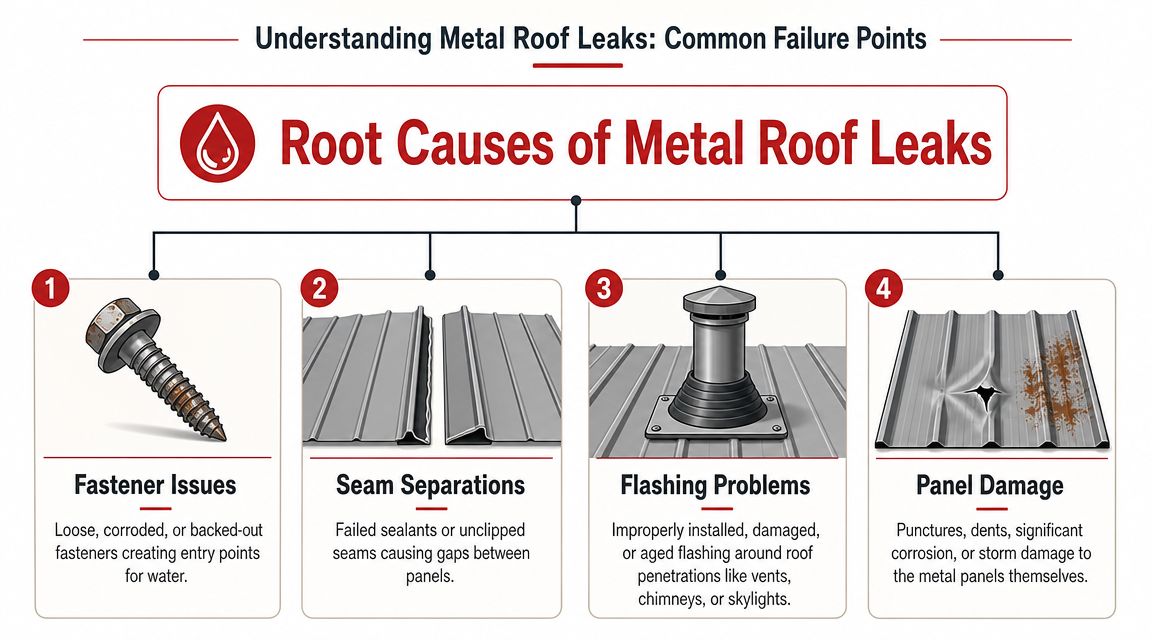
A metal roof is only as dependable as its weakest detail. The panels matter, but leaks often start at the connections, transitions, and penetrations.
Fastener problems
Exposed-fastener metal roofs leak most often at screws and washers. The screw can back out over time, the washer can dry out, or corrosion can weaken the assembly. Once that seal under the washer is compromised, water has a direct route into the roof system.
On Texas roofs, heat cycles matter. Metal expands in the sun and contracts when temperatures drop. That movement works on fasteners over time, especially on older roofs or roofs with inconsistent installation.
Seam separation
Standing seam and lap-seam roofs can leak where panels join. Sometimes the seam sealant fails. Sometimes the joint loses compression. Sometimes the panels move enough that a previously tight connection starts admitting water under wind-driven rain.
This is common on long panel runs, detached structures, and simpler accessory buildings. If you're comparing assemblies for sheds, barns, or metal panel carport solutions, it helps to understand that panel layout and joint design affect long-term leak behavior as much as the metal itself.
Water rarely enters exactly where it appears inside. It often gets in at a seam or penetration and travels before it drips.
Flashing failures
Flashing is where a lot of homeowners get fooled. The panel field may look fine, but the leak is around a vent, chimney, skylight, sidewall, or transition. If you want a plain-language primer on that component, this guide on what flashing is on a roof is useful before you start pulling sealant out of the truck.
Common flashing problems include:
- Cracked pipe boots: Rubber components age and split.
- Loose metal counterflashing: Wind or movement opens a path behind it.
- Bad sealant transitions: Old sealant shrinks, hardens, or loses adhesion.
- Improper original installation: Water gets directed into, not away from, the detail.
Panel damage and corrosion
Not every leak comes from a joint. Hail, fallen branches, foot traffic, and rust can damage the panel itself. A pinhole from corrosion behaves differently than a torn panel near a ridge cap. One might accept a sealant repair. The other may need a metal patch or panel replacement.
When people say “my metal roof is leaking,” they're often describing four different problems with four different repair paths. That's why diagnosis comes first.
The Essential Metal Roof Repair Product Toolkit
A roofer's kit for metal roofing repair products isn't just tubes of sealant. Each product category solves a different kind of problem, and using the wrong one can create a repair that looks good for a month and then starts leaking again.
Sealants and mastics
This is the category most homeowners recognize first, but it's also where the most mistakes happen. Joint movement matters. According to Western States Metal Roofing's guidance on metal roof sealant, butyl tape works best in compressed, static joints, while gun-grade sealants such as polyurethane or silicone are better for exposed details that move with thermal expansion and contraction. Use the wrong chemistry in the wrong place and you can end up with adhesion failure and chronic leaks.
In practice, that means:
- Butyl tape belongs where metal parts clamp tightly together.
- Polyurethane sealant works well for exposed detailing where flexibility matters.
- Silicone sealant is often used where weather resistance and long-term flexibility are important.
- Mastic is useful for heavier detail work, but it isn't a cure-all.
Tapes and patch materials
Reinforced repair tapes have their place, especially on small punctures, minor tears, and certain seam details. The surface prep has to be right or the tape won't bond well enough to matter.
I like to think of repair tape as a spot-repair material, not a substitute for fixing loose metal, failed flashing, or active corrosion underneath. If the substrate is unstable, the tape is just covering movement.
Fasteners and washers
A surprising number of leaks need hardware, not chemistry. If a screw is backed out, stripped, or rusted, the fix may be an oversized replacement fastener with a fresh sealing washer. Smearing sealant over a failed screw head without resetting the connection is one of the most common bad repairs on exposed-fastener roofs.
Primers and adhesion helpers
Primers don't get much attention until a repair fails to stick. On oxidized metal, lightly rusted areas, or surfaces with questionable coating compatibility, a compatible primer can make the difference between a repair that bonds and one that peels.
Some products are designed to be used as systems. Mixing brands or chemistries without checking compatibility is where people get into trouble.
Repair Product Quick Reference
| Product Category | Primary Use | Best For |
|---|---|---|
| Sealant and mastic | Sealing joints, exposed details, and penetrations | Small gaps, flashing edges, detail work |
| Butyl tape | Compressed joint sealing | Metal-to-metal laps and static joints |
| Repair tape and patch material | Reinforcing localized damage | Small punctures, tears, limited seam repairs |
| Replacement fasteners and washers | Re-securing roof components | Backed-out, stripped, or leaking screws |
| Primer and adhesive products | Surface preparation and bond improvement | Rust-prone areas, difficult substrates, coating prep |
What doesn't belong in every repair
Not every sticky product sold in a roofing aisle belongs on metal. Avoid the mindset that thicker means better. Some products stay too rigid. Some don't handle movement. Some don't bond well to coated metal. Some are fine for a short emergency patch but not for a lasting repair.
The best metal roofing repair products are usually the ones that solve one precise problem well, not the ones marketed as universal.
How to Match the Right Product to the Damage
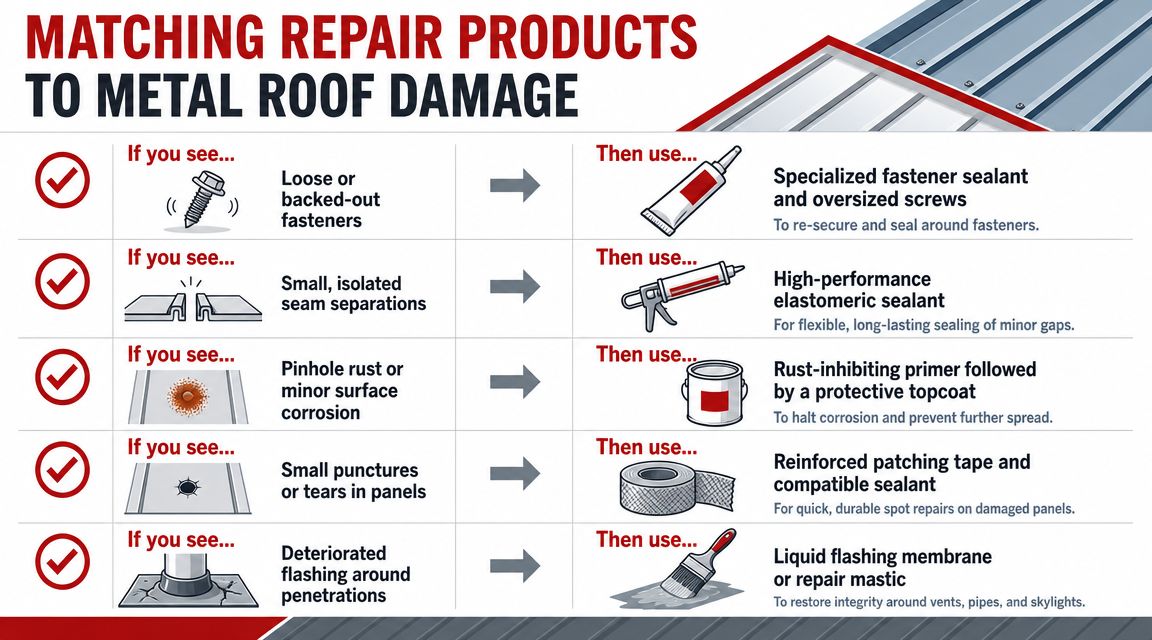
Diagnosis matters most when you're standing on the roof deciding what to do next. At this stage, homeowners either save themselves a second repair or create one.
If the problem is a failed fastener
A screw that has backed out, loosened, or lost its washer seal needs a mechanical correction first. Replace or re-secure the fastener with the correct roofing screw and a new sealing washer. Then seal only if the detail calls for it.
Don't put a blob of caulk over a bad screw and call it fixed. Water often gets under that patch, and the loose connection is still loose.
If the problem is a small hole or puncture
The repair depends on size and location. Lowe's guidance on repairing a metal roof notes that small holes can be handled with high-solids sealant, while larger tears may need a metal patch, and loose seams need to be re-secured rather than treated as a generic caulk problem.
That matches what works in the field:
- Small pinholes or isolated punctures: High-solids sealant on a properly prepared surface.
- Larger tears: Matching metal patch, fastened as needed, with sealed edges.
- Thin rusted-through areas: Don't trust sealant alone if the base metal has lost integrity.
Here's a useful walkthrough before you start comparing products:
If the problem is seam separation
This one gets misdiagnosed constantly. A slightly open seam may look like it needs sealant, but the core question is whether the seam has lost compression or attachment. If it has, re-securing the seam comes before any top-side sealing.
For small, stable seam openings, a compatible elastomeric or high-performance sealant may work. For longer seam issues, reinforced treatment and broader restoration may make more sense than repeated spot repairs.
When a seam keeps leaking after fresh sealant, assume movement or attachment is the real issue.
If the problem is flashing around penetrations
Vents, pipes, skylights, and wall transitions are detail repairs. A liquid flashing product or repair mastic may work for minor deterioration, but cracked boots, distorted metal flashing, or poorly installed transitions often need component replacement.
This is also where local experience matters. In Texas, hail and strong thermal cycling create failure patterns that don't show up the same way on every roof. If you want another option besides DIY products, Hail King Professionals handles metal-roof leak diagnostics, repairs, and restoration work in Dallas-Fort Worth and East Texas.
When to Use Roof Coatings for Full Restoration
Spot repair makes sense when the roof has a few isolated defects. It stops making sense when the whole roof is aging at once.
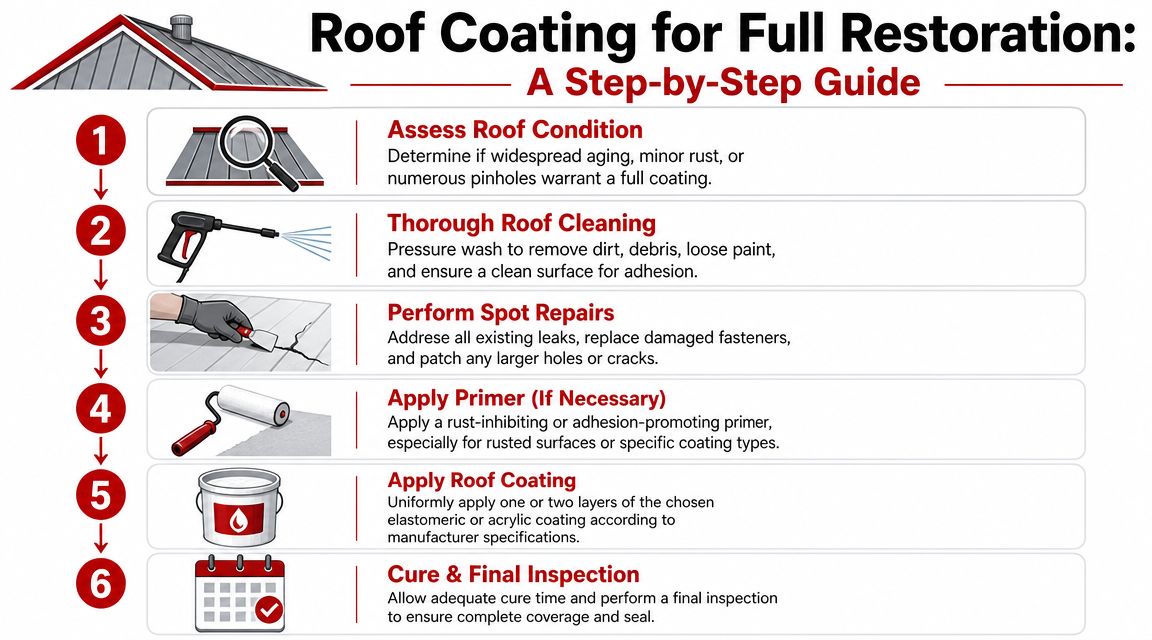
If the panels are still structurally serviceable but the roof has scattered fastener leaks, weathered seams, minor surface rust, and too many small trouble spots to patch one by one, a coating system may be the smarter path. That's not just “painting the roof.” It's restoration when done correctly.
What a real restoration system involves
Modern systems are multi-step. GAF's silicone-over-metal system describes cleaning the roof, securing loose or missing fasteners, treating seams with silicone mastic and embedded fabric, detailing penetrations, and then applying the silicone coating. It also offers 10-, 15-, or 20-year limited warranty or guarantee options, depending on specification, and is designed to protect against leaks caused by ponding water, as shown in GAF's silicone-over-metal coatings system information.
That matters because it shows how far metal roofing repair products have come. The coating is only one layer in a broader repair system.
When coatings make sense
A coating approach is often worth considering when:
- The roof leaks in multiple areas: Chasing one leak at a time turns into constant maintenance.
- Surface oxidation is present but manageable: The roof needs protection before corrosion spreads.
- Seams and penetrations need system-wide treatment: Isolated patches won't address overall aging.
- Replacement isn't yet necessary: The roof still has serviceable structure and attachment.
If you want a basic overview of material behavior before comparing systems, this explanation of what elastomeric roof coating is helps frame where coatings fit and where they don't.
What coatings won't fix
Coatings aren't a shortcut around bad substrate conditions. They won't solve major structural failure, heavily deteriorated panels, widespread loose attachment, or badly damaged flashing that should be rebuilt first. If a contractor wants to coat over obvious defects without correcting the underlying issues, that's a red flag.
Knowing When to Call a Roofing Professional
Some metal roof repairs are realistic for a careful homeowner. Others carry enough risk, complexity, or hidden damage that bringing in a roofer is the smart move.
Call a pro when the leak source isn't obvious
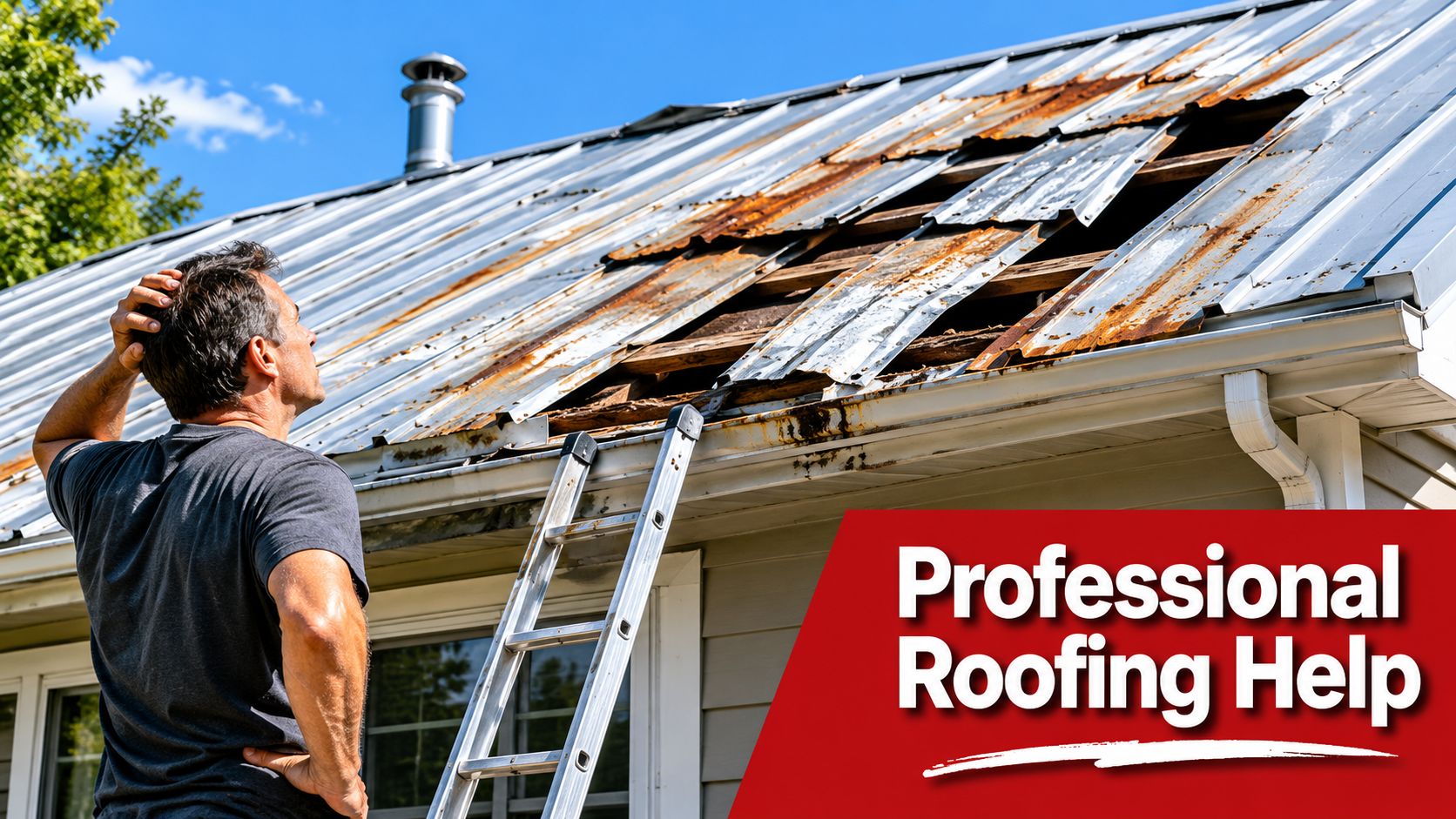
If water shows up inside but you can't clearly identify the roof entry point, the repair has already moved beyond a simple product decision. Metal roofs often leak upslope from where the stain appears. A professional inspection can sort out whether the issue is a seam, a flashing transition, a fastener pattern, or storm damage.
Call a pro after hail or storm impact
Texas storms don't always leave dramatic damage you can spot from the yard. Small punctures, loosened seams, deformed flashing, and impact damage around accessories can all create delayed leaks.
This is especially true when insurance may be involved. Documentation, photos, and a clean scope of work matter.
Call a pro for steep roofs, high roofs, and complex details
There's no repair product worth a fall. If the roof pitch, height, or access makes inspection unsafe, stop there.
The same goes for complicated details:
- Multiple penetrations: Skylights, plumbing vents, HVAC curbs, and wall transitions
- Long seam runs: Harder to diagnose and harder to stabilize correctly
- Mixed-material details: More chance of compatibility and corrosion issues
- Unknown prior repairs: Old mastics and patches can hide the actual defect
A repair that lasts depends as much on finding the right failure as choosing the right product.
Call a pro when you're deciding between repair and replacement
There's a point where buying more repair materials is just delaying a larger decision. If your roof has repeated leaks, broad corrosion, panel damage in multiple zones, or earlier repairs stacked on top of each other, compare both paths thoroughly. This guide on deciding roof repair vs replacement is a helpful outside reference for framing that choice.
If you're still early in the process and want to understand how a sound system should be assembled, this metal roofing installation guide gives useful context. A lot of repair problems make more sense once you understand what the original components were supposed to do.
Frequently Asked Questions About Metal Roof Repair
Can I use the same repair product on steel and aluminum?
Not automatically. Product compatibility matters with both the metal and the factory finish. A sealant or primer that bonds well to one surface may not perform the same way on another. Always check the manufacturer's compatibility guidance before applying anything to coated panels, bare metal, or oxidized surfaces.
Will a DIY repair void my roof warranty?
It can. Some roof systems and coatings are sold as part of a defined installation method. Unapproved sealants, incompatible coatings, or field modifications may affect coverage. Before doing a repair, review your warranty paperwork and the product instructions. If the roof is still under a manufacturer or installer warranty, ask before you patch.
Can I repair a leak from inside the attic?
Only as an emergency measure to manage water, not as a lasting repair. Metal roof leaks need exterior diagnosis because the water entry point is almost always on the roof system itself. Interior patching may slow visible dripping, but it won't solve failed fasteners, open seams, flashing issues, or panel damage.
How do I improve the odds of insurance coverage after storm damage?
Document the damage quickly. Take photos of the interior signs, roof surface issues you can safely see, and the date the problem appeared. Keep records of prior maintenance and any temporary mitigation you performed. If hail or wind likely caused the damage, a roofing professional can help identify whether the loss is isolated repair work or part of a broader storm claim.
If you're dealing with a leaking metal roof in Dallas-Fort Worth or East Texas, Hail King Professionals can inspect the roof, identify whether the issue is fasteners, seams, flashing, panel damage, or a larger restoration need, and give you a clear repair-or-replacement recommendation.