

Longview Roofing Companies: A Homeowner’s Hiring Guide
A storm rolls through Longview at night, and the next morning you notice granules in the driveway, a water stain spreading near the hallway vent, or a neighbor already has a roofing sign in the yard. That's usually when the phones start ringing and trucks start appearing.
A lot of homeowners get pushed into a bad decision.
Roofing looks simple from the street. It isn't. The difference between a solid contractor and a smooth-talking storm chaser often shows up months later, when flashing leaks around a chimney, ridge ventilation was handled wrong, or the crew vanished after cashing a check. In East Texas, that kind of mistake gets expensive fast.
The good news is you don't need to become a roofer to hire one wisely. You just need to know what to look for, what questions to ask, and what shortcuts usually cause trouble. That's what this guide is for.
Your Guide to Choosing a Roofer in Longview Texas
Most Longview homeowners start the search the same way. They type in roofing companies, call two or three names, and hope the lowest number doesn't come back to bite them. After a hailstorm, that process gets even messier because plenty of companies show up looking local for the week.
That's not paranoia. It's the nature of the business. The U.S. roofing contracting industry is projected at $92.5 billion in 2026 with over 109,000 businesses, according to IBISWorld's roofing contractors industry overview. In plain English, homeowners are choosing from a crowded, fragmented market. A lot of roofers are legitimate. A lot are not built for long-term service after the job is done.
In Longview, roof performance is critical because roofs here take a beating. Hail bruises shingles without always causing obvious leaks right away. Wind lifts tabs and weakens seals. Heat cooks aging pipe boots and attic ventilation problems make everything worse. If a contractor misses those details, the roof can look fine from the curb and still fail where it counts.
What matters most in a local market
A dependable roofer doesn't just sell shingles. They diagnose the whole roof system, explain the options in plain language, and leave a paper trail you can review before signing anything.
That means you want someone who can do more than say, “You've got damage.” You want a contractor who can show where the damage is, explain whether repair or replacement makes sense, and tell you what the crew will do at the chimney, valleys, vents, wall transitions, gutters, and cleanup stage.
Practical rule: If a roofer can't explain the job clearly before the contract, don't expect clear communication once your roof is torn off.
A local hiring process also needs some discipline. Don't start with the price. Start with proof. Then compare scope. Then compare materials. Then compare how each company handles insurance, supplements, cleanup, and final walkthrough.
If you want a solid starting point before you call anyone, this guide on how to choose a roofing contractor is worth reviewing alongside your shortlist.
The shift that saves homeowners trouble
The smartest Longview homeowners stop thinking like panicked buyers and start thinking like project managers.
That shift matters. When you slow the process down just enough to verify the company, inspect the estimate, and understand the roof system being proposed, bad contractors usually expose themselves quickly. The right ones don't mind your questions. They expect them.
How to Vet and Verify Reputable Roofing Companies
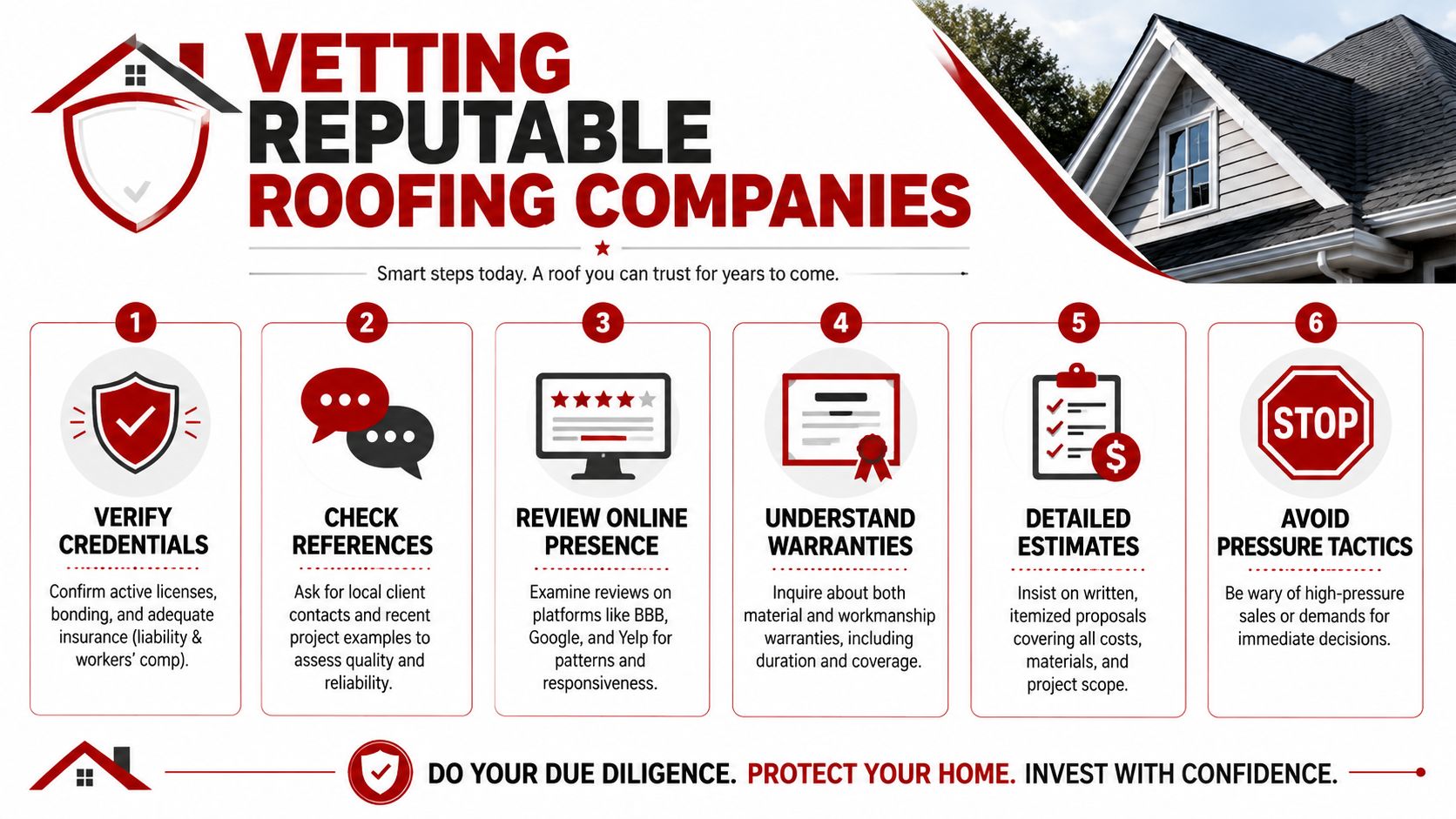
The fastest way to weed out weak contractors is to ask for documents, not promises. A polished sales pitch doesn't protect your house. Paperwork does.
Long-term presence matters in East Texas. Some local Longview contractors report over 50 years of family-owned operation and say they carry workers' compensation, which can signal a steadier commitment to the area than short-term storm outfits, according to Longview Roofing LLC.
What to verify before you talk about price
Start with the company identity. You want a real business address, a working local phone number, a website that names the company clearly, and written proof of insurance. If they hesitate when you ask for certificates, that's a warning sign.
Use this checklist:
- Insurance proof: Ask for current general liability and workers' compensation documentation. Don't settle for “we're covered.” Ask for the certificate.
- Business footprint: Look for a permanent address, not just a temporary yard sign campaign after a storm.
- Local references: Ask for recent projects in Longview, Hallsville, White Oak, or nearby neighborhoods where roofs see the same weather patterns.
- Written scope: Make them show exactly what gets replaced, what gets repaired, and what happens if damaged decking or rotten trim is found.
- Crew structure: Ask who installs the roof. The company's own crews and repeat crews are usually easier to hold accountable than a revolving door of unknown labor.
A reputable contractor won't get offended by this. They'll be prepared.
Red flags that should end the conversation
Some problems show up before anyone climbs a ladder.
Watch for these:
- High-pressure urgency: “Sign tonight or the price changes” usually means the sales process is driving the job, not the roof condition.
- Deductible games: If someone offers to absorb or hide part of your deductible, you're already in dangerous territory.
- Large cash demands upfront: A fair deposit and a reckless demand are not the same thing.
- Vague language: If the estimate says little more than “replace roof,” it's not detailed enough.
- No discussion of safety or cleanup: Good contractors talk about property protection, nail pickup, landscaping, driveway staging, and final walkthrough because those are part of the job.
The easiest contractor to hire is often the hardest one to get back when something leaks.
What longevity usually tells you
A company that's been around locally has more to lose by cutting corners. That doesn't make every older company good, but it does matter. Businesses that survive in roofing tend to build repeat relationships with homeowners, property managers, suppliers, and crews. They know their reputation follows them from one storm season to the next.
That's why one of the best vetting questions is simple: how long have you worked this market, and who can confirm the quality of your work nearby? If the answer sounds slippery, move on.
What a Professional Roof Inspection Should Include
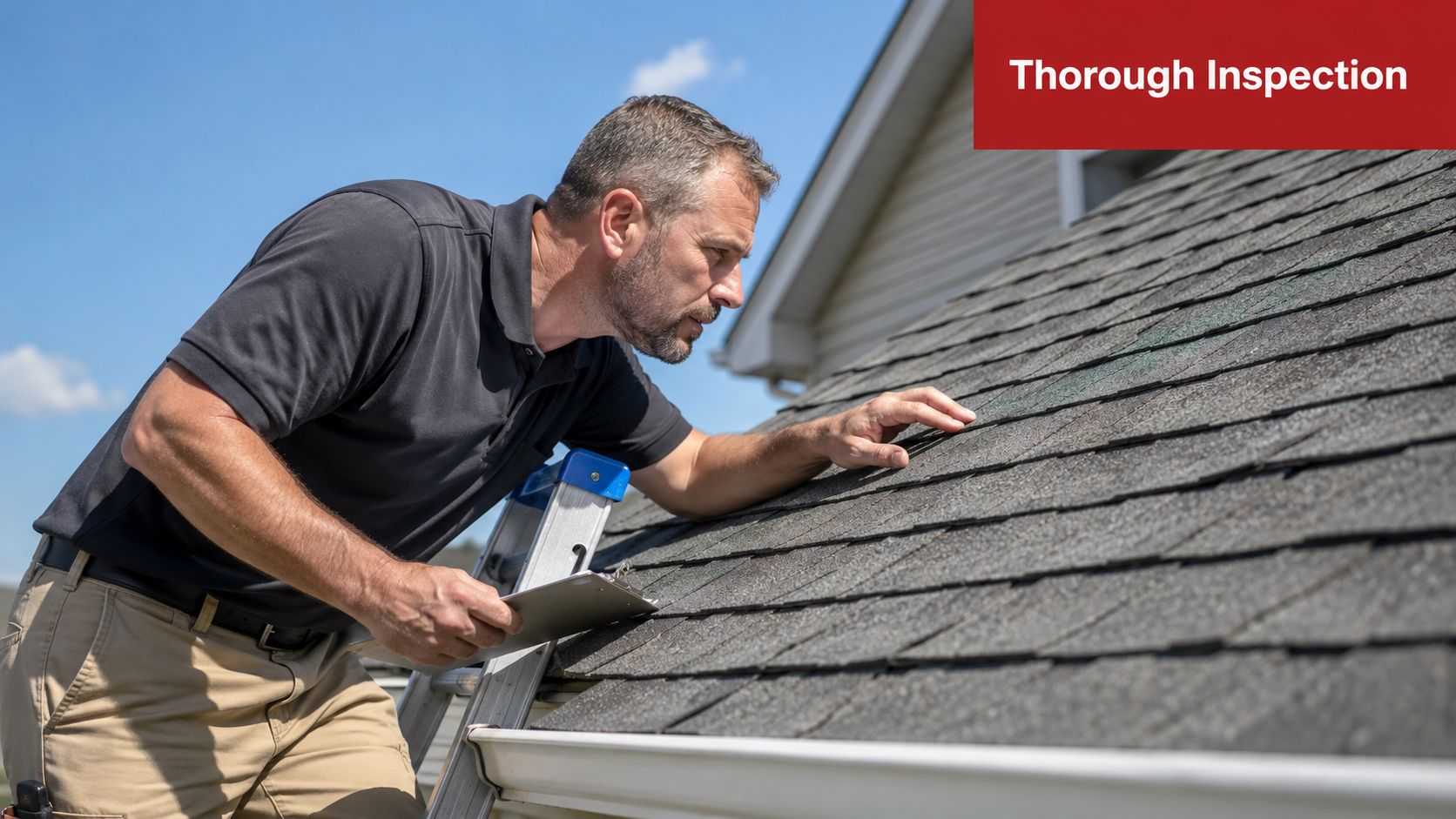
A real roof inspection is not a salesman glancing from the eaves and telling you that you need a full replacement. It's a diagnostic process.
The first thing I'd want any homeowner to understand is this: a roof leak rarely means the water entered directly above the stain. Water travels. It runs decking, follows nails, moves along framing, and shows up where gravity finally wins. That's why a serious inspection has to look beyond the obvious symptom.
What should be checked on the roof and inside the home
A professional residential workflow should follow inspection, material selection, transparent pricing, and a final walkthrough, and that inspection should be standardized before any quote is issued, according to this Longview roofing workflow overview.
That inspection should include more than shingles. It should cover:
- Leak-path mapping: The contractor should trace likely water entry points and not just circle the room stain on a notepad.
- Flashing and penetrations: Chimneys, pipe boots, valleys, skylights, step flashing, wall flashing, and vent details need close inspection.
- Underlayment and accessory condition: A good roofer looks at the whole assembly, especially on older roofs or roofs with prior patchwork.
- Hail impact assessment: East Texas roofs often show granular loss, bruising, soft spots, or damage at accessories before homeowners notice any active leak.
- Ventilation and attic signs: If accessible, the attic can reveal moisture, heat buildup, daylight intrusion, stained decking, or mold-like growth patterns tied to airflow problems.
A quick glance from a ladder won't catch half of that.
What useful documentation looks like
A homeowner should leave the inspection with evidence. That means photo documentation, marked problem areas, and a clear explanation of what is storm-related, what is wear-and-tear, and what needs immediate attention regardless of insurance.
If you want a homeowner-friendly tool to keep the process organized, use this roof inspection checklist template while the contractor is on site. It helps you compare inspections instead of relying on memory later.
If two companies inspect the same roof and one spends ten minutes while the other checks flashing, attic conditions, penetrations, and drainage, those are not equivalent inspections.
For homeowners dealing with low-slope additions, patio roofs, or commercial-style sections, drainage matters just as much as membrane condition. Ponding water, seam details, and curb flashing failures don't behave like steep-slope shingle problems, so the contractor needs to know the difference.
Here's a short explainer worth watching before you approve major work:
What a weak inspection usually misses
Weak inspections tend to miss the small parts that later cause the callback. Reused pipe boots. Unaddressed decking damage. Improperly sealed exposed fasteners. Wall flashing hidden under old siding. Hail hits on soft metals and vents that support an insurance file even when shingles are borderline.
That's why the inspection phase matters so much. If the diagnosis is sloppy, the estimate and the installation usually follow the same pattern.
Decoding Estimates and Selecting Roofing Materials
Most roofing estimates confuse homeowners for one reason. They mix scope, materials, labor, and assumptions into a few lines and expect you to compare them as if they're equal. They usually aren't.
A professional workflow ties the proposal to the inspection, the code requirements, the chosen material, and a final walkthrough, not just a number at the bottom of the page, as noted in this residential roofing workflow reference.
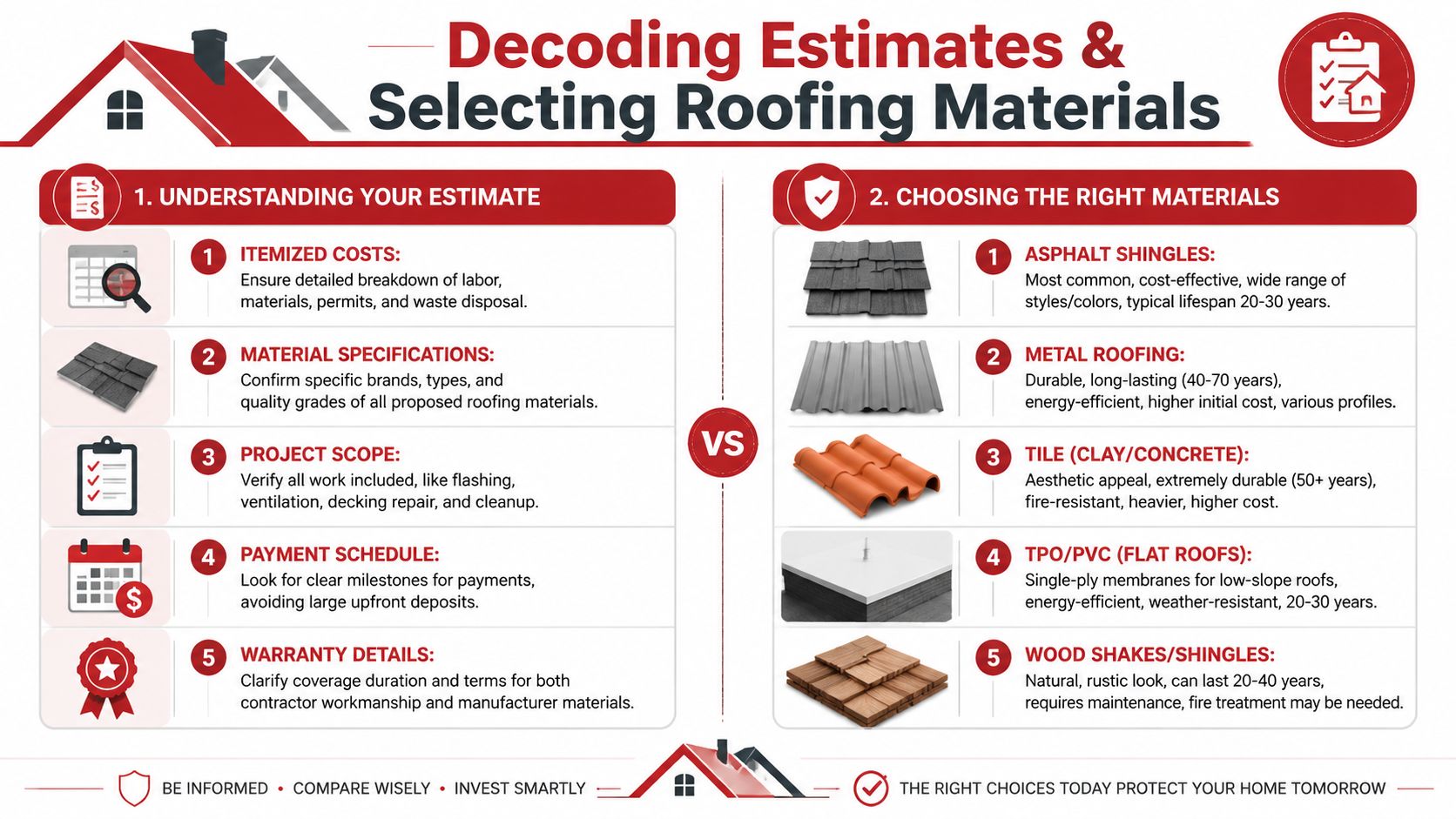
How to compare estimates line by line
A good estimate answers the question, “What exactly am I buying?”
Look for these details in writing:
| Estimate item | What you want to see |
|---|---|
| Tear-off | Whether the old roof is removed fully or partially |
| Materials | Specific shingle or metal system, underlayment, starter, ridge, flashing components |
| Decking | How damaged decking is handled if bad wood is found |
| Ventilation | Intake and exhaust plan, not just “replace vents” |
| Accessories | Pipe boots, valley metal, drip edge, chimney or wall flashing |
| Cleanup | Magnet sweep, haul-off, gutter cleanup, landscaping protection |
| Warranty | Separate workmanship and manufacturer terms |
| Payment terms | Clear schedule tied to job progress, not vague requests |
If one estimate is much lower, check what got left out. Cheap bids often skip accessory replacement, flashing detail work, ventilation corrections, and cleanup standards. Those are the very areas that create leak complaints later.
For homeowners trying to keep the budget straight while comparing quotes, it helps to streamline construction project finances with a simple budgeting template before signing. That way you can track the roof itself, gutter work, possible decking repairs, and any separate trades like solar or painting.
Material choices that make sense in Longview
Longview roofs deal with hail, heat, heavy rain, and long summer exposure. That means the “best” material depends on your roof shape, budget, neighborhood, and tolerance for future maintenance.
Architectural asphalt shingles
These are the most common choice for a reason. They fit most homes, they're widely available, and repairs are usually more straightforward than with specialty systems. In hail country, many homeowners also ask about impact-resistant shingles, especially when they want a tougher product profile.
What works:
- Good fit for standard residential rooflines
- Broad color and profile options
- Easier matching for many neighborhood styles
What doesn't:
- They're not all the same quality
- Cheap accessory packages can undermine a decent shingle
- A shingle roof is only as good as the flashing, ventilation, and installation details around it
Standing-seam metal
Metal makes sense when a homeowner wants durability, cleaner water shedding, and a different look than shingles. It can be a strong option in East Texas, but it's not a beginner system. Trim details, transitions, fastener approach, and panel layout matter.
What works:
- Strong fit for homeowners planning to stay long term
- Good choice for simple to moderately complex roof designs
- Can pair well with certain ventilation plans and modern home styles
What doesn't:
- Complex cut-up roofs drive labor complexity
- Bad trim work stands out immediately
- Repairs and additions need a contractor who knows metal details, not one who mostly does shingles
Low-slope and flat roof sections
Porches, additions, garages, and commercial buildings often have low-slope areas that need a different system entirely. For those roofs, the benchmark is whether the contractor can prove competence in flat-roof design, materials, and detailing. Roofing-sector reporting also notes a labor difference of 59% of jobs completed by full-time workers versus 29% by subcontractors, which matters when repeatable installation quality and seam discipline are critical, as cited in this Longview commercial roofing discussion.
What works on low-slope roofs:
- Careful substrate review
- Moisture detection and drainage evaluation
- Proper seam, edge, and penetration detailing
- Surface prep before coatings are applied
What fails:
- Ponding water ignored during quoting
- Penetration flashing treated like a minor detail
- Coatings applied over poorly prepared surfaces
The lowest roofing price often buys the least attention to the parts you can't see from the driveway.
Don't choose materials in a vacuum
Material selection should follow the inspection. A hail-exposed roof with lots of penetrations may point one direction. A clean, simple roof with a homeowner planning to stay long term may point another. A detached garage or patio addition may need a completely different system than the main house.
That's also where one practical option can matter. Companies such as Hail King Professionals handle asphalt, metal, flat roofing, and solar panel detach-and-reset, which is useful when the project includes more than a basic shingle swap.
Navigating Insurance Claims and Solar Panel Logistics
Insurance and solar are where many roofing jobs get derailed, not because the roof is complicated, but because the coordination is.
Homeowners often expect the roofer to “handle the whole claim.” A good roofer can document damage, explain the repair scope, provide photos, and meet with an adjuster at the property. That helps. But the claim itself belongs to the homeowner and the insurance carrier. Keep that distinction clear from day one.
What your roofer should do during a claim
A competent contractor should inspect the damage carefully, provide documentation, and explain the roof system in a way that supports a fair review. They should also identify items that are easy to miss, like soft metal impacts, flashing damage, detached ridge components, or collateral issues around vents and accessories.
What they should not do is promise claim approval, rewrite your policy from the driveway, or make side deals around deductibles.
A few basic claim terms help:
- RCV: Replacement Cost Value. This generally refers to the cost basis for replacing covered damage under the policy terms.
- ACV: Actual Cash Value. This generally reflects depreciation being applied before full recoverable amounts, if your policy works that way.
- Supplement: A request for additional payment when legitimate scope items were missed in the first review.
Those terms matter because roof projects often uncover necessary line items after tear-off, especially if decking or flashing conditions couldn't be fully confirmed from the surface.
For homeowners trying to stay organized during a claim, protecting assets with a home inventory can make the broader insurance process easier, especially if the storm affected more than the roof.
Solar changes the roofing timeline
Solar panel detach-and-reset is not a side note. It affects scheduling, cost planning, liability, and who touches what on the roof.
If your home has rooftop solar, ask these questions early:
- Who removes the panels: The roofing crew, the solar company, or a coordinated subcontractor?
- Who stores and protects components: Panels, rails, wiring, and attachment hardware need a controlled process.
- Who is responsible for reset and testing: Reinstallation has to be done by qualified people who understand the solar system.
- What happens to roof penetrations: Old attachment points must be handled correctly during reroofing.
- How does this affect the build calendar: Roofing can't move cleanly if another trade is delayed.
Plenty of jobs bog down in these situations. The tear-off is ready, the solar crew isn't scheduled, the homeowner assumes someone else is handling permits or warranty questions, and the whole project sits exposed longer than it should.
If your roof replacement includes panels, read this guide on solar panel roof replacement before signing a contract. It'll help you ask the right coordination questions up front.
Solar jobs go smoothly when the roofer, the solar provider, and the homeowner agree on sequence before materials are delivered.
Don't forget the adjoining trades
Solar isn't the only moving part. Roof jobs often overlap with gutters, fascia wrap, siding transitions, chimney work, and window screen or fencing protection around staging areas. None of that is glamorous, but all of it affects the finished result.
A sharp contractor addresses those handoffs early. A sloppy one discovers them after tear-off and starts improvising.
Making Your Final Decision and Starting Your Project
By the time you're ready to sign, the choice should feel narrower and clearer. You're no longer comparing ads. You're comparing documentation, scope, communication, and whether the contractor has thought through the ugly parts of the job that homeowners rarely see.
If a company inspected thoroughly, answered direct questions, wrote a detailed estimate, and explained the material trade-offs without pushing one option blindly, that's a strong sign. If they stayed vague, rushed decisions, or made the whole job sound effortless, be careful.
Critical Questions for Your Potential Roofer
| Category | Question | Why It Matters |
|---|---|---|
| Insurance | Do you carry current liability coverage and workers' compensation, and can you provide proof? | It helps you verify that the company is operating responsibly and not asking you to trust a verbal claim. |
| Scope | What exactly is included in the contract besides shingles or panels? | Flashing, ventilation, accessories, and cleanup often separate a complete job from a cheap one. |
| Decking | How do you handle damaged decking if it's discovered after tear-off? | You need to know the approval process and how changes are documented. |
| Crew | Who will actually install my roof? | Accountability matters when different crews, subs, or specialty trades are involved. |
| Property protection | How do you protect landscaping, driveways, pools, fences, and AC units? | Roof replacement affects more than the roof surface. |
| Cleanup | What does final cleanup include? | Nails, debris, gutters, and magnetic sweeping should be addressed clearly. |
| Warranty | What is your workmanship warranty, and what material warranty applies to the system you're installing? | Homeowners need both pieces explained separately. |
| Communication | Who is my point of contact during the job? | Miscommunication causes more frustration than most homeowners expect. |
| Final walkthrough | Do you do a final walkthrough with photos or punch-list review? | This is where small misses get caught before the job is closed out. |
| Payments | What is the payment schedule? | Clear milestones reduce confusion and pressure. |
What happens after you sign
Once you choose the roofer, expect scheduling, material ordering, delivery coordination, and a pre-job communication call or visit. Good contractors tell you where materials will be staged, when the crew arrives, what noise to expect, and how they want vehicles moved out of the driveway.
During the build, communication should stay simple. If decking issues appear, you should get photos and options. If weather changes the schedule, you should hear about it early. If the project includes financing, make sure you understand the payment terms before work starts, not after the roof is loaded.
Financing can be a useful tool when it lets you install the right system instead of settling for a cut-corner repair or a bargain proposal that ignores critical components. Used well, it buys quality and timing. Used poorly, it hides a bad contract.
A roof project shouldn't feel casual. It also shouldn't feel chaotic. When the contractor is right, the process is direct, documented, and manageable.
If you want a second opinion before you hire anyone, Hail King Professionals provides roof inspections, repair and replacement options, help with storm-damage documentation, and coordination for solar-equipped homes across East Texas. That kind of clarity is what homeowners need when the roof decision can't wait but still has to be made carefully.