


Roofing Permit Requirements: A Texas Homeowner’s Guide
You get a roof replacement estimate after a hail storm, scan the line items, and stop at permit fees. That's usually the moment the questions start. Do I really need this? Isn't this just paperwork? Why does one roofer include it while another barely mentions it?
That confusion is normal, especially in Texas. A homeowner in Dallas, TX may face a different permitting rule than someone in Fort Worth, TX, and both may have a different process than a homeowner in San Antonio, TX or Austin, TX. If you're searching for a roofing contractor near me, roof repair near me, or roof replacement near me, you need more than a price. You need a contractor who understands local roofing permit requirements and can keep your project compliant from start to finish.
A permit can feel like red tape until something goes wrong. Then it becomes the document that shows the work was reviewed, the roof was installed to code, and the project was handled correctly. In Texas weather, that matters. Hail storms, high winds, heavy rain, and extreme heat put real stress on roofing systems. A roof that isn't installed to local code can create problems with inspections, resale, and insurance claims long after the crew leaves.
Navigating Texas Roofing Permits Without the Headache
Most homeowners don't think about permits until they need a roof repair or full roof replacement. They're focused on active leaks, missing shingles, storm damage roof repair, and getting the house protected before the next round of weather moves through. That's reasonable.
Still, the permit side of the job can't be treated as an afterthought. A city permit is one of the main checkpoints that separates a code-compliant roofing project from one that may create problems later. It helps confirm that the scope of work matches local rules, that inspections can happen when required, and that the finished roof is more likely to hold up under Texas conditions.
Practical rule: If a contractor tells you permits never matter, slow down and ask more questions.
Homeowners often assume permit fees are just a city tax added to the invoice. They're not. They're part of a process that protects the structure under the shingles, the ventilation details around the roofline, and the workmanship standards that affect how your roof performs during hail damage repair and wind damage repair situations.
Why the hassle is worth it
Permits matter most when the project is large enough to change the roof system in a meaningful way. That includes full tear-offs, re-roofing, decking replacement, and structural work. Those aren't cosmetic updates. They affect how your home sheds water, resists uplift, and supports the materials installed on top.
For homeowners in Arlington, TX, Plano, TX, Frisco, TX, McKinney, TX, Garland, TX, Irving, TX, Mesquite, TX, Tyler, TX, Longview, TX, Marshall, TX, New Braunfels, TX, San Marcos, TX, Boerne, TX, Round Rock, TX, and Georgetown, TX, the safest move is simple. Verify local requirements before work begins, and make sure your roofing contractor handles the permit correctly.
Why local knowledge matters
National articles often make roofing permits sound straightforward. Texas isn't straightforward. The rules are local, the interpretations can differ, and city staff may classify the same type of work differently depending on scope.
That's why experienced project management matters. Good roofing services don't just install shingles or metal roofing. They also help prevent paperwork mistakes that can stall a project, complicate insurance claim assistance, or create trouble when you sell the property later.
Why Roofing Permits Are Non-Negotiable for Texas Properties
The first thing to understand is simple. Texas does not have one statewide roofing permit rule. Permit requirements are set by local city or county authorities, and HOAs may add their own approval requirements on top of municipal rules, which means a project that's acceptable in one city may be non-compliant in a neighboring jurisdiction just miles away, as explained in this overview of Texas roofing permit differences by jurisdiction.
That single fact clears up a lot of confusion. Homeowners hear advice from family, neighbors, or online forums and assume it applies everywhere. It doesn't. A friend in one part of DFW may have replaced a roof without a permit issue, while your home may require a formal approval and inspection cycle.
Permits protect more than the paperwork
A roofing permit creates accountability. It ties the work to a defined scope and puts the project under local building review when the city requires it. That matters when the roof system includes underlayment, flashing, decking repairs, roof ventilation changes, or other details that affect performance.
It also protects your investment in less obvious ways:
- Insurance documentation: After hail damage roof repair or storm damage restoration, carriers may ask for proof the replacement was done properly.
- Resale confidence: Buyers and agents often want reassurance that major exterior work was permitted when required.
- Safety checks: Work that touches roof framing, sheathing, or penetrations can affect the home well beyond the shingles you see from the driveway.
An unpermitted roof can look fine from the street and still create expensive questions later.
Texas weather raises the stakes
Texas roofs deal with more than age. They absorb heat exposure for months, then take hard hits from hail storms, severe thunderstorms, heavy rain, and strong winds. Local codes exist because the roof has to perform under local conditions, not just look new on installation day.
That's true for residential roofing and commercial roofing alike. A flat roofing system on a business in Dallas, TX has different details than an asphalt shingle roofing system on a home in Longview, TX, but both need to meet the local standard that applies to the project.
Homeowners often confuse city rules with HOA rules
An HOA approval is not the same thing as a city permit. You may need one, the other, or both. The HOA may care about shingle color, material style, or visible design changes. The city cares about code compliance, safety, and whether the work triggers inspection requirements.
If you're comparing estimates from a roofing company near me search, ask one direct question: Who is responsible for confirming permit requirements and pulling the permit if one is needed? If the answer is vague, that's a warning sign.
Permit Required vs Permit Exempt Roofing Work
Many homeowners often get tripped up on this matter. They hear that “repairs don't need permits” and assume that applies to any roofing work short of a full replacement. In practice, the line between exempt maintenance and permit-triggering work can be narrow.
In Dallas, TX, the city states that minor repairs to roofing or roof vents do not require a permit, but replacing large areas of a roof or an entire roof requires a re-roof permit, and replacing structural members such as roof joists or rafters requires a full building permit, according to the City of Dallas single-family roofing guidance.
That tells you two important things. First, minor work may be exempt. Second, once the project becomes substantial, the permit requirement changes fast.
Roofing Permit Triggers in Major Texas Cities
| City | Full Roof Replacement | Decking Replacement | Minor Repair (Under 100-120 sq ft) |
|---|---|---|---|
| Dallas, TX | Yes, re-roof permit required | Structural member replacement requires full building permit | Minor roofing or roof vent repairs are exempt |
| Fort Worth, TX | Local review needed based on scope | Permit required for decking, lathing boards, sheathing boards, rafters, or ridge boards | Shingle work itself does not require a permit |
| Arlington, TX | Check local building department | Check local building department | Check local building department |
| San Antonio, TX | Re-roofing permit process applies | Review needed if scope affects roof assembly details | Check local building department |
| Austin, TX | Check local building department | Check local building department | Check local building department |
The table matters because it shows how patchy local enforcement can be. Even inside North Texas, the trigger isn't always “roofing” in the broad sense. Sometimes the permit issue turns on whether the work affects decking, framing, or penetrations.
Fort Worth makes the distinction clear
Fort Worth, TX is a good example of why homeowners should never assume. The city states that shingle work itself does not require a permit, but replacing decking material, lathing boards, sheathing boards, rafters, or ridge boards does require a building permit, as noted in the Fort Worth residential permit information.
That means two jobs on the same street can follow different rules. One house may only need shingle replacement. The next may have storm damage that extends into the decking. From the curb, both look like roofing projects. From the city's perspective, they are not the same job.
The maintenance versus replacement problem
Homeowners and even inexperienced contractors often make mistakes. “Maintenance” sounds broad, but many jurisdictions define it narrowly. Leak sealing or very small patch work may be treated differently from re-roofing, even if the homeowner sees both as repairs.
A useful example comes from outside Texas because it highlights the issue so clearly. Santa Cruz County states that re-roofing requires permits except for limited maintenance or leak sealing under strict size limits, as shown in its re-roofing permit and inspection procedures. The key lesson is not about California. It's that city definitions matter more than casual language.
If the work covers a large area, removes existing roofing, replaces decking, or changes structure, don't assume it counts as simple maintenance.
A plain-language way to think about it
Use this homeowner test before a roofing contractor starts work:
- Small patch with no tear-off of major areas: It may be exempt, depending on your city.
- Full roof replacement: Assume a permit is likely required unless your local authority says otherwise.
- Decking or structural repairs: Expect permit review.
- Changes to penetrations or roof components: Ask whether other trade permits are triggered too.
That last point becomes important in cities where roofing work connects to mechanical, electrical, or plumbing details around vents and equipment.
Understanding Local Building Codes and Inspections
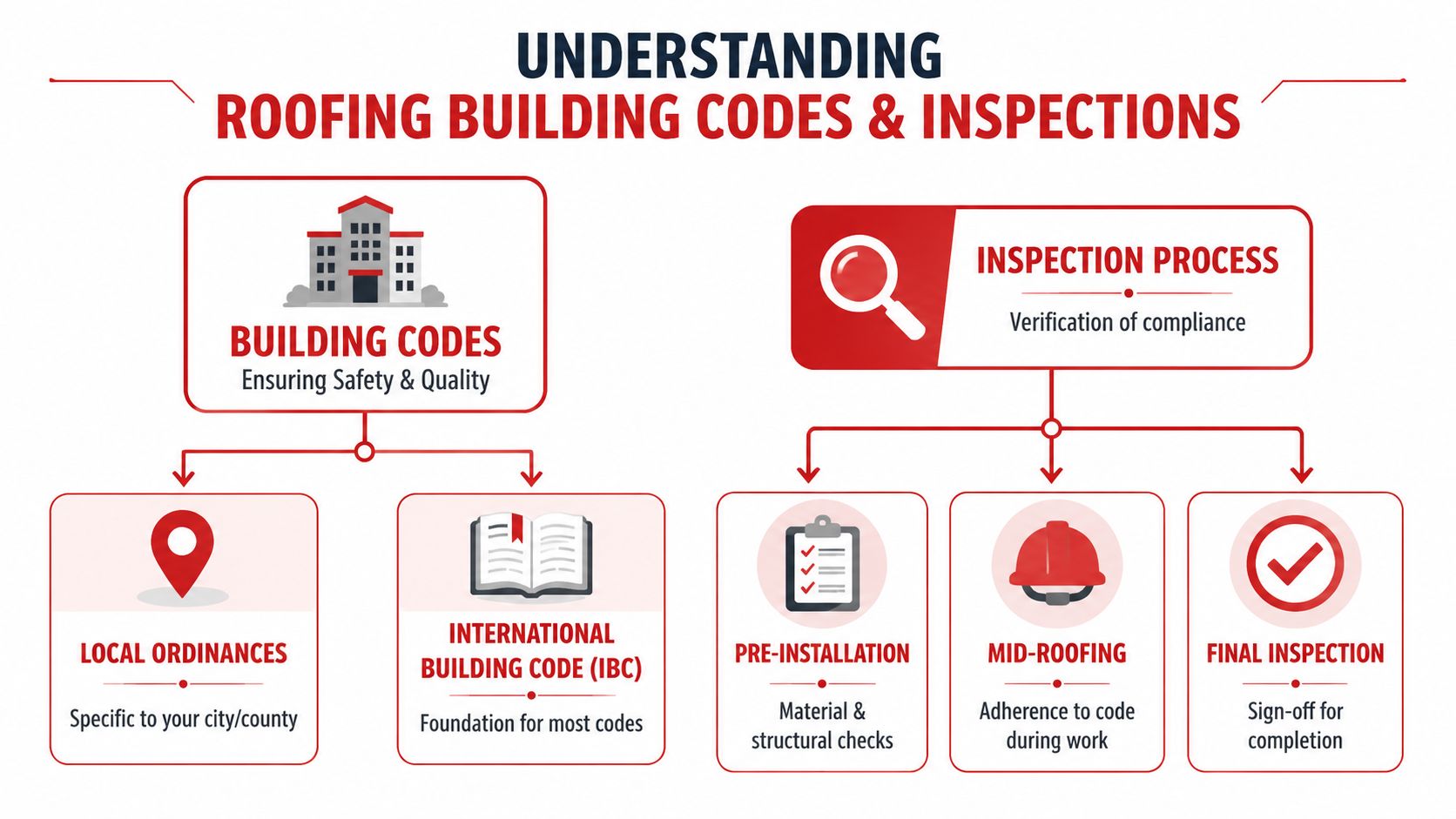
A permit is only the first step. After the city accepts the application, the primary concern becomes whether the roof is being installed to code. That's where homeowners hear terms like IRC, inspection, roof assembly, and approved scope of work.
In plain language, building codes are the rules that tell contractors how the roof must be put together. They cover things like material layers, flashing details, fastening methods, ventilation requirements, and how the roof ties into the rest of the house. Inspections are the city's way of checking whether the work matches those rules.
What local code can change on a real project
San Antonio, TX gives homeowners a very practical example. The city enforces a maximum of two layers of roofing materials under the IRC, and if work changes existing roof penetrations that extend above the new roofline, separate mechanical, electrical, and plumbing permits are required and must be secured by licensed trade contractors, according to the San Antonio re-roof permit application requirements.
That's not abstract code language. It directly affects project decisions.
If your existing roof already has multiple layers, the contractor may need to tear off rather than install over the top. If penetrations around rooftop equipment or venting are altered, the roofing job may expand into separate trade coordination. Homeowners who don't know this often think the contractor is adding unnecessary steps, when the city is requiring them.
What an inspection usually looks like
Inspection stages vary by jurisdiction and scope, but most homeowners can expect a sequence like this:
Application review
The city checks the submitted scope, materials, and any supporting documents.On-site work with permit posted
Once approved, the project starts and the permit should be available on site if the city requires posting.Progress inspection when applicable
Some projects are checked before everything is covered up, especially when deck condition, penetrations, or structural items are involved.Final inspection
The inspector verifies that the completed roof matches the approved work and local code requirements.
Good inspections don't slow down a quality job. They confirm it.
Why homeowners should care about code language
A lot of roofing disputes come from misaligned expectations. The homeowner wants a leak fixed. The city wants code compliance. The contractor has to deliver both. That's why details matter, even if they're hidden under the shingles.
If you're interested in a broader plain-English explanation of how permit and code logic works on residential projects, this guide to Greater Boston home addition codes from Aureli Construction is a useful comparison. It isn't Texas-specific, but it does a good job showing why local ordinances and baseline building codes have to work together.
What code compliance means for storm-prone roofs
For homes dealing with hail damage repair, roof leak repair, or emergency roof repair after severe weather, code compliance isn't just paperwork cleanup. It affects how the rebuilt roof system performs the next time wind-driven rain or hail hits. The hidden details matter as much as the shingles visible from the street.
The Roofing Permit Application Workflow
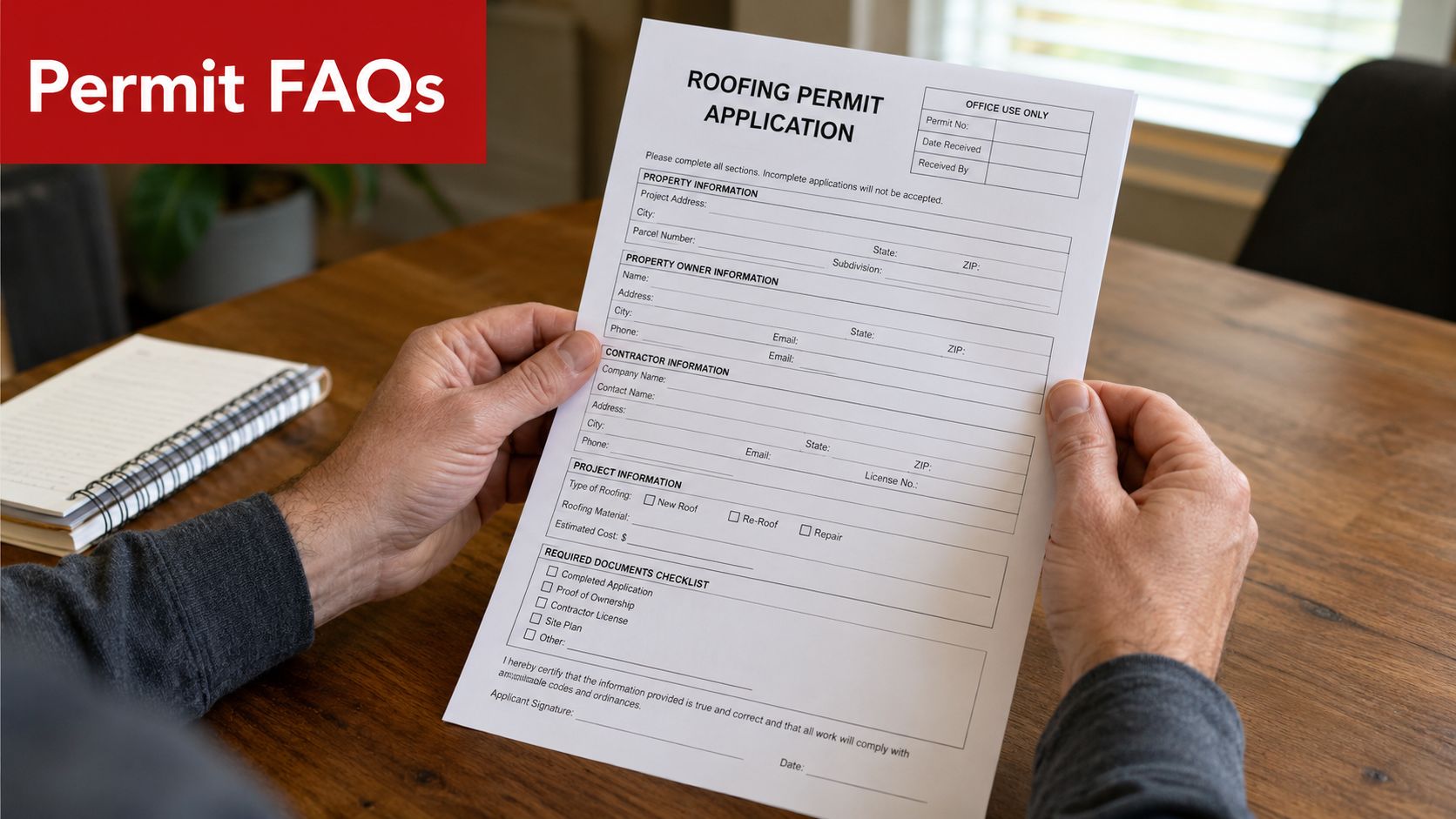
Most permit stress comes from not knowing what happens next. Homeowners imagine a messy back-and-forth with city offices, surprise forms, and project delays that nobody can explain. In reality, the process is usually predictable when the scope is documented correctly.
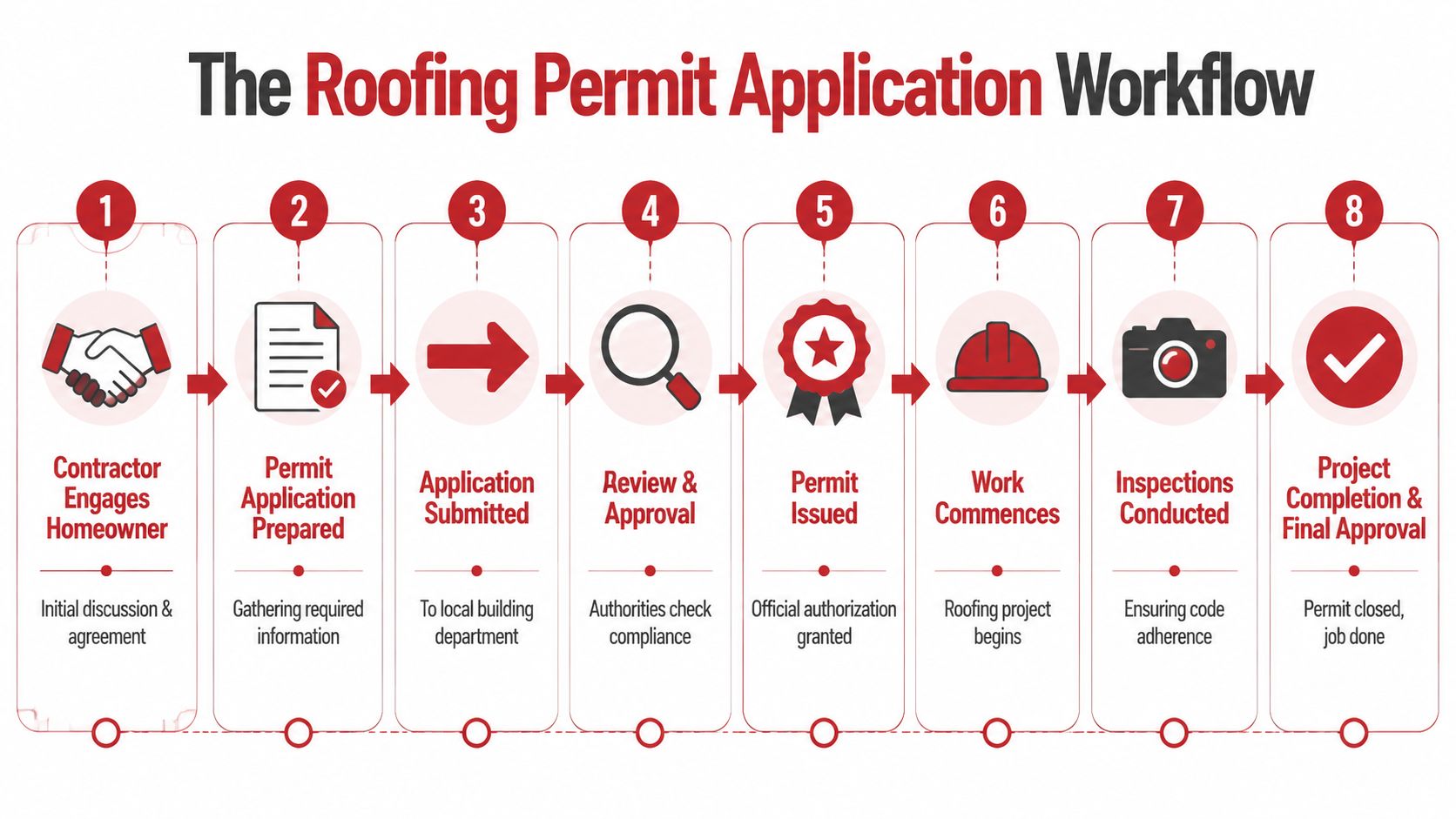
A typical roofing permit workflow starts with a detailed scope of work. The contractor identifies whether the job is roof repair, full roof replacement, storm damage restoration, commercial roof replacement, or a project involving additional work such as gutter replacement or solar detach-and-reset. That scope becomes the basis for the permit application.
What the process usually looks like
A clean permit workflow often follows this order:
Project scope is written clearly
The contractor describes the roofing system, affected areas, and whether decking or structural components are involved.Application and supporting documents are submitted
The city may ask for contractor credentials, material information, or trade coordination details.City review takes place
If the application matches the local requirements, the permit is issued. If not, the city requests corrections.Work begins after approval
The permit is posted if required, materials are delivered, and roofing crews start the approved scope.Inspections are scheduled
The contractor coordinates inspection timing based on the city's process.Final approval closes the job
Once inspections pass, the permit can be closed out.
Common situations that change the workflow
A simple reroof on a standard home is usually the easiest path. Other situations add layers.
A house in an HOA may need architectural approval before the city paperwork is even submitted. A historic property may need material review before color or profile choices are finalized. A home with rooftop solar may need another contractor to remove and reinstall panels in the right sequence so the roofing work can proceed safely.
If you're comparing bids and want a homeowner-focused checklist for evaluating the people handling this process, this article on how to choose a roofing contractor is a practical next read.
What not to do
Don't let work start first and paperwork catch up later. That's where homeowners run into stop-work orders, missed inspections, and disputes over who was supposed to handle the permit in the first place.
The smoother route is simple. Confirm responsibility before the first shingle comes off.
Permits for Special Cases Solar Panels and Historic Homes
Some roofs aren't standard replacement jobs. The permit itself may be straightforward, but the project has moving parts that change scheduling, approvals, and who needs to be involved before work starts.
Homes with solar panels
If your roof has solar, the roofing permit is only one piece of the job. The panels usually can't stay in place during a full roof replacement. They need to be detached, stored or staged properly, and reinstalled after the new roofing system is complete.
That means you should ask these questions early:
Who handles detach and reset
Don't assume the roofer and solar company have already coordinated this.Will the city require updated trade review
Some jurisdictions may treat related work differently depending on system changes.What happens if decking damage is found under the panels
Hidden repairs can affect both schedule and sequencing.
For homeowners planning that type of project, this guide on solar panels in Fort Worth, Texas gives helpful context on how solar-equipped reroofs are typically approached.
Historic homes and appearance controls
Historic districts can add another layer of review beyond normal roofing permit requirements. The issue may not be whether you can replace the roof. The issue may be which material, profile, or visible detail you're allowed to use.
A homeowner may want modern asphalt shingles for simplicity. A district board may require a product or color that better matches the historic appearance of the structure. That review can affect ordering, scheduling, and contractor planning even before city approval is finalized.
On older homes, the right question isn't just “Do I need a permit?” It's “Who else must approve the material before the permit process is complete?”
HOA-governed properties
HOA rules often catch people off guard because they exist alongside city requirements, not in place of them.
Use this quick checklist if your neighborhood has an HOA:
Review material rules first
The HOA may limit color blends, metal roofing visibility, or shingle style.Ask about forms and timing
Some associations need samples, photos, or board approval before work starts.Keep approvals in writing
Verbal approval from a neighbor or board member doesn't protect you later.Match the city scope
The work you submit to the HOA should align with what the contractor plans to submit for permitting.
That last point matters. If the HOA approves one thing and the city permit describes another, you can end up redoing paperwork on both sides.
Your DFW and East Texas Roofing Project Checklist
A roofing project goes more smoothly when you treat it like a process, not just a purchase. If you're hiring for residential roofing, commercial roofing contractor near me searches, or hail damage roof repair in DFW and East Texas, keep this checklist handy.
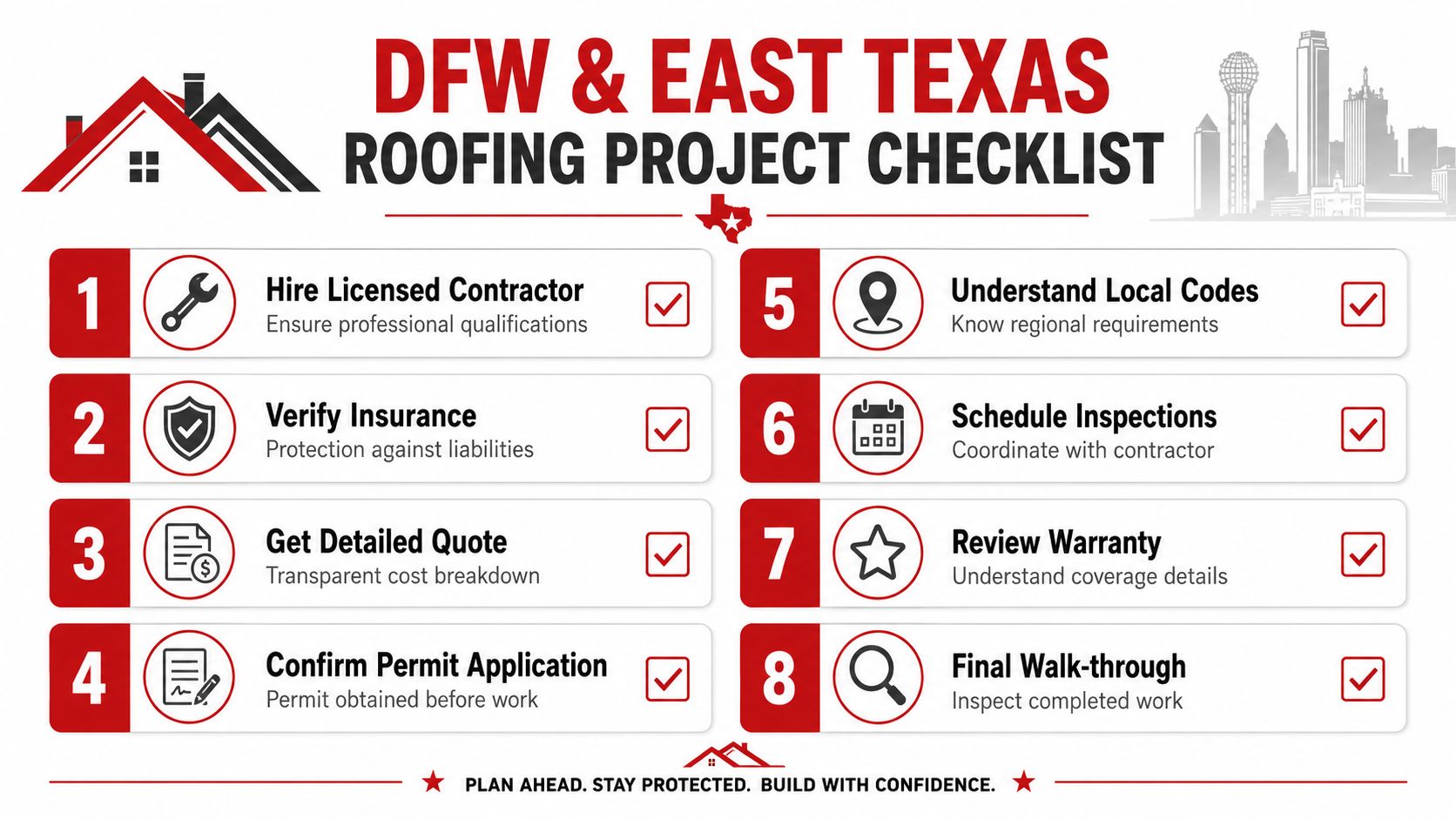
Save this before your project starts
Confirm city-specific permit rules
Don't rely on what applied to a friend's house in another city.Verify the contractor is licensed and insured where required
Ask who is carrying liability coverage and workers' compensation-related protection. Homeowners who want a plain-English overview of why insurance status matters can review this resource on coverage for roofing contractors from Liberty Insurance Associates.Request a detailed written scope
The estimate should state whether the job includes tear-off, decking replacement, roof ventilation work, gutters, or detach-and-reset for solar.Ask who pulls the permit
Don't accept a fuzzy answer. The responsible party should be named clearly.Get the permit number once issued
Keep it with your project paperwork.Make sure inspections are scheduled
Ask what stage requires inspection and who coordinates it.Check for HOA approval if needed
City approval and HOA approval are separate items.Hold final payment until the project is complete and inspection requirements are satisfied
This ensures you maintain control.
Why this checklist matters
Most roofing problems aren't caused by shingles. They come from skipped steps, vague paperwork, and assumptions about local rules. A homeowner who asks the right questions up front usually avoids the worst surprises later.
FAQ Your Top Roofing Permit Questions Answered
Roofing permits raise the same questions on almost every job. The answers below are the ones homeowners usually need most before they sign a contract.
What are the penalties if I don't get a roofing permit in Texas?
That depends on the city and the scope of work. Possible consequences include stop-work orders, delays in selling the home, trouble closing out insurance-related documentation, and being required to reopen or expose completed work for inspection. If structural or trade-related items were involved, the risk gets higher.
The safest approach is to verify requirements before work starts, not after the roof is already installed.
How much do roofing permits usually cost in Dallas or Fort Worth?
Permit costs vary by city and project scope. Because local fee schedules change and the amount can depend on the work involved, it's better to request the current amount directly from the city or require your contractor to show the permit fee as a separate line item in the estimate.
If a contractor gives you a round number with no explanation, ask what it includes. Sometimes homeowners think they are paying only for a city permit when the charge also includes administrative handling and inspection coordination.
Does homeowner's insurance cover permit costs?
Coverage depends on the policy and the nature of the loss. In storm-related claims, permit-related costs may be handled as part of the broader covered repair scope, but homeowners should confirm that with their carrier and review the estimate carefully. Don't assume the permit is automatically excluded, and don't assume it's automatically included either.
The key is documentation. Make sure the roofing scope, permit status, and city requirements are clearly documented if the work is part of an insurance claim.
How long does permit approval take?
Approval times vary widely by jurisdiction, staffing, and complexity. Simple roofing work may move faster than projects involving structural repairs, trade permits, HOA coordination, historic review, or solar panels.
One broader permitting data point shows how delays can matter. In Arizona, the Common Sense Institute estimated that just over 50% of residents need a permit for like-for-like roof replacements, and obtaining a permit adds an average of 23 days to project completion timelines in the state, according to the Common Sense Institute analysis summarized in this roofing permit data. Texas cities follow their own local processes, but the practical lesson is the same. Don't treat permit timing as automatic.
Do minor roof repairs need a permit?
Sometimes yes, sometimes no. It depends on your city and the exact scope. Small repairs may be exempt, but once the work expands into large-area replacement, decking, framing, or major re-roofing, permit requirements often change.
If you're not sure whether your job is maintenance or replacement, ask the city or have your contractor provide the local rule in writing.
A short video can also help clarify what homeowners should expect from the permit process and roof replacement planning.
Should I let a contractor start before the permit is approved?
No. If the job requires a permit, work should begin only after approval is issued. Starting early can create inspection problems and put the homeowner in the middle of a dispute over responsibility.
Ask one direct question before materials arrive: “Has the permit been approved, and can you show me the permit information?”
If you want a roofing team that understands local permit rules, storm damage restoration, insurance claim assistance, and code-compliant roof replacement across Dallas, TX, Fort Worth, TX, East Texas, San Antonio, TX, and Austin, TX, contact Hail King Professionals. They provide inspections, clear project guidance, and practical help navigating roofing permit requirements so your investment is protected from day one.