
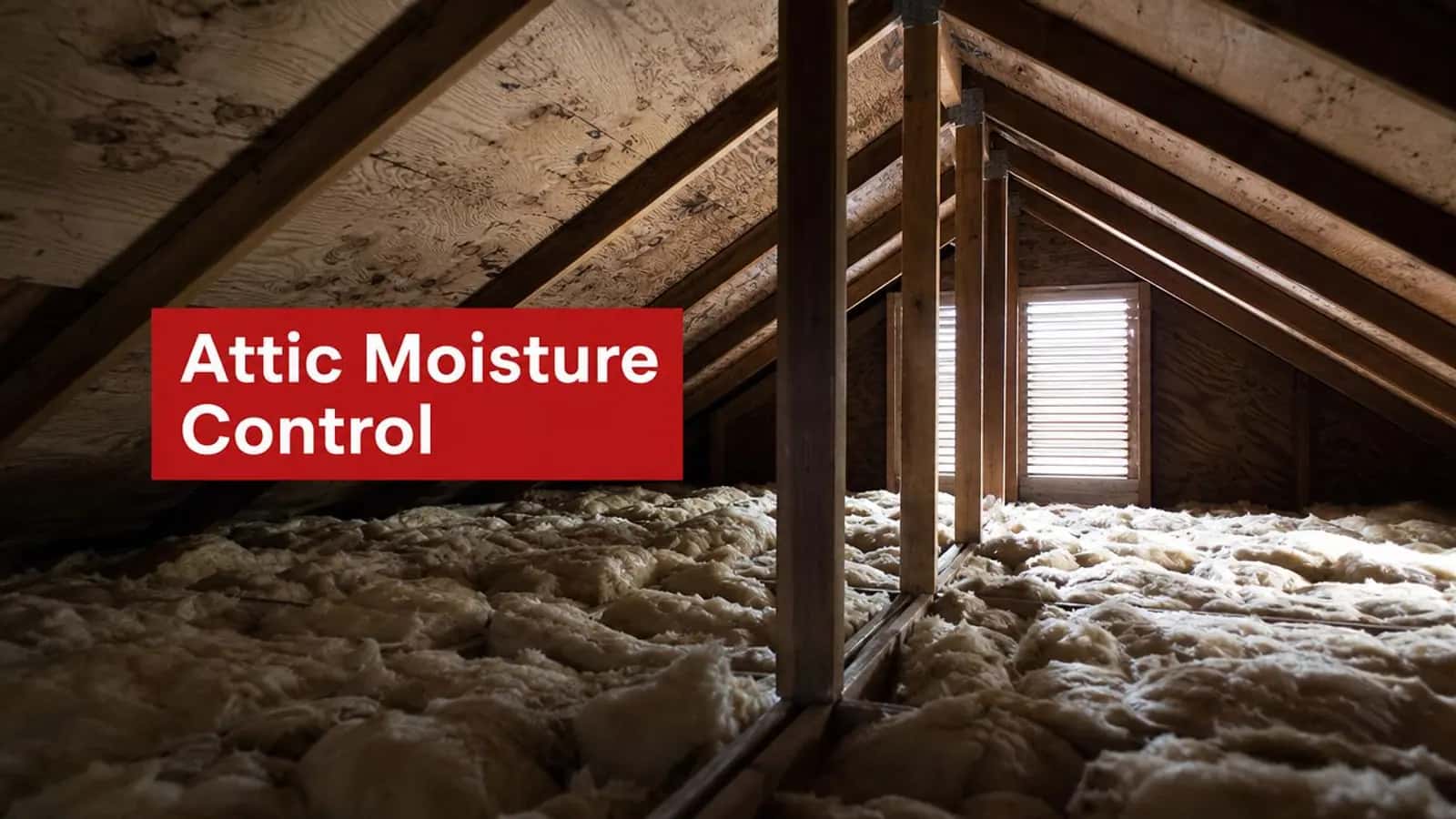
A lot of Texas homeowners first notice attic moisture indirectly. The house smells a little musty after a hard rain. The upstairs feels sticky even though the AC is running. Summer electric bills creep up, and when you poke your head into the attic, the air feels heavy instead of dry.
That's not a small housekeeping issue. It's often the start of a building problem.
When moisture hangs around in an attic, it can lead to mold, stained decking, damp insulation, rusted fasteners, and wood damage. In Texas, that risk gets worse because heat, humidity, thunderstorms, and aging roof details all work together. A roof can look fine from the yard and still allow moisture to build where you can't see it.
The Hidden Threat Lurking in Your Attic
A common pattern shows up after a stretch of stormy weather in places like Dallas, Fort Worth, Tyler, or Longview. The roof doesn't have an obvious active leak into the living room, so the homeowner assumes everything is fine. Then a musty odor starts showing up in a hallway closet, or the ceiling near an exterior wall looks slightly off-color.
By the time those signs appear, the attic may already be holding moisture for long enough to damage insulation and wood.
What homeowners usually notice first
The first clues are rarely dramatic. They're usually things like:
- A stale or mildew-like smell after rain or during humid weather
- Higher cooling demand in summer because damp insulation doesn't perform like dry insulation
- Uneven temperatures upstairs where rooms stay muggy
- Discoloration on ceiling drywall near penetrations or exterior edges
- Visible darkening on roof decking if you look into the attic with a flashlight
Practical rule: If your attic smells damp in Texas heat, don't assume it will dry itself out.
Attics, positioned directly beneath the most exposed section of a home, endure significant stress. In North Texas, East Texas, and Central Texas, roofing systems deal with hail storms, high winds, heavy rain, and long periods of heat exposure. That combination can turn a minor roof detail problem into a moisture problem fast.
Why attic moisture gets expensive
Moisture doesn't stay neatly contained. It spreads through insulation, framing, and fasteners. It can also affect indoor air quality when humid attic air or moldy air finds its way into the living space through gaps around lights, access hatches, and duct penetrations.
Homeowners often focus on the roof covering itself. That's understandable. But attic moisture control is about the whole assembly. The shingles, flashing, vents, ceiling air leaks, insulation, and ductwork all affect whether that attic stays dry or turns into a hot, damp trap.
If you own a home in Arlington, Plano, McKinney, or San Marcos, ignoring that early musty smell can cost far more than dealing with it when it first appears.
Why Your Texas Attic Is a Target for Moisture
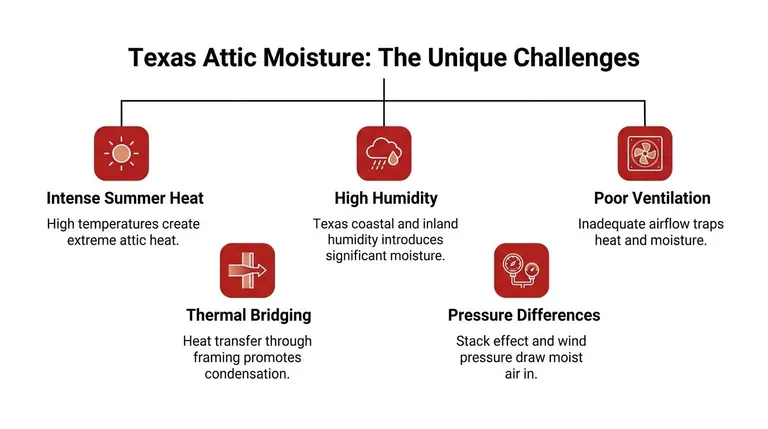
Texas attics don't struggle with one moisture source. They usually get hit from several directions at once. Outdoor humidity, storm-driven rain, air leakage from the house, and heat buildup all push the attic toward condensation and material breakdown.
Heat and humidity work together
In Dallas, Garland, Mesquite, and Irving, summer attics get brutally hot. In Tyler, Longview, and Marshall, outdoor humidity often adds another layer of trouble. Warm air carries moisture. When that moisture-laden air enters the attic and meets cooler surfaces at the wrong time, condensation can form on decking, nails, metal components, and duct surfaces.
A lot of homeowners think moisture problems only happen in cold climates. That's wrong. In Texas, hot-humid conditions often create a different kind of attic problem. The attic stays hot, damp, and under-vented, especially after storms or during long humid stretches.
The most common moisture entry paths
Most attic moisture problems trace back to a short list of causes:
- Air leakage from the house below through can lights, attic hatches, top plates, and utility penetrations
- Blocked or poorly designed ventilation that traps humid air instead of flushing it out
- Roofing defects such as damaged flashing, storm-hit shingles, or unsealed penetrations around vents
- Duct leakage and air handler issues in vented attics
- Wind-driven rain intrusion during severe thunderstorms
If you've also seen more pest activity around the house during humid weather, this piece on spiders and humidity in spring gives helpful context on how excess moisture changes conditions around a home.
Moisture problems rarely come from one dramatic failure. More often, several small openings and design issues feed each other.
The HVAC issue many people miss
One of the biggest blind spots in attic moisture control is mechanical equipment. A vented attic with ducts and an air handler can become a moisture source, not a protective zone. A widely overlooked point is that relocating HVAC ductwork and air handlers from vented attics into the conditioned living space is the single most effective solution for preventing moisture and condensation issues, and for new construction the preferred method is to air seal the ceiling plane and relocate all mechanical systems so the attic becomes a dry passive buffer, as discussed in this building science video on relocating HVAC from vented attics.
That's especially important in Texas. When supply ducts leak in a vented attic, the pressure balance changes. Humid outdoor air can get pulled into places it shouldn't be. Over time, that drives mold and wood deterioration.
Roof problems still matter
Not every attic moisture issue is hidden building science. Sometimes the cause is simple. Hail damage, failed flashing, aged pipe boots, and poorly sealed roof penetrations still allow water into the attic. Texas roofs take a beating. That means attic moisture can be part ventilation problem, part air sealing problem, and part roof repair problem all at once.
Your DIY Attic Inspection Checklist
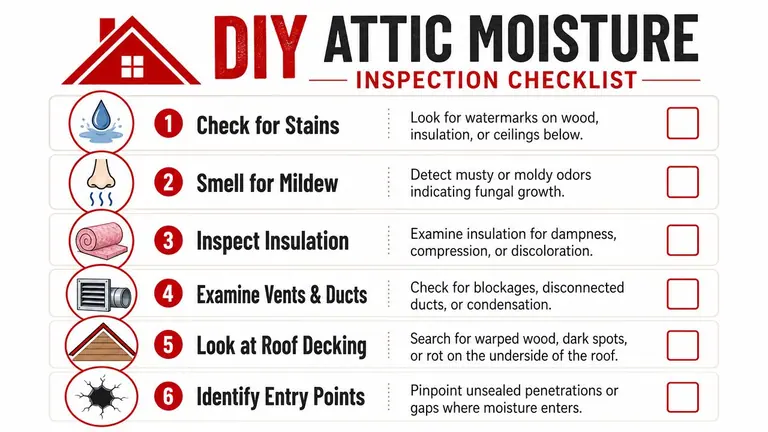
Before you call for help, it makes sense to do a careful visual check. Keep it simple and keep it safe. Don't step between joists, don't move around in a dark attic, and don't stir up insulation without a mask.
What to bring with you
Take a few basic tools:
- A bright flashlight so you can see dark staining on decking and rafters
- A dust mask or respirator if the attic smells moldy or dusty
- Gloves and long sleeves because exposed fasteners and fiberglass are unforgiving
- A basic humidity monitor if you want a better read on conditions
- Your phone camera to document what you find
Home indoor humidity should stay between 30% and 50%, and humidifiers should be set to 30% or less to reduce moisture migration into the attic, according to Attic Experts guidance on attic moisture. If your house already feels damp indoors, the attic may be reflecting a larger humidity issue.
The actual checklist
Use this order so you don't miss the obvious.
Start with your nose. If the attic smells musty, earthy, or sour, that's a warning sign. Moisture problems often announce themselves by odor before you see staining.
Look up at the roof decking. Check the underside of the sheathing for dark patches, uneven discoloration, or fuzzy growth. Pay close attention near valleys, chimneys, plumbing vents, and roof penetrations.
Check the insulation. Damp insulation may look matted, compressed, or darker than the surrounding material. Dry insulation should look fluffy and consistent.
Inspect metal parts. Rust on roofing nails, metal straps, or HVAC components points to repeated moisture exposure.
Follow the ducts and vents. Look for disconnected ducts, condensation on metal surfaces, and bathroom fans that dump air into the attic instead of outside.
Inspect attic openings. Pull-down stairs, recessed lights, and wiring penetrations are common air leakage points.
If you want a second checklist to compare against your own notes, this roof inspection checklist template is a useful reference for documenting roof and attic conditions.
When a device helps
A low-cost monitor can help confirm what your senses are telling you. If you're already working on indoor air quality too, some homeowners look at products like the EcoQuest Hyg 2 purifier while they sort out the bigger moisture source. That won't fix a roof or attic leak, but it can be part of a broader plan if stale air and humidity are affecting comfort indoors.
If you find widespread staining, obvious microbial growth, or dripping, stop there. That's no longer a basic homeowner inspection.
Decoding the Clues Common Causes and Fixes
Attic symptoms tell a story if you know how to read them. The key is separating a small air-sealing issue from a roofing problem, and separating both from a full moisture-control design problem.
What the clue usually means
Here's a practical way to decode what you're seeing:
| Symptom | Likely cause | Best response |
|---|---|---|
| Dark stains near a vent pipe or chimney | Failed flashing or seal detail | Professional roof repair |
| Insulation looks damp near the attic hatch | Indoor air leakage | Air-seal the hatch and evaluate house humidity |
| Rusted nails across large areas | Ongoing humidity, not a single leak | Check ventilation, air sealing, and indoor moisture load |
| Water marks after storms | Wind-driven rain or roof covering damage | Professional inspection after severe weather |
| Condensation on ducts | Humid attic air and duct temperature difference | Seal ducts, address leakage, improve moisture control |
| Bathroom exhaust ends in attic | Wet air dumped directly into attic | Reroute fan to the exterior |
What you can fix yourself
A homeowner can often handle the simpler corrections:
- Seal obvious ceiling leaks: Gaps around attic hatches, wiring penetrations, and plumbing openings let conditioned indoor air rise into the attic.
- Confirm bath fans terminate outdoors: If a fan ends in the attic, every shower adds moisture where you don't want it.
- Clear blocked soffit intake paths: Insulation baffles and open intake paths matter if the attic is designed to be vented.
- Replace missing weatherstripping at the hatch: It's a small detail that often leaks a lot of air.
Those fixes help, but they don't solve every attic.
Where code-level ventilation matters
For vented attic assemblies, the ratio has to be right. Building codes typically require 1 square foot of vent area per 300 square feet of ceiling when a vapor retarder is used, and the best layout places 50% of that vent area at the roof peak and 50% at the soffits, as outlined by NAIMA moisture management guidance.
That matters because random vents don't equal proper airflow. Too many high vents without balanced low intake can short-circuit ventilation. Blocked soffits can make ridge vents underperform. And adding powered equipment to a poorly sealed attic can sometimes worsen pressure problems instead of fixing them.
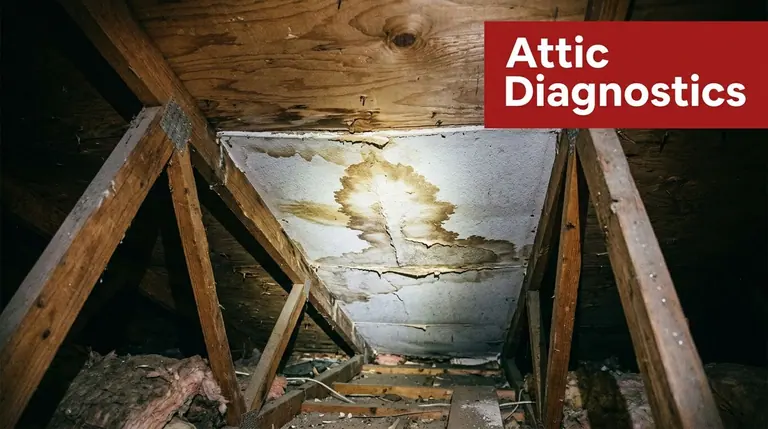
Here's a helpful visual on the kinds of damage that show up when moisture gets ahead of maintenance:
Field note: If staining follows a specific line or penetration, suspect water entry. If the whole attic feels clammy and multiple surfaces show rust or dampness, suspect a humidity control problem.
When it's no longer a DIY issue
Call a professional if you see widespread staining, soft roof decking, repeated storm-related water marks, or signs that the roof system and attic system are working against each other. In Texas, many homes have overlapping issues. A small flashing leak might exist alongside poor ventilation and duct leakage. If you only fix one, the attic may still stay wet.
Proactive Upgrades for a Dry and Healthy Attic
The cheapest attic moisture repair is the one you never have to make. That's why long-term upgrades matter more than temporary patchwork.
Passive systems first
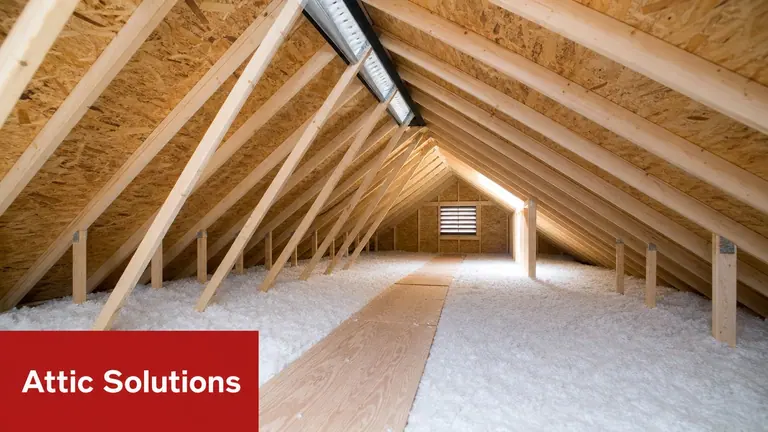
A well-built vented attic still depends on basics done right. That means clear soffit intake, a functional ridge exhaust path, proper insulation alignment, and solid air sealing at the ceiling plane. If one piece is off, the whole assembly struggles.
In many Texas homes, upgrading insulation and ventilation together works better than doing either one alone. If you're comparing options, this article on Dallas attic insulation is a good place to start because insulation performance and moisture performance are tied together.
When passive measures aren't enough
Some attics are too complex, too humid, or too tightly configured to stay dry with ventilation alone. That's common in East Texas, in houses with difficult roof geometry, and in conditioned or encapsulated attics.
For those tougher cases, an emerging best practice is an attic dehumidifier paired with a smart humidity controller when ventilation alone can't maintain 40% to 50% relative humidity, based on practical attic dehumidifier guidance from Terrain Insulation. That active setup gives the attic a direct way to remove moisture instead of hoping airflow will solve it.
A smart controller matters because it runs equipment based on actual attic conditions, not guesswork.
Upgrades that usually pay off in performance
A durable moisture-control plan often includes a mix of these improvements:
- Balanced vent upgrades: Ridge and soffit systems need to work as a pair, not as isolated products.
- Air-sealing the ceiling plane: Stopping interior air leakage is one of the most effective ways to reduce attic moisture load.
- Duct correction: Sealed, properly connected ductwork reduces the chance of pressure-driven moisture problems.
- Targeted dehumidification: Best for encapsulated attics and homes where passive drying keeps falling short.
- Roof detail repairs: Pipe boots, flashing, and storm-damaged areas must be addressed or moisture keeps coming back.
For indoor comfort habits that support the roofing side of the equation, this Covenant Aire humidity advice is useful. It's not a roofing fix, but it helps homeowners understand how daily humidity management inside the house affects what happens overhead.
A good attic doesn't just survive Texas weather. It stays stable through it.
When to Call Your Local Roofing Contractor
There's a point where attic moisture stops being a maintenance issue and becomes a property protection issue. If you're seeing recurring stains, active leaking, mold odor that keeps returning, or signs of hail and storm damage on the roof, it's time to stop troubleshooting alone.
Clear signs you need professional help
You should call a roofing contractor if:
- Water stains keep expanding after storms
- Roof penetrations or flashing appear damaged
- The attic air feels persistently damp despite basic fixes
- Insulation is wet or repeatedly matted down
- You suspect hail damage roof repair may be needed
- You've had severe thunderstorms, high winds, or heavy rain and the problems started afterward
For conditioned attics, the stakes are even higher. Relative humidity can stay above the critical 70% threshold for about eight hours per day in conditioned attics, which is enough to trigger mold growth, and if attic RH consistently exceeds 50% to 60%, professional intervention is required, according to Green Building Advisor on high humidity in spray foam attics.
Why this matters in Texas markets
In Plano, Frisco, Arlington, Tyler, Austin, San Antonio, and nearby communities, roof systems take repeated weather stress. Small weaknesses in flashing or ventilation can turn into major repairs faster than many homeowners expect. Commercial roofing systems can have the same issue, especially where flat roofing details, penetrations, and drainage points interact with humid conditions.
If your attic moisture problem keeps returning, the house is telling you the root cause hasn't been fixed.
If you're searching for a roofing contractor near me, roof repair near me, roof replacement near me, or commercial roofing contractor near me, choose a contractor that understands both storm damage roof repair and attic moisture control. Those two issues often overlap in Texas.
If you're dealing with a musty attic, storm-related staining, or signs that your roof and ventilation system aren't doing their job, Hail King Professionals can help. Homeowners and property owners across Dallas, Fort Worth, Arlington, Plano, Frisco, McKinney, Tyler, Longview, Austin, San Antonio, and surrounding Texas communities can schedule a free, no-obligation roof inspection to identify leaks, storm damage, ventilation problems, and moisture risks before they turn into major repairs.