You walk outside after a Texas storm, and the first thing you notice isn't always the roof. It's the shredded leaves in the yard, the dented downspout, the shingle tab in the driveway, or the water spot that showed up on the ceiling overnight. That's usually when the second problem starts. Your phone rings, someone knocks on the door, and suddenly you're trying to decide which of the many Weatherford roofing contractors is worth trusting.
That decision matters more than most homeowners realize. Roofing is a large, crowded trade. The U.S. roofing contractors industry includes 109,000 active businesses as of 2026, with projected 3.4% CAGR from 2021 to 2026, according to IBISWorld's roofing contractors industry overview. A big market gives property owners options. It also creates noise, especially after hail and wind events when every truck in Texas seems to become a roofing company overnight.
If you own a home or commercial property in Weatherford, Fort Worth, Arlington, Plano, Frisco, McKinney, Garland, Irving, Mesquite, Tyler, Longview, Marshall, Austin, San Marcos, Round Rock, Georgetown, San Antonio, Boerne, or New Braunfels, the best protection is a clear process. Know how to spot damage safely. Know how to vet a contractor. Know when a roof repair makes sense and when roof replacement is the smarter move. And know how to keep a roofing insurance claim from going sideways.
Your Guide to Roofing After a Texas Storm
Texas storms create two kinds of damage at once. One hits the roof. The other hits your decision-making.
After hail, high winds, and heavy rain, most homeowners want answers fast. Is the roof leaking now, or is the problem hidden? Is that dent on the metal vent cosmetic, or does it point to broader storm damage roof repair needs? Can a simple roof repair handle it, or is a full roof replacement coming?
Start with the practical priorities
The first move is safety. Stay off the roof. Wet shingles, steep slopes, and soft decking turn a quick look into a real injury risk. A ground-level inspection, some photos, and a calm walk around the property tell you more than is commonly assumed.
Then look at timing. Storm damage doesn't always announce itself with a dramatic leak. Small hail strikes can loosen granules on asphalt shingles. Wind can lift tabs without tearing them off. Flashing can shift just enough to let water in later, after the storm is forgotten.
Practical rule: The best time to inspect a storm-hit roof is as soon as conditions are safe, before debris gets cleaned up and before a contractor tells you what they think happened.
Why informed homeowners make better roofing decisions
A rushed choice usually costs more than a careful one. That applies whether you're searching for a roofing contractor near me, a roof repair near me, a roof replacement near me, or a commercial roofing contractor near me.
A good roofing decision usually follows this order:
- Identify visible signs of damage
- Document what you see
- Get a professional roof inspection
- Verify the contractor before signing anything
- Compare repair versus replacement based on roof condition
- Coordinate the insurance claim if storm damage is involved
That sequence protects both your property and your wallet. It also helps you avoid one of the biggest mistakes Texas property owners make, which is letting urgency override due diligence.
How to Spot Hail and Wind Damage on Your Roof
Most homeowners can spot enough from the ground to know whether they need a professional inspection. You don't need to diagnose the full roofing system. You just need to notice the clues that often show up after severe thunderstorms.
What to check from the ground
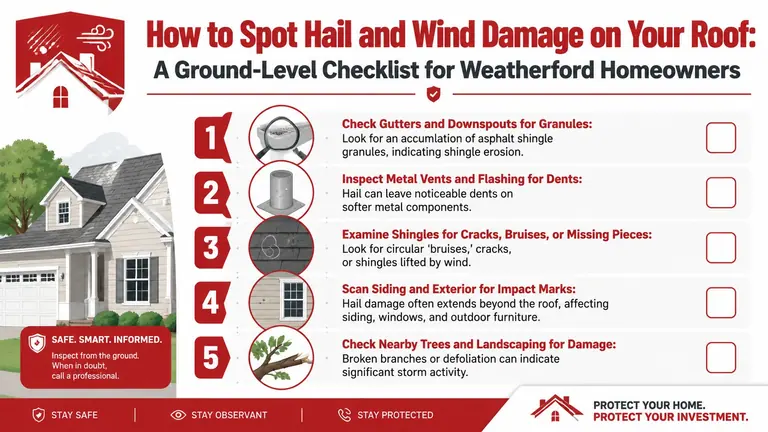
Walk the perimeter slowly. Don't stare only at the shingles. Storm damage leaves a pattern across the whole exterior.
- Gutters and downspouts: Check for asphalt granules collecting in the gutter runs or at the bottom of downspouts. Granule loss often signals hail wear or accelerated shingle aging.
- Metal surfaces: Look at roof vents, flashing, metal valleys, chimney caps, and gutters. Soft metal often shows dents before shingles show obvious bruising.
- Shingle lines: Scan for tabs that look lifted, creased, torn, or missing. Wind damage often creates uneven roof lines that are easier to notice from an angle.
- Siding and trim: If hail hit the roof hard, it may have marked window screens, trim, painted surfaces, or soft metals on the exterior.
- Yard evidence: Broken branches, stripped leaves, and scattered roofing pieces tell you the storm had enough force to justify a closer inspection.
Material-specific warning signs
Asphalt shingle roofs and metal roofing don't fail the same way.
On asphalt shingles, hail damage often shows up as bruised spots, circular impact marks, cracked tabs, or areas where the protective granules have been knocked loose. Wind damage usually appears as lifted shingles, horizontal creases, or missing tabs along ridges and edges.
On metal roofing, hail often leaves visible dents in panels, flashing, and ridge components. Not every dent means the roof needs replacement, but dent patterns can reveal how intense the impact was and whether seams, fasteners, or penetrations need closer review.
Signs inside the house
Exterior clues matter, but interior symptoms often confirm the roof needs attention.
Look for:
- Ceiling stains: New yellow or brown spots after heavy rain
- Attic moisture: Damp insulation, dark decking, or a musty smell
- Wall changes: Bubbling paint or soft drywall near exterior corners
- Light intrusion: Daylight visible around roof penetrations or decking joints
If you can see the leak inside, water has usually already moved past the first line of defense.
A proper roof inspection still matters because not all hail damage roof repair issues are obvious from the yard. But this checklist helps you decide when to make that call.
Vetting Weatherford Roofing Contractors a Checklist
Texas puts more responsibility on the property owner than many people expect. Roofing is unregulated at the state level here, so someone can call themselves a roofing contractor without a state roofing license requirement. In that environment, vetting isn't optional.
That risk is amplified by instability in the local market. In Weatherford, approximately 80% of roofing companies shut down within two years, and 96% cease operations within five years. Those figures matter because a roof warranty is only useful if the company behind it is still around.
What separates a real local contractor from a storm chaser
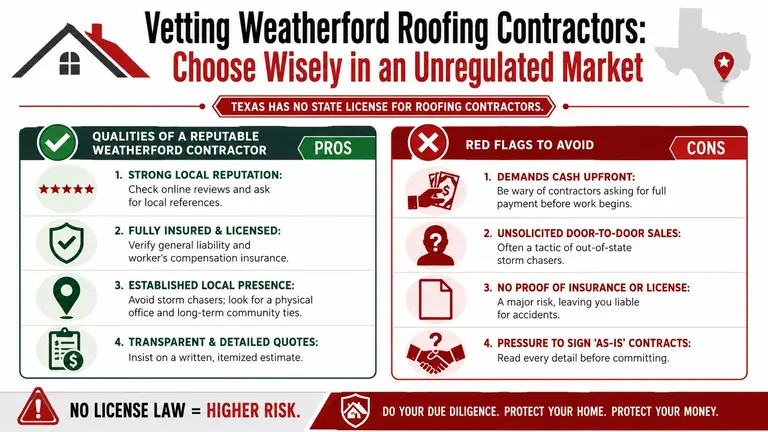
A polished estimate doesn't prove legitimacy. A wrapped truck doesn't either. In storm season, the basics matter more.
Verification steps that actually help
- Confirm a physical business location: Ask for the street address and verify it. A real office is different from a mailbox, temporary suite, or borrowed address.
- Check whether the phone number matches the claimed service area: A contractor serving Weatherford, Dallas, Fort Worth, Arlington, or Frisco should be easy to place online across multiple listings, not just one fresh website.
- Ask for current proof of insurance: General liability and workers' compensation documentation should be available before work starts.
- Look for manufacturer partnerships or certifications: Those don't replace due diligence, but they can show the contractor has met training and product installation standards with major roofing systems.
- Read review patterns, not just star ratings: Consistent comments about communication, cleanup, supplements, warranty follow-through, and project supervision tell you more than a single glowing review.
Red flags that should slow you down
Some warning signs are common enough that they should stop the conversation until you get answers.
| Sign | Why it matters |
|---|---|
| Cash-only pressure | Harder to document and harder to dispute |
| Large upfront demand | Shifts risk to the homeowner before materials or labor are delivered |
| No insurance proof | You may absorb liability if someone gets hurt on site |
| No local address | Harder to reach them for leaks, warranty issues, or punch-list work |
| Vague contract | Leaves room for shortcuts, material swaps, and dispute over scope |
A contractor who gets irritated when you verify insurance or address details is telling you something useful.
A better screening process
Most homeowners start with reviews. That's fine, but it's not enough in Texas. A better approach is to pair public reputation with hard verification. Check business presence, ask what crew will install the roof, and make sure the written scope lists materials, underlayment, flashing work, cleanup, and warranty terms.
For a deeper screening process, this guide on how to choose a roofing contractor covers the questions experienced property owners ask before they sign.
That extra homework is what separates stable Weatherford roofing contractors from roaming storm crews that disappear after the last insurance check clears.
Roof Repair Versus Full Roof Replacement
Many roofing decisions often get oversimplified. Homeowners often hear one of two extremes. “It's just a small repair” or “you need a whole new roof.” The right answer depends on damage spread, roof age, material condition, and whether the supporting components are still doing their job.
When roof repair makes sense
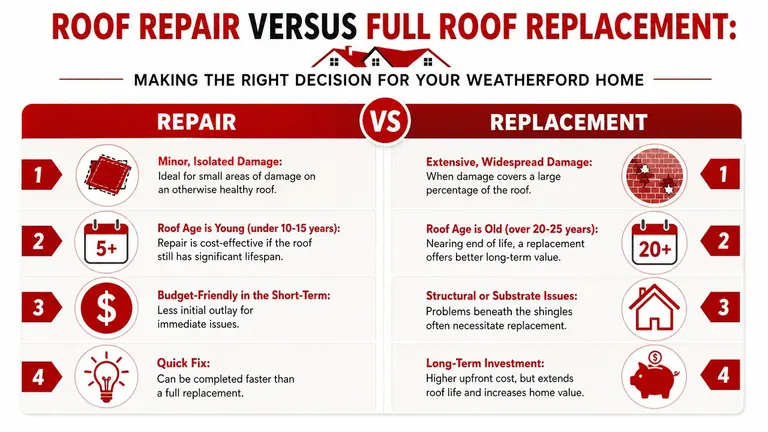
A targeted roof repair is usually reasonable when the damage is isolated and the rest of the system is still in solid shape.
That often includes a few wind-lifted shingles, a localized leak around flashing, or a small section of impact damage on a roof that still has service life left. In those cases, patching the affected area can restore performance without forcing a full reroof.
Repair also makes sense when the roof is relatively newer and matching materials are available. If you can correct the weak point without creating a patchwork problem, repair is often the practical move.
When full roof replacement is the better investment
Replacement becomes the smarter option when damage is widespread, repeated repairs have already stacked up, or the roof is near the end of its useful life.
If storm activity exposed underlying decking problems, ventilation issues, or multiple failing penetrations, patching one spot won't solve the bigger problem. The same goes for roofs with broad granule loss, recurring leaks, or visible signs that the system is wearing out across multiple elevations.
A roof doesn't have to be actively leaking everywhere to be failing as a system.
Material choices that matter in Texas
In Parker County, UL 2218 Class 4 impact-resistant materials are especially important for commercial properties because the region sees frequent major hail, and specifying Class 4 can reduce commercial property insurance premiums by up to 35%. That benefit comes from better resistance to hail impact and better long-term roof integrity.
For homeowners and property managers comparing options, here's the practical trade-off:
- Standard asphalt shingles: Familiar, widely available, and suitable for many homes
- Class 4 impact-resistant shingles: A strong upgrade in hail-prone areas, especially if you want better storm resilience
- Standing seam metal roofing: Durable, clean-looking, and well suited for properties that want long service life and strong hail performance
- Flat roofing systems: Common on commercial roofing projects and low-slope structures where drainage and membrane detailing are critical
For Parker County commercial projects, design details matter as much as material choice. Weatherford's conditions require attention to UL 90 wind design, and local design wind speed reaches 115 mph. Fastening patterns and seam performance can't be an afterthought on commercial roof replacement work.
A contractor should be able to explain why a repair will last, or why replacement solves the underlying problem. If they can't explain that clearly, keep looking.
A Homeowners Guide to Roofing Insurance Claims
Most insurance claim frustration starts with one mistake. Homeowners assume the carrier, the adjuster, and the contractor are all looking at the roof the same way. They usually aren't. That's why documentation and process matter so much.
A strong claim starts before anyone climbs a ladder.
First steps after storm damage
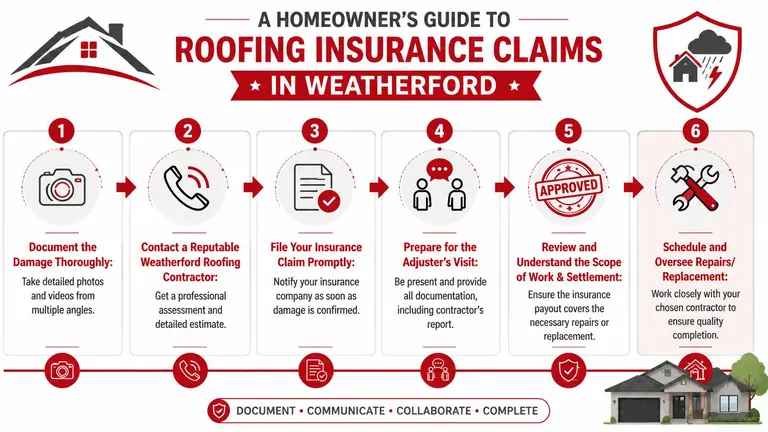
Take photos and video from safe locations. Capture the roofline, gutters, downspouts, vents, fencing, screens, and any interior leaks. Keep notes on when the storm hit and what you noticed right after.
Then contact a reputable roofing contractor for an inspection before the adjuster meeting if possible. That gives you a professional read on what needs to be examined closely.
For homeowners who want a plain-English overview of how carriers evaluate hail losses, this resource on hail damage roof insurance claims is worth reading before you speak with the adjuster.
Terms that confuse homeowners
These are the terms that usually cause the most misunderstandings:
- Deductible: The amount you're responsible for under your policy
- Depreciation: The value the carrier subtracts based on age or condition
- Actual Cash Value: A settlement approach that reflects depreciation
- Replacement Cost Value: A settlement approach tied to replacing the damaged item according to policy terms
You don't need to become an insurance expert. You do need to know which type of policy settlement applies, because it changes how the money is released and what documentation you'll need during the job.
A short explainer can help before you talk numbers. This overview of roof damage insurance coverage is useful if you're trying to understand how claim language affects the final payout.
Why contractor legitimacy matters during claims
The insurance side and the contractor side overlap more than people think. The Texas Department of Insurance reported that over 60% of storm-related roofing complaints in 2024 involved contractors with no verifiable local address or state license. That's one reason claim-related fraud often follows major storms.
A solid contractor helps document scope accurately, attends the adjuster meeting when needed, and keeps the work aligned with what was approved. A bad one creates gaps between the roof's actual condition and the paperwork supporting the claim.
Bring every document to the adjuster meeting. Photos, notes, inspection findings, and prior repair history all help keep the conversation grounded in facts.
Modern Roofing Solutions for Texas Properties
Roofing projects have changed. A replacement used to mean tear-off, install, cleanup, done. Today, many Texas properties have added systems and design details that affect how the roof must be handled, especially in places like Round Rock, Georgetown, Austin, and Dallas where solar adoption is part of the conversation.
Solar panel detach and reset is not optional
If a home has rooftop solar, reroofing has to include a proper detach-and-reset process. That means removing the panels, protecting the roof system during replacement, then reinstalling the array with the right mounting and sealing details for the new roof.
45% of Texas homeowners with solar faced project delays or warranty disputes in 2025 due to improper roof-solar coordination, according to the Solar Energy Industries Association data provided above. The common failure isn't the new shingles themselves. It's poor coordination between the roofing crew and the solar side.
Weatherford-area and DFW property owners should ask very direct questions:
- Who removes the panels?
- Who documents the array layout before removal?
- How are penetrations resealed?
- Who verifies grounding and mounting compatibility when the panels go back on?
- How is warranty responsibility documented before work starts?
What modern property owners should expect
Today's roofing service should account for more than shingles and nails. It should also fit the property's actual use.
A good residential or commercial roofing plan usually includes:
- Clear scheduling: Homeowners need to know when material delivery, tear-off, installation, and final walkthrough will happen.
- Material compatibility: Metal roofing, asphalt shingles, flat roofing membranes, coatings, and solar mounts all interact differently.
- Budget flexibility: Financing can help property owners move forward without delaying necessary roof replacement or storm damage roof repair.
- Low-disruption planning: Commercial buildings and occupied homes need work sequencing that reduces downtime and protects interiors.
Modern roofing isn't about adding buzzwords. It's about solving practical coordination problems that show up on Texas properties now.
Why Choose Hail King Professionals for Your Roof
When you step back and look at the whole process, the pattern is clear. Texas property owners don't just need a crew that can install shingles. They need a contractor that can handle hail, wind, insurance paperwork, code expectations, material choices, and long-term follow-through.
That's where Hail King Professionals stands out.
They've served Dallas-Fort Worth and East Texas since 1991, which matters in a market where so many contractors disappear before a warranty issue ever surfaces. They're licensed and insured, offer free, same-day roof inspections, provide clear repair and roof replacement options, and back their work with a 100% satisfaction guarantee.
Their services fit the way Texas properties get used. That includes asphalt shingle roofing, metal roofing, flat roofing, Class 4 impact-resistant upgrades, roof coatings, gutter replacement, storm damage restoration, and solar panel detach-and-reset for reroof projects. They also offer financing with soft credit checks, no prepayment penalties, and no home-equity requirement, which gives homeowners and property managers practical room to act when a roof can't wait.
If you're comparing Weatherford roofing contractors, look for stability, communication, code-aware installation, and a company that understands storm restoration from inspection to final walkthrough. Hail King Professionals checks those boxes across North Texas, East Texas, Austin, San Antonio, and surrounding communities.
If your roof may have storm damage, don't guess and don't rush into a contract with the first truck in the neighborhood. Contact Hail King Professionals for a free, same-day roof inspection and get a clear assessment of your roof repair, roof replacement, or hail damage insurance claim options.