Seamless Gutter Installation in TX by Hail King: 2026 Guide
A lot of Texas homeowners start thinking about gutters only when they fail. A storm rolls through Dallas, Fort Worth, Arlington, or Tyler. Rain comes down hard, water shoots over the edge, mulch washes out, and the corner of the house stays soaked long after the sky clears. By then, the gutter system isn't just an accessory. It's part of your roof drainage system, and when it underperforms, the house pays for it.
That's why continuous gutter installation matters more in Texas than many national guides admit. Hail, wind, heat, and sudden heavy rain expose every weak point fast. A loose hanger, a bad slope, a short downspout discharge, or a gutter tucked too low below the drip edge can turn a manageable rain event into fascia damage, siding stains, soil washout, and foundation trouble.
For homeowners searching for a roofing contractor near me, roof repair near me, or gutter installation tied to a larger roof replacement, the right question isn't just what gutters cost. It's whether the system is measured, fabricated, and installed for Texas conditions.
Why Your Texas Home Needs a Gutter Upgrade
A common scenario looks like this. The roof is still shedding water, but the gutters are sectional, aging, and full of old joints that have opened up over time. During a severe thunderstorm in Plano or Longview, water hits those seams first. Instead of moving cleanly to the downspouts, it starts dripping behind the gutter line, running down fascia boards, and splashing near the foundation.
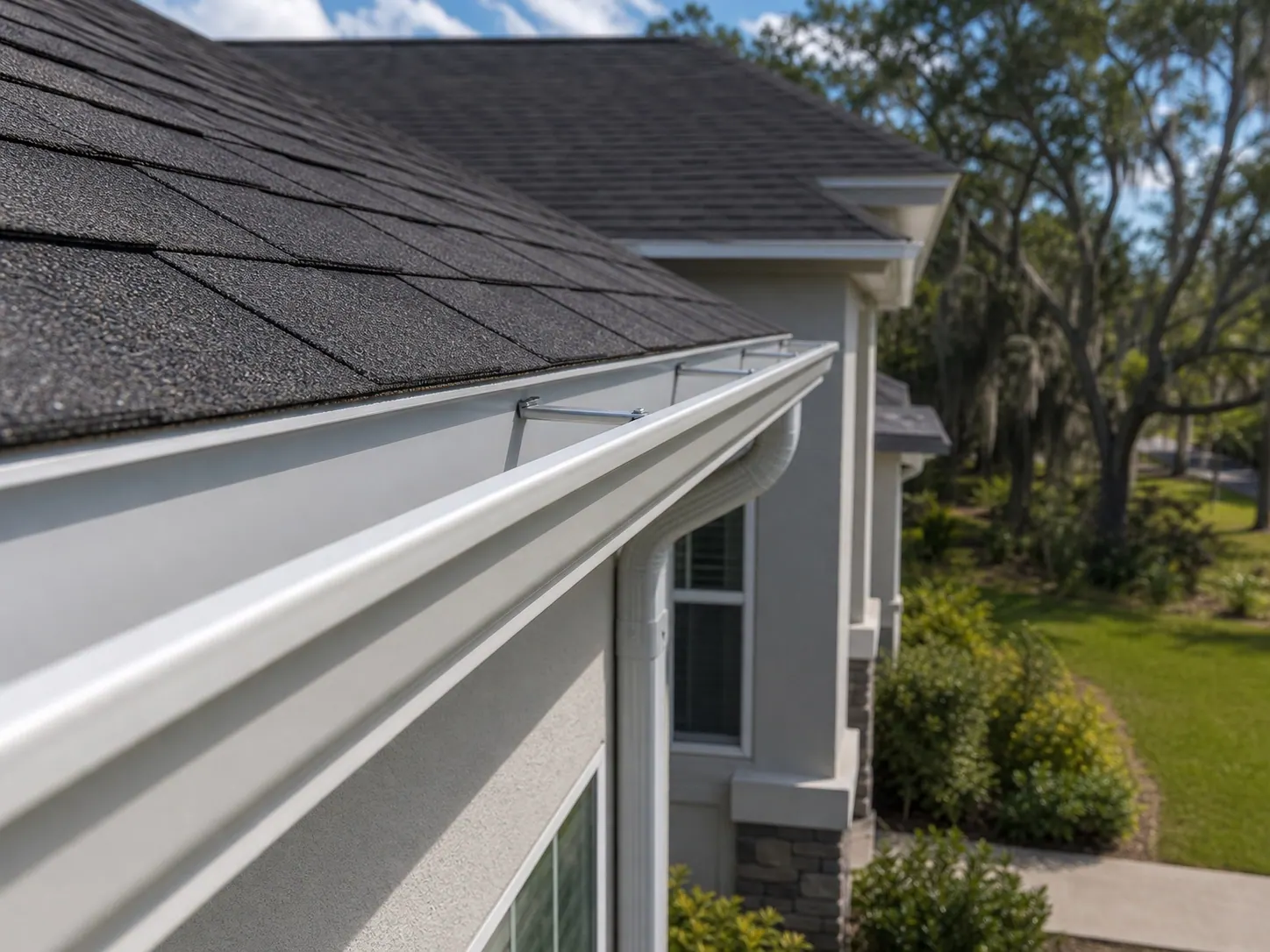
That's where continuous gutters solve a real problem. They're custom-fabricated on-site from a single continuous piece of material, which removes the joints and seams found in traditional sectional systems. They also represent 75% of all gutter installations in the United States according to SeamlessGutters.com's overview of seamless gutter systems. That adoption makes sense. Fewer joints usually means fewer leak points.
What makes seamless systems different
Traditional sectional gutters come in pieces. Every connection is another place where water can escape, debris can catch, and movement from heat or storms can stress the system.
Continuous gutter installation changes that by forming long runs on-site to match the roofline. In practical terms, that means:
- Fewer leak points: Long runs don't rely on repeated field joints.
- Cleaner fit: The gutter is shaped for the home instead of pieced together from stock sections.
- Better storm performance: A properly built system handles fast roof runoff more predictably.
Practical rule: In Texas, the gutter system has to manage both routine rain and sudden high-volume runoff. If it only works in light weather, it isn't doing its job.
Why Texas weather exposes bad gutters quickly
North Texas and East Texas don't give exterior systems much grace. Hail shakes loose older fasteners. Heat expands metal. Heavy rain tests capacity and slope immediately. High winds punish weak attachment points. If your gutters are pulling away, leaking at joints, or dumping water too close to the slab, those aren't cosmetic issues.
For homes dealing with storm damage roof repair or hail damage roof repair, gutter replacement often belongs in the same conversation as roof inspection, roof repair, and roof replacement. Gutters protect fascia, soffit, siding, landscaping, and the soil around the house. They also help preserve the work done during residential roofing or commercial roofing projects.
A gutter upgrade isn't about making the roofline look newer, though that helps curb appeal. It's about giving rainwater one controlled path off the roof and away from the building envelope.
Planning and Measuring for Your New Gutters
A Texas gutter job is won or lost before the first piece of metal is formed. In Dallas-Fort Worth and East Texas, I look at roof runoff, fascia condition, downspout routing, and where that water will end up on the lot. A layout that works in a mild climate can fail fast here once a hard spring storm hits or summer heat starts stressing the metal and fasteners.
Measure the roofline the right way
Good measurement starts at the roof, not the driveway. Straight runs matter, but they are only part of the job. The installer also has to map inside and outside corners, note valley locations, check story height, and identify sections where a steep pitch sends a heavy burst of water into a short span.
In North Texas, I pay close attention to concentrated runoff points. A roof valley over one window bay can overload an average layout, even if the total gutter footage looks reasonable on paper. That is why experienced crews measure for water volume and placement, not just length.
Slope needs the same level of care. Too little pitch leaves standing water. Too much pitch looks crooked from the street and can cause water to outrun the outlet during a downpour. For homeowners who want a visual overview of how roof edge planning fits into the full job, Pipeline On's roofing gutter insights offer a helpful high-level look.
Choosing material for Texas conditions
Material choice is less about trends and more about exposure. Aluminum is common for a reason. It is lighter, widely available, and fits the budget range of many homes in Frisco, McKinney, Garland, and surrounding areas. It also handles routine rain well when the gauge, hanger spacing, and fascia attachment are right.
Copper has its place, especially on higher-end homes or historic-looking exteriors, but it comes with a different price point and a different expectation for appearance over time. Steel can make sense in some situations, though it brings its own maintenance trade-offs if the finish is damaged.
Texas weather changes the decision. Hail can dent softer metals. Long heat cycles expand and contract every run. In East Texas, tree coverage and debris can keep gutters wet longer, which makes finish quality and maintenance more important than many national guides suggest.
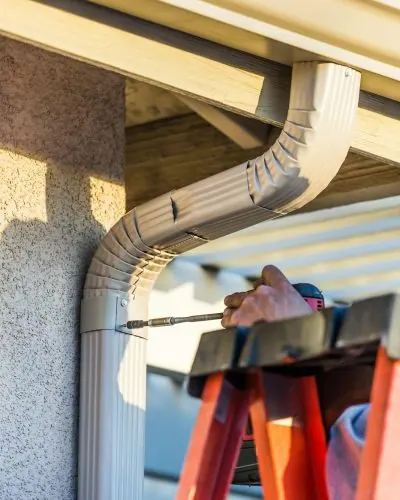
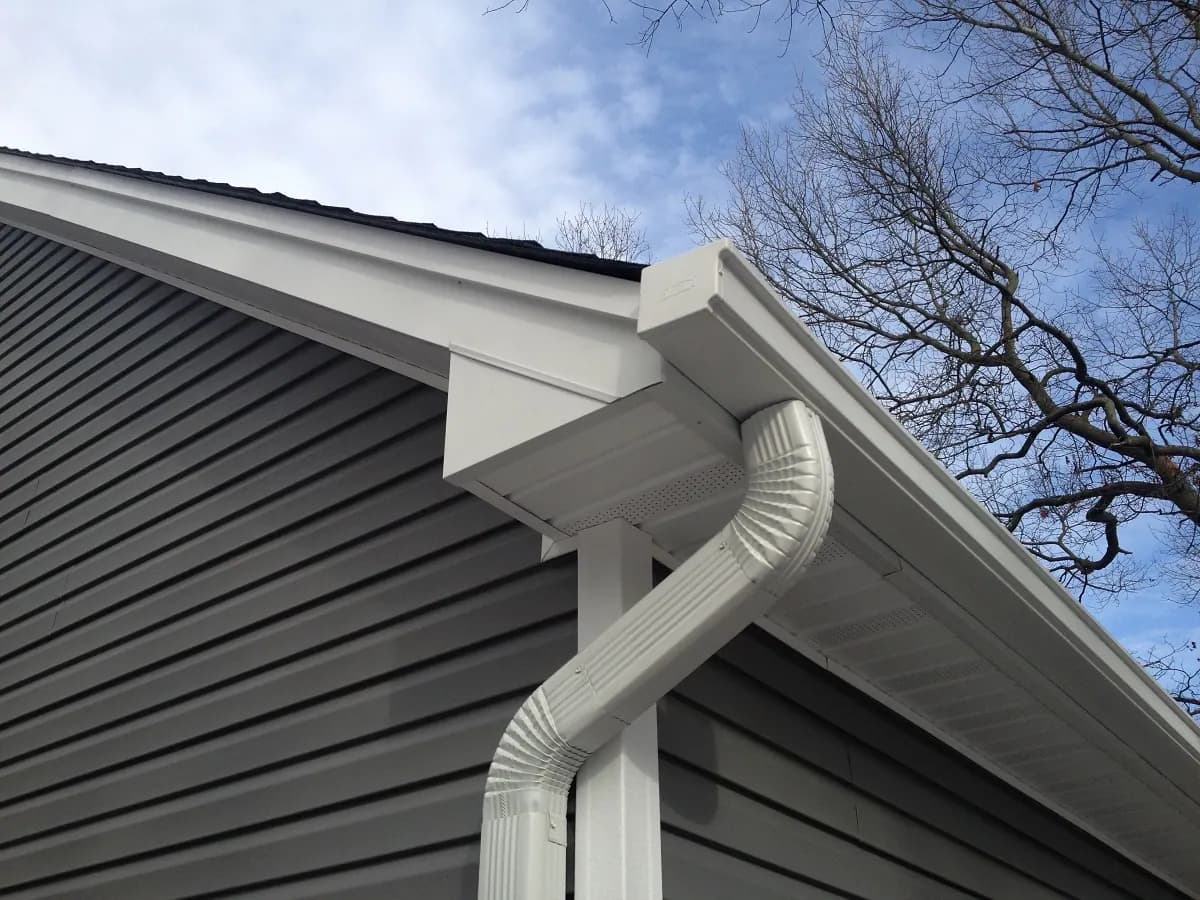
Downspout layout decides whether the system works
Downspouts are where planning gets practical. If they are undersized, poorly placed, or discharge too close to the house, the rest of the system cannot make up for it. That matters even more in areas with expansive clay soils, where repeated saturation near the slab can contribute to movement over time.
A good layout considers more than curb appeal:
- Roof valleys and collection points: Heavy runoff often needs an outlet nearby.
- Foundation protection: Water should be directed away from the house, not dropped at the corner.
- Drainage path across the lot: Splash blocks, extensions, and grading all affect performance.
- Access for cleaning: A downspout tucked into a tight corner may look cleaner, but it can be harder to service.
Dallas-Fort Worth homes also bring code and practical constraints that generic advice misses. Front elevations may limit where downspouts look acceptable. Side-yard spacing can affect extension routing. In some neighborhoods, the cleanest-looking plan is not the best-performing plan.
The right design is the one that matches the roof, the lot, and the way Texas storms hit that house.
The Professional Installation Process
A good install day in Texas looks controlled from the start. The crew protects the beds and AC pad, stages long gutter runs where they will not get bent, and works the roof edge without scarring shingles or trim. That matters after hail season, when many homes already have bruised fascia paint, loosened drip edge, or storm-related wood movement that a careless crew can make worse.
Removal and fascia preparation
Old gutters come down first, but removal is only part of the job. A critical checkpoint is the fascia behind them.
Crews should inspect for rot, swelling, split wood, loose rake-end trim, and old fastener holes that no longer hold. On Texas homes, I also look for heat-related warp along long elevations and staining at corners where overflow has been hitting the same spot for years. If the backing is weak, the new system may look straight on day one and start sagging after the first hard rain.
Fascia condition determines whether the new gutter system has solid backing. Skip that inspection, and the install starts with a built-in failure point.
Any damaged wood or loose metal edge should be corrected before the new runs go up. Fastening into soft material is one of the fastest ways to get callbacks in North Texas.
On-site fabrication and layout
Professional crews usually form continuous gutters on site with a truck-mounted machine. That gives each run the right length for the house instead of piecing together multiple short sections that create more leak points.
Homeowners who want a plain-language overview of the sequence can compare what they're seeing in the field against Pipeline On's roofing gutter insights, which gives a helpful high-level look at how roofing and gutter work fit together.
The layout still has to be adjusted at the house. Roof lines are rarely as clean as they look from the driveway. Brick ledges, window trim, chimney offsets, patio covers, and uneven fascia can all affect outlet placement and hanger spacing. On taller homes in Dallas-Fort Worth, crews also have to account for wind exposure on long upper runs. In East Texas, overhanging limbs and constant debris change how accessible cleanout points need to be.
Slope, hangers, and final water test
The part that separates a durable install from a short-lived one is usually hard to see from the ground. Pitch has to be set so water moves to the downspouts without making the gutter line look crooked from the street. Hangers need to be anchored into solid backing at consistent spacing, with closer attention near corners, outlets, and end caps where stress builds during heavy rain.
Sealant work matters too. The few joints that remain, usually at corners or special transitions, need clean surfaces, proper overlap, and the right sealant for heat and UV exposure. Texas sun is hard on sloppy sealant work. What holds in mild weather can crack, shrink, or separate after a long summer.
These details affect performance more than the color or profile:
| Installation detail | Why it matters |
|---|---|
| Correct pitch | Keeps water moving instead of standing in the trough |
| Consistent hanger attachment | Helps the run stay aligned under wind, debris, and heavy rain |
| Well-sealed outlets and corners | Reduces leaks at the few connection points in a continuous system |
Before the crew leaves, the system should be tested with water. That final check confirms flow, exposes slow spots, and shows whether outlets and corners are sealed. A clean finish includes straight lines, tight downspout straps, no metal shavings left on concrete, and discharge that sends water away from the house instead of dumping it back near the foundation.
Safety Codes and Permit Rules in Texas
A lot of gutter advice online treats installation like trim work. In Texas, that mindset causes expensive mistakes. Gutters tie directly into roof drainage, and roof drainage affects fascia, siding, foundations, and sometimes code compliance. In Dallas, Fort Worth, Tyler, and Longview, the local climate adds another layer. Wind-driven rain and hail don't forgive sloppy fastening.
Where safety starts on site
The safety side isn't just about ladders. It includes stable footing, managing long fabricated runs, protecting landscaping, and staying aware of overhead service lines. On taller homes and commercial roofing projects, safe access becomes part of job quality because rushed movement at height often leads to poor alignment and missed attachment points.
Municipal permit requirements can vary, especially if the project is bundled with exterior alterations, new construction, historic-district work, or a larger storm restoration scope. A homeowner should ask the contractor directly whether permits apply in that city and whether the drainage layout changes any local review requirement.
Why screws beat nails in severe weather
Fastening method is not a minor detail in North Texas. The verified data is unusually clear here. A 2024 Insurance Institute for Business and Home Safety study found that screw-fastened continuous gutters showed 35% higher wind resistance and 28% fewer detachment incidents during hail events than nail-fastened systems, according to IBHS.
That lines up with what contractors see after severe thunderstorms. Nail-fastened systems can loosen over time as the fascia cycles through heat, moisture, and impact. Screws generally hold tighter and give the installer more control over pull-through and seating.
National Gutter Authority also notes that hangers should use #10 or larger hex-head screws through the gutter into the fascia, and that drip edge overlap matters under IRC Section R905.2.8.5 because poor overlap lets water bypass the gutter entirely. I covered that source earlier because it belongs in the planning and execution side of the conversation too.
If you own a home in a hail-prone part of Texas, ask how the gutters are fastened. Don't accept a vague answer.
Local code awareness matters during roof work
This gets even more important when gutters are tied to roof replacement near me searches, insurance claim assistance, or storm damage restoration after hail. The roof edge, drip edge, fascia, and gutter all interact. If one trade ignores the other, water finds the gap.
That's one reason integrated exterior planning matters for homes with solar as well. Some reroof projects also require solar detach-and-reset before the roof edge and gutter details can be rebuilt correctly. Coordination prevents rework and clearance conflicts.
Estimating Your Installation Cost and Timeline
A Texas homeowner usually asks two questions first. What will it cost, and how long will the job take before the next hard rain hits?
Those are the right questions, but the answer should never come from a national average alone. In Dallas-Fort Worth and East Texas, pricing shifts fast when a house has steep roof sections, long valleys dumping water into one corner, heat-dried fascia, or storm damage that only shows up after the old gutter is removed.
What actually drives the price
The final number usually comes down to five things. Material, height, roof complexity, condition of the wood behind the gutter, and drainage layout.
Aluminum is the common choice because it balances cost, corrosion resistance, and color options. Copper costs more up front and takes a different level of finish work. Two-story homes cost more because setup, access, and labor all get slower once crews are working higher off the ground. A simple ranch with straight runs is much faster to build than a house with multiple offsets, tight corners, and second-story tie-ins.
Fascia condition matters more in Texas than many homeowners expect. After years of heat, wind-driven rain, and occasional hail, the trim behind the old system may not hold new fasteners well. If repairs are needed, the scope changes that day.
Downspout planning changes price too. I would rather see a homeowner pay for one additional outlet and a better discharge path than save a little money and watch water dump beside the slab during a spring thunderstorm. If you want a local budgeting baseline, Hail King Professionals breaks that out in this guide to gutter installation cost in Texas.
Why Texas timelines can change
A straightforward one-story job can often be measured, fabricated, installed, and tested in a single day once materials are ready. Larger homes or homes with repair needs usually take longer. The schedule also depends on weather windows, and Texas weather does not always cooperate.
Summer heat can slow crews in the afternoon, especially on dark rooflines with little shade. Pop-up storms in DFW can stop installation halfway through the day. In East Texas, saturated soil and muddy access around the perimeter can delay ladder setup and cleanup even after the rain ends.
The cleanest schedule usually looks like this:
- Site visit and field measurements
- Color and material approval
- Removal of the old system, if needed
- Fabrication and installation
- Water test, discharge check, and final walkthrough
Budget for the house you have, not the average house online
Homeowners get into trouble when they compare a simple national estimate to a real Texas project with storm wear, long roof runs, and drainage problems at the foundation. A low bid can look fine on paper and still leave out fascia replacement, extra downspouts, splash management, or the labor needed to work safely on a taller home.
That same pattern shows up in other trades too. Contractors who understand pricing, job presentation, and customer acquisition often talk about landing roofing jobs with marketing, but the field side still decides whether the job holds up after the first major storm.
Cheap pricing usually means something was omitted. On gutter work in Texas, the missing item is often the part that keeps water away from the roof edge, siding, and foundation.
DIY vs Hiring a Professional Gutter Installer
A lot of Texas homeowners start here after the same kind of storm. The rain comes hard, water jumps the front gutter at a valley, and by the next morning you are asking whether this is a job you can handle yourself or one that needs a crew with the right equipment.
For a short, straight roofline on a one-story shed or workshop, a DIY sectional system can make sense. For a house in Dallas-Fort Worth or East Texas, the decision changes fast once you add steep eaves, long runs, second-story ladders, rotten fascia, heavy runoff, or tight drainage around the foundation. Those are the details that separate a weekend project from a water-control system that holds up in hail season and torrential summer storms.
The side-by-side decision
| Option | What works | What usually goes wrong |
|---|---|---|
| DIY sectional approach | Lower apparent labor cost, direct control over materials and schedule | Slope errors, leaking joints, weak corner seals, ladder risk, poor runoff control at valleys |
| Professional installation of continuous gutters | On-site fabrication, longer runs with fewer joints, stronger hanger spacing, better drainage layout | Higher upfront cost |
The biggest practical difference is equipment. A continuous aluminum system is formed on-site to fit the house, and that takes a roll-forming machine, coil stock, and a crew that knows how to cut outlets, set pitch, and secure the run without twisting it. Homeowners who start with the idea of a custom-fit gutter system usually end up comparing that professional process to a retail sectional kit, which is a different product with different failure points.
Installation quality shows up first at the roof edge. If the drip edge dumps behind the gutter, if the fascia is soft, or if the hanger placement is too wide for a North Texas downpour, water will miss the trough or pull the run loose over time. In DFW, I also pay close attention to back patio covers, high-volume valleys, and upper-to-lower roof transitions because those spots overload a basic layout in a hurry.
Where DIY usually breaks down
Slope is the part homeowners underestimate most. A gutter can look level from the yard and still hold water because the fall is off by a small amount. Corner miters are another trouble spot. They need clean cuts, proper sealant, and support that does not loosen after the first long heat cycle.
Safety matters too. Metal near power drops, uneven soil after rain, and ladder work above concrete walks create real risk. On taller homes, the labor is not just hard. It is unforgiving.
This short video gives a useful visual look at what homeowners should think about before deciding who handles the job.
Professional crews also solve problems a kit cannot. They can adjust downspout placement around garage doors and walkways, add capacity at problem valleys, and spot roof-edge or fascia issues before new metal goes up. That matters in Texas, where heat movement, hail damage, and fast cloudbursts expose weak installation work quickly.
For homeowners comparing companies, Hail King Professionals is one local option that handles gutter installation alongside roofing and storm-related exterior work, including detach-and-reset coordination for solar-equipped homes. If you're sorting through contractors, this guide to how to evaluate gutter installation companies can help you frame the questions.
There's also a business angle worth noting. Contractors who explain their process clearly, show their work, and educate homeowners tend to earn trust faster. For that side of the industry, landing roofing jobs with marketing from Bruce and Eddy is a useful read because it shows how communication shapes buying decisions.
Hiring and Maintaining Your Gutter System
A North Texas storm can show you whether the installer did the job right in about ten minutes. Water shoots over the front entry, one downspout dumps beside the slab, and a corner joint starts dripping before the rain even lets up. By then, the sales pitch does not matter. The workmanship does.
What to ask before you hire
Texas homes need more than a basic install crew. In Dallas-Fort Worth and East Texas, I would look for a contractor who understands steep roof runoff, heat-driven metal movement, hail exposure, and the way overflowing water can damage fascia, soffit, and foundations fast.
Use a short screening list and ask direct questions.
- Insurance: Ask for current liability and workers' compensation information.
- Written scope: The estimate should spell out material, gauge, hanger spacing, downspout count and location, splash control, and any fascia replacement.
- Storm repair experience: Ask how the crew handles areas that see hard rain, hail strikes, and wind-driven overflow.
- Roof-edge coordination: The installer should be able to explain how the gutters will work with drip edge, shingles, valleys, and flashing.
- Warranty terms: Get labor coverage in writing, with clear limits and duration.
- Water management plan: Ask where each downspout discharges and how runoff will be moved away from the slab, flower beds, and walkways.
Local visibility is not proof of quality, but it does tell you whether a company has built a real service footprint. For homeowners who want to understand that part of contractor vetting, the definitive guide on local SEO for contractors gives a practical explanation of why strong local presence can matter.
How to maintain the system after installation
Good gutters are low maintenance, not no maintenance.
In Texas, I recommend a visual check after major spring storms, another in late summer after heat and expansion have done their work, and one more when leaves start dropping. That schedule catches the problems that lead to repairs. Loose hangers, slope changes, crushed downspouts, and debris-packed outlets.
Focus on these items:
- Clear debris from troughs and outlets: Leaves, granules, seed pods, and small branches slow flow first at the outlet.
- Watch where water exits: Downspouts should carry runoff away from the house, not back toward the foundation or under a patio edge.
- Inspect after hail and wind: Look for dents, loosened brackets, separated miters, and sections pulling off the fascia.
- Check the line from the ground: A visible belly or sag usually means standing water is forming.
- Clean professionally when needed: Homes under mature trees usually need more than a quick ladder check.
Material life depends heavily on maintenance, storm exposure, and the quality of the original installation. Neglected overflow can also lead to expensive interior and exterior water damage. That is why routine inspection matters.
A reliable gutter system asks for periodic cleaning, a quick post-storm check, and fast repair when something shifts.
For homeowners juggling roof upkeep, gutter replacement, and insurance claim questions after severe weather, that habit pays off. Gutters are one of the first exterior components to show drainage trouble, and early signs are usually visible if you know where to look.
If your gutters are leaking, pulling away, or dumping water where it doesn't belong, Hail King Professionals can inspect the roof edge, drainage layout, fascia condition, and storm-related exterior damage so you can make a clear decision about repair or replacement.