
Roofing & Building Code Compliance in Texas: A 2026 Guide
A hailstorm just rolled through Dallas, Fort Worth, or Austin. Now you're staring at a roof that may need repair or replacement, and the estimates don't match. One contractor says your roof needs to be brought “up to code.” Another says they can just swap the damaged shingles and move on. If you own the property, that gap in advice is where stress starts.
Most property owners aren't worried about building code compliance until a storm, an insurance claim, a sale, or an inspection forces the issue. That's normal. It also explains why so many people get trapped by old repairs, skipped permits, or materials that looked fine from the street but created problems underneath.
That confusion is common for a reason. A 2025 OpenGov report notes that 22% of code enforcement cases in Texas involve unpermitted work, and an estimated 30-40% of U.S. residential properties have some form of unpermitted improvements, which makes retroactive compliance a real issue for homeowners dealing with repairs and upgrades.
Your Guide to Texas Roofing Code Compliance
A lot of roof problems in Texas don't begin with the storm. They begin years earlier, when someone patched a section after a wind event, added equipment to the roof, replaced decking without a permit, or hired the lowest bid and assumed the paperwork didn't matter.
That usually stays hidden until hail damages the roof again. Then the insurance adjuster, city inspector, buyer, or lender starts asking questions. Was the last roof installed properly? Were the right materials used? Was the permit pulled? Does the current roof meet the local standard for the work being done now?
Why this gets so tense after a storm
A roof claim already comes with pressure. You're trying to stop leaks, protect the interior, talk to your insurer, and decide whether you need a roof repair near me search or a full roof replacement near me quote. Adding code issues to that situation can make it feel like the whole project just got more expensive and harder to finish.
Practical rule: If two estimates are far apart, check whether both contractors included permits, code-required components, and inspection closeout. Price gaps often start there.
Texas owners run into this after hail damage roof repair, storm damage roof repair, and even what looked like simple leak work. Residential roofing projects can trigger code questions. Commercial roofing projects can trigger even more, especially on flat roofing systems where drainage, insulation, edge securement, and surface materials all matter.
What matters most
Code compliance isn't just about avoiding a citation. It affects four things owners care about right away:
- Safety of the structure: Your roof has to resist wind, shed water, and protect what's underneath.
- Insurance position: Claim disputes get harder when past work wasn't documented.
- Property value: Buyers and inspectors notice missing permits and questionable repairs.
- Project durability: A roof that passes today but fails in the next thunderstorm wasn't really a bargain.
For property owners in Dallas, Arlington, Plano, Tyler, Longview, Austin, San Antonio, and surrounding Texas markets, the safest path is simple. Treat compliance as part of the roof system, not as optional paperwork.
What Building Code Compliance Means for Your Roof
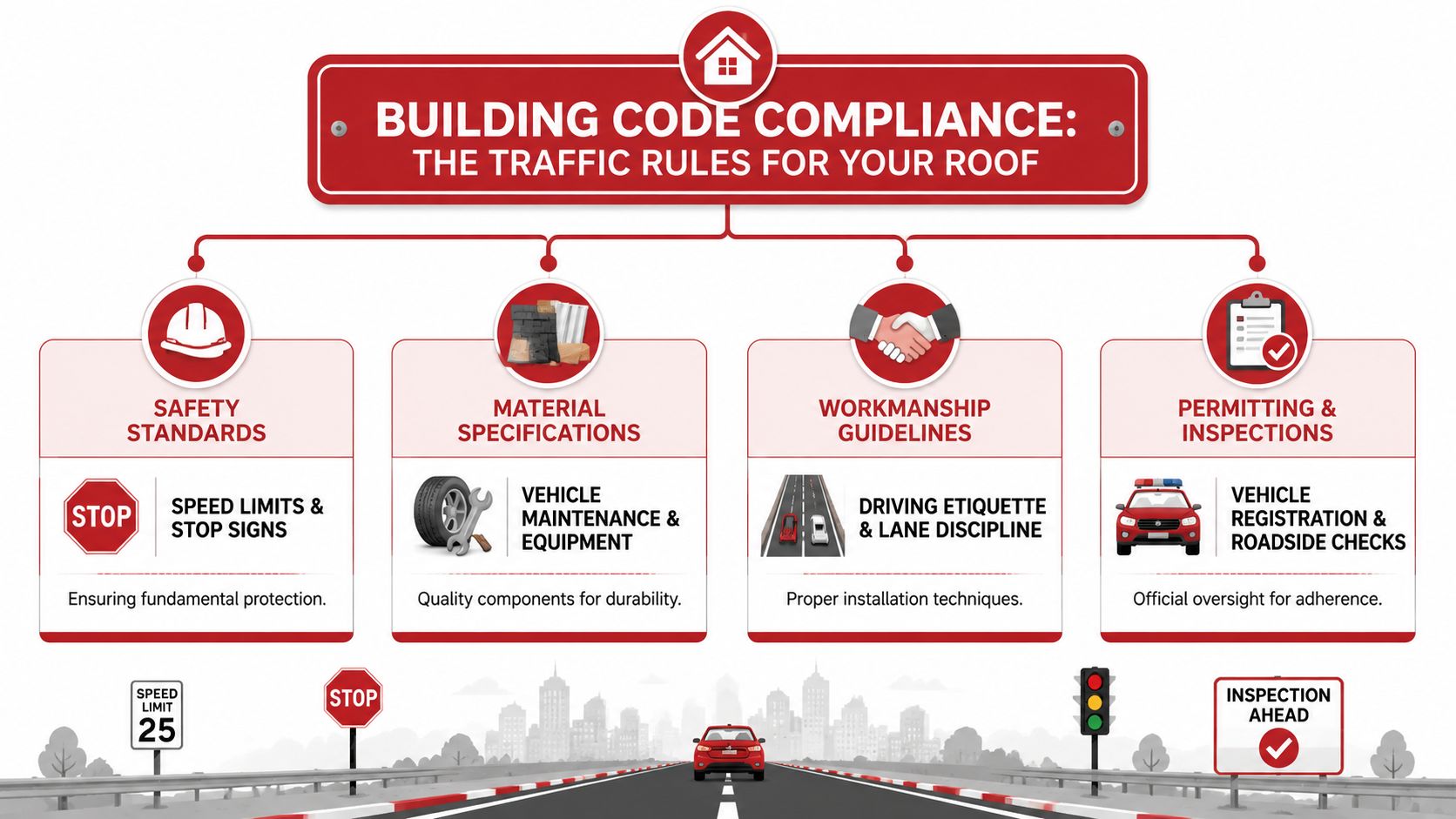
Building code compliance is easiest to understand if you think of it as traffic rules for your home. Traffic laws tell drivers where to stop, how fast to go, and what equipment a vehicle needs to stay safe on the road. Roofing codes do the same job for your property.
They tell contractors how the roof must be assembled, what materials are acceptable, where permits are required, and how the work gets checked. The point isn't bureaucracy. The point is making sure the roof can perform under real conditions like hail, heavy rain, high winds, and long Texas heat exposure.
The roof is a system, not a pile of materials
Owners often focus on shingles, metal panels, or coatings because that's what they can see. Inspectors and experienced roofers look at the entire assembly. That includes decking, underlayment, flashing, ventilation, fastening, penetrations, drainage, and edge details.
If one part is wrong, the whole roof can fail early. A cheap vent detail can cause leaks. Bad fastening can lead to blow-offs in a Fort Worth thunderstorm. Poor attic ventilation can shorten the life of an asphalt shingle roof during a San Antonio summer.
Minimum standard versus better practice
Codes set the floor, not the ceiling. A code-compliant roof should meet minimum legal requirements. A well-built roof often goes beyond that minimum in areas that take repeated weather stress.
That's why owners should ask direct questions when comparing bids:
| Question | Why it matters |
|---|---|
| Will the work be permitted? | It creates a formal review path |
| Are flashing details included in writing? | Leak points often start there |
| Are materials matched to local weather exposure? | Texas weather is hard on roofs |
| Will inspections be scheduled and closed out? | Final documentation protects you later |
A roof can look finished and still be non-compliant. Clean appearance isn't proof of correct installation.
The industry's growing focus on compliance is one reason the global building code compliance market is projected to reach US$ 20.66 Billion by 2033, growing at a 9.2% CAGR, reflecting heavier reliance on professional services and digital tools to manage complex rules in construction, according to building code compliance market projections.
If you own property with a steep-slope or low-slope roof and want a second opinion on condition reporting, outside Texas examples like these UK roofing survey options can be useful for understanding how structured roof assessments document defects, lifespan concerns, and repair priorities.
Key Texas Roofing Codes Every Property Owner Should Know
Texas roofing work sits at the intersection of local building rules, adopted model codes, and insurance-related standards. Most owners don't need to memorize code books. They do need to understand which requirements can directly affect whether a roof is legal, durable, and insurable.
Wind resistance and insurability
One of the clearest Texas-specific rules involves insurability for windstorm and hail coverage. In Texas, roofing materials must meet the UL 997 wind resistance standard or an equivalent, and be installed according to Texas Department of Insurance requirements to qualify as insurable property for windstorm and hail coverage under 28 TAC §5.4441(vii).
That matters more than many owners realize. A roof isn't just a surface over your house or commercial building. It's also part of your insurance risk profile. If material selection or installation falls short of TDI requirements where they apply, you can create problems that don't show up until you file a claim.
Local code adoption changes the details
Cities and counties across Texas can adopt and amend code requirements differently. The broad framework may look similar from Arlington to McKinney to Round Rock, but field details can shift. Fastener patterns, deck attachment expectations, inspection timing, and material approvals can vary by jurisdiction.
A contractor who works across Texas has to confirm local requirements before the job starts. That's especially important for:
- Full roof replacements
- Projects involving decking repairs
- Structural modifications
- Commercial roof replacement work
- Properties with prior storm damage repairs
Commercial roofs face extra scrutiny
Commercial roofing owners in Dallas, Irving, and San Antonio often run into code issues tied to drainage, insulation, penetrations, rooftop equipment, and energy performance. Low-slope roofs also have product-specific requirements that can affect coating and membrane choices.
For commercial low-slope roofs in Texas climate zones 1 through 3, the 2024 IECC requires an aged solar reflectance of at least 0.55 and an aged thermal emittance of at least 0.75, which directly affects material selection for energy-efficient roof coatings and roof replacement work.
The code book doesn't care what was cheapest last week. It cares whether the installed roof meets the current requirement for that project.
The practical takeaway for owners
When you hear “up to code,” ask for specifics. You want to know which rule applies, what part of the roof triggers it, and whether the requirement affects insurance, permit approval, or long-term performance.
That conversation should be plain and direct. If the answer sounds vague, that's a warning sign.
Navigating the Permit and Inspection Process
The permit process scares people because it sounds like delay, paperwork, and city red tape. In practice, it's a control system. It helps confirm that the roof replacement or major roof repair was reviewed, approved, and inspected the right way.
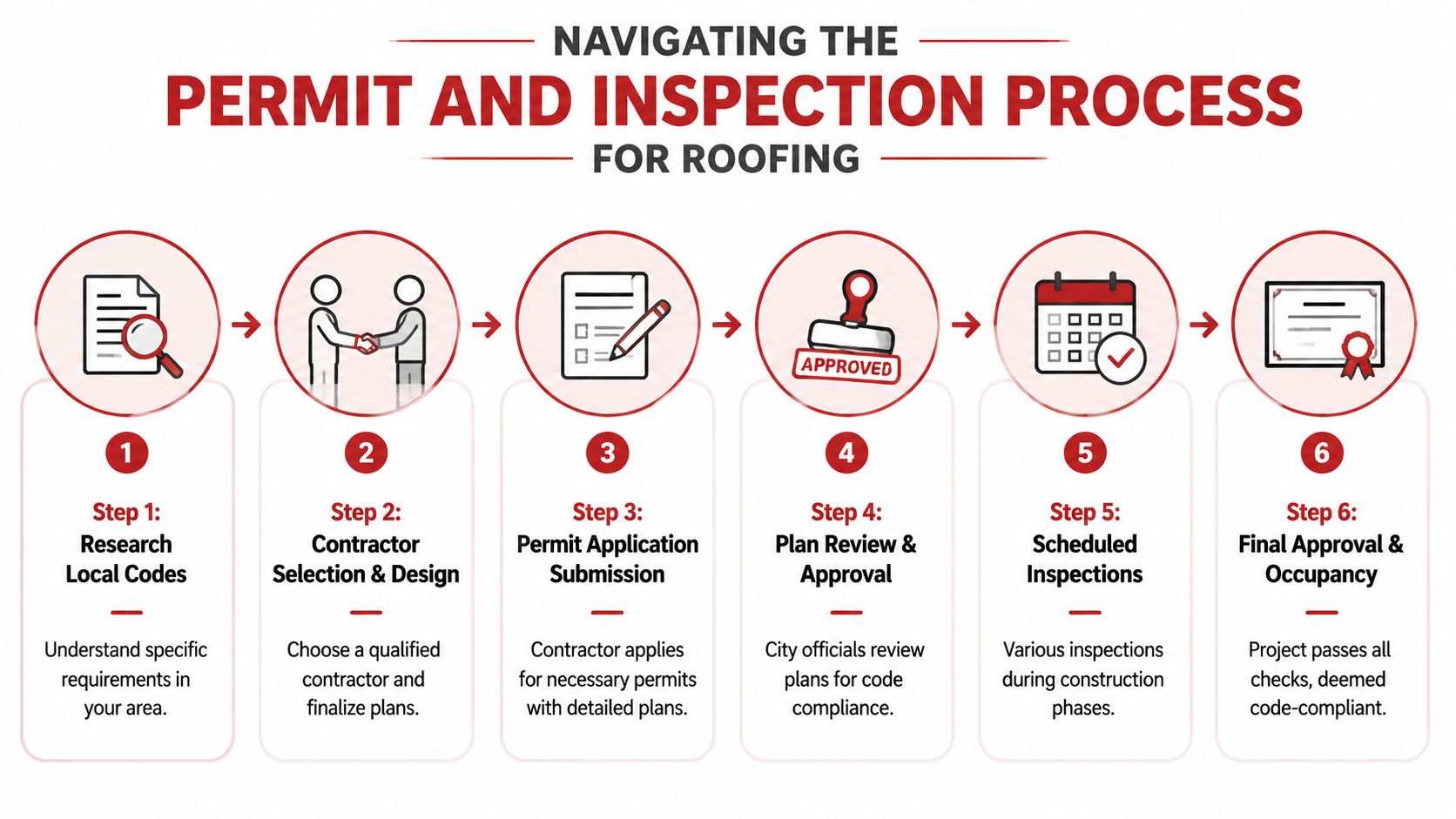
Most counties across Texas mandate a permit for re-roofing projects, especially when the work involves decking, structural modifications, or complete replacement, and failing to secure that permit can lead to fines and construction delays, as outlined in this overview of Texas building and roofing codes.
What usually happens on a roof project
The exact sequence can vary by city, but the workflow is usually recognizable.
Local requirements get checked
Before materials show up, someone confirms what the jurisdiction requires for your address and project scope.The permit application is submitted
For a straightforward residential roof replacement, this may be simple. For commercial roofing or structural work, plan review may be more involved.The permit is issued and posted
Once approved, the permit should be active before the main work begins.Work proceeds in stages
Tear-off, decking review, dry-in, installation, flashing, and finish details all happen in order.Inspections are scheduled
Some jurisdictions may want an in-progress look. All of them care about final approval.The project is closed out
Final approval matters. An open permit can create problems later during a sale or claim.
For owners who want a closer look at permit triggers and local variations, this guide to Texas roofing permit requirements is a useful reference.
A quick visual overview can also help if you haven't dealt with inspections before:
What owners should ask the contractor
A good roofing contractor near me should answer these questions without hesitation:
Who is pulling the permit
It should be clearly assigned, not assumed.What inspections are expected
Even a simple answer is better than “we usually don't need that.”Will I receive final documentation
Keep it with your insurance and property records.What happens if decking damage is found
The contract should explain how hidden conditions are handled.
If a contractor tells you a full replacement doesn't need a permit anywhere in Texas, slow the conversation down and verify that with the local jurisdiction.
Permits don't guarantee craftsmanship. But skipping permits removes an important checkpoint. In roofing, that usually benefits the shortcut, not the owner.
Common Roofing Code Violations and Their Hidden Costs
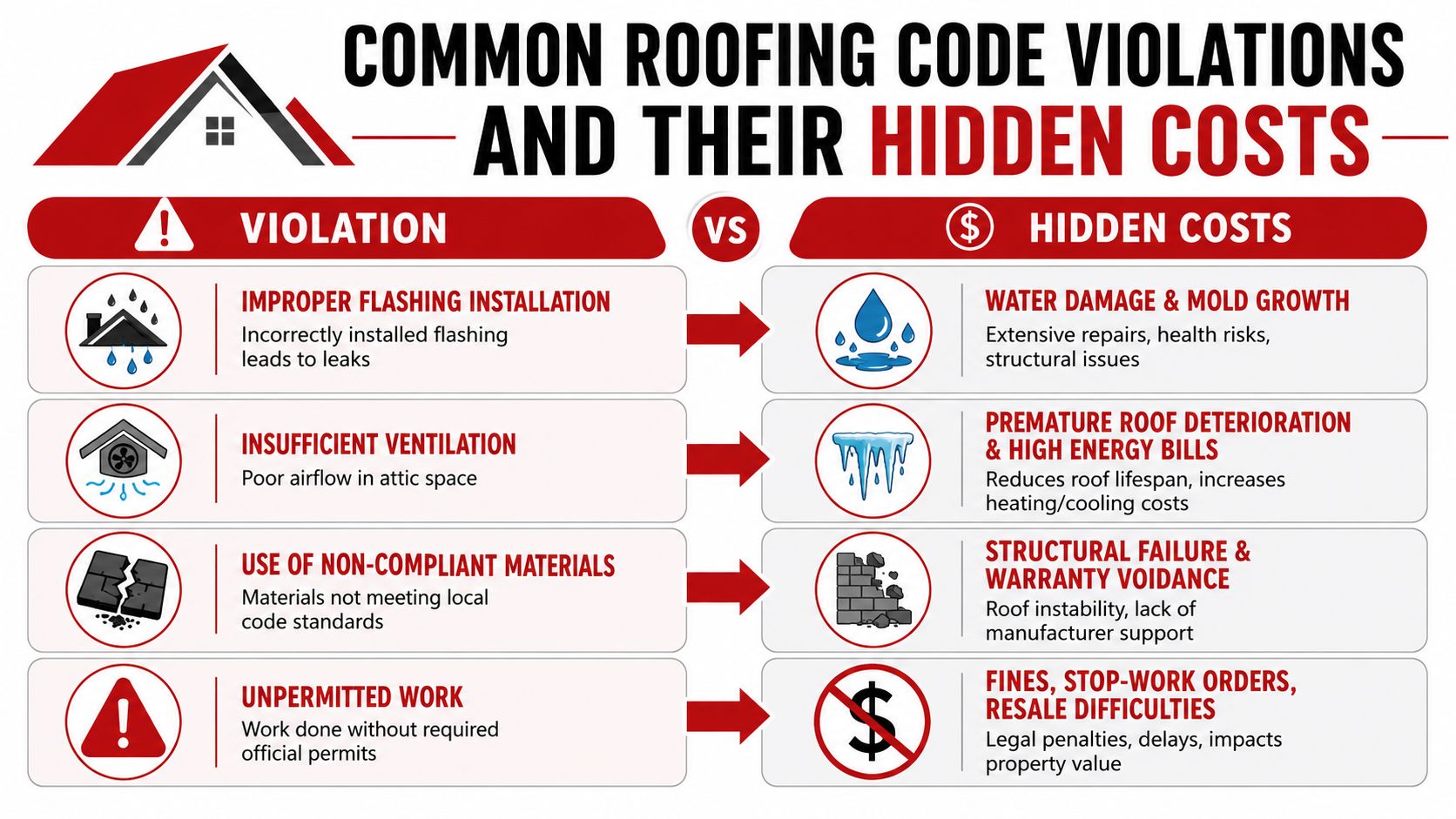
Most code violations don't announce themselves on day one. They lie dormant until the next storm, the next leak, or the next buyer inspection. By then, the repair cost is usually larger than the money saved by cutting corners in the first place.
The violations owners see most often
A house in Garland may look fine from the driveway, then fail around vent penetrations after the first hard rain. A commercial roof in Irving may hold up until pooled water exposes weak edge detailing. The pattern is familiar.
Improper flashing installation
Flashing around chimneys, walls, skylights, and vents has to shed water correctly. When installers rush this detail, water gets under the roof covering and starts damaging decking, insulation, ceilings, and wall cavities.Insufficient ventilation
Attic ventilation isn't cosmetic. When intake and exhaust are out of balance, heat builds up under the roof. That can age shingles faster, increase cooling strain, and create moisture issues in the attic space.Non-compliant materials
A product may be cheaper and still be the wrong choice for the project. If the material doesn't meet local requirements or system specifications, the owner can end up with premature failure and warranty problems.Unpermitted work
This one creates trouble well beyond construction. Unpermitted roof replacement or roof repair can complicate claims, resale disclosures, and later renovation work.
The hidden cost is usually downstream
Owners tend to focus on the first invoice. The actual expense often arrives later:
| Violation | What it can trigger |
|---|---|
| Bad flashing | Interior leaks, rotten decking, mold concerns |
| Poor ventilation | Shortened roof life, comfort issues, energy waste |
| Wrong materials | Failed inspections, denied warranty support |
| Missing permit | Fines, stop-work orders, resale friction |
For owners trying to understand how installation defects can turn into bigger legal and financial disputes, this comprehensive guide to construction flaws gives useful context on defect-related claims and why documentation matters.
What doesn't work
The worst approach is patching symptoms while leaving the original violation in place. Caulking over failed flashing isn't a lasting repair. Replacing a few blown shingles won't solve a fastening problem across the field of the roof. Covering over wet or damaged substrate just traps a bigger issue.
The cheapest roof repair is often the one you only pay for once.
That's why code violations matter even when the roof isn't actively leaking today. In Texas weather, weak details rarely stay hidden for long.
How Code Compliance Affects Your Insurance and Property Value
Building code compliance stops feeling theoretical. It directly affects claims, negotiations, closing documents, and how much uncertainty follows the property.
A lot of owners assume any existing code issue gives the insurer a free pass to deny a storm claim. That isn't how these disputes always work. While 18% of homeowners with code violations face claim disputes, court precedents often rule that insurers cannot deny claims for storm damage solely because of a pre-existing code violation unless that violation directly caused the loss. That distinction matters.
Causation matters in roof claims
If hail damages a roof, the key question is whether the covered weather event caused the loss being claimed. A pre-existing code problem may still create friction, but it doesn't automatically erase storm damage coverage.
That's why owners need to separate two issues:
- Storm-created damage
- Pre-existing non-compliant conditions
They can exist at the same time. They aren't always the same thing.
For a deeper look at claim handling and what policies often cover after a storm, this article on roof damage insurance coverage is worth reviewing before you talk with your carrier.
Code upgrades can change the budget
Even when the storm damage itself is covered, bringing the replacement roof up to current requirements may add cost. Owners should review whether their policy includes Ordinance or Law coverage. That part of the policy can help when local rules require upgrades during replacement.
This comes up often on older homes and commercial properties where the prior roof was installed under an older standard. It also matters when added features, like solar, affect roof assembly and warranty questions. If your property has rooftop solar or you're planning it, this explanation of solar panel roof warranty is a useful companion read because penetrations, attachments, and reroof timing all affect future liability.
Buyers like paperwork more than promises
When a property goes up for sale in McKinney, Frisco, Georgetown, or Boerne, a documented roof is easier to defend than a verbal story. Permit records, final approvals, invoices, and product documentation reduce buyer hesitation. They also help appraisers, inspectors, and lenders understand what was done.
A code-compliant roof with a clean paper trail doesn't just protect the structure. It protects the transaction.
Your Simple Checklist for a Code-Compliant Roof
You don't need to become a code expert to protect yourself. You need a short list and the discipline to use it before work begins.
Use this before you sign anything
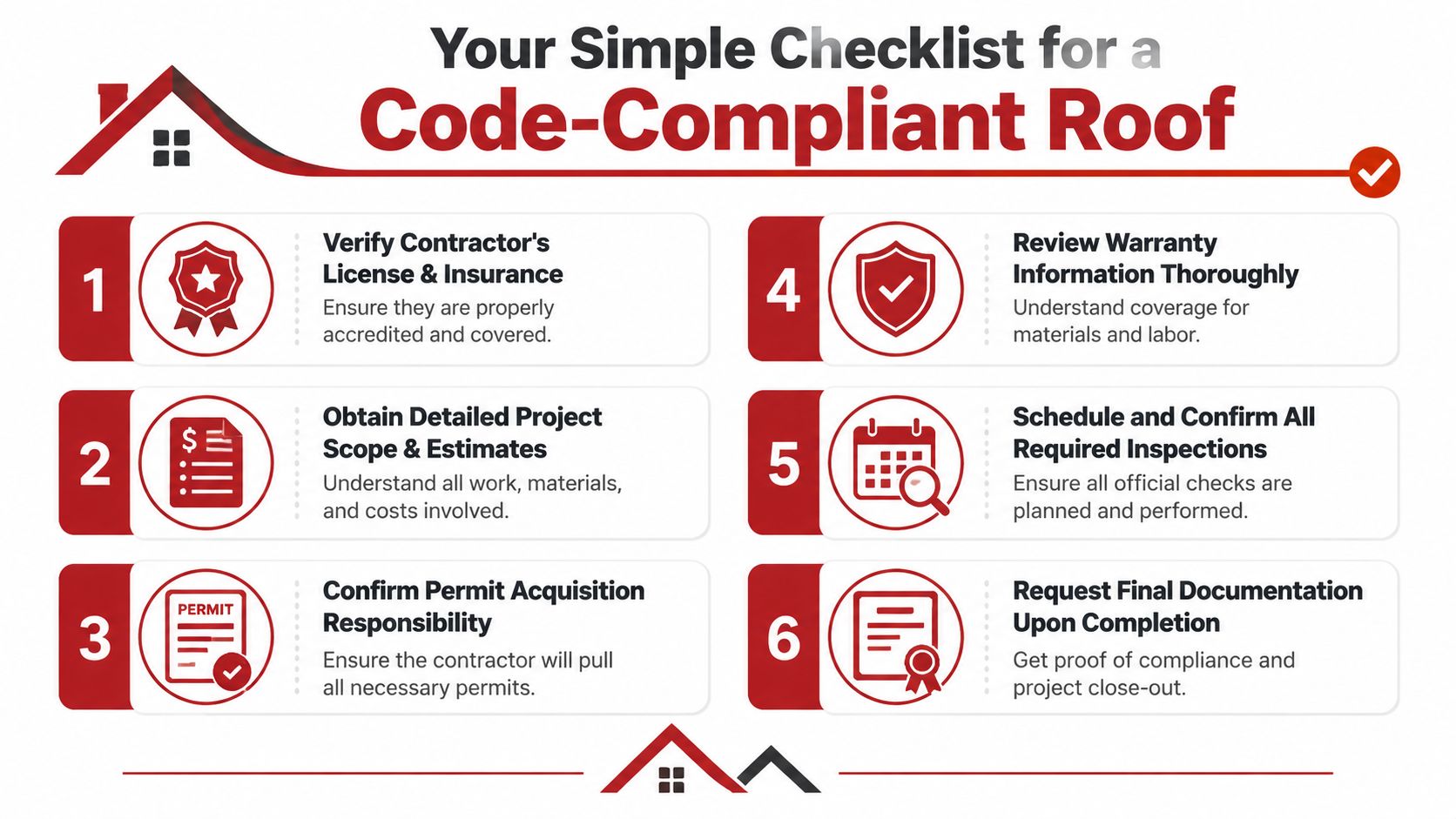
Verify contractor credentials
Confirm the contractor is insured, established, and experienced with residential roofing or commercial roofing in your Texas market.Get the project scope in writing
The estimate should identify materials, tear-off scope, flashing work, decking assumptions, and whether code-related items are included.Ask who pulls the permit
Don't leave this vague. Make sure responsibility is stated in the contract.Review product and labor warranties
A strong-looking roof isn't enough. Know what's covered and what could void that protection.Confirm inspections will be completed
Ask whether the contractor will schedule required inspections and provide closeout records.Keep final documentation
Save permits, invoices, inspection approvals, and material details with your insurance papers.
Peace of mind usually looks boring on paper
That's a good thing. Permits, inspection sign-off, compliant materials, and clear scope documents aren't exciting. They're what keep a roof replacement from turning into a claim dispute or a resale problem later.
If you're searching for a roofing company near me after hail, wind, or leak damage, the right question isn't just “What's the price?” It's “Will this roof be done correctly, documented properly, and defensible if I need to file a claim or sell the property later?”
If you want that process handled carefully from inspection through final documentation, Hail King Professionals is a trusted Texas roofing contractor serving Dallas, Fort Worth, Arlington, Plano, Frisco, McKinney, Garland, Irving, Mesquite, Tyler, Longview, Marshall, San Antonio, Austin, New Braunfels, San Marcos, Boerne, Round Rock, and Georgetown. Whether you need storm damage roof repair, hail damage roof repair, a commercial roof replacement, or a full residential reroof, the team can help you sort out permits, code requirements, and insurance questions with clear guidance and a practical plan.