
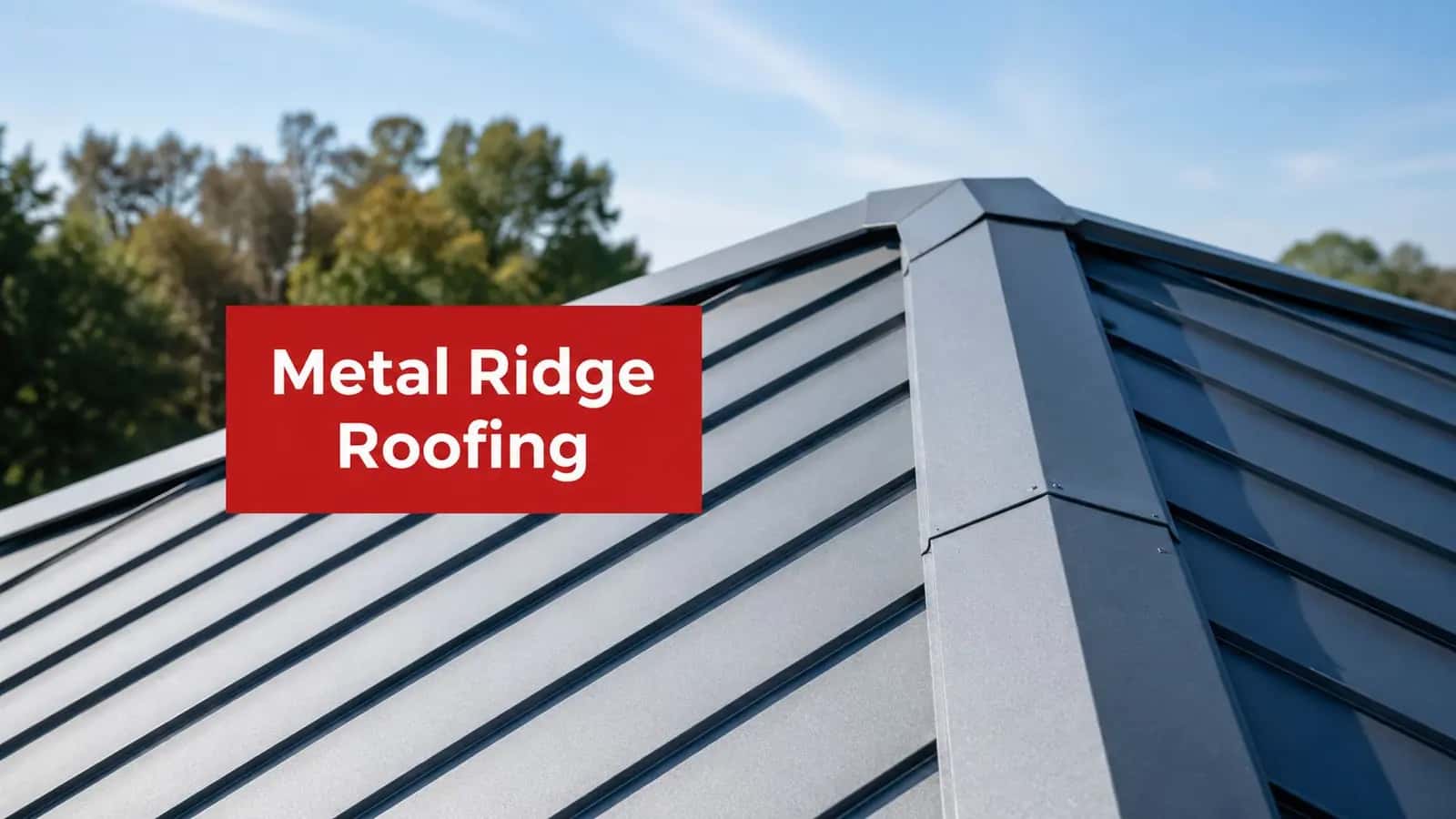
A lot of Texas property owners find out how important the roof ridge is at the worst possible time. A hailstorm moves through Dallas, wind starts pushing rain sideways, or a brutal summer stretch in Austin turns the attic into an oven. The leak, heat, or noise usually seems to come from “somewhere near the top.” That's often exactly where the problem starts.
On a metal roof, the ridge isn't just the line at the peak. It's a working assembly that has to shed water, handle wind pressure, allow for movement, and in many cases help the roof breathe. When that system is designed well, a metal roof can give you years of dependable service through hail, heat, and storm season. When it's treated like a cosmetic afterthought, the failures tend to show up fast.
Why Your Roofs Peak Matters Most in Texas
The ridge is the highest seam on the roof, where two roof planes meet. That makes it one of the most exposed parts of the whole system. In Texas, that exposure matters because the ridge takes direct punishment from gusting wind, driven rain, hail impact, and long heat cycles that expand and contract the metal.
A lot of homeowners still think of metal roofing as a specialty upgrade. It isn't anymore. Metal roofing now holds around 15% of the residential market and is described as the second-most-used material in that segment, with reported lifespans of 40 to 80 years compared with about 20 years for typical asphalt shingles, according to this industry discussion on residential metal roofing growth.
That shift matters for one reason. More homes and commercial buildings are relying on metal systems, and the ridge is one of the details that decides whether the roof performs the way the owner expects.
What Texas weather does to a weak ridge
A weak ridge usually doesn't fail all at once. It starts with small problems.
- Wind lift: High winds can work at cap edges and laps.
- Driven rain: Water gets pushed where gravity alone wouldn't send it.
- Heat movement: Daily expansion and contraction stress trim, fasteners, and sealants.
- Hail strikes: Impacts can deform metal trim or open vulnerable joints.
A metal ridge roofing system has to do more than cover a seam. It has to stay watertight while the roof moves, the weather changes, and the pressure at the peak keeps shifting.
That's why the ridge deserves more attention than it usually gets. On homes in Arlington, Plano, or Tyler, I've seen owners focus on the field panels because that's what they notice from the street. But leaks often begin at transitions, penetrations, and the peak. The ridge sits in that category.
Why this detail changes the whole roof
If the ridge is wrong, the rest of the roof has to work harder to compensate. Sealants get overused. Fasteners take stress they shouldn't. Ventilation gets compromised. Water finds paths into underlayment, decking, or attic space.
A proper ridge assembly does the opposite. It closes the roof at its most vulnerable line, supports airflow when needed, and helps the roof act like one system instead of a stack of separate parts.
Ridge Caps vs Ridge Vents Understanding the Basics
A lot of confusion starts here. Property owners hear “ridge cap” and “ridge vent” used like they mean the same thing. They don't.
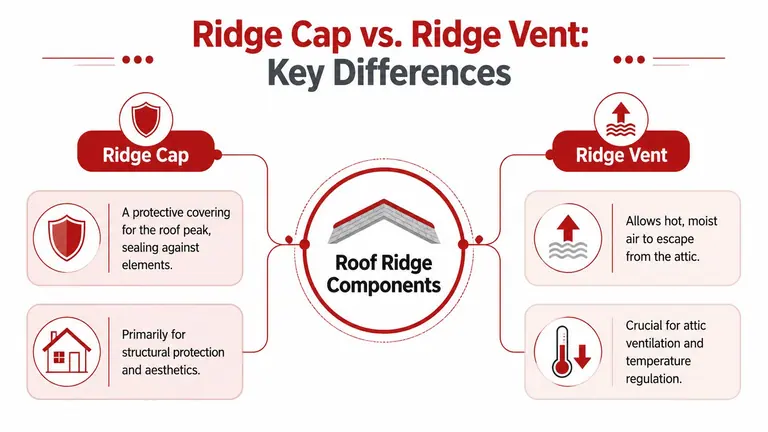
A ridge cap is the metal trim piece that covers and protects the roof peak. A ridge vent is the ventilation component that allows hot, moist air to escape at the top of the roof. On many metal roofs, both functions are combined into one assembly.
What a ridge cap actually does
Think of the ridge cap as the roof's protective cover at the spine. Two roof planes meet there, and that joint has to be closed in a way that sheds water and resists wind entry.
On metal roofing, that closure has to match the panel shape below it. Flat trim over a profiled panel leaves openings unless the installer uses the right closures, vent material, and seal points. That's where many avoidable leaks begin.
Technical installation guidance for standing seam systems calls for a profile vent placed about 1 inch upslope of the ridge mark, with the ridge cap fastened after the vent is installed. The same guidance specifies sealant or tape at the Z-trim interface and sealed side laps to reduce wind-driven rain entry at the peak, as shown in this metal ridge cap installation guide.
What a ridge vent adds
A vented ridge assembly does more than close the peak. It helps move hot air and moisture out of the attic or roof cavity. That matters in Texas, where trapped heat builds fast and moisture problems don't always announce themselves until stains, mold, or deck deterioration show up.
Here's the practical difference:
| Component | Main job | Common failure if done poorly |
|---|---|---|
| Ridge cap | Weather protection at the peak | Water intrusion, lifted trim, exposed gaps |
| Ridge vent | Airflow at the peak | Heat buildup, moisture retention, poor attic performance |
Practical rule: If the ridge assembly doesn't match the roof profile and ventilation plan, it won't matter how good the panel looks from the yard.
What homeowners should look for
If you're standing back from the house in Fort Worth or Garland, look for these signs:
- Uneven ridge lines: A cap that waves or sits high in spots may not fit the panel profile correctly.
- Visible openings: Gaps under the cap can let in rain, insects, and debris.
- Heavy caulk dependence: Excess sealant often means someone tried to fix a fit problem with goo instead of proper trim.
- Poor attic conditions: Excess heat or moisture can point to a venting issue, not just insulation.
When the ridge is built right, it looks clean. Beyond its appearance, it works in the background during the weather events that punish Texas roofs the most.
Choosing the Right Materials and Profiles
The best ridge system starts with a simple truth. There is no universal ridge cap that works well on every metal roof. Material, panel profile, slope, and ventilation design all have to line up.
That's where a lot of projects go sideways. Someone orders a generic cap, assumes the roof pitch tells the whole story, and tries to make it fit in the field. On a basic shed roof, you might get away with that. On a home with multiple ridges, changing slopes, or a vented assembly, that shortcut usually shows.
Material choice is only part of the decision
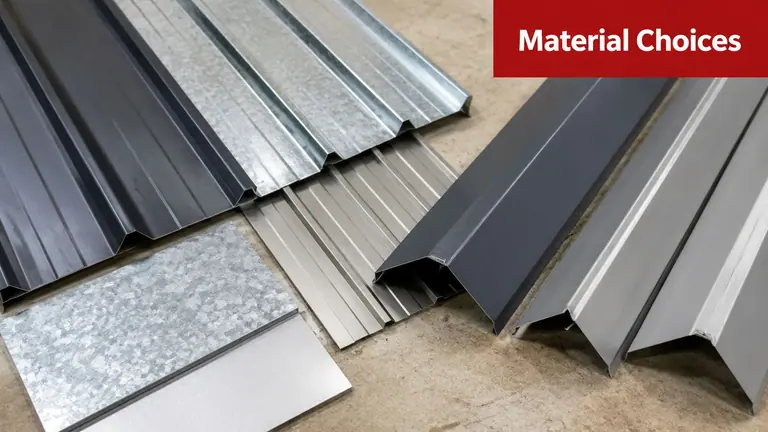
Owners often start by asking whether steel or aluminum is better. That's a fair question, but it's not the only one. The ridge cap also has to fit the roof panel profile below it.
Common profile considerations include:
- Standing seam panels: These need trim that works with ribs, clips, and closure details.
- R-panel systems: These have exposed ribs and need cap geometry that lands correctly over the profile.
- Corrugated panels: The wave pattern creates its own closure and fit-up challenges.
A ridge cap that doesn't match the panel profile leaves voids. Once that happens, every other fix becomes a patch. Foam closures, vent material, and sealants are meant to support the system, not rescue the wrong trim.
Bend angle is where expertise shows
This is the part most online advice skips. The bend angle for the ridge cap is not just the roof slope written a different way.
A detailed installer guide shows that ridge cap interior angles vary dramatically, from 36.87° on a 36:12 roof to 170.47° on a 1:12 roof, and it explains that the angle must be measured properly relative to the hip or ridge line, not guessed from pitch alone. That's why one-size-fits-all ridge caps fail on custom roofs, as explained in this guide to hip and ridge cap angles for metal roofing.
That detail matters even more on roofs with intersecting sections or nonstandard geometry. A cap can look close enough on the ground and still be wrong at the bend, which creates poor bearing, open edges, and sealant stress.
What works and what doesn't
What works:
- Profile-matched trim
- Custom-bent ridge caps for the actual roof geometry
- Vented or solid assemblies chosen for the building's airflow needs
- Closures and trim accessories designed for the panel system
What doesn't:
- Generic “close enough” trim
- Bending by eye on complex roofs
- Forcing flat stock over aggressive panel shapes
- Treating the ridge like a finish piece instead of a weather detail
If you want a useful technical reference before talking to a contractor, this metal roofing installation guide is a good place to start. It helps property owners understand how panel type, trim design, and installation sequence fit together.
Ventilation and Performance in the Texas Climate
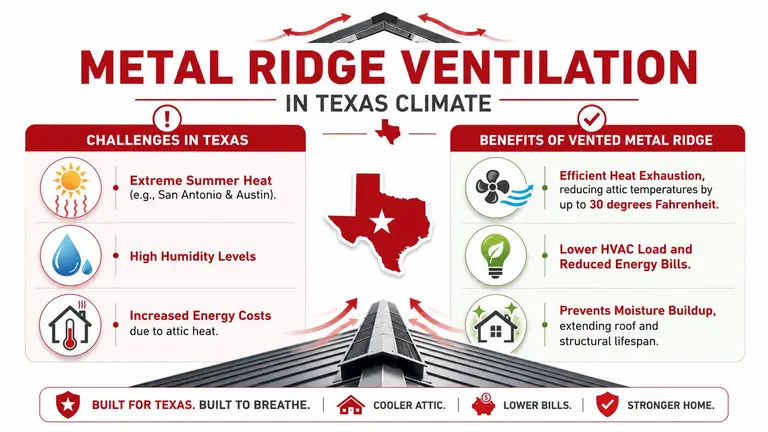
A Texas attic can hit punishing temperatures by late afternoon, then take a hailstorm and wind-driven rain a few hours later. The ridge has to handle both conditions in the same roof system. If it cannot exhaust heat and resist weather at the same time, the roof starts losing ground where it matters most.
For homes in San Antonio, Austin, Round Rock, and Georgetown, trapped attic heat drives up cooling strain and cooks roof components from below. In Dallas, McKinney, and Longview, the bigger problem often shows up during severe storms, when wind pushes rain uphill and hail tests every exposed detail at the peak. The ridge sits at the center of that pressure because it is the roof's highest exhaust point and one of its most exposed weather joints.
Why vented ridges matter in heat
A vented ridge works only when the full system is balanced. It needs intake air from below, a clear air path through the attic or ventilation space, and a ridge vent assembly that matches the panel profile and exposure. Put a vented cap on a roof with poor intake, crushed insulation at the eaves, or badly fitted closures, and the owner gets the look of ventilation without much actual airflow.
That point gets missed all the time in Texas. I see roofs where the ridge was treated like a trim upgrade instead of part of the thermal and moisture design. The result is predictable. The attic stays hot, the metal radiates heat into the structure longer into the evening, and condensation risk goes up when humid air gets trapped instead of exhausted.
The U.S. Department of Energy explains that cool roofing and ventilation work best as part of a broader roof strategy, not as stand-alone fixes, in its guidance on cool roofs and hot-climate performance.
A short visual helps explain how airflow and moisture control work together in a metal roof assembly.
Low-slope ridges need more care, not less
Low-slope metal roofs can be unforgiving at the ridge. Water drains more slowly, wind has more time to push rain under laps, and any small gap in closures or sealant becomes a leak path. A ridge detail that survives on a steeper roof may fail early on a lower-slope section.
One installer guide recommends butyl tape or sealant between overlapping ridge cap pieces on low-pitched roofs because water can work under flat caps and leak into the attic during heavy rain. That lines up with what shows up after Texas storm events, as noted in this low-pitch metal ridge cap installation article.
On a low-pitched metal roof, a ridge cap overlap without the right seal is an invitation for wind-driven rain.
Where Texas ridges usually fail
The failure points are usually practical, not mysterious:
- Unbalanced ventilation: A vented ridge is installed, but soffit intake is blocked or undersized, so hot air has nowhere to move from.
- Weather detailing that ignores exposure: The cap may look tight on a calm day, then admit rain once strong wind changes the water path.
- Closures that do not fit the panel profile: Openings at ribs and voids under the cap give wind, water, and insects a direct path in.
- Oversealed assemblies: Crews sometimes lock down the ridge so tightly for storm protection that the attic loses the exhaust path it was supposed to have.
Good Texas ridge work is always a balancing act. The assembly has to shed hail and wind-driven rain, stay attached in high winds, and still let heat escape. That is why Hail King Professionals evaluates the ridge as part of the whole roof system, not as a cosmetic cap at the top. On metal roofs across Texas, that approach is what keeps the peak from turning into the weak point.
Cost Lifespan and Maintenance for Metal Ridge Roofing
Most owners asking about metal ridge roofing really want the same answer. Is it worth the investment over time?
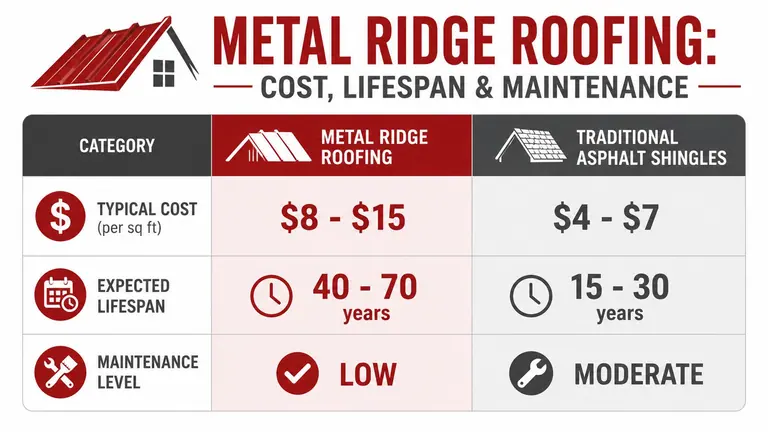
The honest answer is yes, when the ridge is part of a properly designed metal roof system and not an afterthought. The longer service life of metal is one reason many owners accept a higher upfront price. The ridge itself is a small part of the roof by area, but it has an oversized effect on whether the whole roof stays dry and stable.
What matters more than sticker price
The image above compares metal ridge roofing with traditional asphalt shingles, but there's an important caution here. Published cost ranges vary by panel type, trim complexity, access, region, underlayment, and whether the project includes custom fabrication or storm-related repair work. That's why I advise owners to focus less on generic online pricing and more on the full replacement cycle, maintenance burden, and failure risk at critical details like the ridge.
What usually makes metal attractive is the lifecycle picture:
- Long service life: Owners generally expect fewer replacement cycles.
- Lower disruption: Fewer tear-offs over time means less interruption to the property.
- Better resilience: A properly installed metal ridge handles weather stress better than many patch-based solutions on aging roofs.
Maintenance is simple, but it isn't optional
Metal ridge systems don't usually need constant attention. They do need periodic inspection, especially after hail, wind, or prolonged heat.
From the ground, look for:
- Lifted cap edges
- Missing or backed-out fasteners
- Bent trim after hail impact
- Sealant failure at overlaps or transitions
- Rust staining or water marks below the ridge line
The hidden part matters too. Manufacturer data says roof panels and trim should be fastened to a substrate thick enough to meet design loads, with 2-inch nominal lumber providing maximum pullout values when fasteners penetrate at least 1 inch into wood. The same guidance specifies fastening trim and roofing sheet every 12 to 24 inches along the gable edge and using a minimum slope of 2.5 inches per foot for proper drainage, based on this metal roofing installation data sheet.
Field note: A ridge problem isn't always visible at the cap itself. Sometimes the real issue is weak fastening below, substrate problems, or water that entered earlier and showed up later.
A smart inspection routine
For most properties, the best routine is straightforward:
- Check after storms: Hail and high winds can distort trim or loosen fasteners.
- Look inside the attic: Stains, damp insulation, or daylight near the peak are warning signs.
- Inspect before small issues spread: Ridge leaks often travel before they show.
- Document changes over time: Photos help track movement, corrosion, or recurring moisture.
That kind of maintenance is inexpensive compared with interior damage repair after a long-hidden leak.
When to Repair or Replace Your Metal Ridge
A metal ridge doesn't always need full replacement. Sometimes it needs targeted repair. The trick is knowing whether the problem is cosmetic, localized, or structural to the roof system.
After a Texas storm, property owners often focus on the obvious dents. Dents matter, but they aren't the only issue. A ridge can also fail because wind lifted an overlap, a closure shifted out of place, sealant aged out, or fasteners loosened enough to let water work under the trim.
Signs a repair may be enough
Localized repair is usually reasonable when the underlying roof system is still sound and the issue is limited to a specific section.
A repair often makes sense if you have:
- A small area of lifted trim
- Minor separation at an overlap
- Isolated fastener replacement needs
- A limited sealant failure with no widespread water damage
- A single damaged cap section after a storm impact
In those cases, the goal is to restore the original function of the ridge. That means matching trim, closure type, fastening pattern, and seal detail. It doesn't mean smearing sealant over everything and hoping for the best.
Signs replacement is the better call
Replacement becomes the smarter move when the ridge problem points to a broader fit, design, or aging issue.
Common triggers include:
- Repeated leaking at the same ridge line
- Incorrect cap geometry from the original installation
- Visible gaps along multiple sections
- Storm damage across a large length of ridge
- Substrate or deck deterioration under the peak
- A vented assembly that was never built correctly
If you're sorting through storm-related damage, this guide for homeowners on storm damage is a helpful plain-language resource for organizing documentation and understanding the repair process before you speak with your insurer or contractor.
Don't ignore warranties and repair compatibility
One mistake I see too often is mixing patch materials or repair methods that don't fit the original roof system. That can create problems with performance and, in some cases, with warranty expectations.
If your contractor is talking through repair options, ask exactly what products they plan to use and whether they match the panel system already on the roof. This overview of metal roofing repair products can help you understand the difference between a real system repair and a temporary patch.
If the ridge has failed because the original design was wrong, repairing the symptom won't solve the cause.
That's the key repair-versus-replace question. Are you fixing isolated damage, or are you trying to save a ridge assembly that was never right to begin with?
Hiring a Contractor Questions for Your Project
After a Texas hailstorm, the ridge is often where a contractor's skill shows first. I've seen roofs with decent-looking panels and a poorly built peak that let in wind-driven rain, trapped attic heat, or started lifting in the next hard blow. If you are hiring someone for metal ridge roofing, ask how they build the whole ridge system, not just what cap they plan to install.
A good contractor should be able to explain how the ridge will handle your panel profile, your roof shape, your attic ventilation needs, and your local exposure to wind and hail. If the answers stay general, you are not getting a real plan.
Questions worth asking
Start with the parts of the job that determine whether the ridge will perform in Texas weather:
- How will you match the ridge cap to my exact panel profile and roof pitch?
- Will the ridge trim be field-fit, shop-bent, or custom-fabricated for this roof?
- Are you building a vented ridge or a solid ridge, and what makes that the better choice for this property?
- What closures, sealants, and vent materials will you use to block wind-driven rain and insect entry without choking airflow?
- How will you fasten the ridge so it resists uplift without creating leak points?
- How do you handle transitions where the ridge meets hips, valleys, wall flashings, or changing roof sections?
Then ask what happens when the roof is less than ideal. Real jobs are not perfect. The right contractor should be ready to talk through uneven framing, previous repair mistakes, old storm damage, and deck issues that can throw off ridge alignment.
Questions that show whether the contractor runs a disciplined project
The ridge can fail before the first storm if the measurements, fabrication, and sequencing are sloppy.
Ask these:
- Who confirms final measurements before trim is ordered or bent?
- Will you inspect the decking at the ridge before installing new metal components?
- How do you document hail or wind damage if insurance is involved?
- What is your plan if you find wet insulation, rotten wood, or ventilation problems at the peak after tear-off?
- Who is responsible for coordinating related trades if gutters, skylights, or solar need attention during the project?
- Will I get a written scope that lists ridge materials, vent type, closures, fastening method, and warranty terms?
For owners comparing companies, organized communication matters too. The Recepta.ai platform shows the kind of job-tracking and client communication systems serious roofing and siding contractors use to keep measurements, approvals, and scheduling from slipping through the cracks.
What the right answers sound like
Good answers are specific. You want to hear exact panel names, trim details, ventilation strategy, fastening layout, and how the ridge assembly will be sealed against blowing rain without trapping heat in the attic.
Weak answers usually sound casual. Phrases like “we use the same ridge cap on most jobs” or “we'll make it fit on site” are warnings, especially on Texas roofs that take hail, high wind, and long summer heat cycles.
Hail King Professionals approaches ridge work the way it should be handled. As a system tied to the roof panels, ventilation path, and weather exposure on the structure. If your ridge has storm damage, chronic leaking, poor vent performance, or signs of uplift, their team can inspect the assembly, identify whether the problem is isolated or systemic, and recommend a repair or replacement plan built for Texas conditions.
If you need help with a storm-damaged roof, a metal ridge repair, or a full roof replacement, Hail King Professionals serves homeowners and commercial property owners across Dallas, Fort Worth, Arlington, Plano, Frisco, McKinney, Garland, Irving, Mesquite, Tyler, Longview, Marshall, San Antonio, Austin, New Braunfels, San Marcos, Boerne, Round Rock, and Georgetown. Their team provides inspections, clear repair or replacement recommendations, insurance claim support, and code-compliant roofing solutions built for Texas hail, wind, rain, and heat.