
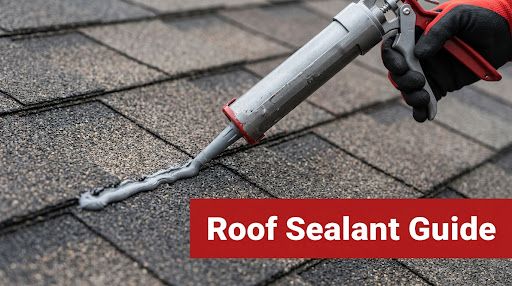
Asphalt Shingle Roof Sealant: A Texas Homeowner’s Guide
A lot of bad roofing advice starts the same way. You see a stain on the ceiling after a Texas storm, notice a few lifted tabs from the yard, and somebody says, “Just seal it.”
That advice sounds cheap, fast, and harmless. For a minor issue, it sometimes is. But for many Texas roofs, especially after hail, asphalt shingle roof sealant turns into a shortcut that hides damage instead of fixing it.
I've seen why homeowners reach for it. A tube of sealant from the hardware store looks a lot easier than calling for an inspection, waiting on insurance, or facing the possibility that the roof may need real repair work. In Dallas-Fort Worth and East Texas, storm season creates that pressure every year. People want to stop a leak now and deal with the rest later.
The problem is that “later” often gets more expensive. A sealed-over shingle can still be bruised from hail. A coated area can hold moisture where you don't want it. A patch can also muddy the picture when someone finally inspects the roof for a claim or replacement decision.
That's why the key question isn't whether roof sealant exists or whether it sticks. The core question is simpler: Is sealing this roof a smart repair, or is it a mistake that delays the work you need?
Introduction
A common Texas scenario goes like this. A storm rolls through overnight. In the morning, you find a small leak near a vent, a few shingle tabs look a little raised, and the roof still looks mostly fine from the driveway.
At that point, a can or tube of asphalt shingle roof sealant feels like the practical move. It's available the same day. It promises water resistance. It seems like a way to buy time without spending replacement money.
Sometimes that instinct is reasonable. If the problem is isolated and the shingle itself is still sound, a targeted seal can help. But homeowners get into trouble when they treat sealant like a cure-all for storm damage.
Practical rule: If the roof problem is structural, impact-related, or spread across multiple slopes, sealant usually covers symptoms. It doesn't restore the roof system.
That distinction matters more in Texas than in milder markets. Many leaks that show up after a hailstorm don't come from one neat little opening. They come from a roof assembly that has taken hits, lost integrity, and now has several weak points working together.
The smartest approach is to treat sealant as a repair material, not a recovery plan. If you know that going in, you can save money. If you don't, you can spend money twice. Once on patches, and again on the repair or replacement that was needed from the start.
What Asphalt Shingle Sealant Is and What It Is Not
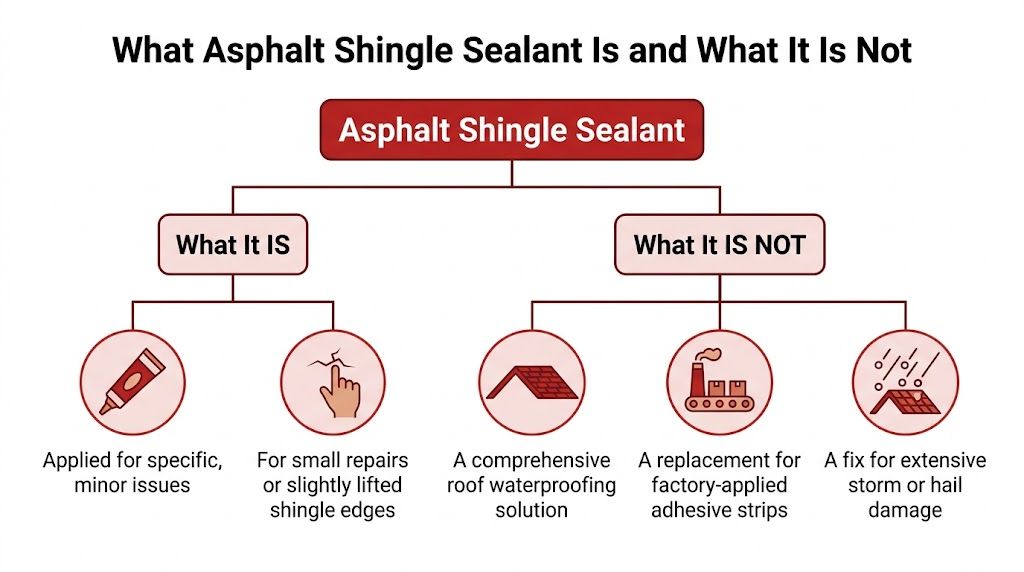
The first thing to understand is that most asphalt shingles already rely on sealant before you ever open a tube. Modern shingles have a factory-applied seal strip on the underside. That strip is part of the shingle design, and it helps neighboring courses bond together for wind resistance.
That factory strip is not the same thing as field-applied roof sealant. A roofer might use field-applied sealant for a small repair, such as a lifted tab or a limited detail around a penetration. It is a spot-fix product, not a magic coating that turns an old roof into a new one.
What it is
Think of asphalt shingle roof sealant as a precision material. Used correctly, it can help with a narrow set of problems.
- A tab re-bonding aid: If one tab lifted in wind but the shingle isn't torn, creased, or broken, sealant may help resecure it.
- A flashing detail product: Around certain small roof details, old sealant can dry out and need renewal.
- A temporary control measure: In some cases, it can slow active water entry until a proper repair is scheduled.
What it is not
Where homeowners get misled is when product marketing makes sealant sound like a liquid reset button.
It isn't any of the following:
| Not a good use | Why it falls short |
|---|---|
| Full-roof storm recovery | It doesn't reverse hail impact or aging |
| Replacement for factory bond design | Site-applied sealant isn't the same as integrated shingle construction |
| Fix for brittle, worn-out shingles | Old substrates often fail underneath the patch |
| Cure for widespread leaks | Multiple failure points need diagnosis, not just smearing product around |
Research on asphalt roofing sealant failure shows why this distinction matters. The sealant between shingles may delaminate at wind speeds significantly below the shingle's nominal rating, and in one simulation, single-sealant shingles were predicted to fail in roughly 4.1 to 4.3 hours under expected pressure loading conditions, while a two-strip configuration was projected to last far longer under similar conditions, according to asphalt shingle sealant failure research from the University of South Carolina.
A roof system is only as reliable as its weakest bond. Sealant design isn't a cosmetic detail.
That's the practical takeaway. Sealant matters, but it has limits. If you use it like a scalpel, it can help. If you use it like a paint roller, you're asking a repair product to do a replacement job.
When Sealing Your Roof Makes Sense
There are times when sealing is the right call. Not glamorous. Not dramatic. Just appropriate.
The best uses are small, isolated, and clearly identified. If the roof is otherwise in serviceable condition, a targeted seal can be sensible maintenance instead of wasted money.
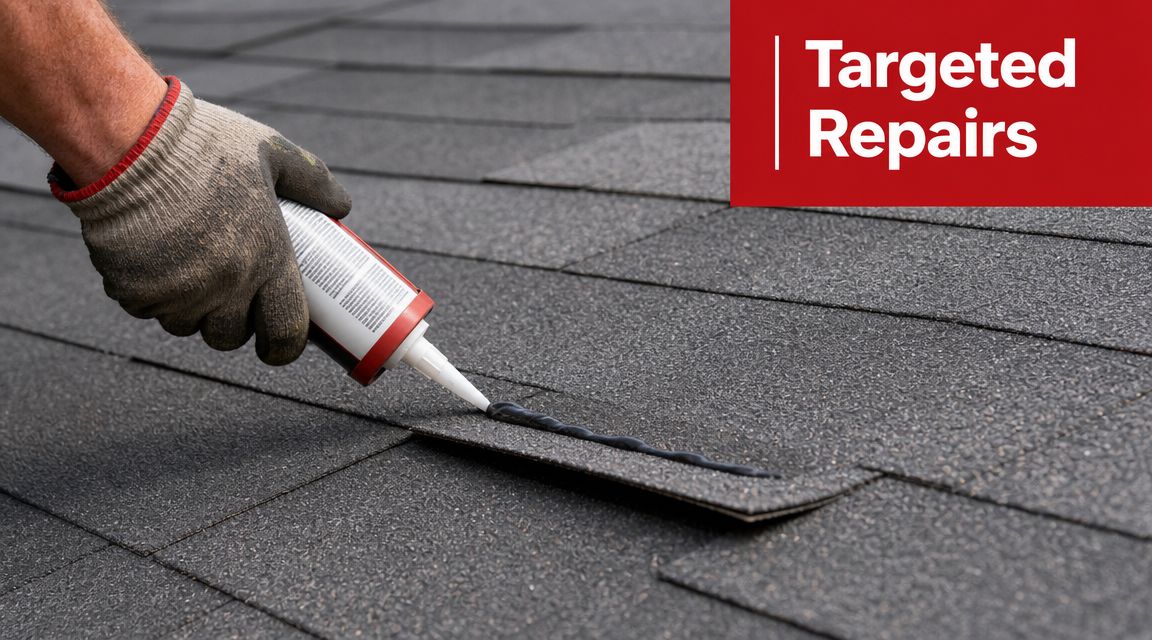
Good candidates for a localized seal
A few examples come up regularly on asphalt shingle roofs:
- One lifted tab after wind: The shingle still lies properly, hasn't creased, and the surrounding area is intact.
- Minor edge adhesion issues: A tab didn't fully reseal, but there's no sign of broad wind damage.
- Small detail maintenance: Sealant around a vent boot, flashing edge, or similar transition has dried and needs refreshing.
- Short-term leak control: You need to stop active water entry while scheduling a fuller repair.
These are repair situations, not rehabilitation projects. The roof still has to be sound for sealant to make sense.
The difference between repair and disguise
A proper repair solves a defined defect. A disguise covers uncertainty.
That's why the first question should always be, “What exactly failed?” If the answer is specific, sealing may help. If the answer is vague, such as “the roof took some hail and now we have a leak somewhere,” a tube of sealant usually isn't the right next step.
Here's a simple way to understand it:
| Situation | Sealant makes sense | Sealant is a bad bet |
|---|---|---|
| Single lifted tab | Yes, often | No, if creased or storm-damaged |
| Small flashing gap | Often | No, if flashing itself is loose or corroded |
| Widespread granule loss | Rarely | Usually |
| Recent hail damage across several slopes | No | Yes, if used as a substitute for inspection |
If you can point to one small defect and explain why the rest of the roof is sound, sealant may be a repair. If you can't, it's probably a patch.
This is also where product choice matters. Asphalt-based repair sealants are formulated to adhere to asphalt shingles for minor corrections, but they still don't replace proper fastening or the original factory seal strip. Used sparingly and in the right location, they can do their job well. Used broadly, they become a mess that the next roofer has to cut through.
Why Replacement is Often Better After Storm Damage
Hail changes the conversation. Once impact damage enters the picture, the question isn't “Can I make this shingle stick again?” It's “Is the shingle still sound enough to trust?”
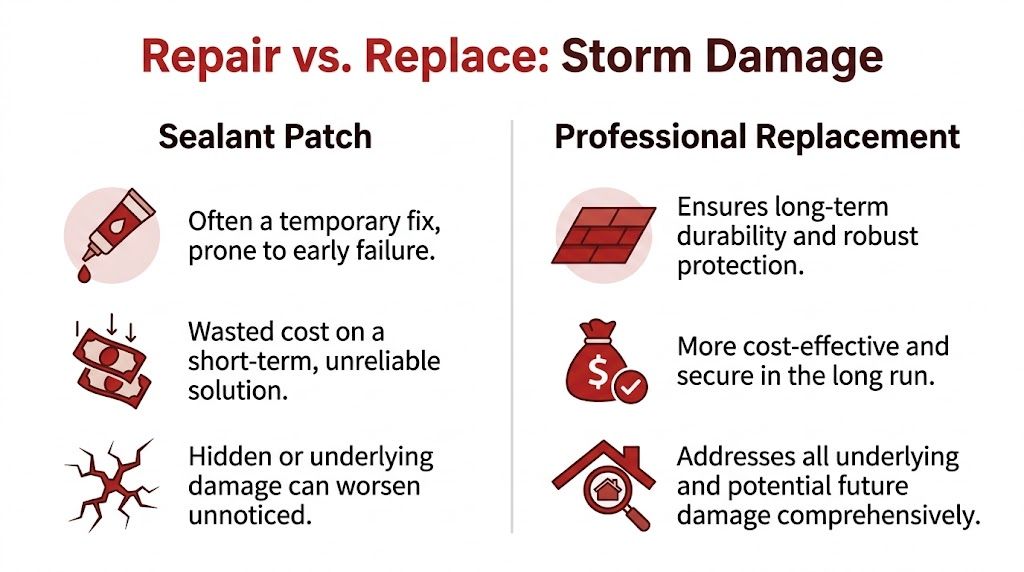
That's where a lot of homeowners lose money. They buy sealant to fix what looks like a surface issue, but hail often damages the shingle in a way sealant can't reverse. The mat may be compromised. Granules may be displaced. The shingle may keep shedding life even if the tab is glued back down.
Why hail damage doesn't behave like a simple leak
A leak from a tiny unsealed point is one kind of problem. A storm-hit roof is another.
In hail-prone markets like Dallas-Fort Worth, the primary issue is often impact damage, not just water entry. Product marketing tends to highlight water resistance, but it rarely answers the homeowner's practical question: will sealing improve post-hail performance or help with an insurance outcome? That gap matters because sealing storm-damaged shingles can be a poor substitute for necessary replacement, as noted in Bob Vila's roof sealant overview.
A hail-damaged roof can still look “mostly okay” from the lawn. Up close, it may be a different story. Bruising, fractured surfacing, and weakened shingles don't get restored by adding sealant on top.
Patch now, pay later
The short-term logic of sealant is easy to understand. It feels cheaper.
The long-term math is where it often fails:
- You may hide evidence of the original damage. That can complicate later inspections.
- You can trap moisture in the wrong place. A wet roof system doesn't improve because it got covered.
- You still haven't restored impact resistance. The roof remains compromised.
- Future repairs can get uglier. Once multiple areas have been smeared or coated, clean replacement work gets harder.
For homeowners weighing a patch against a replacement decision, a proper storm assessment is usually more valuable than another tube of product. If the roof has taken meaningful hail, it's worth understanding whether hail damage means roof replacement is the better path.
A quick video explanation can help frame that decision:
A Texas owner's decision test
Ask these questions before sealing anything after a storm:
- Is the problem isolated, or did the storm affect multiple areas?
- Is the shingle merely loose, or has hail changed the material itself?
- Will this repair still make sense if an adjuster or roofer inspects the roof later?
- Am I trying to stop a minor defect, or avoid hearing that the roof is at the end of the road?
If it's the second category, replacement is often the cleaner and cheaper decision over the life of the roof. Not because sealant never works, but because it can't undo impact damage.
Applying Roof Sealant Correctly and Safely
Some homeowners are still going to handle a small repair themselves. That's understandable. If you do, the big priorities are safety, preparation, and restraint.
Most bad sealant jobs fail before the product even cures. The surface was dirty. The shingles were wet. The person applied too much. Or they worked on a roof that was too hot, too steep, or too risky to be on in the first place.
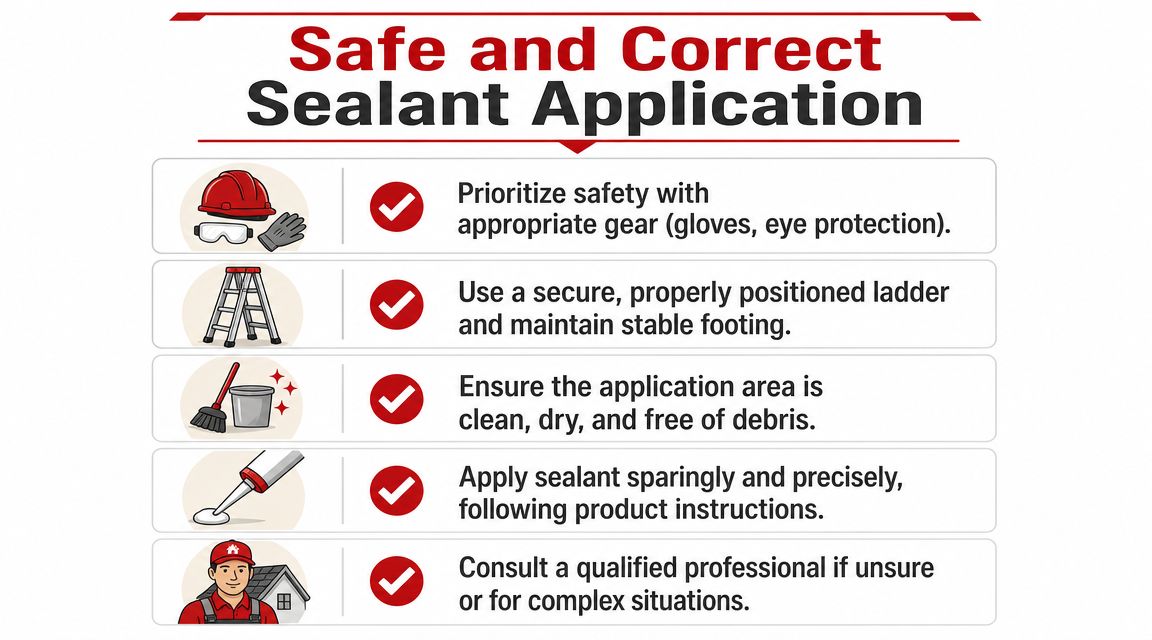
Start with roof safety, not product choice
Before you think about the tube or the caulk gun, think about whether you should be on the roof at all.
- Stable access matters: Use a secure ladder on firm ground.
- Footwear matters: Soft, non-slip shoes reduce sliding and scuffing.
- Pitch matters: A repair that seems simple from the ground can be dangerous on a steep slope.
- Heat matters: Texas roofs get unforgiving fast.
For workers who spend time around significant job hazards, a broader safety guide for oil and gas workers is useful reading because it reinforces the same core discipline: proper footwear, hand protection, eye protection, and respect for unstable surfaces.
Temperature and surface condition decide a lot
Asphalt shingle sealant performance is highly temperature-dependent. The seal strips need thermal activation to bond correctly, and while shingles can be sealed in cool or hot weather, conditions above about 80°F (26°C) can soften shingles enough that foot traffic scuffs and damages them, according to IIBEC guidance on asphalt roofing shingles.
That's not just technical trivia. On a Texas afternoon, you can damage perfectly serviceable shingles just by walking carelessly during a repair attempt.
Don't judge roof temperature by the air. A roof surface can punish sloppy timing.
A good application setup usually includes:
- A dry target area
- Clean contact surfaces
- Minimal product
- No rushing across hot shingles
- A clear stop point if the issue appears larger than expected
If you want a broader look at the coating side of the conversation, this guide on how to apply roof coating helps explain why surface prep and application conditions matter so much.
Less is often better
One of the most common mistakes is overapplication. Homeowners think more product means more protection. On shingle repair details, it often means squeeze-out, mess, trapped debris, and a repair that looks worse than the original problem.
Use sealant the way a roofer uses it for a small correction. Precisely. Sparingly. Only where the repair logic is sound.
If you find yourself wanting to coat a broad area because you're not sure where the leak is coming from, stop there. That's the point where diagnosis matters more than product.
How Sealants Affect Shingle Warranties and Codes
A tube of sealant can save a small repair. It can also muddy the record on a storm-damaged roof.
That distinction matters in Texas. If a roof took hail and a homeowner starts spreading coating or sealant across visible damage, the roof is no longer in the same condition it was in right after the storm. That can complicate the two questions that matter most later. Was the roof repairable, and what changed after the storm versus after the homeowner worked on it?
Why warranty problems start fast
Manufacturers warranty a tested roof assembly, not every field fix someone decides to add years later. Once the shingle surface gets altered with a non-approved treatment, the clean warranty argument gets weaker. The same goes for many insurance conversations. Adjusters and inspectors want to see storm effects clearly, not under a layer of aftermarket material.
Older shingles are where I see the worst calls. A sealant may bond for a while, but that does not mean the shingle below is still flexible, sound, or worth preserving. On an aged roof, added material can change how the surface sheds water, how future repairs bond, and how easy it is to document hail strikes or mat damage later.
One retail example is the Henry 812 RoofSaver shingle coating listing. The listing shows that these products are marketed for shingle use, but a store listing is not the same thing as blanket approval from every manufacturer, insurer, or local authority for every roof condition.
Code and claim issues homeowners miss
Code questions usually show up after the product is already on the roof.
Local requirements can involve fire rating, installation instructions, roof assembly compatibility, and whether the added material changes the tested performance of the system. On a storm claim, there is also a practical issue. A broad sealant or coating application can make it harder to separate old wear, hail damage, prior repairs, and homeowner-applied changes.
Here is the plain-language version:
| Issue | Why it matters |
|---|---|
| Manufacturer warranty disputes | Aftermarket treatment may be treated as an unapproved roof modification |
| Insurance claim friction | Post-storm changes can blur what damage was storm-related and what was altered later |
| Moisture and aging concerns | Some products can change drying behavior on an already tired shingle roof |
| Future repair and tear-off trouble | Patchy coatings and heavy sealant make later service messier and less predictable |
If you are weighing a patch against a claim or replacement, read this guide on what voids a roof warranty before you put anything on the shingles.
Safety matters too. Roof work after a storm often means hot surfaces, steep slopes, and unstable footing. For a broader PPE overview, this safety guide for oil and gas workers covers the kind of protective gear mindset that carries over to hazardous field work.
The short version is simple. Sealant is usually low-risk when it stays limited to a small, well-diagnosed repair. Once it starts covering damage patterns on an older or hail-hit roof, it stops being a cheap fix and starts looking like a shortcut that can cost you warranty clarity, claim clarity, and replacement timing.
When to Call Hail King for a Professional Assessment
A tube of sealant is cheap. A bad call after a Texas storm is not.
The primary question is not whether sealant can stop a small leak. It often can. The more important question is whether sealing this roof saves money or muddies up a roof that is already headed toward replacement, claim review, or both.
That decision gets harder after hail, high wind, or repeated repairs. From the yard, a lifted tab, a scuffed shingle, and hail bruising can all look close enough to tempt a quick patch. Up on the roof, they are not the same problem, and they do not lead to the same next step.
Signs you shouldn't rely on sealant alone
Call for an assessment if any of these apply:
- The roof leaked after hail or a major wind event
- You see damage across multiple slopes
- Shingles look bruised, fractured, or heavily worn
- Tabs are loose in more than one area
- The roof already has old patchwork or prior coating attempts
- You plan to file, reopen, or protect an insurance claim
In those situations, sealant can become a costly shortcut. It may slow one leak while covering up the bigger story of the roof. That matters in Texas, where one storm can turn a repair decision into a replacement decision fast.
Why a professional opinion changes the decision
A good inspection does two jobs. It identifies what is repairable, and it documents what existed before anyone starts smearing product over the shingles.
I have seen homeowners spend a little money trying to avoid a bigger bill, only to make the roof harder to evaluate later. Old mastic, scattered patching, and coated spots can blur the line between storm damage, wear, and prior repair work. If replacement is coming anyway, that extra step usually does not buy much.
If your roof has hail history, aging shingles, solar equipment, or signs of repeated leak paths, get it assessed before you seal anything. You need to know whether you are looking at a small detail repair, a storm-related repair, or a roof that makes more sense to replace now.
The cheapest move is not always the lowest-cost move.
If you're in Dallas-Fort Worth or East Texas and you're trying to decide whether asphalt shingle roof sealant is a smart repair or a risky shortcut, Hail King Professionals can help you make that call before you spend money the wrong way. Their licensed and insured team offers free, same-day roof inspections, clear repair-versus-replacement guidance, insurance claim support for storm damage, Class 4 impact-resistant upgrade options, and reroof planning for homes with solar that need detach-and-reset coordination. If your roof took hail and you're not sure whether to patch, repair, or replace, start with an inspection and get a straight answer.