
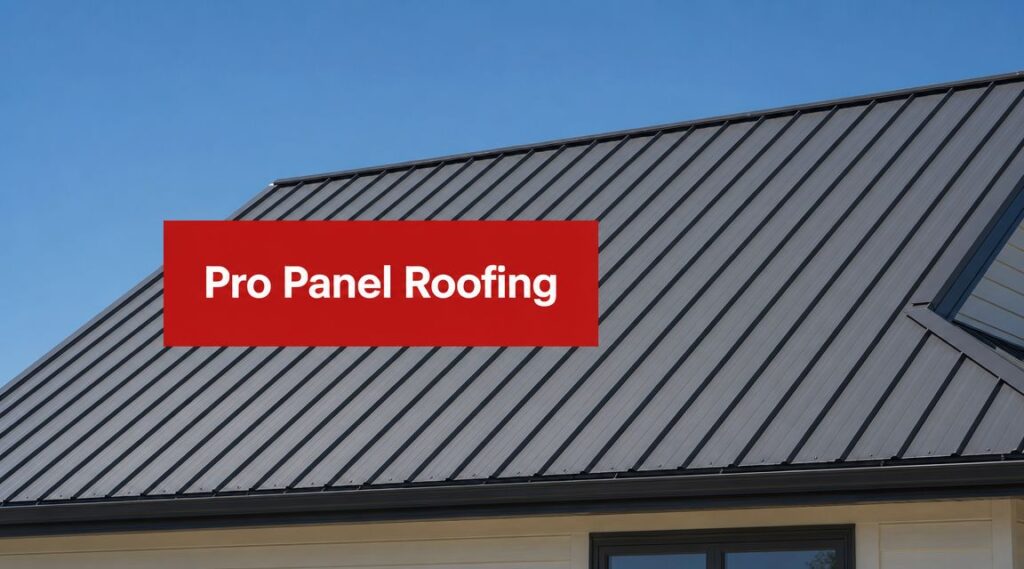
Pro Panel Roofing Texas: Costs, Installation, & Benefits
A lot of North Texas homeowners start looking at Pro Panel roofing the same way. A storm rolls through. Hail hits hard for a few minutes. Then you're outside looking at dents in gutters, shredded screens, granules in the driveway, and a roof you suddenly need to make a decision about.
That's usually when metal enters the conversation.
A neighbor says metal lasts. Another says it's louder. Somebody else says hail can't hurt it. Then a contractor throws around terms like R-panel, PBR, exposed fastener, standing seam, Class 4, and low slope. By that point, individuals aren't comparing roofs. They're trying to decode the language.
Pro Panel roofing is a real option in Dallas-Fort Worth and East Texas, especially if you want a durable metal roof without paying standing seam prices. But it's also one of the most misunderstood systems I see. The panel itself can be solid. The trouble usually comes from where it's used, how it's lapped, and how carefully it's installed.
That matters here more than in a mild climate. DFW gets hail, strong wind, heat, and hard rain that blows sideways. A roof system that works fine on the wrong slope or with sloppy seam details can start showing its weaknesses fast.
Considering a New Roof in North Texas
If you're reading this after a storm, you're probably trying to answer three questions at once. Is the roof damaged enough to replace? What material makes sense in Texas weather? And who's telling me the truth versus just selling what they install most often?
That's a fair place to be.
In North Texas, Pro Panel roofing comes up often because it sits in a middle ground. It's metal, so people associate it with toughness. It's an exposed-fastener system, so it's usually more approachable than premium concealed-fastener metal options. And it's common enough that homeowners see it on shops, barns, porch covers, and more residential applications than they may realize.
What people usually want to know first
Most homeowners aren't asking for “an exposed-fastener structural panel.” They're asking simpler questions:
- Will it hold up to hail
- Will it leak
- Can it go on my roof pitch
- Will it look good on a house
- What kind of maintenance am I signing up for
Those are the right questions.
A metal roof isn't automatically the right roof. In Texas, slope and detail work matter just as much as the material.
I've seen people get drawn in by the phrase “metal roof” as if that settles it. It doesn't. One metal system may be a smart fit for a steep residential roof. Another may be better left to barns, shops, or buildings with the right geometry and drainage setup.
Why Pro Panel gets attention in DFW
North Texas homeowners usually land on Pro Panel roofing for practical reasons, not because they're chasing a trend.
- Storm mindset: After hail, many people want to move away from standard shingles and into something they believe will take a beating better.
- Budget reality: Standing seam looks great, but it isn't every homeowner's budget choice.
- Straightforward profile: Some owners like the clean, workmanlike look of ribbed metal instead of trying to mimic shingles.
That said, this isn't a system you choose on marketing language alone. The panel profile, the roof pitch, the fastener pattern, the lap sealing, and the flashing details all decide whether Pro Panel roofing performs well or becomes a callback roof.
What Exactly Is Pro Panel Roofing
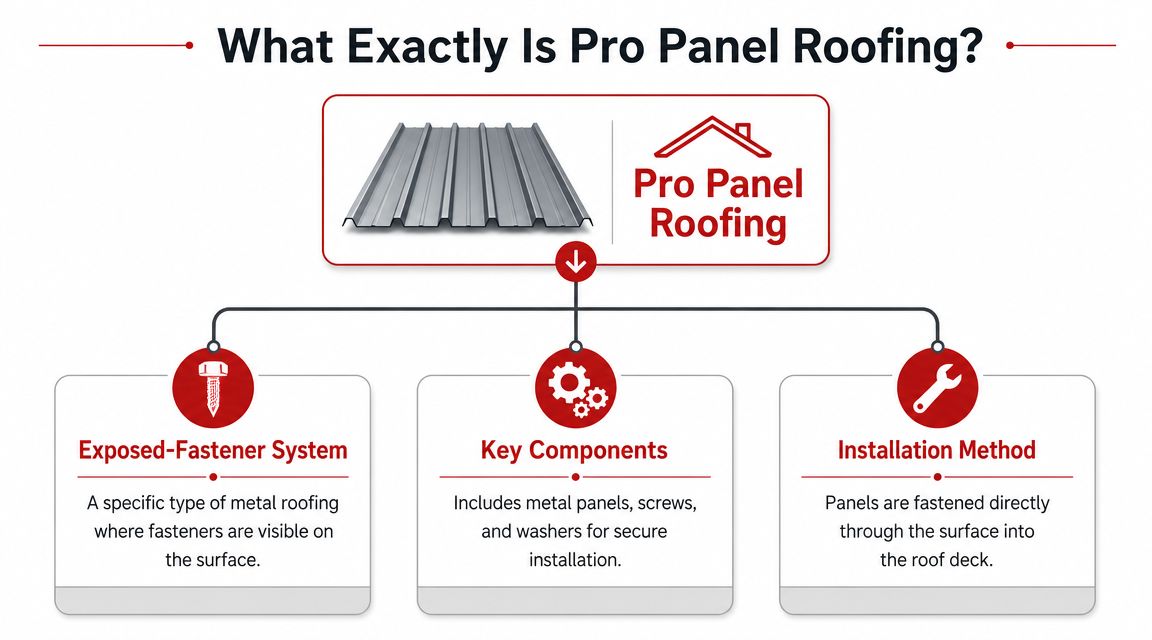
Pro Panel roofing is an exposed-fastener metal roofing system. That means the screws are visible on the face of the panels instead of being hidden inside raised seams like they are on standing seam metal.
To illustrate, standing seam is like a jacket with the zipper tucked away. Pro Panel is more like heavy-duty workwear with the buttons showing on the outside. Both can do the job. They just do it differently, and one leaves the attachment points exposed to weather.
A common example is Pro-Panel II, which is engineered with 36-inch coverage, 5/8-inch trapezoidal ribs on 9-inch centers, and carries UL 2218 Class 4 impact resistance plus UL 790 Class A fire resistance according to the Metal Sales product data sheet.
How the system is built
With Pro Panel roofing, each metal sheet overlaps the next one. Installers fasten the panels directly through the surface into the roof structure or deck. The profile uses ribs to add stiffness, and those ribs also help move water down the roof.
The shape matters more than most homeowners realize. Those trapezoidal ribs aren't just cosmetic. They help the panel resist flex and spread load better than a flatter sheet.
What makes it different from other metal roofs
The biggest difference is the attachment method.
- Exposed screws: Every screw location is part of the weathering surface.
- Panel overlaps: The side laps and end laps have to be sealed and fastened correctly.
- Maintenance reality: Because the system depends on visible fasteners and sealed laps, long-term performance depends heavily on those details staying tight and intact.
That's why I tell homeowners not to compare “metal roof” versus “metal roof” as if all systems behave the same. They don't.
What the ratings do and don't mean
The Class 4 impact rating on a product like Pro-Panel II is important in hail country. It means the panel has a tested level of impact resistance that matters for code and product performance. The Class A fire rating also matters where fire resistance is part of the conversation.
Practical rule: A hail rating means resistance to functional damage under a test standard. It does not promise the roof will look untouched after a Texas hailstorm.
That's where homeowners often get misled. “Hail-resistant” is not the same thing as “dent-proof.” A Pro Panel roof may keep doing its job after a storm and still show cosmetic marks. For some homeowners, that's acceptable. For others, especially on a front-facing home with strong curb appeal goals, it's a serious consideration.
Weighing the Pros and Cons for Your Home
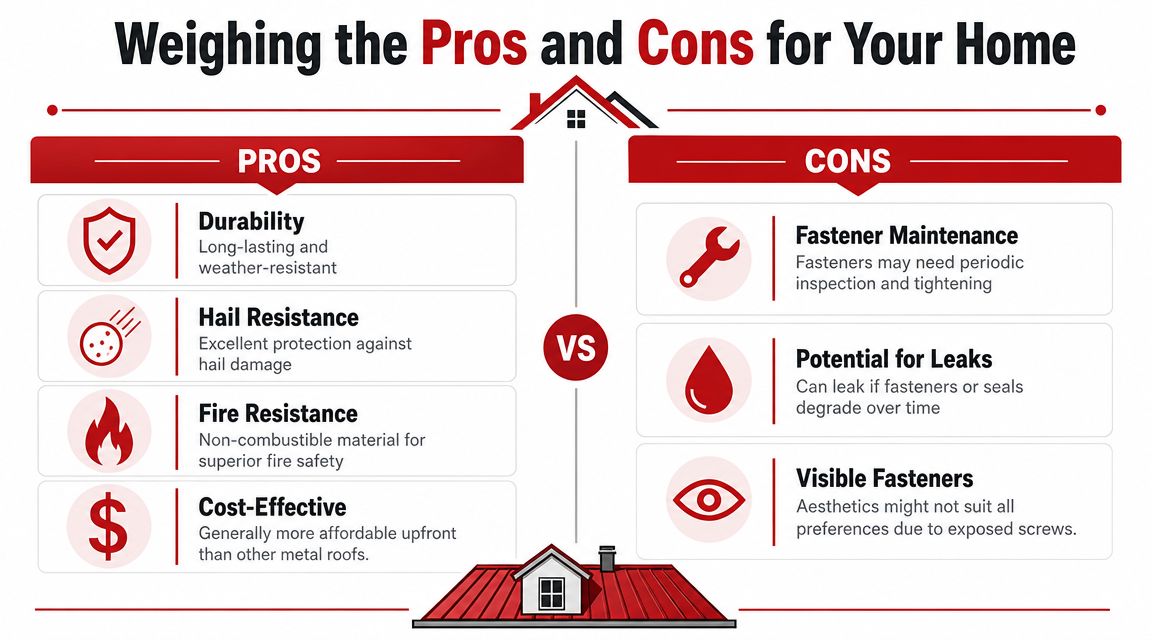
Pro Panel roofing earns its place in Texas because it solves a real problem. It gives homeowners a metal roof option that's typically more affordable and less complex than standing seam. If the roof has the right pitch and the installer respects the details, it can be a very practical system.
But it's not forgiving.
Where Pro Panel makes sense
For the right house, garage, shop, or secondary structure, the advantages are easy to understand.
- Storm-minded durability: Many homeowners like that they're stepping into a metal system with a tested impact-rated option rather than returning to standard shingles.
- Fire resistance: Non-combustible metal systems appeal to owners who want stronger fire-related performance.
- Lower entry point than premium metal: If standing seam feels out of reach, Pro Panel often becomes the metal roof people can install.
- Straightforward look: Some homes wear exposed-fastener roofing well, especially rural, ranch, farmhouse, and utility-driven designs.
Where homeowners get burned
The long-term performance issue in exposed-fastener systems usually isn't the field of the panel. It's the fasteners and lap details. Installation guidance for these systems stresses butyl tape at seams and stitch screws at overlaps to resist wind uplift and thermal movement, as shown in this installation guidance reference.
That's a fancy way of saying this. The weak spots are usually where one panel meets another or where a screw penetrates the metal.
Here's the practical downside list:
- Fastener maintenance: Exposed screws live in the weather. They need periodic visual checks.
- Leak risk from bad detail work: A cheap install can look fine on day one and fail later at laps, penetrations, or flashing transitions.
- Visible hardware: Some homeowners do not want to see rows of screws across the roof plane.
- Less forgiveness in storm country: Wind-driven rain finds mistakes.
If you're comparing systems for wind exposure, it also helps to understand how roof designs handle gusts and pressure changes. This guide on wind-resistant roof options in Texas is useful context.
The real trade-off
Pro Panel roofing is often a sensible choice for homeowners who care more about function, durability, and value than having the most refined architectural metal roof.
If you want a roof you can mostly forget about, exposed-fastener metal may not be your first choice. If you want a practical metal system and you're willing to respect its maintenance needs, it can serve you well.
That's the honest middle ground. It's neither a miracle roof nor a bad roof. It's a system with strengths, limits, and a much smaller margin for installation mistakes than most sales pitches admit.
Pro Panel Compared to Other Roofing Materials
A lot of confusion comes from lumping every metal roof into one category. That's a mistake. Pro Panel roofing, standing seam, and Class 4 asphalt shingles can all be smart choices in Texas, but they solve the problem in different ways.
Side-by-side practical comparison
| Feature | Pro Panel | Class 4 Shingles | Standing Seam |
|---|---|---|---|
| Upfront cost | Usually lower than standing seam | Often familiar to homeowners and widely chosen | Usually higher than exposed-fastener metal |
| Fasteners | Exposed on panel face | Hidden beneath shingle system | Concealed within seam system |
| Hail outlook | Strong functional resistance with impact-rated options, but cosmetic denting can still matter | Familiar residential choice for hail-prone areas | Strong metal option with concealed fasteners |
| Maintenance style | Periodic attention to screws, laps, and seal points | Conventional roof inspections and storm checks | Generally favored when owners want fewer exposed weather-entry points |
| Look | Ribbed, utilitarian, clean but more industrial | Traditional residential appearance | More architectural and high-end |
| Best fit | Homes, shops, barns, and buildings where function and value lead | Homeowners wanting a shingle look | Homeowners prioritizing long-term watertight detailing and appearance |
Pro Panel versus standing seam
This is the most important metal-to-metal comparison.
Standing seam hides the fasteners. That changes a lot. It reduces direct weather exposure at screw penetrations and gives the roof a cleaner architectural look. If a homeowner wants the premium metal option for a primary residence, standing seam usually wins on aesthetics and long-term watertight design.
Pro Panel wins when budget matters more and the roof design suits the system. On the right structure, it's a practical answer. On the wrong roof, it can become an expensive compromise.
Pro Panel versus Class 4 shingles
This one is less obvious.
Class 4 shingles still make sense for many Texas homes because they keep a traditional appearance and avoid the visible screw pattern that turns some homeowners away from exposed-fastener metal. They're also familiar to insurance adjusters, real estate buyers, and neighborhood associations.
Pro Panel roofing becomes attractive when a homeowner wants metal's look and straightforward performance without moving into standing seam pricing. If appearance is secondary to rugged utility, it's easier to justify.
Don't confuse Pro Panel with R-Panel or PBR
Similar exposed-fastener systems like PBR or R-Panel also use 36-inch coverage, but they have a taller 1-1/4-inch rib, are commonly available in 26-gauge steel with optional heavier gauges, and can be used on slopes as low as 1/2:12 in some manufacturer-approved applications if the required side-lap sealing is followed, according to McElroy Metal's R-Panel specifications.
That matters because homeowners hear “metal panel” and assume all ribbed panels can go on any roof pitch. They can't. Panel profile changes the rules.
If you're also looking at integrated energy options during a reroof, it's worth understanding how roof materials interact with newer systems such as solar power tiles. They're a very different category from exposed-fastener panels, but seeing that contrast helps homeowners think more clearly about function versus appearance versus complexity.
Installation Maintenance and Storm Performance
A Pro Panel roof can perform well in Texas. It can also fail early for reasons that had nothing to do with the steel itself. Most of the time, the deciding factor is installation discipline.
Slope is not negotiable
A lot of bad decisions start here.
For Pro-Panel II, the manufacturer installation guide states a minimum roof slope of 3:12, and using it below that increases the risk of water intrusion at seams and fastener points, according to the manufacturer installation guide.
That number matters because exposed-fastener panels rely on shedding water quickly. They are not designed to behave like a fully seamed low-slope commercial roof. If water slows down, backs up, or gets pushed by wind at the laps, the roof starts depending too much on sealants and screw washers.
A bad panel on the right slope can still outperform a good panel forced onto the wrong slope.
That's not a sales line. That's jobsite reality.
The lap details that decide whether it leaks
North Texas doesn't just get rain. It gets hard, slanted rain driven by wind. That's why lap orientation and seam treatment matter so much on exposed-fastener roofs.
Three things matter more than homeowners usually hear about:
- Lap direction: The side laps should work with prevailing weather exposure, not against it.
- Seam sealing: Butyl tape belongs where the system requires it. Skipping it to save time is asking for trouble.
- Overlap fastening: Stitch screws at overlaps help keep the lap tight under movement and wind pressure.
If you want a broader overview of what proper metal detailing should include, this metal roofing installation guide is a useful reference.
What hail ratings mean in real life
A Class 4 impact rating is valuable. It tells you the system has passed a recognized impact-resistance test. In hail country, that matters.
But homeowners need the plain-English version. A roof can remain functional and still show cosmetic denting. The rating doesn't promise a storm leaves no visible trace. It means the roof has a tested level of resistance against impact-related failure.
That distinction matters most with metal because owners often expect a perfect-looking roof after hail. Sometimes that happens. Sometimes it doesn't.
What maintenance actually looks like
Pro Panel roofing isn't high-maintenance, but it is not no-maintenance.
A simple ownership routine helps:
- Look over the roof visually after major storms. You're checking for displaced trim, obvious panel damage, and anything that looks loose.
- Watch the fastener lines. If screws look uneven, lifted, or backed out, have them inspected.
- Check transitions and penetrations. Valleys, pipes, skylights, walls, and flashing edges are where detail errors show up.
- Don't ignore small stains indoors. A small ceiling mark often points to a detail issue that's easier to fix early.
If the install is sharp and the roof is on the proper pitch, those checks are usually straightforward. If the install was rushed, maintenance turns into detective work.
Understanding Costs Financing and Insurance
The first cost question homeowners ask is simple. Is Pro Panel roofing cheaper than other metal roofs? Usually, yes compared with standing seam. But the installed price still depends on tear-off, roof complexity, trim, penetrations, access, and how much custom flashing the house needs.
That's why online price talk gets sloppy fast. A simple gable roof and a cut-up two-story roof are not the same job, even if both use the same panel profile.
What actually affects the budget
For exposed-fastener metal, the budget usually moves based on practical jobsite variables:
- Roof shape: Dormers, valleys, dead areas, and tie-ins all add labor and trim work.
- Substrate condition: If decking or framing needs correction, that changes the job.
- Panel and trim choices: Basic panel runs are one thing. Complex trim packages are another.
- Storm scope: Insurance-funded replacements often involve gutters, screens, paint touchups, or related exterior work.
If you're comparing material decisions broadly, this breakdown of asphalt versus metal roof cost helps frame the trade-offs without pretending every roof has the same price tag.
Financing and claim timing
Some homeowners pay for a metal upgrade out of pocket. Others use financing to spread out the cost, especially when insurance covers part of the project but not the entire material jump from shingles to metal.
Hail King Professionals offers financing with soft credit checks and no home-equity requirement, which can be relevant for homeowners who want flexibility without tying the project to equity lending. For investors looking at larger property rehab planning, it can also help to understand adjacent lending categories such as rehab financing for investors, especially when roofing is part of a broader renovation scope.
Insurance advice that saves headaches
After a storm, the paperwork side matters almost as much as the roof.
- Document what you can see: Photos of dented metal components, broken windows screens, damaged gutters, and interior stains help.
- Read the adjuster summary carefully: Make sure the roof type, accessories, and scope match what's on the house.
- Talk through code and system requirements: Metal replacements may involve details the adjuster doesn't fully spell out in plain language.
Don't assume “metal roof approved” means every metal system is approved on your roof. The material choice still has to match slope, design, and installation requirements.
Choosing the Right DFW Roofing Contractor
The contractor matters more than the panel brand for most homeowners. That's especially true with Pro Panel roofing, where detail work decides whether the system stays dry and stable through Texas weather.
What I'd want to hear from a roofer
If I were hiring someone for an exposed-fastener metal roof in DFW, I'd want direct answers to these questions:
- What slope do you require for this exact panel profile
- How do you handle side laps, end laps, and butyl tape placement
- Where do you place stitch screws at overlaps
- How do you flash walls, pipes, valleys, and roof-to-roof transitions
- What's your process after a hail claim if the house also has gutters, fencing, paint, or solar involved
If the answers stay vague, keep looking.
Local experience matters more in storm country
A roofer who mostly installs shingles but “can also do metal” isn't the same as a contractor who regularly handles exposed-fastener systems in hail and wind country. The details are different, and North Texas weather will test them.
There's also a business side homeowners should verify. Insurance coverage is one piece of that. If you want to understand what proper contractor protection looks like, this guide on roofing liability coverage is a useful reference when vetting companies.
Ask to see actual metal projects, not just sample photos from a supplier brochure.
One modern issue homeowners forget
If your home has rooftop solar, the reroof conversation gets more complicated. The contractor needs a clear detach-and-reset process so the roofing work and solar work don't collide, delay each other, or leave finger-pointing after the fact.
That's one place where choosing a contractor with storm-claim experience and exterior coordination matters. A company handling roofing, related exterior items, and solar detach-and-reset under one process can reduce confusion, provided they're clear about scope and documentation.
In DFW, the right contractor for Pro Panel roofing isn't the one with the loudest sales pitch. It's the one who respects slope limits, knows exposed-fastener details cold, documents the job properly, and tells you when this system fits your house and when it doesn't.
If you want a practical opinion on whether Pro Panel roofing fits your home, Hail King Professionals can inspect the roof, review the slope and storm damage, and walk through repair or replacement options in plain language.