
A lot of Texas homeowners start with the same thought. A tile roof looks right on the house, especially on Spanish, Mediterranean, and custom homes, and it carries a reputation for durability that asphalt shingles don't. Then the first serious hailstorm rolls through Plano, a summer stretch bakes the roof in Austin, or a leak shows up after a wind-driven rain, and the primary question becomes less about appearance and more about performance.
That's where most advice online falls short. It talks about tile as if the tile alone is the roof. In Texas, that's not how these systems succeed or fail. Tile roofs can perform very well here, but only when the assembly is designed and installed for local weather, and only when inspections focus on what's happening underneath the visible surface.
Are Tile Roofs a Smart Choice for Texas Homes
A well-built tile roof fits Texas better than many people realize. It handles sun exposure well, complements a wide range of regional architecture, and can give a home in Dallas, Tyler, or San Antonio a finished look that doesn't feel generic. On the right structure, tile also brings long-term value because it isn't a flimsy roof system.
The catch is simple. A tile roof is never a plug-and-play material choice. It asks more from the installer, more from the roof framing, and more from the inspection process after storms.
Where tile makes sense
Tile is usually a smart choice when the owner wants three things at the same time:
- Stronger curb appeal that matches the style of the home
- A durable exterior surface that holds up better than lighter materials in intense sun
- A roof system built for the long haul, not just the next insurance cycle
That doesn't mean tile is automatically the right answer for every property. Some roofs are too complex, some homes need structural review first, and some owners would be better served by another roofing system if budget or maintenance access is the deciding factor.
Practical rule: If you're comparing tile roofs in Texas, don't ask only whether tile is durable. Ask whether the house, the roof design, and the installation plan are right for tile.
What Texas weather changes
Texas puts stress on roofs in a different way than milder climates do. Hail can break exposed components. Wind can exploit weak fastening. Heat can wear down materials that never show visible damage from the street. A tile roof can still be the right move, but the answer depends on how the entire system is built.
That's especially important because established Texas tile contractors have long treated tile as a specialty trade, not a standard reroof. For example, Tile Roofs of Texas has served the Houston area since 1994 and has maintained an operating history of over 30 years, with service work that includes inspections, repairs, and gutter cleaning across clay tile, slate, sheet metal, flat roofs, patio decks, and gutters, according to their Houston business listing. That kind of longevity reflects something practical. Tile roofs reward specialization.
The real decision
If you want the short version, yes, tile roofs are a smart choice for many Texas homes. But they're only smart when the roof is treated like a system, not a decorative shell.
That's the difference between a roof that still performs after years of heat and storms, and a roof that looks solid from the driveway while problems develop underneath.
Understanding Tile Roofing Materials Clay vs Concrete
Clay and concrete get grouped together all the time. On real jobs, they're not the same discussion. They can look similar from the street, but they differ in appearance, manufacturing, weight profile, and how owners usually evaluate them.
Clay tile in practical terms
Clay tile is the traditional option. Homeowners usually choose it for its classic look, baked-in color, and the way it fits Spanish and high-end custom architecture. It tends to appeal to owners who care as much about long-term appearance as they do about roofing performance.
Clay also carries a narrower visual identity. That's a strength if you want authenticity. It can be a limitation if you want broader profile options.
Concrete tile in practical terms
Concrete tile gives builders and homeowners more flexibility in profile and style. It can mimic different roof looks while still delivering the heft and presence people want from tile roofing.
One reason concrete remains a serious option in Texas is that state architectural specifications reference ASTM C1492 for concrete roof tile, tying compliance to standardized material performance rather than appearance alone, as noted in the Texas architectural specification for concrete roof tile. That matters in the field because a tile that looks good on a sample board still has to perform as a manufactured product.
For homeowners comparing profiles, Spanish-style roof tiles are often where clay and concrete comparisons become most relevant.
Clay vs Concrete Tile Comparison
| Attribute | Clay Tile | Concrete Tile |
|---|---|---|
| Material character | Natural fired material with traditional aesthetic | Manufactured material with wider profile flexibility |
| Visual style | Best for classic Spanish and Mediterranean looks | Broader range of shapes and appearances |
| Color behavior | Known for baked-in color appeal | Appearance depends more on manufacturing and finish |
| Specification focus | Selected heavily for architectural character | In Texas specifications, references ASTM C1492 |
| Budget positioning | Often chosen for premium aesthetic goals | Often considered when owners want tile looks with more design flexibility |
| Main trade-off | Narrower style lane and project sensitivity | Performance still depends on assembly details, not tile appearance alone |
A homeowner should choose between clay and concrete based on roof design, structural considerations, appearance goals, and installer skill. Choosing only by showroom appearance is where bad decisions start.
What doesn't change between them
Whether the tile is clay or concrete, the same field truth applies. The visible tile is only one layer in a larger roof assembly. Good material selection helps, but the underlayment, flashing, edge treatment, and fastening package decide whether the roof performs well in Texas weather.
That's why material choice matters, but installation quality matters more.
How Tile Roofs Perform in Extreme Texas Weather
Texas doesn't test roofs gently. A tile roof in Fort Worth or Arlington might see hail, high winds, driving rain, and long periods of intense heat in the same year. That's why tile performance has to be judged threat by threat.
Early in the buying process, many owners focus only on whether a tile can crack. That's too narrow. Weather performance comes from the roof assembly, not just the tile profile.
Hail resistance
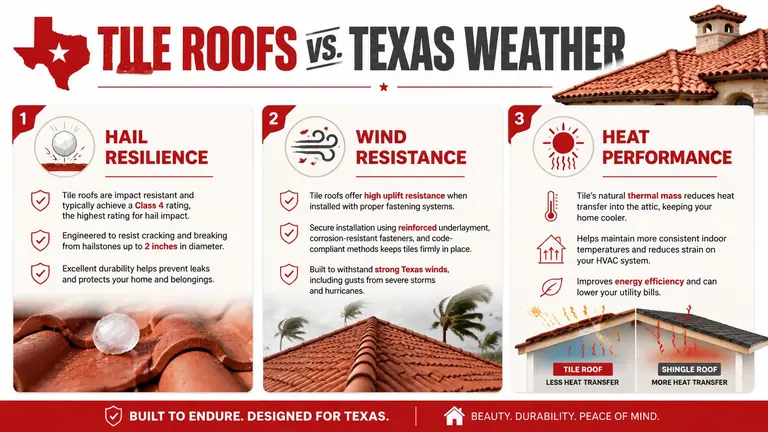
Hail is the first concern most Texas homeowners raise, and for good reason. Tile can perform well against hail, but impact resistance depends on the selected product and the overall roof build. The Pacific Northwest National Laboratory guidance notes that impact-resistant tiles can reduce hail damage risk, and that tile roof systems in high-wind and hail-prone areas should be specified as a complete assembly, including underlayment, deck attachment, and tile fastening that match the site's wind speed and exposure category, in the Building America guidance on clay or concrete tile roofs.
That's the practical takeaway. A tougher tile helps, but it doesn't rescue a poorly designed system.
Wind performance
Wind failures usually trace back to attachment and detailing. Tiles need correct fastening, and the deck below them has to be prepared to resist uplift and water intrusion when storms push rain sideways.
Contractors also need to pay attention to high-risk transitions:
- Valleys where concentrated water flow exposes weak layout
- Eaves and edges where wind starts lifting components
- Hips and ridges where shortcuts often show up first
- Flashing zones around penetrations and walls
If you live in a storm-exposed area, it also helps to review broader emergency prep steps outside the roof itself. Homeowners can use this checklist to prepare your home for hurricanes, especially for securing outdoor items, backup lighting, and overall storm readiness before major weather moves in.
Heat performance
Tile's strongest advantage in Texas may be heat. These roofs have a long history in hot climates because the shape and installation method help manage how heat moves into the structure. In plain terms, the roof system doesn't behave like a thin, direct-contact surface.
That doesn't mean a tile roof solves every summer comfort problem. Attic ventilation, insulation, roof color, and house design still matter. But in prolonged Texas heat, tile remains one of the more sensible roofing categories for owners who want durability paired with strong thermal behavior.
A short overview helps illustrate how these systems are built and repaired in the field:
Wind and hail don't only test the outer surface. They test whether the roofer treated the roof as a coordinated system from deck to flashing to final tile placement.
The Hidden Weakness The Truth About Underlayment Failure
Most owners assume a tile roof leak starts with a broken tile. Sometimes it does. More often in Texas, that visible damage is only the messenger.
The hidden problem is usually underlayment failure.
Why the leak often starts below the tile
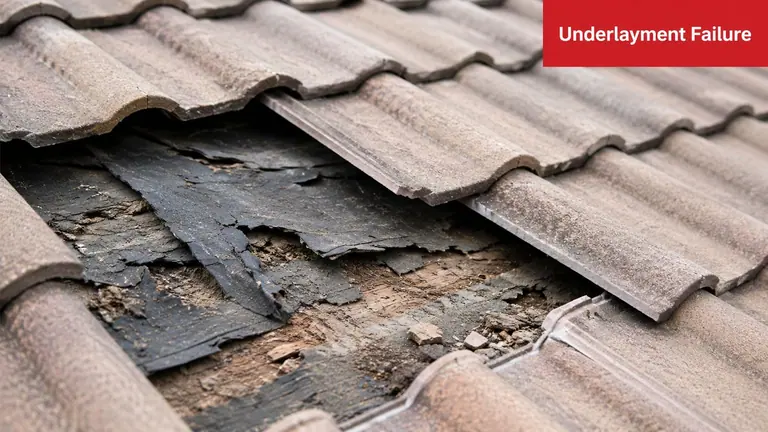
Tile sheds water. It is not the final waterproofing layer. On many Texas roofs, heat exposure ages the underlayment long before the tile itself reaches the end of its useful service life. Then a storm exposes the weakness. A cracked tile, shifted tile, or wind-driven rain gives water access to a layer that was already compromised.
Field analysis from tile roof repair walkthroughs has shown that many Texas tile roof failures are underlayment problems, not tile problems, with leaks often involving deteriorated underlayment and wood beneath intact or only lightly damaged tiles, as discussed in this tile roof failure analysis video.
What crews miss when they do a cosmetic repair
A quick tile swap can stop an obvious entry point, but it won't solve a brittle or torn water barrier underneath. That's why a proper tile roof inspection often involves lifting and checking targeted areas rather than relying on a curbside look.
Common hidden trouble spots include:
- Valleys where water volume stays high during storms
- Pipe penetrations where flashing and seal transitions age differently
- Eaves where runoff patterns expose installation shortcuts
- Hip and ridge details where movement and fastening issues show up
- Deck sections where moisture has already affected the wood below
If you want a plain-language explanation of the layer doing the waterproofing work, this guide on what roof underlayment is is useful background before you evaluate repair options.
Field reality: A tile roof can look solid from the driveway and still be failing underneath.
When replacement goes deeper than expected
Homeowner frustration arises when they budget for a small repair and hear they may need underlayment work, flashing correction, or deck repair in the same area. That isn't upselling when the roof has genuine hidden deterioration. It's the difference between fixing the cause and patching the symptom.
In Texas, that distinction matters more on tile than on many other roofing systems. The visible surface often survives long enough to hide the condition below.
Costs Lifespan and Reroofing a Texas Tile Roof
Tile roofing isn't usually a bargain purchase, and it shouldn't be treated like one. Value comes from system longevity, appearance, and the ability to reuse or reset serviceable tile during a reroof. The mistake is assuming every part of the assembly lasts the same length of time.
The lifespan question owners need to ask correctly
When people ask how long a tile roof lasts, they usually mean the tile. That's only part of the answer.
The tiles and the waterproofing layer do not age on the same schedule. In many Texas reroof projects, the tile remains usable while the underlayment, flashing details, and selected deck areas need replacement. That means the project may involve removing tile, staging it carefully, repairing the roof system beneath it, and reinstalling or replacing tile as needed.
This is one reason tile roofs can become labor-intensive on repairs and reroofs. They're not simple tear-off-and-go jobs.
What affects project cost
Without inventing price ranges, the honest answer is that cost varies widely based on job conditions. A tile roof in Frisco with straightforward geometry is one conversation. A steep custom roof in Austin with multiple valleys, penetrations, and access constraints is another.
The biggest variables are usually:
- Roof complexity including cuts, ridges, valleys, and transitions
- Material choice between clay and concrete profiles
- Tile condition if the project involves salvage and reset
- Structural review needs when weight or retrofit issues are in play
- Extent of hidden repairs once underlayment and deck are exposed
- Accessory work such as gutters, flashing replacement, or ventilation upgrades
Reroofing with solar on the home
Solar changes the scope. Panels can't stay in place while the waterproofing layers beneath them are rebuilt correctly. On a tile reroof, crews often need a coordinated detach-and-reset process so roofing work can happen without turning the solar array into an afterthought.
That means the roofing contractor and solar team need clear sequencing. If they don't coordinate, the homeowner gets delays, finger-pointing, and unnecessary risk around penetrations and reinstallation.
For owners comparing options, the contractor's capability matters more than material brochures. A company that handles the roof as a full project, including access planning and related exterior components, will usually prevent the avoidable problems.
Long-term value, not just first cost
Tile often makes sense for owners who plan to stay in the property, want a distinctive roofline, and are willing to pay for careful workmanship. It makes less sense when the goal is the cheapest near-term replacement.
That's not a knock on tile. It's just the wrong buying lens. A Texas tile roof should be evaluated like a long-term building component, not a commodity roof covering.
Maintenance Inspection and Insurance Considerations
Tile roofs don't need constant fussing, but they do need disciplined maintenance. The owners who avoid expensive surprises are usually the ones who catch small issues before water reaches the deck or interior.
A simple roof inspection routine matters even more after hail, severe thunderstorms, and high-wind events.
A practical maintenance checklist
What homeowners can do
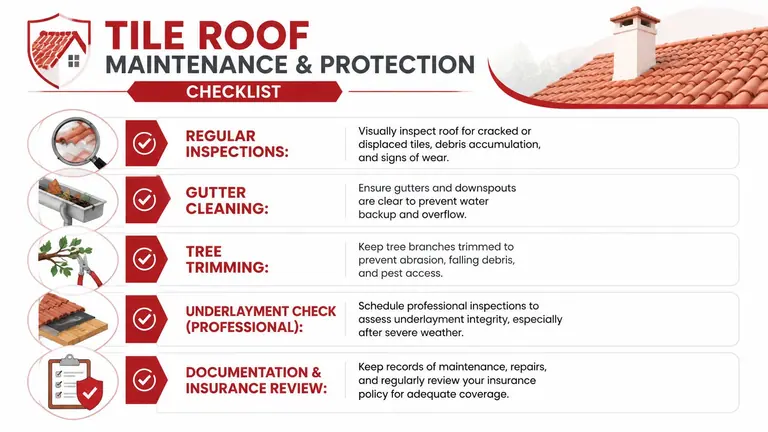
- Look from the ground after storms. Check for displaced tiles, visible debris buildup, or anything that looks newly out of line.
- Keep gutters flowing. Overflow at the edge can push water where it doesn't belong and can mask drainage problems.
- Trim back overhanging limbs. Branch contact and falling debris are common causes of localized tile breakage.
- Limit roof traffic. Many broken tiles come from service work, not weather. Anyone walking tile needs to know where to step.
- Document visible changes. Photos taken after storms help if you later need repair records or insurance support.
What requires a professional inspection
Some of the biggest tile roof problems are concealed. An experienced inspection should focus on more than the field tile. It should include targeted checks of flashing, valleys, penetrations, edge conditions, and signs that the underlying water barrier may have deteriorated.
If you're in Dallas, Garland, Longview, or Georgetown and your property has seen hail or hard wind recently, that inspection is worth doing before interior stains appear.
Don't wait for a ceiling stain to confirm roof damage. By then, the repair scope is often larger than it needed to be.
Insurance and claims
Insurance questions usually come up after a storm, and tile adds complexity because not every issue is obvious from the ground. If impact damage, displaced tiles, or related water intrusion is present, documentation becomes critical. Good photos, prompt inspection notes, and a clear scope of damage help keep the discussion focused on actual roof conditions.
For system upgrades, some homeowners also ask about impact-resistant products. The practical point is this: if your roof is being rebuilt or replaced, product selection can affect how the roof performs in future hail events and how the claim discussion looks after the next storm.
In this stage, some owners work with Hail King Professionals for inspection documentation, storm damage review, gutter-related exterior protection, and reroof coordination on homes that may also have solar panel detach-and-reset needs.
Choosing a Qualified Tile Roofing Contractor in Texas
The contractor matters more than the brochure. Tile roofing has less tolerance for shortcuts than many other systems, and Texas weather exposes weak workmanship fast.
A qualified tile roofer should be able to show four things clearly:
- Tile-specific experience, not just general roofing experience
- Knowledge of Texas code and weather exposure requirements
- Insurance claim familiarity when hail or storm damage is involved
- A repair mindset that includes underlayment, flashing, and deck conditions, not just broken surface pieces
Ask direct questions. Will they inspect concealed failure points? Do they understand when a tile can be reset versus replaced? Can they explain how they handle valleys, edges, penetrations, and staging on a reroof? If the answers are vague, move on.
For homeowners in Dallas, Fort Worth, Arlington, Tyler, Longview, Austin, San Antonio, and surrounding Texas markets, the safest choice is a contractor who treats tile as a system and communicates repair scope in plain language.
If your tile roof has taken hail, shows signs of leaking, or you're trying to decide between repair and reroofing, contact Hail King Professionals for a no-obligation inspection and a clear assessment of what's happening above and beneath the tile.