A lot of homeowners call after the same kind of frustrating week. There's a stain on the ceiling that wasn't there before. A storm rolled through DFW, the roof looks “mostly fine” from the yard, and nobody can tell whether the problem is active, old, or spreading under the surface.
That's where a thermal imaging roof inspection can help, but only when it's used the right way.
Infrared scanning can reveal hidden moisture that your eyes can't see from the ground. It can also produce misleading images if the timing is wrong, the roof surface is reflective, or the person reading the scan treats every hot spot like proof of a leak. The useful question isn't just “Does thermal imaging work?” It's “When should you trust the results, and what should happen after the scan?”
How Thermal Imaging Sees What the Eye Cannot
Think of thermal imaging like a weather map for your roof. A normal photo shows color, texture, and surface condition. An infrared image shows temperature patterns across the roof surface.
That matters because the camera isn't seeing water directly. It's seeing how different materials heat up and cool down.
What the camera is actually detecting
On a roof, dry insulation and wet insulation don't behave the same way. Trapped moisture tends to hold heat differently than dry materials, so when conditions are right, the wet section stands out as a thermal anomaly. On flat and low-slope roofs, that often becomes easiest to spot after the roof has absorbed heat and then starts cooling.
Thermal imaging for roofs has been used since the 1970s to find trapped moisture, so this isn't a gimmick or a trendy add-on. It's a long-established diagnostic method. The U.S. Department of Energy guidance referenced by InterNACHI notes that reliable thermographic results generally require at least a 20°F (14°C) difference between inside and outside air, which is one reason timing matters so much in real inspections (InterNACHI roof thermography guidance).
If you've ever wondered how infrared works in other real-world settings, this plain-language explanation of can deer detect infrared is a surprisingly useful way to think about what infrared can and cannot reveal.
Practical rule: A thermal camera doesn't “find leaks” by magic. It shows temperature differences. A trained inspector still has to interpret what caused them.
Why inspection timing matters so much
Homeowners sometimes assume a thermal scan can be done any time of day. That's not how it works. If the roof hasn't built up and released heat in a useful way, the image may look clean even when moisture is present, or suspicious even when the roof is dry.
Roof composition also affects interpretation. Penetrations, attic conditions, HVAC influence, and insulation performance can all change the thermal picture. That's one reason infrared should be read alongside the rest of the building, not in isolation. If you're also dealing with comfort issues or uneven temperatures inside, it helps to understand how the roof system interacts with the attic and insulation layer, especially in North Texas homes with heat-stressed assemblies. This overview of Dallas attic insulation is useful context.
A good thermal imaging roof inspection turns an invisible pattern into something usable. A bad one turns temperature noise into false confidence.
Uncovering Hidden Leaks and Storm Damage
The biggest value of thermal imaging isn't that it makes the roof look high-tech. It's that it helps answer two hard questions faster than a visual-only inspection usually can.
First, where is moisture hiding before it becomes obvious inside the home or building?
Second, how far has the problem spread after a storm?
Finding leaks before the ceiling tells on them
Roof leaks rarely drip straight down from the entry point. Water moves. It follows decking, fasteners, insulation layers, and slope transitions. By the time you see a stain indoors, the wet area may be several feet away from where water entered.
A thermal scan helps narrow that search. Instead of guessing and opening broad sections of roofing material, the inspector can look for sections that show a pattern consistent with trapped moisture. That makes the next step more targeted, whether the fix is a repair, localized tear-off, or follow-up moisture testing.
That's especially helpful on low-slope roofs and larger properties where visual clues are limited.
Mapping storm-related moisture across the whole roof
After a hailstorm or wind-driven rain event in DFW, visible damage doesn't always tell the whole story. The membrane may still look intact from the ground while insulation below has taken on moisture. A thermal inspection is useful here because aerial infrared practices can cover 100 percent of the roof area, creating a full-surface moisture map instead of relying on sample checks (roof thermography coverage and repair prioritization).
That full-coverage view changes repair decisions in practical ways:
- Broader context: You can see whether the issue is isolated or scattered across multiple roof sections.
- Smarter budgeting: Owners can prioritize the areas most likely to be compromised first.
- Less destructive hunting: Teams don't have to cut open random places just to start finding the wet sections.
- Better claim preparation: The roof condition can be documented more clearly after a major weather event.
If your property was just hit, a standard roof inspection after storm damage should usually come first, then thermal imaging can help clarify hidden moisture where the visual inspection raises questions.
Thermal imaging is often most useful when the roof looks “not that bad,” but the owner knows something changed after the storm.
For homeowners, that can mean catching a slow problem early. For commercial owners, it can mean avoiding a repair plan based on guesswork.
What to Expect During a Professional Thermal Inspection
A proper thermal inspection has a rhythm to it. It starts before anyone climbs a ladder or launches a drone.
The first step is deciding whether conditions are worth scanning at all. If they aren't, a competent inspector should reschedule instead of forcing a bad test and handing you a pretty report with weak conclusions.
To see the kind of flight work and image capture involved, this short video gives helpful context:
What happens before the scan
A professional usually starts with the basics. Roof type, known leak history, drainage pattern, repairs, penetrations, and recent weather all matter. A visual inspection still comes first because thermal images make more sense when the inspector already knows what's on the roof.
Then the equipment and capture plan have to match the job. For drone-based roof surveys, one commercial workflow recommends flying at 50–120 meters, with 70–80% front and side overlap, at 3–5 m/s, using a camera with thermal sensitivity of 100 mK or better to preserve usable radiometric detail (Fluke thermal inspection guidance).
That isn't trivia. It's the difference between a vague heat picture and a scan you can interpret.
What the onsite work looks like
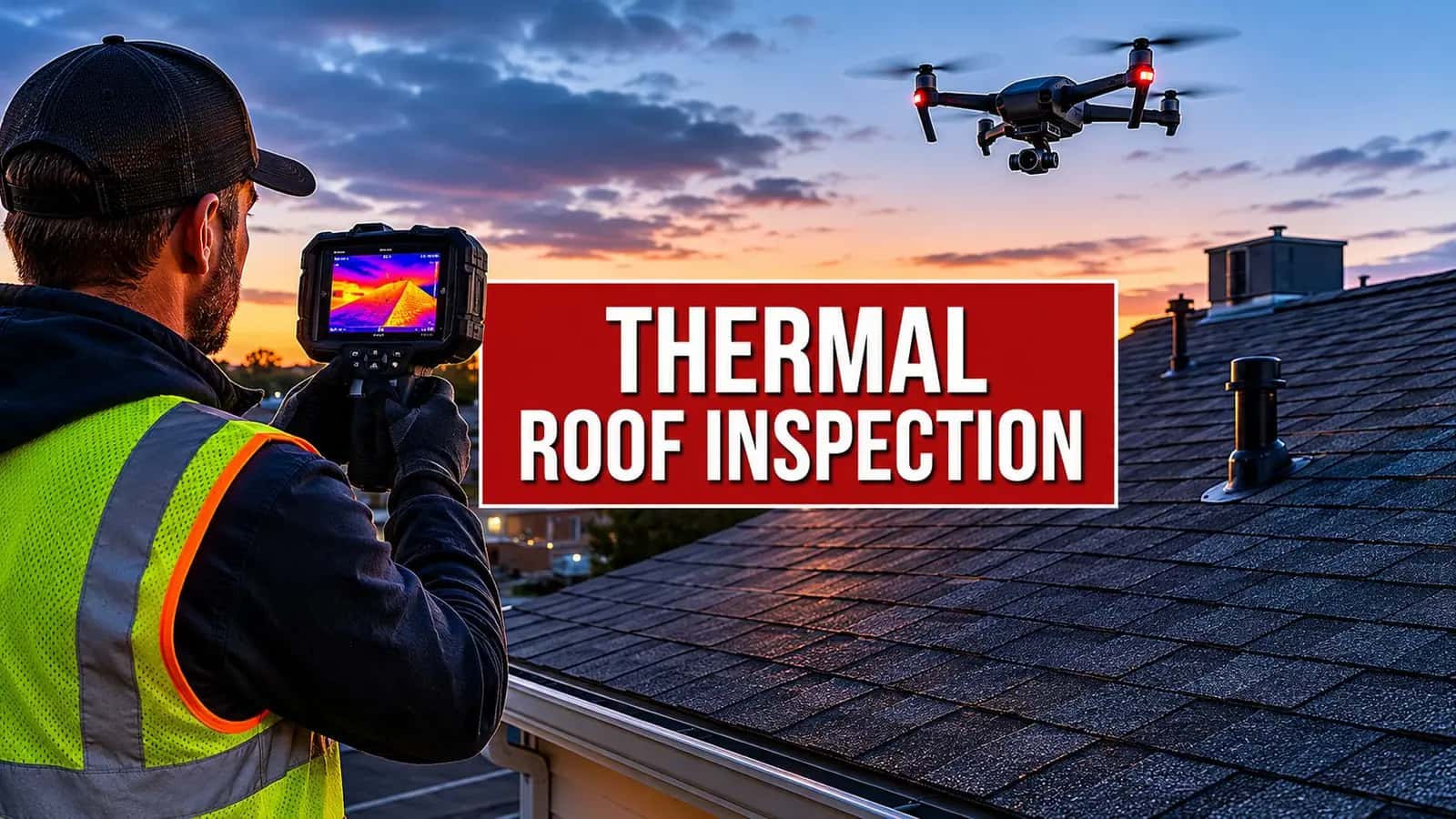
On inspection day, the team may combine walkover review, handheld thermal imaging, and drone capture depending on the roof layout. Flat commercial roofs often benefit from full aerial coverage. Residential work may rely more heavily on direct observation plus selective imaging where symptoms or storm exposure justify it.
A solid process usually includes:
Surface review first
The inspector notes punctures, flashing details, ponding areas, repairs, metal transitions, and anything that could influence readings.Thermal capture during the right window
The scan is done when the roof is likely to produce a readable thermal pattern, not just when it's convenient.Image review off the roof
The raw images are checked for patterns that fit moisture intrusion versus patterns caused by equipment, shading, or reflectivity.
For readers who want a broader look at how drones fit into inspection workflows, this contractor's guide to drone inspections is a useful companion.
Not every contractor offers this level of workflow discipline. Some point a handheld camera at a roof for a few minutes and call it an infrared inspection. That's not the same thing.
Critical Limitations and When to Be Skeptical
This is the part most sales pages skip. Thermal imaging can be extremely useful, but it can also be easy to misuse. If someone presents a thermal image as automatic proof of a leak, you should slow the conversation down.
Conditions that can ruin a scan
Roof thermography depends on environmental control. Professional guidance for roof inspections calls for an imager with at least 320×240 pixels, no appreciable precipitation for 48 hours, no standing water, and wind below 15 mph so convective cooling doesn't blur the moisture pattern (IIBEC roof thermography guidance).
If those conditions aren't there, the scan may not be trustworthy.
Here are common reasons to be skeptical:
- Recent rain: Moisture on the surface can mask what's happening below the membrane or insulation.
- Standing water: Ponding changes the surface temperature pattern and can create readings that look dramatic but aren't diagnostic.
- Windy conditions: Moving air cools surfaces unevenly and can wash out the contrast the inspector needs.
- Reflective roof surfaces: Metal and reflective membranes can distort readings depending on angle and timing.
- Wrong time of day: A noon scan on the wrong roof type may tell you very little.
A hot spot is not a diagnosis
This is the biggest misunderstanding homeowners run into. A thermal anomaly is a clue, not a verdict. It may indicate trapped moisture. It may also reflect heat from mechanical equipment, insulation irregularity, reflective distortion, or another non-leak condition.
If a contractor says, “This red area proves storm damage,” ask what verification method they used after the image was captured.
Good inspectors confirm suspicious areas. They don't stop at the picture.
Questions worth asking any provider
A homeowner doesn't need to become a thermographer, but you should ask a few direct questions before relying on the report:
- What were the weather conditions? If they can't explain why the timing was appropriate, be cautious.
- What roof types do you use this on most successfully? Low-slope systems are often better candidates than every roof in every condition.
- How do you verify anomalies? If the answer is “the image speaks for itself,” that's weak.
- What can this test not tell me? Honest providers should be able to name the limits without hesitation.
A trustworthy thermal imaging roof inspection includes uncertainty where uncertainty exists. That's a strength, not a weakness.
Turning Thermal Data into Actionable Repair Plans
A thermal image becomes valuable when it changes what happens next on the roof.
The point isn't to collect colorful pictures. The point is to move from “there may be a problem somewhere up there” to a repair scope that is narrower, better documented, and easier to defend.
From anomaly to repair scope
A thermal scan identifies temperature anomalies, but it doesn't definitively identify cause. An anomaly could reflect storm damage, an older insulation issue, or a smaller leak path. That's why infrared is best used as a mapping tool, then confirmed with moisture-meter testing or more detailed forensic work before anyone treats it as claim-ready proof (IKO on infrared roof leak detection limits).
In practice, the workflow usually looks like this:
Thermal map first
The scan highlights sections that deserve closer scrutiny.Field verification second
The roofer checks suspect areas with moisture confirmation methods and compares them to visible roof conditions.Repair plan third
The final scope is based on confirmed conditions, not on color contrast alone.
That sequence matters. Skip the middle step and you risk over-repairing, under-repairing, or arguing with an adjuster over evidence that isn't complete.
Why this matters in DFW insurance claims
In hail-prone parts of North Texas and East Texas, many disputes come down to one issue. Is the roof showing fresh storm-related damage, or are we looking at an older moisture problem that happened to be discovered after the storm?
Thermal data can support the conversation, but it usually won't settle it by itself. Adjusters and consultants want to see a chain of evidence. That may include the thermal image, moisture confirmation, roof condition notes, photos of impacted details, and a repair recommendation tied to actual roof sections.
“Infrared helps show where to look. Verification helps show what's really there.”
That's where a roofing contractor with storm-claim experience can be useful. For example, Hail King Professionals includes infrared thermal imaging as part of roof inspection work, with the scan used to identify trapped moisture and energy-loss areas that aren't visible during a standard visual review. The key is that the thermal result should feed a repair plan, not replace one.
When the process is done correctly, thermal imaging helps owners avoid broad guesses and gives insurers a cleaner, more organized file to review.
Choosing a Qualified Provider in DFW and East Texas
In Texas, the equipment matters. The weather matters more. The person interpreting the images matters most.
You don't need the provider with the flashiest marketing. You need one who knows roofing systems, understands storm damage, and is willing to tell you when a scan should be postponed.
What a qualified provider should be able to explain
A reputable inspector should give you straight answers about method, limits, and follow-up. If they can't explain their process in plain English, that's a problem.
Look for these signs:
- Roof-system knowledge: They should understand shingles, metal, TPO, modified bitumen, drainage patterns, flashing, penetrations, and insulation behavior.
- Environmental judgment: They should explain why the chosen inspection window is valid, or why it isn't.
- Verification process: They should have a plan to confirm anomalies rather than treating the image as final proof.
- Local storm experience: In DFW and East Texas, claim support often depends on separating hail-related damage from older moisture issues.
A hiring checklist that works
Before you schedule, ask these practical questions:
| Question | Why it matters |
|---|---|
| What roof types do you inspect most often with infrared? | Some systems produce clearer results than others. |
| Do you perform visual inspection before imaging? | Thermal images make more sense when paired with roof-condition context. |
| How do you confirm suspicious areas? | A provider should describe follow-up testing, not just image capture. |
| Can you explain when a scan would be inconclusive? | Honest limits are a good sign. |
| Do you also repair roofs, or only inspect them? | Either model can work, as long as the recommendations stay grounded in evidence. |
If you're comparing contractors more broadly, this guide on how to choose a roofing contractor is a practical place to start.
A good provider won't promise that thermal imaging answers everything. They'll tell you when it's the right tool, when it isn't, and what the next step should be if the results come back mixed.
Frequently Asked Questions
Is thermal imaging useful on residential roofs or mainly commercial roofs
It's often most effective on flat and low-slope roofs, where trapped moisture patterns are easier to interpret. It can still be useful on residential properties, especially when there's a specific leak question, storm concern, or hard-to-trace moisture path. The main issue isn't residential versus commercial. It's whether the roof type and conditions support a readable scan.
Can thermal imaging prove hail damage for an insurance claim
Not by itself. Thermal imaging shows temperature anomalies, not legal causation. It can help document areas that deserve further review, but claim support usually requires visual inspection, moisture confirmation, and a repair narrative that connects the findings to the actual roof condition.
Does it work on metal or reflective roofs
Sometimes, but those roofs require more caution. Reflective and low-emissivity surfaces can distort readings. On those systems, the inspector's timing, viewing angle, and interpretation become even more important.
Can I do this myself with a store-bought thermal camera
You can take thermal pictures. That's not the same as conducting a dependable roof moisture inspection. The challenge is rarely pushing the button. The challenge is knowing whether the temperature pattern is meaningful, whether the weather window was valid, and whether the anomaly should be verified.
What roof types are most suitable
| Roof Type | Effectiveness | Key Consideration |
|---|---|---|
| Flat roof | High | Best results usually depend on proper weather and cooling conditions |
| Low-slope roof | High | Moisture mapping is often more practical than spot-check methods |
| Metal roof | Moderate | Reflective surfaces can complicate interpretation |
| TPO or reflective membrane | Moderate | Surface reflectivity and timing can affect reliability |
| Steep-slope shingle roof | Situational | Works best when tied to a specific diagnostic question, not as a blanket shortcut |
Will the scan tell me exactly where to repair
Not automatically. It points the roofer toward the areas most likely to need attention. Confirmation still matters before finalizing the scope.
If you're dealing with a leak, storm concerns, or an insurance question and want a roof inspection grounded in actual field conditions, Hail King Professionals can help you evaluate the roof, document what's visible, and determine whether thermal imaging makes sense for your situation.