

Sustainable Roofing Materials: A Texas Homeowner’s Guide
You notice the roof when the storm has already moved on. The yard is littered with leaves, the gutters are full, and there's that uneasy moment when you look up and wonder whether this was just another Texas thunderstorm or the one that shortened your roof's life by years.
In Dallas-Fort Worth and East Texas, that's how a lot of roof replacements start. Not with a design idea or a green-building goal. With hail dents, rising summer power bills, and a roof that's baking all afternoon under punishing sun. Homeowners start asking for “sustainable roofing materials,” but what they usually mean is simpler: What will last, what will keep the house cooler, and what won't put them right back in the same spot after the next storm season?
That's the right question.
A Smarter Roof for a Harsher Texas Climate
A roof in North Texas has to survive two different fights. One is summer heat that pounds the surface day after day. The other is hail that can show up fast and do damage in minutes. If a roofing system can't handle both, it may look sustainable on paper and still be the wrong choice on your house.
I've seen homeowners replace a roof with the cheapest familiar option, then get hit again by another round of weather before they've even stopped thinking about the first project. That cycle is expensive, disruptive, and hard to call sustainable. A roof that goes to the landfill sooner than expected isn't helping your budget or the environment.
What sustainability means in Texas
In this region, sustainability starts with durability. A long-lasting roof reduces tear-offs, labor, disposal, and replacement materials. It also needs to reflect heat well enough to help with cooling demand, especially on homes with long western or southern exposure.
The practical filters are straightforward:
- Can it take hail well enough to avoid early replacement
- Can it reduce heat gain instead of storing it all day
- Can it be maintained without constant patchwork
- Can it work with local code requirements, ventilation needs, and storm exposure
In North Texas, a roof isn't sustainable because a brochure says it's green. It's sustainable if it stays in service, protects the structure, and doesn't force another tear-off too soon.
That's why some materials that sound eco-friendly don't always make sense here, and why some tougher systems outperform them over time. Recycled content matters. Recyclability matters. But if the roof can't stand up to hail and heat, those benefits shrink fast in real-world Texas conditions.
What Truly Makes a Roofing Material Sustainable
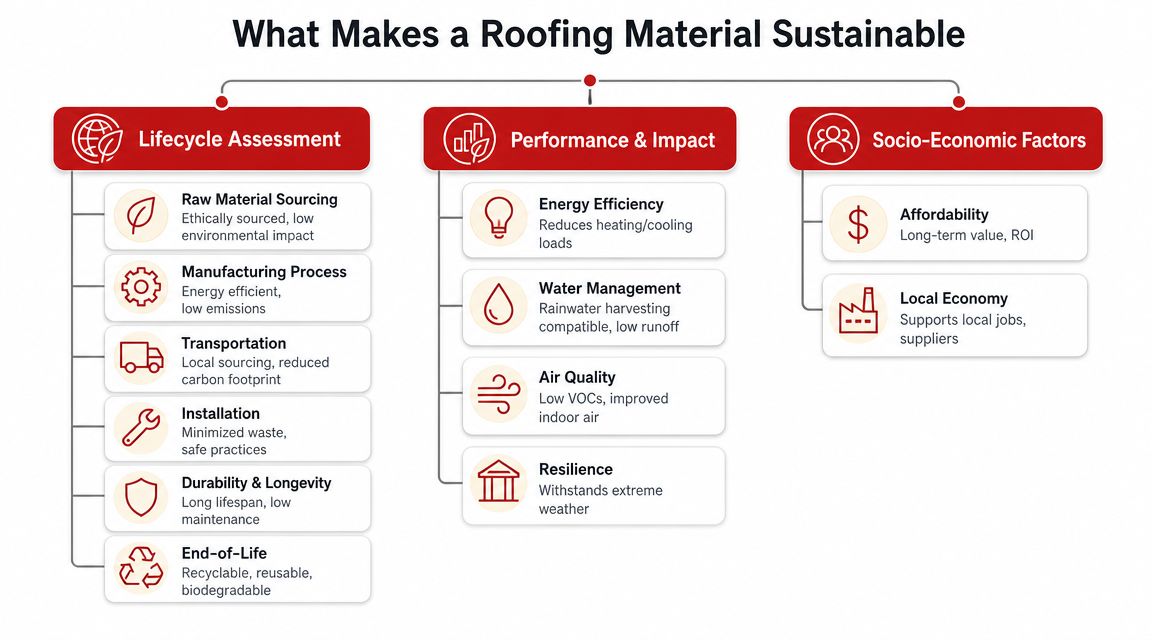
A lot of roofing marketing narrows sustainability down to one label. Recycled. Eco-friendly. Energy-saving. That's too simplistic. A roof works more like a vehicle purchase than a grocery purchase. You don't judge a truck only by gas mileage. You also look at reliability, maintenance, service life, and what it costs you over the years.
That same logic applies to sustainable roofing materials.
Start with lifespan, not branding
The first question is how long the system can realistically stay on the building. Earth911 notes that asphalt roofs usually last 20 to 25 years, though high-quality versions can last 40 years or more, while metal roofs last 40 to 70 years or more. Clay tile roofs can last 50 to 100 years or more, and concrete tiles typically last 40 to 50 years according to the Earth911 sustainable roofing guide.
That matters because replacement frequency drives waste. The same guide says over 13 million tons of asphalt shingles are removed from U.S. roofs each year, and less than 10% are recycled, while metal is 100% recyclable at the end of its useful life in roofing.
The four tests I'd use on any roof
Some roofs look good in a showroom and disappoint in the field. Use these filters instead.
Longevity under local weather
A roof that lasts in a mild climate may not last the same way under Texas hail, heat, and wind. Product category matters, but installation quality and storm exposure matter too.Heat performance
Reflective surfaces, proper ventilation, and lighter color choices can make a real difference in hot climates. A dark roof that absorbs heat all day puts more pressure on your attic and HVAC system.End-of-life reality
Recyclable on paper isn't always the same as recyclable in practice. Ask what happens when the roof comes off.Maintenance burden
Some systems stay sustainable only if owners keep up with inspections, sealants, coatings, and repairs. If a roof needs constant intervention and doesn't get it, performance slips fast.
For homeowners comparing impact-resistant options, this guide on hail-resistant roofing materials is worth reviewing before you choose a product based only on appearance.
Field rule: The most sustainable roof is often the one that avoids early replacement, avoids landfill waste, and keeps performing after years of Texas weather.
Evaluating Sustainable Roofing Options for DFW Homes
Not every sustainable roofing material fits a North Texas home. Some are better on steep-slope residential roofs. Some belong on commercial flat roofs. Some look appealing until hail enters the conversation.
Here's the practical comparison I'd use for DFW.
Side-by-side comparison
| Material | Hail Resistance | Heat Reflectivity | Lifespan (Years) | Typical Cost |
|---|---|---|---|---|
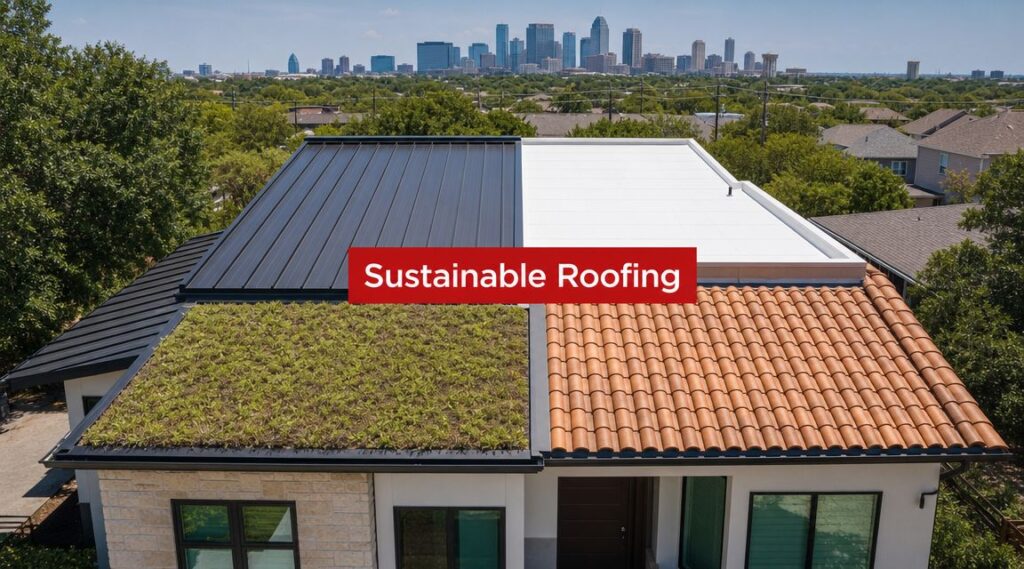
| Metal roofing | Strong when properly specified and installed. Often a top choice for hail-prone areas | Strong, especially with reflective finishes and lighter colors | 40 to 70 years or more | Higher upfront |
| Cool roof membranes for flat roofs | Varies by system and thickness. Better for low-slope commercial use than most homes | Strong on reflective systems | Long-term performance depends on maintenance and drainage | Moderate to higher |
| Recycled-content shingles | Better than standard shingles when engineered for impact resistance, but product quality varies | Moderate. Color and granule design matter | Varies by manufacturer and storm exposure | Moderate |
| Green roofs | Not a hail-first strategy for most detached homes | Strong thermal benefit in the right building type | Long service life when structure and waterproofing are designed correctly | High |
| Solar-integrated roofing or panel-ready roofing | Depends on the roof under the solar system | Can support energy goals, but roof selection still comes first | Varies by roof type below the system | High |
| Clay or terracotta tile | Attractive and heat-friendly, but impact can be a concern in hail country | Good heat performance | Long-lasting in the right conditions | Higher |
| Concrete tile | Durable and substantial, but weight and hail exposure require careful review | Good heat performance | Long-lasting when structure supports it | Higher |
Metal roofing
Metal is usually the first serious conversation for homeowners who want a longer-life roof and plan to stay in the house. According to DECRA, standing-seam systems commonly last 40 to 70 years, which is 2 to 3 times longer than asphalt, and metal is 100% recyclable. DECRA also notes that metal's durability and lightweight profile make it highly compatible with solar panel installations in its overview of sustainable metal roofing.
That doesn't mean every metal roof is equal. Panel profile, gauge, fastening method, underlayment, and installer experience all affect performance. If you want a good primer before talking to contractors, this guide to compare metal roof options does a solid job breaking down the differences.
For homeowners considering this route, a practical next read is this metal roofing installation guide, especially if you want to understand trim details, penetrations, and attachment points before signing a contract.
Cool roof membranes and coatings
For flat and low-slope buildings, reflective membranes often make more sense than trying to force a residential-style material onto the wrong roof shape. In Texas heat, reflectivity matters. A well-chosen cool roof system can reduce heat absorption and help the building stay more manageable during long summer stretches.
This category works best on commercial buildings, multifamily properties, additions, and some modern residential designs with low-slope sections. The catch is maintenance. Ponding, seam issues, flashing wear, and neglected drains can wipe out the benefit if the owner doesn't stay on top of upkeep.
Recycled-content shingles
Marketing in this area can be noisy. Some products in this category are worth a look. Some are mostly a sustainability story wrapped around a familiar shingle. Manufacturer examples cited by Malarkey show meaningful recycled or upcycled inputs. Malarkey reports that its NEX polymer-modified SBS asphalt uses upcycled rubber and cleaner shingle-making technology with fewer emissions than oxidized asphalt production, while Enviroshake states its composite roofing contains 95% post-industrial recycled materials and is 100% recyclable in the manufacturer discussion collected at Malarkey's sustainable roofing page.
The right way to shop this category is to ask for third-party sustainability documentation, product testing, and impact performance details. Don't buy it just because the packaging says eco-friendly.
Green roofs, tile, and solar-integrated systems
Green roofs are legitimate sustainable systems, but they're usually a fit for specific building types, not the average detached house in DFW. Structural loading, irrigation planning, waterproofing, and maintenance all have to be right.
Clay and concrete tile can perform well thermally and have long service potential, but hail risk and weight need an honest review. Solar-integrated systems can be smart, too, but they don't erase the need for a durable base roof. In this climate, the roof under the solar matters as much as the solar itself.
If hail is frequent where you live, impact resistance should outrank buzzwords. A roof that survives the next storm is usually the more sustainable choice.
Calculating the Long-Term ROI of Your Sustainable Roof
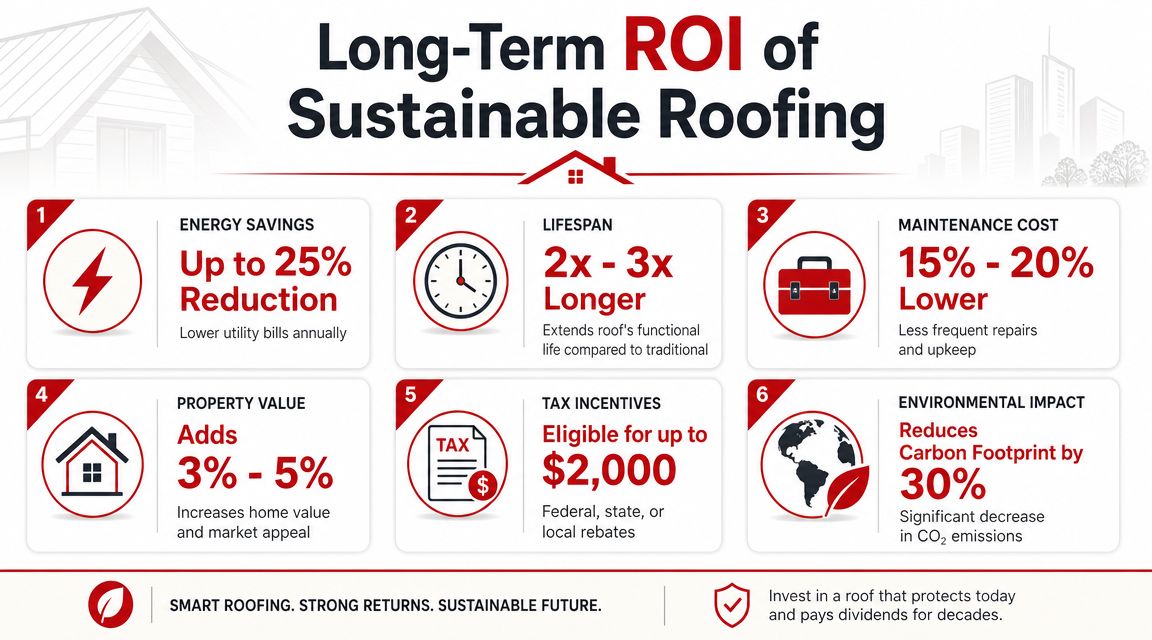
Homeowners often get stuck on purchase price because that's the biggest number in front of them. The better question is what the roof costs over the time you own it. That includes repairs, maintenance, energy use, disruption, and whether you're paying for another full replacement sooner than expected.
A roof with a higher upfront price can still be the cheaper decision over the long run if it lasts longer and holds up better.
Where the return actually comes from
There are four places I'd look for return on investment.
Fewer replacements
If a material stays in service much longer, you avoid another tear-off cycle, another disposal bill, and another installation project.Lower cooling demand
Reflective roofs and cooler roof surfaces matter in Texas. On green roofs, the EPA data summarized by Construction21 reports surface temperatures can be up to 56°F lower than conventional roofs, nearby air temperatures can be reduced by as much as 20°F, cooling load can be cut by 70%, and indoor air temperature can be lowered by 27°F compared with standard roofs. The same summary notes annual energy savings of $0.15 to $0.57 for cooling and $0.18 for heating on a yard-by-yard basis over a 50-year lifecycle in the EPA-cited green roof overview.Less waste and fewer disruptions
Every early replacement creates hauling, disposal, labor, and inconvenience. That's a hidden cost owners feel even if they don't put a line item on it.More durable product design
Composite roofing can make financial sense when it's engineered for storm exposure, not just sustainability branding.
Don't let the bid sheet hide the real cost
A cheap bid can be expensive if it leaves out the details that control roof life. Flashings, ridge ventilation, fastener patterns, underlayments, drainage corrections, and tear-off scope all affect durability.
That's why I like seeing projects priced with clear line items and revision control instead of vague allowances. For contractors and owners who want cleaner scope comparison, tools like Exayard roofing estimating software can help organize materials, labor, and change visibility before the job starts.
Compare options the same way every time
When you review proposals, put each roof through the same screen:
- How likely is it to need major repair after hail
- How much maintenance will it need to stay effective
- How well does it handle heat on your specific home
- What happens when it reaches end of life
If you're weighing common residential choices, this side-by-side breakdown of asphalt vs metal roof cost is useful because it frames price against service life and replacement frequency, not just the install total.
Composite products also deserve a close look in hail and wind markets. Manufacturer examples highlighted by Malarkey include products with upcycled rubber and, in Enviroshake's case, up to 95% post-industrial recycled materials, which can reduce virgin material demand while still targeting durability. That's a better sustainability story than a product that sounds green but fails early.
Unique Roofing Challenges in North Texas
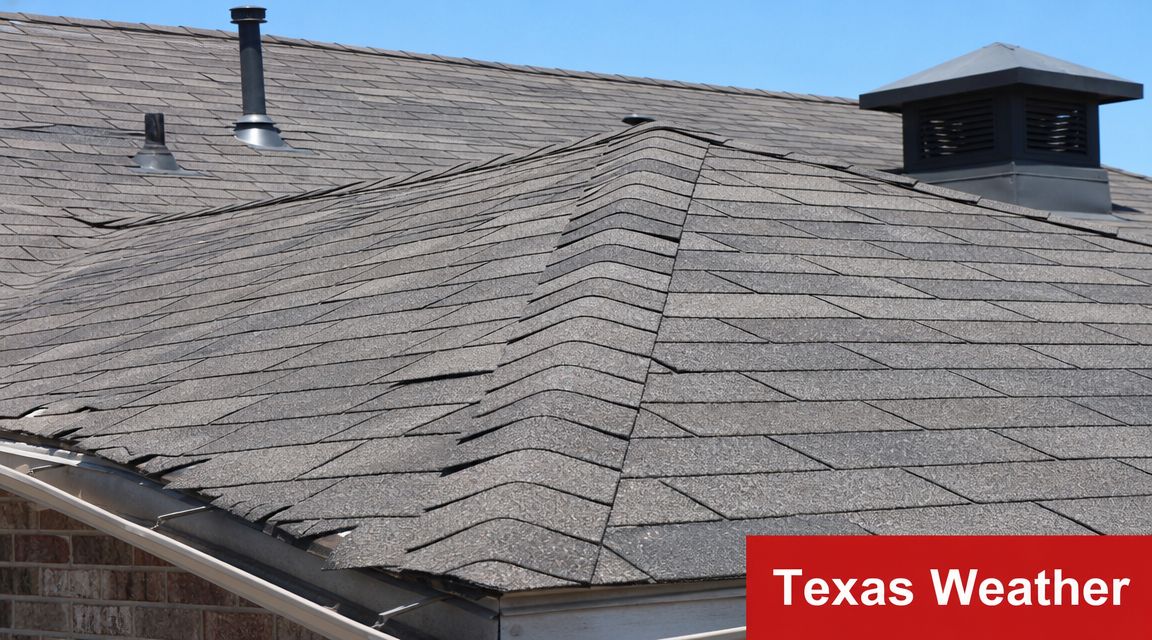
North Texas changes the roofing conversation because the same roof has to deal with punishing sun, abrupt temperature swings, high winds, and repeated hail seasons. Generic national advice misses that.
Hail changes the sustainability math
A material can have excellent lab appeal and still be a poor long-term fit if hail keeps shortening its real service life. That's the biggest local blind spot I see. People compare roofs by brochure lifespan, but storm exposure can erase those assumptions fast.
That's why impact resistance, especially Class 4 where appropriate, deserves a hard look in this market. Recycled content is good. Recyclability is good. But if the roof takes a beating every few seasons and ends up being replaced early, those advantages get diluted.
A roof that needs replacement before its expected service life isn't acting sustainable in the real world, no matter how good the material story sounds.
The solar detach-and-reset problem
A second issue many homeowners don't anticipate is solar. Once panels, rails, and penetrations are on the roof, reroofing gets more complicated. Building Enclosure points out that most sustainable-roofing guides focus on materials but don't address the sustainability impact of a reroof that requires solar detach-and-reset, which can create extra waste and downtime. The same source notes that for flat roofs, extending service life with reflective coatings is a major sustainability lever often overlooked in material-focused discussions, as described in this article on sustainable roof materials for reroofing decisions.
If you already have solar, roof selection should account for the next twenty years, not just the next inspection. A longer-life roof under the array can reduce the chances that panels need to come off again too soon.
Here's a practical look at why that matters on active roofs:
Flat roofs are a different category
Commercial owners and homeowners with low-slope sections should think differently. A full tear-off isn't always the most sustainable move if the existing system can be restored and extended with the right coating or recover strategy. Reflective coatings can improve heat performance and preserve service life when the substrate is still viable.
That's where a contractor's inspection matters more than the product label. Some roofs need replacement. Some need repairs and restoration. Hail King Professionals, for example, includes roof coatings and solar detach-and-reset among its listed service options, which is relevant when sustainability depends on extending service life instead of defaulting to tear-off.
Your Decision Checklist for a Texas-Ready Roof
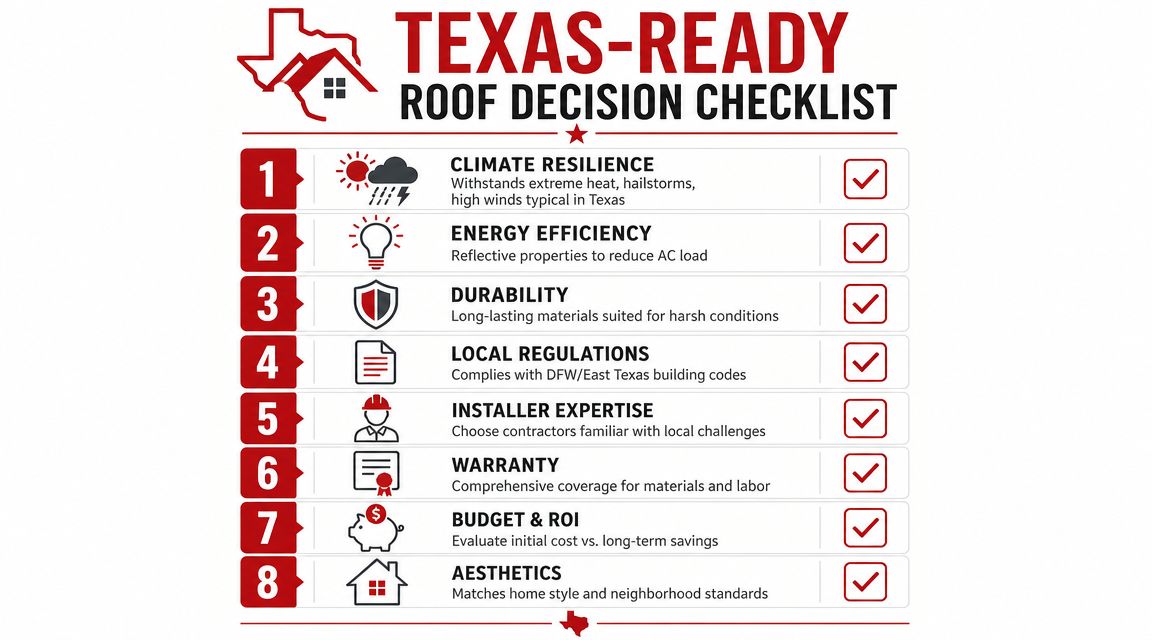
By the time most homeowners get serious about roofing, they're flooded with product claims. The fastest way to cut through that is to treat the decision like a checklist, not a sales pitch.
Work through these questions in order
Start with a real inspection
Don't choose a material before you know the current condition of decking, flashing, ventilation, drainage, and storm damage. A good recommendation depends on what's already happening under the shingles or membrane.Look at your heat exposure
Note which roof planes take the hardest afternoon sun. In Texas, reflectivity and color choice can matter a lot more on those areas than homeowners expect.Ask how the roof handles hail
Don't settle for a vague answer like “durable” or “premium.” Ask specifically how the system performs under impact, what components are most vulnerable, and how repairs are handled if damage occurs.Check structure and slope
Tile, green roof assemblies, and certain upgraded systems may require structural review or may fit one roof shape better than another.
Then verify the details that affect ownership
Insurance questions
Ask your agent whether impact-resistant options change anything on your policy or claims handling.HOA and local code review
Some neighborhoods restrict profiles, colors, or visible material types. Verify before you fall in love with a product.Solar coordination
If you already have panels or plan to add them, make sure the roof choice supports that timeline cleanly.Warranty clarity
Separate the manufacturer warranty from the workmanship warranty. They are not the same thing.
Homeowner shortcut: If a contractor can't explain how a roof performs in hail, heat, and future maintenance, keep shopping.
A sustainable roof in DFW isn't the one with the most dramatic brochure. It's the one that fits your structure, your storm exposure, your budget, and the way you plan to use the property.
Next Steps to Secure Your Property's Future
The strongest takeaway is simple. In North Texas, sustainability isn't a style category. It's a performance standard. A roof earns that label by lasting, resisting storm damage, managing heat, and avoiding premature replacement.
For some properties, that points to metal. For some flat roofs, it points to reflective restoration or a cool membrane. For select urban or commercial projects, green roofs deserve serious attention. The EPA summary discussed earlier is a good example of why. Green roofs can deliver major thermal and stormwater benefits when the building is designed for them. But most homeowners in DFW still need to start with hail resistance, heat performance, and realistic maintenance.
If your roof is already showing wear, or if you've had recent storm activity in your area, the next smart move is an inspection that focuses on real conditions instead of generic product categories. Good decisions come from knowing whether your current roof can be repaired, restored, or whether replacement is the better long-term move.
A sustainable roofing decision should lower future headaches, not create new ones.
If you want a practical next step, schedule an inspection with Hail King Professionals. They serve Dallas-Fort Worth and East Texas, handle storm-related roof assessments, work on asphalt, metal, and flat roofing, and can coordinate issues like solar detach-and-reset when reroofing is needed. The goal should be a code-compliant roof plan that fits Texas weather, your property, and your budget.