
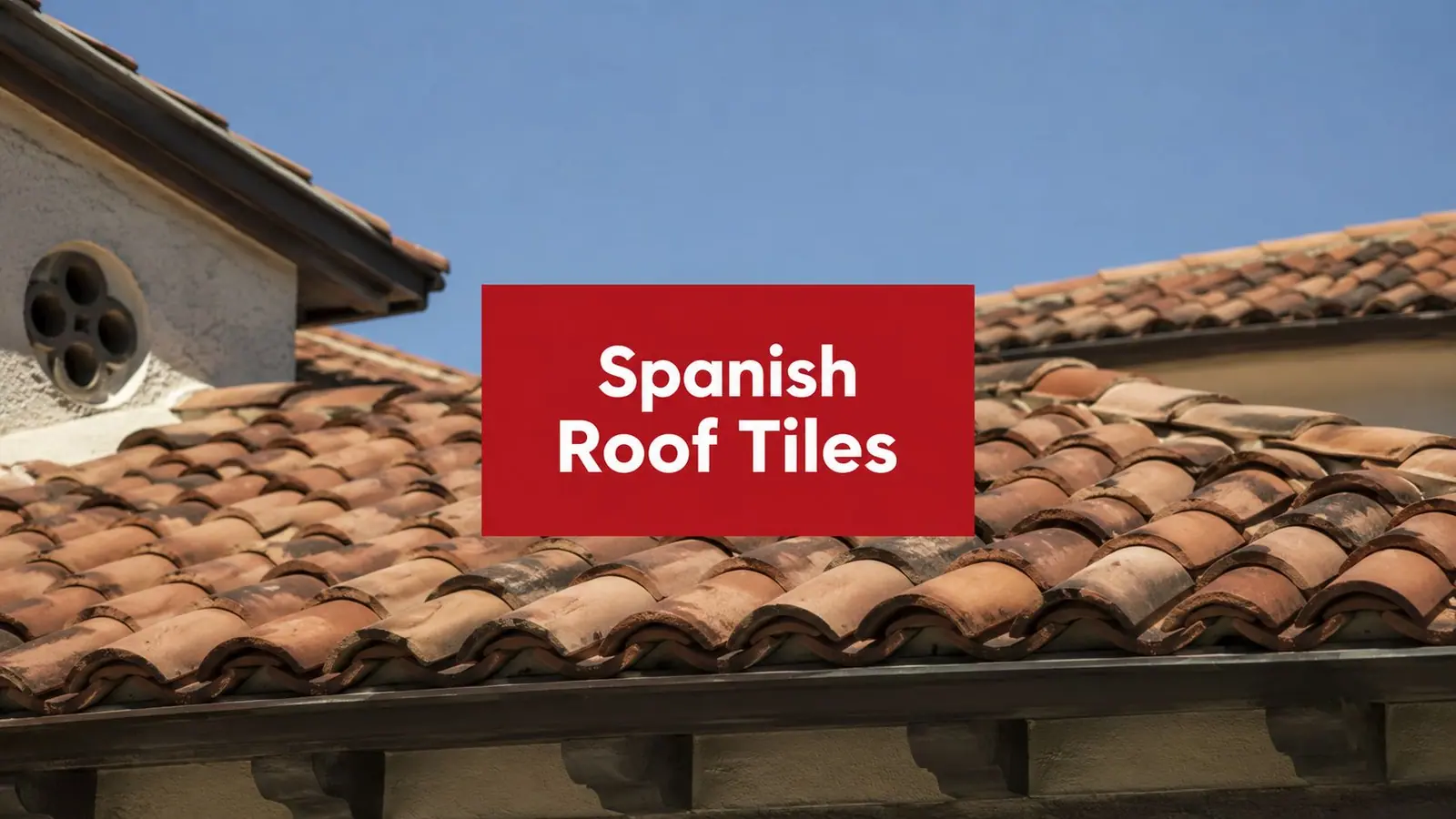
You're probably looking at a house with that classic terracotta profile and thinking the same thing a lot of Texas homeowners think. It looks sharp, it stands out from a street full of composition roofs, and it gives a home a finished, high-end look that asphalt usually can't match.
That part is true.
What gets missed is the part that decides whether Spanish style roof tiles are a smart move in Texas. Not the curb appeal. The engineering, the roof pitch, the storm exposure, the repair reality, the solar coordination, and the cost of owning that roof for years instead of just admiring it from the driveway.
A Spanish tile roof can be an excellent system on the right home. On the wrong home, it turns into an expensive lesson.
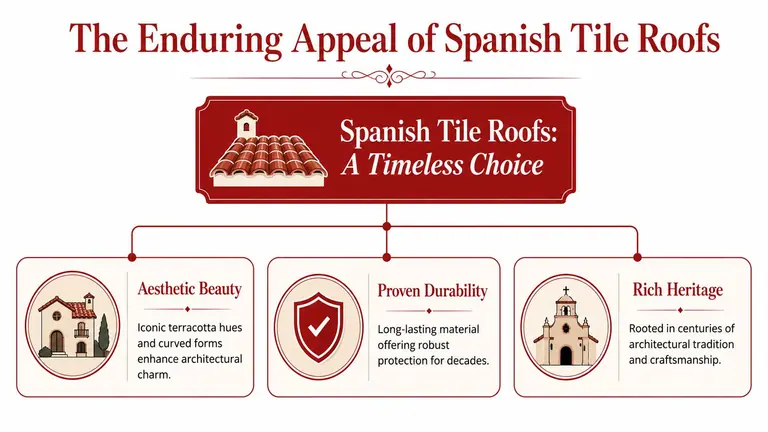
The Enduring Appeal of Spanish Tile Roofs
The appeal is easy to understand. Curved tile lines throw strong shadows, the roof looks substantial from the street, and the whole house takes on a more architectural feel. In Texas, that style works especially well on Mediterranean, Spanish Colonial, stucco, masonry, and upscale custom homes. Even on newer builds, the profile can make a plain roofline look more intentional.
A lot of homeowners start with the look, then assume the performance will sort itself out. That's backwards. Style gets your attention. Suitability decides whether the roof belongs on your house.
Why this style has stayed relevant
Spanish-style roof tiles aren't a trend. They have a documented history in the Americas going back at least to the 17th century, when Spanish settlers introduced clay tile roofing to colonial buildings. The material itself goes back much further, with roots in ancient China, the Middle East, Greece, and Rome, according to this history of Spanish tile roofs. That matters because you're not buying into a new design experiment. You're looking at a roofing language that has survived for centuries.
Clay gets most of the attention, but homeowners today also have more finish and material choices than they used to. If you're comparing decorative surfaces and interior-adjacent design ideas as part of a broader remodel, Spanish style cement tiles are worth reviewing because they help clarify the visual vocabulary many people are trying to match across exterior and interior spaces.
Texas homeowners need a different question
The wrong question is, “Do I like Spanish tile?”
The right question is, “Will Spanish style roof tiles work on my structure, in my weather, with my budget and long-term plans?”
A roof can be beautiful and still be a poor fit for the house underneath it.
That's why some homeowners end up looking at alternatives that keep the profile without taking on the full weight and installation demands of traditional tile. A good example is Spanish metal tile roofing, which can make sense when the look matters more than sticking with clay or concrete.
If you live in Dallas-Fort Worth or East Texas, that practical filter matters. Hail, heat, steep insurance deductibles, and retrofit limitations change the conversation fast. A tile roof can be a great fit here, but only when the house is ready for it and the owner understands what comes with it.
Understanding Your Material Options
Not all Spanish style roof tiles are the same. Homeowners often use “tile roof” as if it means one product category, but in practice you're choosing between clay, concrete, and composite or synthetic look-alikes. Those choices affect weight, repair approach, appearance, and long-term ownership.
Clay is the traditional option. It's the look commonly envisioned first. Concrete is the workhorse. It can deliver the same general profile with a different feel and a different maintenance pattern. Composite products are usually chosen when someone wants the style without the mass and brittleness of a true tile system.
What usually drives the decision
On real Texas projects, the shortlist usually comes down to four issues:
- Structural capacity: Can the home safely carry a heavy roof system without major framing work?
- Storm exposure: Is the house in an area where hail and wind events make brittle materials a tougher sell?
- Appearance standards: Does the home call for authentic clay, or would a close visual match do the job?
- Ownership plans: Is this a forever-home decision, or do you want a strong look with fewer complications?
Here's the practical side-by-side view.
Spanish Tile Material Comparison
| Material | Weight (Lbs / 100 sq ft) | Avg. Lifespan | Installed Cost (Avg. $/sq ft) | Key Pro | Key Con |
|---|---|---|---|---|---|
| Clay | Qualitatively heavy | Long service life when properly specified and maintained | See clay tile pricing discussed later in this article | Classic appearance and strong color stability | Brittle under foot traffic and impact, may require structural review |
| Concrete | Qualitatively heavy, often substantial | Long service life with proper installation and maintenance | Qualitatively lower than premium clay in many projects | Broad style availability and strong value for the look | Weight, color weathering over time, and repair matching can be issues |
| Composite | Qualitatively lighter than clay and concrete | Varies by manufacturer and product line | Varies by product and installer | Lower structural burden and easier handling | Can lack the depth and authenticity of true tile |
Because the verified data available for this article only provides specific weight and cost figures for Spanish clay tile, the table stays qualitative for the other categories rather than guessing.
Which one fits which homeowner
Clay fits best when authenticity is essential and the house was designed, or can be upgraded, to carry it.
Concrete fits the homeowner who wants the Spanish profile and accepts that this is still a heavy, specialized roof. It's often the middle lane between prestige and practicality.
Composite fits the owner who wants less risk around structure and rooftop access. That includes homes where HVAC, satellite equipment, chimney work, or future modifications mean people will be on the roof more often than anyone hopes.
For some properties, the better comparison isn't clay versus concrete. It's tile versus a lighter profile system. If that's the fork in the road, stone-coated metal tile roofing is one of the more useful categories to study because it solves a different problem than true tile does.
Decision test: If the house can't comfortably support the system, or the owner doesn't want specialized repair and access rules, traditional tile usually isn't the best answer no matter how good it looks.
Performance in the Texas Climate Hail, Heat, and Wind
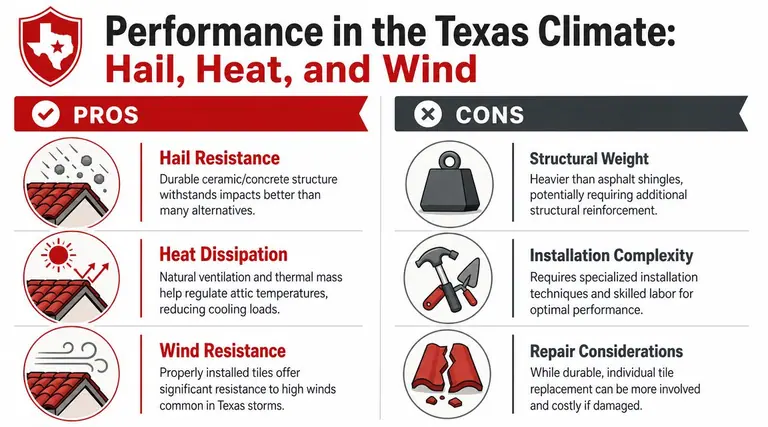
Texas doesn't care how good a roof looks from the street. It tests the roof with heat, sudden hail, hard wind, and long stretches of sun. That's where Spanish style roof tiles either justify their reputation or expose their limits.
One thing tile does well in this climate is manage heat. The shape and mass of the roof system can help moderate heat transfer, and the profile naturally creates air space within the assembly. On hot, exposed homes, that can be a real comfort advantage when the full roof package is built correctly.
The issue most homeowners underestimate
The bigger question is whether the roof is appropriate for the structure at all. Neutral roofing guidance notes that Spanish clay tile has stricter slope requirements than metal roofing, and many homes not originally designed for tile may need structural reinforcement because clay tiles are very heavy. One source puts clay tile weight at roughly 850 to 1,000 pounds per square with installed costs around $13 to $25 per square foot, as explained in this comparison of metal roofing and Spanish clay tile.
That's why I tell homeowners to stop talking about tile as a finish and start thinking about it as a load. The wrong framing package, the wrong deck condition, or the wrong slope can kill the idea before color selection even starts.
Hail and impact reality
Here's the straight answer on hail. Tile can do well. Tile can also crack. Both statements are true.
Clay has beauty and heritage on its side, but it's still a brittle product. Concrete often gives homeowners a little more confidence on impact, but it's not invincible either. What matters is the specific product, the storm, and whether damage is isolated or spread across multiple slopes. A roof can look mostly intact from the yard and still have enough broken units to justify a serious repair conversation.
For homeowners comparing storm-oriented options, hail-resistant roofing materials can help frame where tile sits relative to other systems built with impact in mind.
A quick visual walkthrough helps show how these systems behave in the field:
Wind and heat work when installation is right
Wind performance depends heavily on layout, fastening method, edge detailing, and the discipline of the installer. A sloppy tile job doesn't age gracefully in Texas. The tile profile sheds water and handles weather well when the entire assembly is engineered and installed as a system.
On a Texas tile roof, the installation quality usually decides performance more than the sales brochure does.
That's especially true in areas where weather swings from intense summer heat to sudden storm cycles. Good tile roofs feel deliberate. Bad ones reveal every shortcut over time.
The Roof System Your Home Needs for Spanish Tile
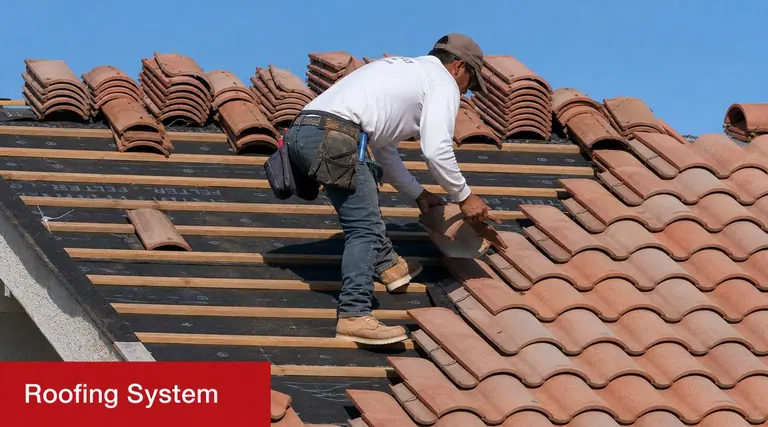
A lot of homeowners think tile is the waterproof roof. It isn't. Tile is primarily a water-shedding surface. The actual roof protection depends on the assembly below it, especially when the weather turns ugly.
That distinction matters because a good-looking tile roof can still leak if the underlayment, deck prep, flashings, or geometry are wrong. On these systems, the parts nobody sees do the most important work.
Pitch is not optional
Spanish-style roof tiles commonly have a minimum slope requirement of about 3:12 in the Sun Belt and 4:12 in severe-weather areas, and below that threshold some tile systems are treated as cosmetic only and require a separate waterproof roof assembly beneath the tile, according to technical guidance for Spanish tile installation.
That means a low-slope roof can be disqualified from a true tile application even if the homeowner loves the look. You can still sometimes create the appearance, but then you're really buying a waterproof roof with tile as a visual layer rather than as the primary weathering surface.
Layout details that separate good jobs from problem jobs
Traditional mission and barrel Spanish tiles are often installed with a side lap of 70 mm to 150 mm (2.76" to 5.9") and an eave overhang of about 5 cm to 8 cm (2" to 3.15"), based on the same technical guidance linked above. Those details aren't trivia. They affect how the roof sheds water, especially during wind-driven rain.
Here's what has to be right:
- Deck condition: The deck has to be sound before any tile goes on. Tile won't hide a weak substrate for long.
- Underlayment choice: This is the true moisture defense. Cheap underlayment under expensive tile is a bad decision.
- Flashing execution: Chimneys, walls, penetrations, valleys, and transitions decide whether the system stays dry.
- Tile spacing and overlap: The dimensions above exist for a reason. Tight shortcuts cause problems later.
Field note: The tile is what you see. The underlayment and flashings are what save the house.
Heat control works best as a package
If the goal is better comfort in a Texas attic, think bigger than the tile profile alone. Ventilation, insulation, and radiant heat control all matter. Homeowners comparing options for attic heat reduction should also review roof radiant barriers because they can complement the roof system rather than asking the tile to do every bit of thermal work by itself.
A proper tile roof isn't a single product purchase. It's a coordinated assembly. When one part is underspecified, the whole roof pays for it.
Navigating Maintenance Repair and Reroofing
Tile ownership is different from shingle ownership. The roof can serve well for a long time, but it asks for smarter maintenance and more careful access. Most unnecessary tile damage happens because someone treats it like a composition roof and walks it the wrong way, loads tools carelessly, or ignores debris buildup in areas that need to stay clear.
What routine care actually looks like
You don't maintain tile by constantly touching it. You maintain it by protecting the system from avoidable stress.
A sensible maintenance routine usually includes:
- Clearing valleys and drainage paths: Leaves, needles, and storm debris can trap water where the roof needs to move it quickly.
- Checking flashings and penetrations: Leaks often start at transitions, not in the field of tile.
- Watching for displaced or cracked units: One broken tile isn't always a crisis, but it shouldn't be ignored.
- Controlling roof traffic: Satellite, HVAC, chimney, solar, and gutter work can all damage tile if crews aren't careful.
Repair is possible, but it's specialized
One advantage of tile is that individual units can often be replaced without rebuilding the entire roof. The catch is matching profile, color, weathering, and fit. That sounds simple on paper and gets harder in the field, especially on older roofs where the original tile line may have changed or the roof has aged unevenly.
That's also why post-storm inspections matter. Hail damage on tile doesn't always announce itself with obvious leaks right away. A roof can have scattered fractures, broken corners, or impact points that compromise the system before the underlayment finally tells on it.
If a storm hit and you own tile, don't rely on a ground-level glance. Tile damage often hides in plain sight.
Reroofing gets more complicated with solar and insurance
A full reroof on tile takes planning. The crew may need to salvage reusable units, stage materials more carefully, and coordinate underlayment replacement without turning the project into a breakage festival. If the home has rooftop solar, detach-and-reset becomes part of the roofing scope whether the homeowner planned for it or not.
That coordination matters. The panels come off, roofing work happens, and the solar equipment goes back on in the correct sequence. If the trades don't communicate, delays and blame start immediately.
Insurance claims can also be more involved with tile than with common shingle systems. Matching issues, partial repairs, and the distinction between repairable damage and full-system concerns can all affect the conversation. Homeowners do best when they document visible issues early, keep records of prior repairs, and work with people who understand how tile systems fail in real weather rather than how they look in a brochure.
Budgeting for a Spanish Tile Roof in DFW
Most homeowners know tile costs more. Fewer understand why the final number moves so much from house to house.
The visible material is only part of the budget. With Spanish style roof tiles, the actual price is shaped by access, roof geometry, tear-off complexity, structural review, underlayment quality, trim details, and how much labor it takes to install the system without breaking product and cutting corners.
The price range homeowners should know first
For Spanish clay tile, one cited range puts installed cost at about $13 to $25 per square foot, as noted earlier from the Sheffield Metals comparison source. That range is useful as a starting point, not a guaranteed quote. A simple roof and a complicated roof don't land in the same place.
What pushes the price up in Texas?
- Structural evaluation or reinforcement: Some homes need more than a roof quote. They need confirmation that the framing can carry the system.
- High-end underlayment and flashing work: Smart contractors spend money here, while careless ones save it.
- Roof complexity: Valleys, dormers, elevation changes, transitions, and cut-up architecture all slow tile work down.
- Material handling: Tile is heavier and more break-sensitive than many alternatives, so staging and installation labor are different.
- Disposal and preparation: Old roofing removal, deck repairs, and site logistics affect the total just as much as the tile choice does.
Total cost of ownership is bigger than the contract amount
The cheapest tile proposal is often the most expensive roof to own.
A homeowner also needs to think about insurance conversations after hail, the cost of specialized repairs, rooftop access limits for future trades, and whether the house may need solar detach-and-reset or other coordination during a reroof later on. Those aren't abstract concerns in DFW or East Texas. They're normal ownership events.
Financing changes the conversation for many families because roofing doesn't always wait for perfect timing. If a contractor offers financing that doesn't require home equity, that can make a premium system easier to plan for without forcing a lower-grade install just to hit a cash number.
The practical way to budget is to ask for a line-by-line scope, not just a grand total. A serious tile estimate should tell you what's happening below the tile, at the flashings, at the deck, and around any structural concerns before anyone talks about aesthetics.
Choosing Your Contractor and When to Consider Alternatives
On a tile roof, the contractor matters more than the color chart.
A poor installer can ruin premium materials. A disciplined installer can make a demanding system perform the way it should. That's why homeowners shouldn't shop tile the way they shop basic shingles. This is closer to specialty construction than commodity roofing.
Questions worth asking before you sign
Ask direct questions and listen for direct answers.
- Tile-specific experience: How many Spanish-style tile projects have you installed and repaired?
- Structural process: Who evaluates whether the existing framing and deck are adequate?
- Slope review: Have you confirmed this roof is suitable for the tile system being proposed?
- System details: What underlayment, flashings, fastening methods, and edge details are included?
- Repair approach: If tiles break later, how do you handle matching and replacement?
- Solar coordination: If the house has solar now or may later, what is your process during a reroof?
If you want a broader checklist for screening contractors on overhead work and structural tie-ins, Equity Building Materials' contractor insights are useful because they reinforce the same basic truth. Specialized exterior work needs a contractor who plans, documents, and communicates clearly.
When another roof system may be the smarter choice
Sometimes the honest answer is no. That's not a sales failure. It's good roofing judgment.
Spanish style roof tiles may not be the best fit when:
- The roof slope is too low: The house may need a different assembly or a profile alternative.
- The framing doesn't support the load economically: Structural upgrades can change the whole value equation.
- Hail exposure is a constant concern: Some homeowners would rather shift toward a system built around impact resistance and easier repair.
- The budget is tight: Cutting corners on tile is worse than choosing a simpler roof done right.
- The home will need frequent rooftop access: Solar, mechanical equipment, and future service work can make brittle roof surfaces a headache.
In those cases, dimensional shingles, stone-coated steel, or metal profiles made to resemble tile can be more practical. They won't be the same roof, but they may be the better ownership decision.
The best contractors will tell you that before you spend money.
If you're weighing Spanish style roof tiles against hail exposure, structure limits, insurance concerns, or a solar-equipped reroof, Hail King Professionals can help you sort out what suits your home in DFW or East Texas. They provide same-day inspections, clear repair-versus-replacement guidance, storm damage expertise, and solar panel detach-and-reset support, so you can make a decision based on the roof system your house needs, not just the look you like.