


Gutter Installation Cost: A 2026 Texas Homeowner’s Guide
A Texas homeowner gets three gutter quotes on the same house. One looks cheap because it lists only linear footage. One folds in downspouts and cleanup. The highest bid includes guards, fascia repairs, and a heavier install setup for storms. The numbers do not match because the scope does not match.
For budgeting, gutter replacement often starts as a few hundred feet of metal and quickly turns into an all-in project cost. On homes around DFW and East Texas, the final invoice usually shifts based on roof complexity, second-story access, long downspout runs, on-site fabrication, and whether the system is being built to handle heavy rain instead of light seasonal runoff.
That is why national averages help only at the start. Broad pricing ranges exist because a basic aluminum job on a simple one-story home is priced very differently from a two-story house with multiple corners, steep sections, screened guards, and drainage upgrades. In Texas, I also watch for overflow points, soil washout near the foundation, and whether the homeowner needs a setup that can keep up with hard spring storms.
Homeowners often compare pricing in other regions to get their bearings. This overview of Flagstaff AZ gutter services is a useful example of how local weather and home design change the recommendation, even when the product category is the same.
The practical way to read a quote is line by line. Separate the gutter material from labor. Separate fabrication from downspouts. Separate guards, splash blocks, fascia repairs, and disposal. That is where the actual cost lies.
For a local walkthrough of the installation process before you start collecting bids, Hail King Professionals has a practical gutter installation guide.
Understanding Your Gutter Installation Quote
A homeowner in DFW gets a quote for $1,400. Another in East Texas gets $2,600 for what sounds like the same job. The difference usually is not the gutter itself. It is the house, the drainage plan, and how much storm capacity the installer is building into the system.
A good quote breaks that total into parts you can verify. If it does not show footage, downspouts, outlet count, removal, and any repair work, it is hard to compare bid to bid.
What actually drives the invoice
Linear footage is still the starting point. Homewyse lists a national installed range of about $10.41 to $15.77 per linear foot in its gutter installation cost breakdown. That helps with rough budgeting, but it does not capture many of the cost swings I see on Texas homes.
Significant price changes happen at the corners and trouble spots. A one-story rectangle with clean fascia is faster to measure, fabricate, and hang than a two-story home with multiple rooflines, steep sections, and long downspout runs to keep water away from the slab. Homes in East Texas also tend to bring more leaf load and more guard discussions because of tree cover.
Storm-readiness matters here too. If a homeowner wants the cheapest replacement, the quote may cover basic gutters and standard downspouts. If the goal is to keep up with hard spring rain, protect landscaping, and reduce overflow at valleys, the installer may price larger outlets, more downspouts, or drainage extensions. That is part of the all-in cost Texas homeowners need to see clearly before signing.
Local conditions change recommendations in other regions too. This overview of Flagstaff AZ gutter services shows how climate and home design shift the right setup.
Why national averages only help at the start
National averages are fine for setting expectations. They are weak tools for judging your house. Two homes with similar square footage can produce very different gutter bids because access, roof shape, fascia condition, and water management needs are not the same.
I tell homeowners to use averages as a starting range, then focus on scope. A lower quote can be perfectly valid, or it can leave out tear-off, disposal, extra downspouts, splash blocks, fascia repairs, or guards. Those omissions are common reasons one bid looks much cheaper on paper.
If you want a plain-language walkthrough of what installers measure and why those line items show up, this gutter installation guide from Hail King Professionals is a useful reference before collecting estimates.
How to review a quote line by line
Use this checklist:
- Confirm the measured footage. The quote should state how many linear feet are being installed.
- Check the gutter type. Sectional and custom-cut systems are priced differently and carry different maintenance expectations.
- Count the downspouts and outlets. These affect drainage performance and labor.
- Look for removal and disposal. Old gutter tear-off is often priced separately.
- Ask about fascia or soffit repairs. Rotten wood behind old gutters can change the job total once work starts.
- Read the add-ons closely. Guards, oversized downspouts, drainage extensions, and splash blocks can be worth the money, but they should be listed clearly.
A clear quote answers one practical question: what am I paying for, and what is still outside the price? That is how you get from a national average to a real Texas project number.
Cost Per Linear Foot by Gutter Material
Material changes the job price fast. On the same house in Texas, the difference between basic aluminum and copper can shift the invoice by thousands, especially once you factor in long runs, corners, second-story work, and storm-ready upgrades.
Installed cost by material
Installed pricing usually falls into clear tiers. Lower-cost systems start with vinyl. Mid-range jobs are usually aluminum. Premium jobs move into steel or copper. If you want a closer look at how custom-cut systems affect pricing, this guide to custom-fit gutter systems for Texas homes explains where the price jump often comes from.
| Material | Average Cost Per Linear Foot | Pros | Cons |
|---|---|---|---|
| Vinyl | Lower-cost end of the market | Lowest upfront material cost, simple option for light-duty needs | Poor fit for Texas heat, more likely to get brittle, sag, or warp over time |
| Aluminum | Mid-range installed cost on many homes | Good value, rust-resistant, lots of color options, widely available | Dents more easily than steel and final cost rises with height and roof complexity |
| Copper | Premium installed cost | Long service life, distinctive appearance, strong fit for high-end or historic homes | High upfront price and higher labor cost |
| Steel | Upper-mid to premium cost tier | Stronger than aluminum, better impact resistance | Heavier, can cost more to install, needs the right coating to avoid rust issues |
What usually makes sense in Texas
For most DFW and East Texas homes, aluminum is the material that balances cost and service life. It handles day-to-day weather well, keeps color choices open, and does not push the project into premium territory unless the house has a complicated roofline.
Vinyl looks cheap at the start, but I rarely recommend it for Texas homes that see long heat cycles, hard sun, and heavy rain. The labor to put it up may be reasonable. The replacement cycle usually is not.
Steel can be a smart choice if the homeowner wants a tougher gutter body and accepts the added weight and cost. Copper is a design decision first. It belongs on homes where the exterior budget already supports that level of finish.
How material affects the real invoice
Homeowners often focus on the metal and miss the bigger pricing issue. Material cost is only one part of the total.
A basic aluminum job on a one-story home with a simple roof edge prices very differently than aluminum on a two-story brick house with multiple gables, long downspout runs, and high-volume drainage needs. In North Texas, hail exposure and fast runoff can also push a contractor toward heavier gauges, larger profiles, or more downspouts. Those choices raise the total even when the material stays the same.
That is why two quotes for "aluminum gutters" can be far apart and both still be legitimate.
A practical way to choose
Use the house and the budget together.
- Choose vinyl only for tight-budget situations where long-term durability is not the main goal.
- Choose aluminum if you want the best mix of price, appearance, and dependable performance.
- Choose steel if impact resistance matters more and you are comfortable paying more for the upgrade.
- Choose copper if the home style and budget justify a premium finish.
The right material is the one that fits the roof, drains hard rain correctly, and does not force you into repairs sooner than expected.
Seamless Gutters vs Sectional Systems A Key Cost Decision
Material gets attention first, but the bigger long-term decision is often how the gutters are built. Regarding this, many low quotes look attractive up front and disappointing later.
Why seamless costs more
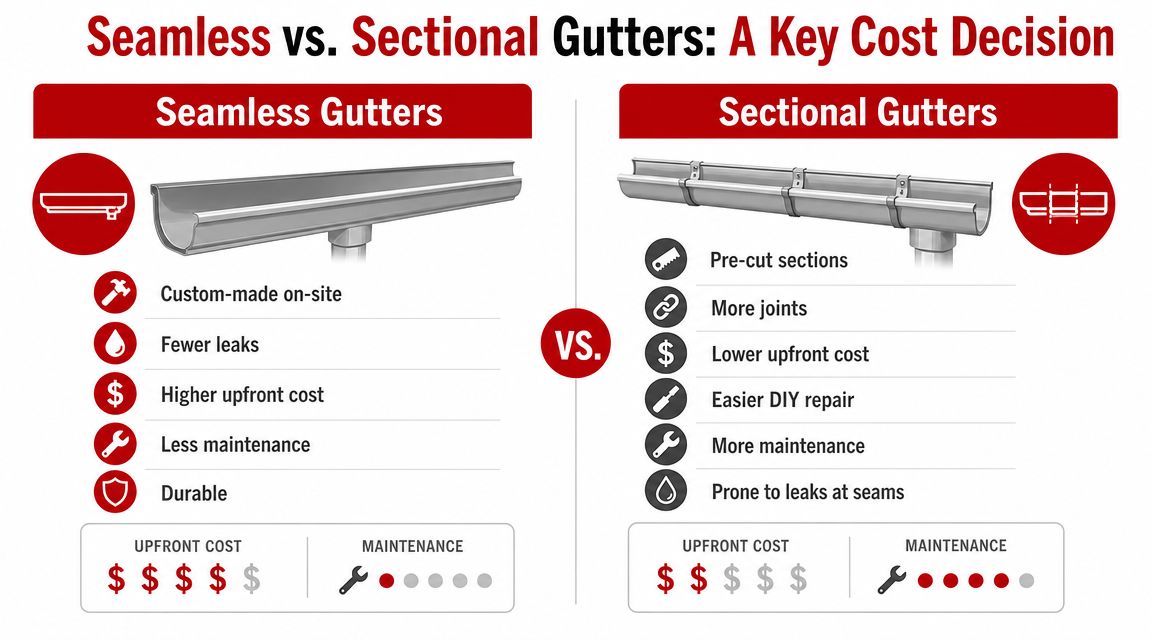
National pricing data show aluminum gutters often land around $6 to $12 per linear foot installed, while continuous gutters are typically $8 to $28 per linear foot and sectional systems run about $3 to $20 per linear foot, according to Modernize's gutter cost calculator. That same source notes the premium for continuous systems is tied to lower leak points and less maintenance.
That difference matters in Texas. Big rain doesn't care whether a seam failed because of age, movement, or weak sealing. Once water starts escaping at joints, it can stain masonry, wash out beds, and dump runoff too close to the foundation.
What usually works better on Texas homes
Sectional systems can make sense when a homeowner is focused on the lowest entry price or when a small repair needs to match an existing setup. They're made from shorter pieces joined together, so they're easier to patch in spots.
Gutters formed specifically for the house and installed in continuous lengths. Fewer joints usually means fewer opportunities for leaks and less maintenance over time. That's why most full replacements I'd recommend on Texas homes lean towards this style, especially when the owner plans to stay put.
For a closer local look at system differences, this page on seamless gutter options in Texas gives a good visual sense of what homeowners are comparing.
Here's a quick visual that captures the trade-off well.
The real cost decision
The continuous versus sectional question usually comes down to this:
- Lower upfront quote: Sectional often wins.
- Lower leak risk over time: Continuous gutters usually win.
- Better fit on complex rooflines: Continuous gutters tend to install cleaner.
- Easier small-piece replacement: Sectional is simpler.
If you're comparing bids and one is dramatically lower, check whether it's pricing a sectional system against a continuous one. That's not a fair apples-to-apples comparison.
Budgeting for Labor Downspouts Guards and Other Costs
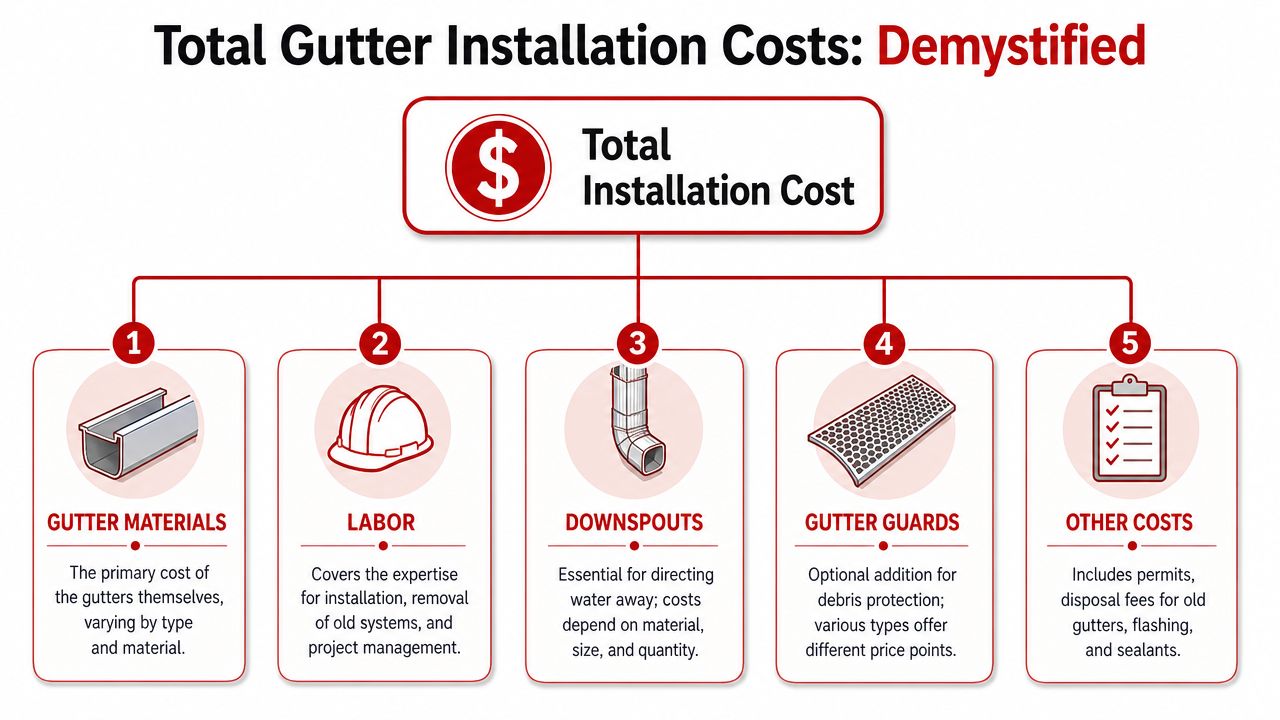
This is the part most homeowners don't get shown clearly enough. The base gutter number may be accurate, but it may not be the final invoice.
Labor changes the all-in cost fast
Recent coverage notes that continuous gutter installs are often quoted at $6 to $28 per linear foot, but labor can add $3 to $10 per foot and gutter guards average about $1,500, based on Landmark Roofing's seamless gutter cost article. That's exactly why a low material quote can turn into a much higher total once the full installation scope shows up.
Labor rises when the crew deals with height, difficult access, multiple corners, or detailed downspout routing. In DFW subdivisions, fence lines, landscaping, patio covers, and tight side yards can all slow the job down. In East Texas, trees and debris management often push homeowners toward guards at the same time they replace the gutters.
Don't ignore downspouts and drainage
Downspouts are not a side note. They're part of the drainage system, and they can materially affect the quote. Modernize notes that downspouts often run $5 to $40 per linear foot depending on material in its earlier-cited pricing data. Taller walls and longer drops raise that part of the budget quickly.
That also leads to a bigger site question. Gutters move water off the roof, but they don't always solve where the water goes after discharge. If your property already has pooling, soggy beds, or runoff near the slab, it helps to understand related drainage work too. This guide to the cost of drainage tile installation is useful for homeowners deciding whether gutter replacement alone will solve the whole problem.
A gutter system can be installed perfectly and still underperform if the discharge path at ground level is wrong.
What often appears as extra line items
Expect quotes to include or exclude some combination of these items:
- Old gutter removal: Ask whether tear-off and disposal are included or billed separately.
- Downspout count and length: This should be listed clearly, not buried inside a lump sum.
- Gutter guards: Worth discussing if your house sits under trees or you're tired of repeated cleanouts.
- Attachment-area repairs: Rot at fascia or soffit may not be visible until the old system comes off.
How to keep the quote honest
Ask for the estimate in categories. Material. labor. downspouts. guards. repair allowances. cleanup. When a contractor separates those items, you can compare bids without guessing what's hidden inside the total.
Real World Gutter Estimates for DFW and East Texas Homes
The biggest mistake homeowners make is expecting a national number to behave like a local quote. It usually doesn't.
Regional pricing can move sharply. One recent source noted continuous gutter pricing in Nevada around $29 to $31 per foot versus Iowa at roughly $13 to $22 per foot, showing how geography and labor conditions can outweigh simple national averages, as explained in this regional gutter pricing discussion. That same point matters in storm-prone Texas markets where house design, access, and weather exposure all affect bid structure.
Scenario one in a DFW suburb
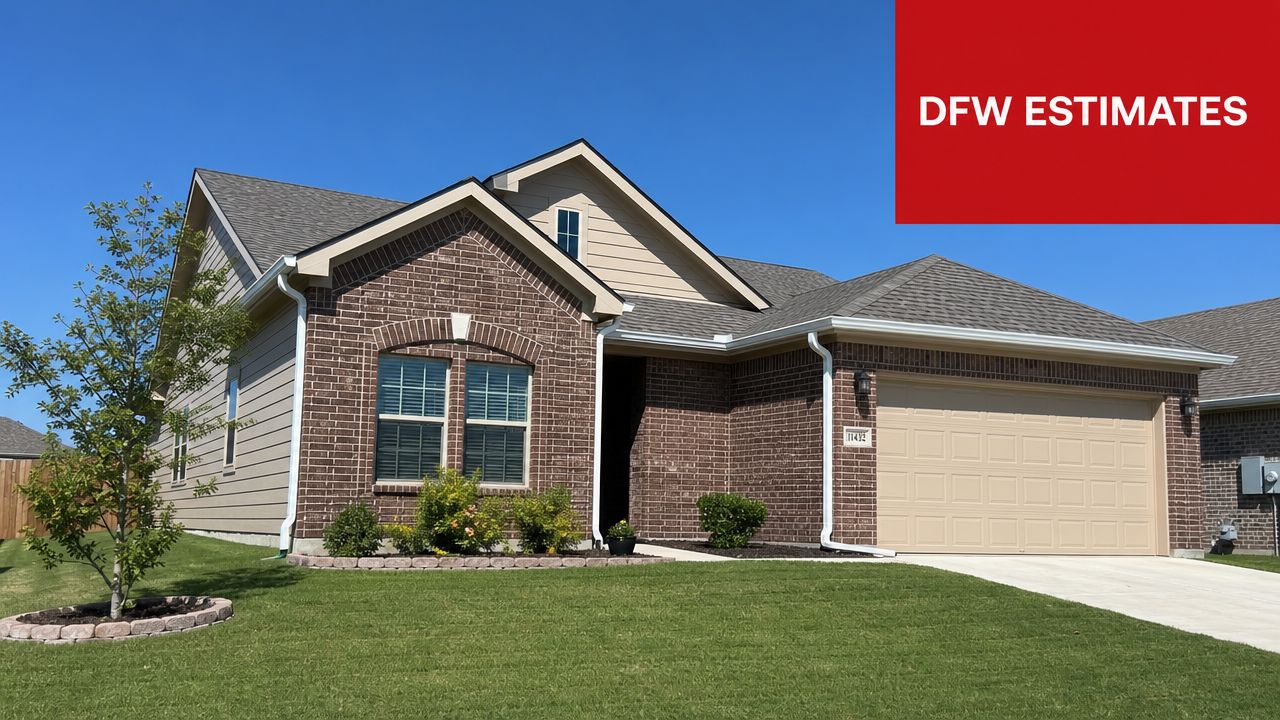
Take a straightforward single-story brick home in a DFW suburb. The roofline is fairly clean. Access is decent. The owner wants a practical aluminum system and doesn't need premium metal.
For a home that needs around 150 linear feet, national examples place that size of project near $750 to $2,300 depending on material and complexity, as noted earlier in the article. On a house like this, I'd expect the final number to depend less on exotic materials and more on whether the quote includes on-site custom fabrication, how many downspouts are needed, and whether guards are being added.
This is also where maintenance history matters. If the homeowner has been paying for regular cleaning, a service like Dallas gutter cleaning can help them compare the cost of ongoing maintenance against the one-time cost of adding guards during replacement.
Scenario two in East Texas with trees and a steeper roof
Now take a larger two-story East Texas home with a steeper roof and more surrounding trees. The roofline has more turns. Access is tighter. Debris load is heavier.
A larger 300-linear-foot project can reach $1,500 to $12,000+ depending on material and complexity, based on the earlier national benchmark. The house size matters, but the bigger cost drivers here are height, roof geometry, and the owner's likely need for guards and additional downspout planning.
On tree-heavy properties, the “extra” items often stop being optional. They become part of a system that actually works.
For homeowners trying to compare these scenarios against local service expectations, this page on gutter installation in Dallas is a useful reference point for what contractors in this market typically evaluate.
Why local estimates vary so much
Three homes can all be called “typical” and still produce very different totals. In Texas, the details that move the bid most are usually:
- Roof access: One story versus two story isn't a minor difference.
- Layout: More corners and transitions add fabrication and labor time.
- Tree coverage: More debris often pushes guards into the conversation.
- Drainage path: Downspout routing can be simple on one lot and awkward on the next.
That's why the all-in number matters more than the advertised per-foot teaser.
ROI Insurance and Financing Your New Gutter System
A lot of Texas homeowners call about gutters after they see water stacking up at a corner, washing out a flower bed, or dripping behind the fascia during a hard storm. By that point, the question is no longer just what new gutters cost. The primary question then becomes what happens if the drainage problem stays in place another season.
That is where gutter ROI becomes practical. A properly sized, properly pitched system helps control runoff before it stains brick, rots trim, softens soffit and fascia, or dumps water too close to the slab. In DFW, fast storm runoff exposes bad pitch and undersized downspouts quickly. In East Texas, tree debris and steady moisture put more pressure on guards, cleaning access, and overflow control.
The return is not usually about adding resale dollars in a neat, one-to-one way. It is about avoiding repair work that starts at the roof edge and spreads outward. Homeowners often focus on the per-foot gutter number and miss the all-in value of the full system, including downspouts, outlet placement, guard decisions, and any attachment-area repairs needed to hang the new gutters correctly.
Insurance can also affect the final out-of-pocket cost, but only in certain situations. Standard wear, age, and deferred maintenance usually fall on the homeowner. Storm damage is a different conversation. After hail or high wind events, gutters may be reviewed alongside roof components, fascia wrap, and other exterior items if there is a documented claim and visible damage. Policy terms drive that decision, not the contractor.
That is one reason bundled exterior evaluation matters. If the roof edge, drip edge, fascia, or attachment points are compromised, hanging new gutters first can create callbacks and extra labor later. Hail King Professionals handles gutters and downspouts as part of broader exterior work in DFW and East Texas, which helps when drainage repairs need to line up with roofline repairs and insurance documentation.
Financing has a place here too.
Many homeowners replace gutters on a forced timeline, not a convenient one. A two-story run pulling away from the fascia, overflow near entry walks, or drainage dumping next to the foundation usually should not wait until next year. In that situation, financing can help cover the full scope now instead of trimming out guards, extra downspouts, or needed repairs just to hit a lower starting number.
The better approach is simple. Compare the monthly payment against the cost of continued overflow, repeat patching, and avoidable wood repair. Cheap partial fixes tend to look good only on the first invoice.
Get a Clear Gutter Cost Estimate from a Local Pro
By the time you've seen a few estimates, the pattern becomes clear. Gutter installation cost isn't random. It's just layered. The material matters. The system type matters. The downspouts, guards, roof access, and drainage layout matter just as much.
That's why the most useful quote is rarely the shortest one. A reliable estimate should tell you what you're buying, what's included, and what could change once the old system comes off. If a bid doesn't explain those things, it's hard to trust the total.
For Texas homeowners, local conditions make that even more important. DFW homes deal with storm exposure, fast runoff, and subdivision layouts that can complicate discharge planning. East Texas homes often add tree debris and more guard-related decisions. Those aren't edge cases. They're normal quoting conditions in this market.
A clear estimate should answer simple questions directly. How many feet. What material. Continuous or sectional. How many downspouts. Are guards included. Is old gutter removal included. Is fascia repair excluded unless needed. When you get those answers in writing, the quote becomes much easier to compare and much easier to trust.
If you want a transparent quote for your home, Hail King Professionals can inspect the roof edge, measure the actual gutter runs, identify add-ons like downspouts or guards, and give you a no-obligation estimate that reflects your property instead of a generic national average.