
You usually notice gutter problems at the worst time. Rain is dumping off the roof in sheets, one corner is overflowing, and the flower bed next to the foundation is turning into a trench. In Texas, that's not a small nuisance. It's often the first sign that your drainage system isn't keeping up with hail, wind, heavy rain, and long heat cycles.
That's why so many homeowners start looking into Storm Master gutters after a storm season exposes every weak spot in an older system. The key question isn't just what brand name is on the gutter. It's whether the system can move water fast, resist impact, and stay tight when the weather turns rough.
A good gutter setup should do three jobs well. It should collect runoff cleanly, direct it away from the house, and hold its shape when storms hit. If it fails at any one of those, you can end up with fascia damage, soil erosion, siding stains, roof edge problems, and avoidable claim headaches later.
What Are Storm Master Seamless Gutters
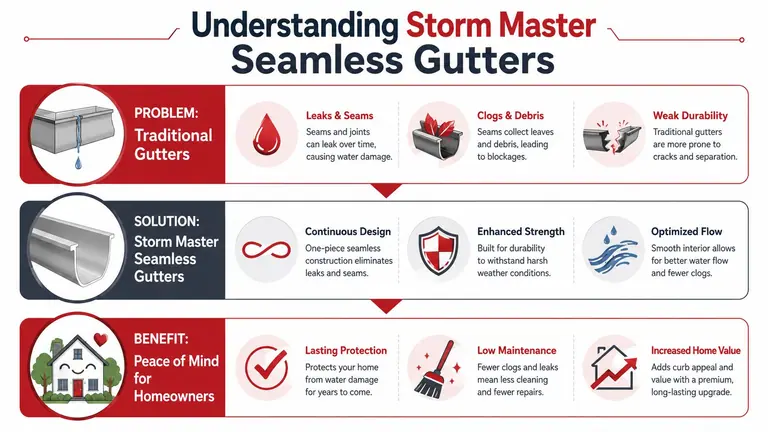
Most homeowners have seen sectional gutters. They come in pieces, and those pieces are connected along the roofline with joints, couplers, and sealant. That design works for a while, but every seam creates another place where water can leak, debris can catch, and movement can loosen the connection over time.
Storm Master gutters are built differently. Instead of assembling short sections, installers fabricate long gutter runs on-site so each stretch matches the home's exact dimensions. That means fewer connection points and a cleaner line along the roof edge.
Why seamless construction matters
Understanding how these gutters are constructed can sometimes be a source of confusion. It doesn't mean the entire house gets one single endless gutter. It means each straight run is made from one continuous piece wherever possible, with joints limited to corners and changes in direction.
That design change matters because, according to Storm Master product details, continuous aluminum gutters typically feature a 0.032-inch wall thickness for 5-inch models and 0.040-inch for 6-inch models, and the custom on-site fabrication process eliminates pre-formed joint vulnerabilities, which are the primary failure point in 85% of gutter leak claims during heavy precipitation events.
What homeowners usually notice first
The benefit isn't abstract. You see it in day-to-day performance:
- Fewer leak points: Water has fewer places to escape before it reaches the downspout.
- Cleaner appearance: Long, continuous runs look more finished than pieced-together sections.
- Less snagging inside the gutter: With fewer internal breaks, leaves and roof grit have fewer spots to collect.
- Better fit to the home: On-site fabrication helps the gutter match the roofline instead of forcing standard pieces to work.
Practical rule: If your current gutters leak at the joints, pull apart at the seams, or need fresh sealant too often, the problem may be the system design, not just its age.
Why that matters in real life
Think about a long roof section over your front entry. With a sectional system, water has to pass several joined pieces before it reaches the outlet. Every connection is a possible weak point. With a continuous run, water moves through a smoother channel with fewer interruptions.
That's the core value of Storm Master gutters. They're not just a cosmetic upgrade. They're a purpose-built drainage system designed to reduce the exact problems that make homeowners replace gutters in the first place.
Performance and Durability for Texas Weather
Texas weather punishes weak materials. In the same year, a home in Dallas, Fort Worth, Arlington, or McKinney can take hail, wind-driven rain, blazing sun, and debris from fast-moving thunderstorms. Gutters sit right on the edge of that punishment zone.
A gutter that's fine in calm weather may buckle when a strong cell rolls through. That's why material thickness, fastening method, and overall build quality matter more in Texas than many homeowners realize.
Hail resistance starts with material choice
In North Texas, hail isn't theoretical. According to this explanation of hail damage in North Texas, severe hail is frequently categorized as quarter-size or larger, and at terminal velocity, an individual stone of this mass possesses enough energy to damage almost any roofing material.
That point helps explain why heavier-gauge aluminum gets attention. A gutter has to do more than carry water. It also has to absorb impact without turning into a rippled, sagging channel that can't drain correctly after the storm passes.
When homeowners compare systems, they often focus only on whether the gutter is aluminum, steel, or vinyl. That's incomplete. Thickness matters. A thin gutter may look acceptable on installation day, then show dents and distortion after one bad hail event.
Heavy rain tests the whole system
Texas storms often dump water fast. When that happens, two things decide whether the system works:
- The gutter has to catch runoff without flexing too much
- The slope has to move that runoff to the downspouts quickly
If the channel sags even slightly, water can sit in low spots. Once standing water starts collecting, you get overflow, staining, mosquito issues, and extra weight pulling on the hangers.
A gutter should still look straight after a storm. If it doesn't, performance is already compromised.
A strong system with minimal connections helps because fewer joints mean fewer stress points along the run. Secure fastening matters just as much. A quality installation places hangers to support the system through pounding rain, roof runoff, and debris load.
Wind and runoff work together
Wind damage doesn't only affect shingles. Strong gusts can push branches and roof debris into gutters, twist loose sections, and expose weak attachment points. On homes in Frisco, Plano, Irving, and Garland, that combination of wind and runoff often reveals problems that stayed hidden during lighter weather.
This short video gives a good visual sense of how storm conditions challenge exterior systems:
For Texas homes, durability isn't a bonus feature. It's the baseline. A gutter system needs to survive the hit, keep draining, and stay attached.
Customization Materials and Style Options
Performance comes first, but appearance still matters. Gutters run across some of the most visible lines of your home, so the right system should protect the house without looking like an afterthought.
Storm Master gutters are commonly discussed as a high-quality aluminum option, and that's important for both function and finish. Aluminum gives homeowners a practical balance. It's widely used, it doesn't have the brittleness problem that concerns many people with basic vinyl systems, and it works well for custom fabrication on-site.
Choosing the right size
Size is one of the first decisions that confuses homeowners. The short version is simple. A larger roof area pushes more water into the gutter, so some homes need a larger channel and downspout setup to keep up.
In practical terms:
- 5-inch gutters: Often fit many standard residential rooflines.
- 6-inch gutters: Often make sense where roof planes are larger, steeper, or where storm runoff is especially intense.
- Downspout layout: Even a strong gutter can struggle if the downspout placement doesn't match the water volume.
A steep roof in Austin or San Antonio can shed water fast during a hard storm. In that case, moving up in size may be less about preference and more about capacity.
Matching the house instead of fighting it
Color also matters more than people expect. A gutter line can either blend into fascia and trim or stand out in a way that makes the roof edge look choppy. Many homeowners prefer a baked-on enamel finish because it gives a more finished look and helps the gutter integrate with the home's architecture.
Here's a practical way to think about color selection:
- Trim match: Best if you want the gutter to visually disappear
- Roof-tone match: Useful when you want the roof edge to read as one clean line
- Accent contrast: Works on some brick, stone, or modern exteriors when you want sharper definition
Pick the gutter color in daylight, not from a phone screen. Exterior colors change a lot between shade and full Texas sun.
A storm-ready gutter doesn't have to make the home look more industrial. The best choice usually looks quiet, straight, and intentional.
Storm Master Gutters vs Standard Gutter Systems
Homeowners usually compare continuous gutters against whatever is already on the house or whatever they've seen at a home improvement store. That's a fair comparison. It's also where the long-term difference becomes obvious.
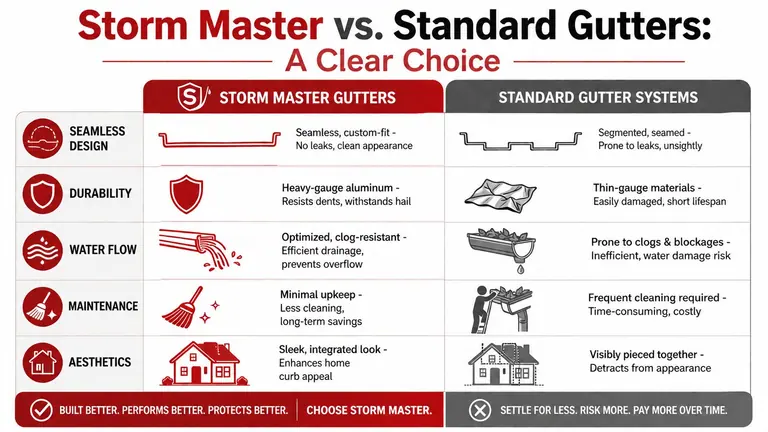
Standard gutter systems often rely on shorter pre-cut sections joined together during installation. That approach can cost less upfront, but it introduces more seams, more sealant, and more places for the system to fail under stress. Storm Master gutters aim to solve those weak points by reducing joints and using a sturdier construction.
Side-by-side differences that matter
| Feature | Storm Master gutters | Standard gutter systems |
|---|---|---|
| Construction | Custom-fabricated runs with minimal seams | Multiple short sections joined together |
| Leak risk | Lower because there are fewer joints along each run | Higher because every joint is a potential failure point |
| Impact handling | Better suited for demanding weather when built from thicker aluminum | Thin materials and basic sections can dent, crack, or separate more easily |
| Appearance | Cleaner roofline with a more integrated look | More visible connection points and patched sections |
| Maintenance pattern | Fewer interruption points where debris can catch | Seams and joints can trap buildup and require more attention |
Where cheap systems usually break down
The low-cost option often looks reasonable at first. That's especially true with basic sectional aluminum or vinyl. But Texas weather exposes shortcuts quickly.
Common trouble spots include:
- Joint seal failure: Sealant dries, shrinks, or separates over time
- Sagging between fasteners: Long runs lose line and hold standing water
- Cracking or denting: Thin or brittle materials don't absorb impact well
- Frequent patch repairs: Small leaks keep coming back because the core design hasn't changed
Some homeowners try to solve repeat leaks by resealing the same trouble spots every season. That can buy time, but it rarely fixes the underlying issue if the system has too many joints or too little strength for local weather.
Long-term value is different from purchase price
A better gutter system often costs more than the most basic alternative. But value isn't just what you pay at installation. It's also what you avoid later. If a system leaks less, holds alignment better, and needs fewer repairs, that changes the ownership experience.
The cheapest gutter is often the one you buy twice.
For homes in Mesquite, Tyler, Longview, or Marshall, that matters because storm exposure isn't occasional. It's part of ownership. A system that performs consistently can reduce repeat service calls, prevent runoff damage around the foundation, and keep the roof edge in better condition over time.
Installation Process and Roof Compatibility
A continuous-run gutter system is only as good as its installation. Even strong material won't perform well if the slope is wrong, the hangers are spaced poorly, or the attachment method damages the fascia or roof edge.
Professional installation starts with measurement, not material. The installer maps the roofline, checks drainage paths, identifies corner transitions, and plans downspout placement before fabrication begins. Then the gutter runs are formed on-site so they fit the home instead of being pieced together from whatever lengths happen to be available.
What a proper installation includes
A solid installation usually involves these steps:
Roofline assessment
The installer checks fascia condition, runoff patterns, and areas where overflow has happened before.Custom fabrication on-site
Each straight section is formed to the needed length for that part of the house.Slope tuning
The run is angled enough to move water to the outlet without looking visibly crooked.Secure hanger placement
Support points are positioned to help the gutter stay straight under rain load and debris weight.Downspout planning
Water has to leave the system efficiently once it reaches the outlet.
For homeowners who want a broader overview of the process, this guide to seamless gutter installation is a useful companion resource.
Roof types these systems commonly work with
Most Texas homes can accept continuous gutter systems when the fascia and edge conditions are sound. Compatibility usually isn't the problem. Installation detail is.
That matters because roofing materials vary. According to RoofLink industry statistics summarized here, asphalt shingles account for approximately 73% of U.S. residential roofing market share in 2024, while Class 4 impact-resistant shingles are becoming the standard in hail-prone regions like Texas. Gutters are commonly integrated with asphalt shingle roofs, but they also need to work cleanly with metal and tile rooflines.
The key is making sure the gutter captures runoff without interfering with the roof system. That's one reason professional installation matters so much. A sloppy install can create drainage problems at the exact roof edge where water control matters most.
Costs Insurance Claims and Financing
The first cost question most homeowners ask is simple. How much do new gutters cost? The honest answer is that pricing depends on the house and the scope of work, not just the product name.
A quote is usually influenced by the total linear footage, the number of corners, the number and size of downspouts, roof access, and whether damaged fascia or other edge components need attention first. Larger gutters and more complex rooflines usually require more material and labor.
Thinking about cost the right way
A gutter project is easier to evaluate when you frame it as property protection, not just an exterior upgrade. If gutters overflow or fail after storms, they can contribute to water problems around the foundation, soffit, siding, and roof edge. A better system can help prevent those repair chains from starting.
For a practical breakdown of what commonly affects project pricing, this page on gutter installation cost helps homeowners compare line items in a more informed way.
How gutters fit into storm claims
After hail or wind events, homeowners often focus on shingles and miss the rest of the damage pattern. But gutters and downspouts can be part of the same claim when the storm affected them. Dents, deformation, separation, and drainage failure may all matter during the inspection and documentation process.
Insurance conversations often go more smoothly when the property owner has clear photos, notes on when the storm occurred, and a professional inspection that documents the full exterior condition. That includes roof surfaces, soft metals, and water-management components.
There's also value in learning from how storm risk is handled in other severe-weather markets. For example, this guide on protecting Charleston homes from hurricanes offers a useful outside perspective on matching insurance planning to local weather threats. The storm type is different, but the principle is the same. Good documentation and the right coverage matter before damage happens.
Financing and maintenance planning
Not every gutter replacement comes at a convenient time. When the need is urgent, financing can make the project easier to schedule before the next storm arrives.
Maintenance still matters after installation. According to Texas roofing guidance on inspection timing, professional roof inspections scheduled every 12–18 months can double a typical Texas roof's lifespan from 15 years to 30 years by identifying minor issues before extreme UV radiation, temperature swings, and hailstorms cause expensive damage. Gutters are part of that larger protection strategy because drainage problems and roof edge problems often show up together.
Why Choose Hail King Professionals for Installation
A strong gutter product still needs the right hands behind it. That's where local experience changes the outcome. In Texas, installation decisions have to account for hail exposure, hard rain, heat movement, roof type, drainage layout, and the way storm claims are documented in the field.
Storm Master Gutters has a long history in the category. According to this company background summary, Storm Master Gutters was founded in 1977, marking a 49-year presence in the gutter installation market as of 2026, and the company began in a small garage in Old Bridge, New Jersey before expanding to serve customers across 8 states. Longevity matters. So does the quality of the local installer putting the system on your home.
Local weather knowledge matters on every install
A contractor working in Dallas, Fort Worth, Plano, Frisco, McKinney, and Garland sees a different set of storm patterns than one working outside Texas. The same goes for Tyler, Longview, Marshall, Austin, Round Rock, Georgetown, San Antonio, New Braunfels, San Marcos, and Boerne. The roof pitch, runoff speed, debris load, and hail risk all shape how a gutter system should be sized and installed.
That local understanding affects details homeowners don't always see right away:
- Drainage planning: Downspout placement has to match how Texas roofs shed water in heavy storms.
- Attachment strength: Installers need to plan for wind and runoff stress, not just fair-weather appearance.
- Claim awareness: Storm-related gutter damage often needs to be documented with the rest of the exterior system.
- Material matching: The gutter setup should work with the roof system already protecting the home.
Why homeowners call for an inspection first
It's common to be unsure whether repair, partial replacement, or a full new gutter system is needed. An inspection answers that before money gets spent in the wrong place. It helps identify whether the underlying issue is leaking seams, undersized capacity, poor slope, storm damage, or hidden fascia deterioration.

If your gutters overflow in one storm, pull away from the fascia, or show hail dents after severe weather, don't wait for the next round of rain to confirm the problem.
Homeowners usually want three things from a contractor. A clear inspection, a straight answer, and workmanship that holds up when the weather turns ugly. That's exactly why local expertise matters so much with storm master gutters and roof-edge protection in Texas.
If your gutters are leaking, dented, undersized, or pulling away after a storm, Hail King Professionals can inspect the full roofline and help you understand the next right step. Whether you're in Dallas, Fort Worth, Tyler, Austin, or San Antonio, their team provides practical guidance on gutter replacement, hail damage roof repair, storm damage roof repair, and insurance claim support so you can protect your home before the next Texas storm hits.