

Your Ultimate 2026 Roof Inspection Checklist Template Resource Guide
A thorough roof inspection is the first line of defense against costly leaks, premature aging, and frustrating insurance claim denials, especially in the volatile weather of Dallas-Fort Worth and East Texas. Without a structured process, however, critical details are easily missed. A quality roof inspection checklist template transforms a casual look-over into a systematic, documented assessment. It ensures consistency whether you're a homeowner performing a seasonal check, a property manager overseeing commercial assets, or a contractor documenting storm damage.
This guide moves beyond guesswork by providing 12 expert-vetted templates, from printable PDFs for quick field use to powerful mobile apps for professional teams. We'll break down which template to use for every scenario, including residential, commercial, and hail-damaged roofs. For each resource, you'll find a direct download link, a screenshot, and practical advice on how to use it effectively.
Our analysis will also show you how to customize any template for local conditions like intense sun exposure and how to create undeniable proof for your insurance carrier. While our focus is squarely on roofs, understanding the broader context of property oversight is also key. For instance, this essential guide to rental property inspection checklists offers valuable insights into comprehensive property assessments that can complement your roofing knowledge. This article provides the specific tools and instructions you need to start inspecting with precision. Let's find the right checklist for your project.
1. NRCIA – Free Printable Roof Inspection Template & Checklist
For homeowners and contractors seeking a straightforward, authoritative starting point, the National Roof Certification and Inspection Association (NRCIA) offers an excellent free printable roof inspection checklist template. This resource stands out because it comes directly from a recognized industry association, lending it immediate credibility. The design is clean and organized, focusing on the essential elements of a residential roof assessment without overwhelming the user with unnecessary complexity.

This PDF document is perfect for someone who prefers a physical checklist during an inspection. It includes structured fields to document the roof's age, material type, and overall condition. The layout guides you through inspecting common problem areas, including penetrations like vents and skylights, flashing, gutters, and even interior signs of leaks like water stains. For those preparing for a professional assessment, using this template beforehand can help you understand the key areas an inspector will examine. You can discover more about what a thorough professional evaluation entails in our guide to a Dallas roof inspection.
Practical Use and Limitations
The NRCIA checklist is ideal for annual self-inspections or for a contractor providing a basic report to a homeowner. Since it’s a downloadable PDF, it’s instantly accessible and requires no software or app.
Pros:
- Free and accessible: No cost or sign-up required.
- Authoritative source: Created by a respected U.S. roof inspection association.
- Simple to use: The print-and-go format is fast and efficient for on-site notes.
Cons:
- Not a digital tool: Lacks features like cloud storage or digital photo integration.
- Residential focus: It is not detailed enough for complex commercial or flat roof systems.
Get the checklist: NRCIA Free Printable Roof Inspection Template
2. GAF – Commercial Scheduled Maintenance Checklist (PDF)
For commercial property managers and facility teams, GAF, a leading roofing manufacturer, provides a specialized roof inspection checklist template focused on scheduled maintenance. This document is specifically engineered for low-slope and flat commercial roofing systems, making it an indispensable tool for anyone overseeing these types of properties. Its value comes from its alignment with manufacturer best practices, designed to help preserve system integrity and meet warranty requirements.
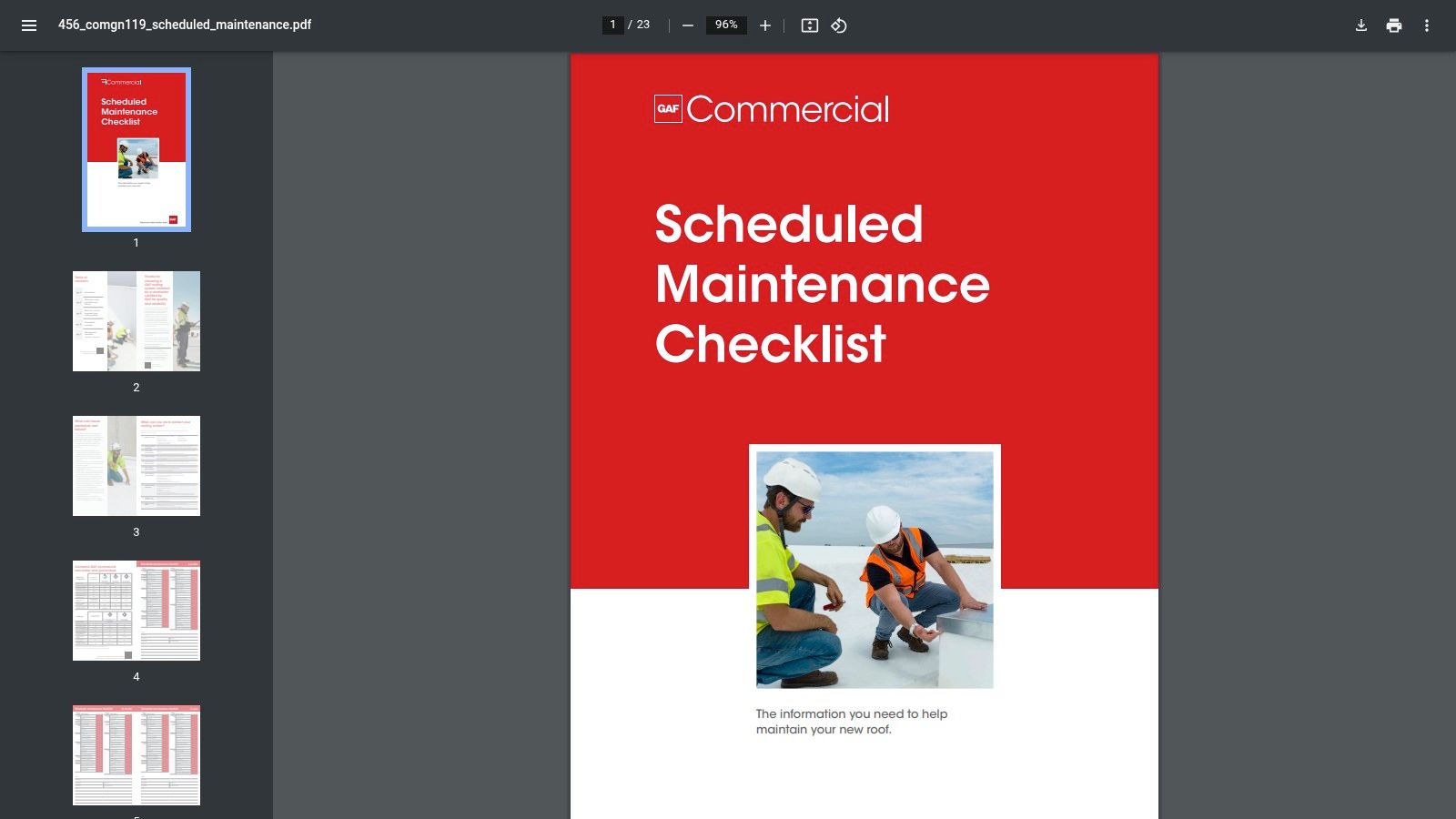
This free PDF checklist guides users through a systematic evaluation of critical components like membranes, flashing details, drainage systems, and rooftop equipment. It provides organized space to document observed defects and any corrective actions taken. Using this resource for regular inspections can significantly extend the life of a commercial roof, particularly in demanding Texas climates. It helps identify minor issues like debris accumulation or early signs of membrane wear before they escalate into costly problems.
Practical Use and Limitations
The GAF checklist is perfect for building owners or maintenance staff conducting biannual or quarterly roof health checks. As a downloadable PDF, it is immediately accessible for printing and use on-site without any software or account creation.
Pros:
- Manufacturer-backed: Aligns with industry standards from a major U.S. manufacturer.
- Commercial focus: Excellent for the specific needs of flat and low-slope roofs.
- Free and simple: No cost to download and the PDF format is straightforward.
Cons:
- Manufacturer-specific: Recommendations are optimized for GAF systems, though the principles are broadly applicable.
- Static document: Lacks digital features like photo embedding or cloud sync.
Get the checklist: GAF Commercial Scheduled Maintenance Checklist
3. IBHS – Roof Damage/Inspection Checklist (Hurricane/Wind)
For homeowners specifically concerned about severe weather, the Insurance Institute for Business & Home Safety (IBHS) provides a crucial roof inspection checklist template focused on wind and hurricane readiness. This checklist stands out due to its specific application for pre-storm preparation and post-event damage assessment. As a leading research organization, IBHS's guidance is grounded in scientific data about what makes roofs fail in high winds, making this a highly practical tool for homeowners in storm-prone regions like Dallas-Fort Worth.
This document is designed for easy use by non-experts, with clear items for checking shingle condition (curling, cracking, granule loss), flashing, roof penetrations, and drainage systems. Its true value lies in documenting damage for an insurance claim after a storm. Using this checklist helps organize your observations and ensures you don't miss key evidence. Understanding what to look for can also help you determine if you need a professional evaluation to decide between repairs or a full replacement. To better understand these distinctions, our guide can help you determine if you need a roof replacement or just a repair.
Practical Use and Limitations
This checklist is the perfect companion for annual storm readiness checks or for an immediate post-storm walk-around. It empowers homeowners to conduct a methodical inspection and speak knowledgeably with contractors and insurance adjusters.
Pros:
- Strong authority: Comes from a respected safety and insurance research institute.
- Storm-focused: Specifically designed for high-wind and hurricane risk assessment.
- User-friendly: Uses simple language accessible to any homeowner.
Cons:
- Specific focus: Not intended as a general-purpose or commercial roof checklist.
- Static format: As a PDF, it does not offer digital features or mobile form-filling.
Get the checklist: IBHS Roof Damage Checklist
4. Owens Corning – Roof Storm Damage Checklist (Download)
After severe weather strikes, homeowners and contractors need a specific tool to document the aftermath. Owens Corning, a leading shingle manufacturer, provides a targeted roof inspection checklist template designed explicitly for scoping storm damage. This resource is notable because it comes from a major industry brand and is structured to guide a user methodically through a post-storm assessment, ensuring no critical detail is missed when documenting for an insurance claim or repair estimate.
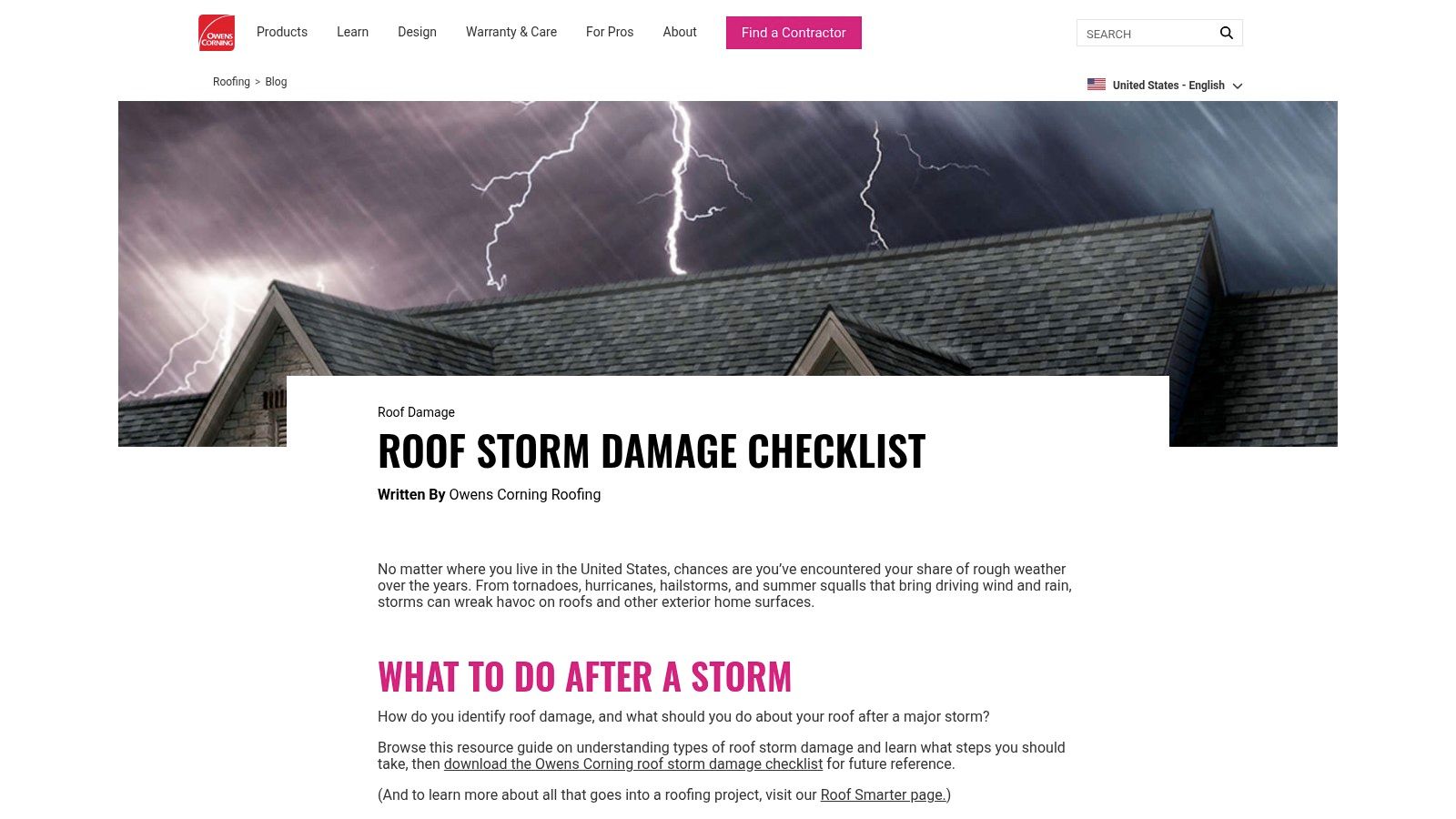
This free, downloadable guide helps you identify common signs of hail, wind, and debris impact. It covers everything from missing or bruised shingles to damaged flashing and skylights. Crucially, it also prompts you to check the attic for signs of water intrusion and to inspect gutters for an accumulation of shingle granules, a key indicator of significant wear or hail damage. The step-by-step format is perfect for homeowners in storm-prone areas like Dallas-Fort Worth who need to create a detailed record for their insurance provider.
Practical Use and Limitations
The Owens Corning checklist is an excellent first-response tool for documenting the condition of a roof immediately following a storm. Its focus on claim-relevant damage makes it a practical aid for both property owners and the roofing contractors they hire.
Pros:
- Storm-specific focus: Guides you to look for hail and wind damage that general checklists might miss.
- Authoritative source: Comes from a trusted, well-known roofing material manufacturer.
- Great for claims: The organized flow helps create a clear record for insurance documentation.
Cons:
- Not for routine maintenance: It is designed for post-storm scenarios, not for regular preventative inspections.
- Primarily residential: The checklist is geared toward asphalt shingle roofs and may not cover all aspects of commercial or flat roofing systems.
Get the checklist: Owens Corning Roof Storm Damage Checklist
5. InterNACHI – Asphalt Shingle Roof Covering Inspection Checklist
For those specifically inspecting asphalt shingle roofs, the International Association of Certified Home Inspectors (InterNACHI) provides a specialized visual roof inspection checklist template. This resource is less of a fillable form and more of a professional visual aid, designed to complement InterNACHI's training materials for home inspectors. It details common defects and conditions found on asphalt shingle roofs, such as cracking, blistering, and granule loss, making it a valuable educational tool.
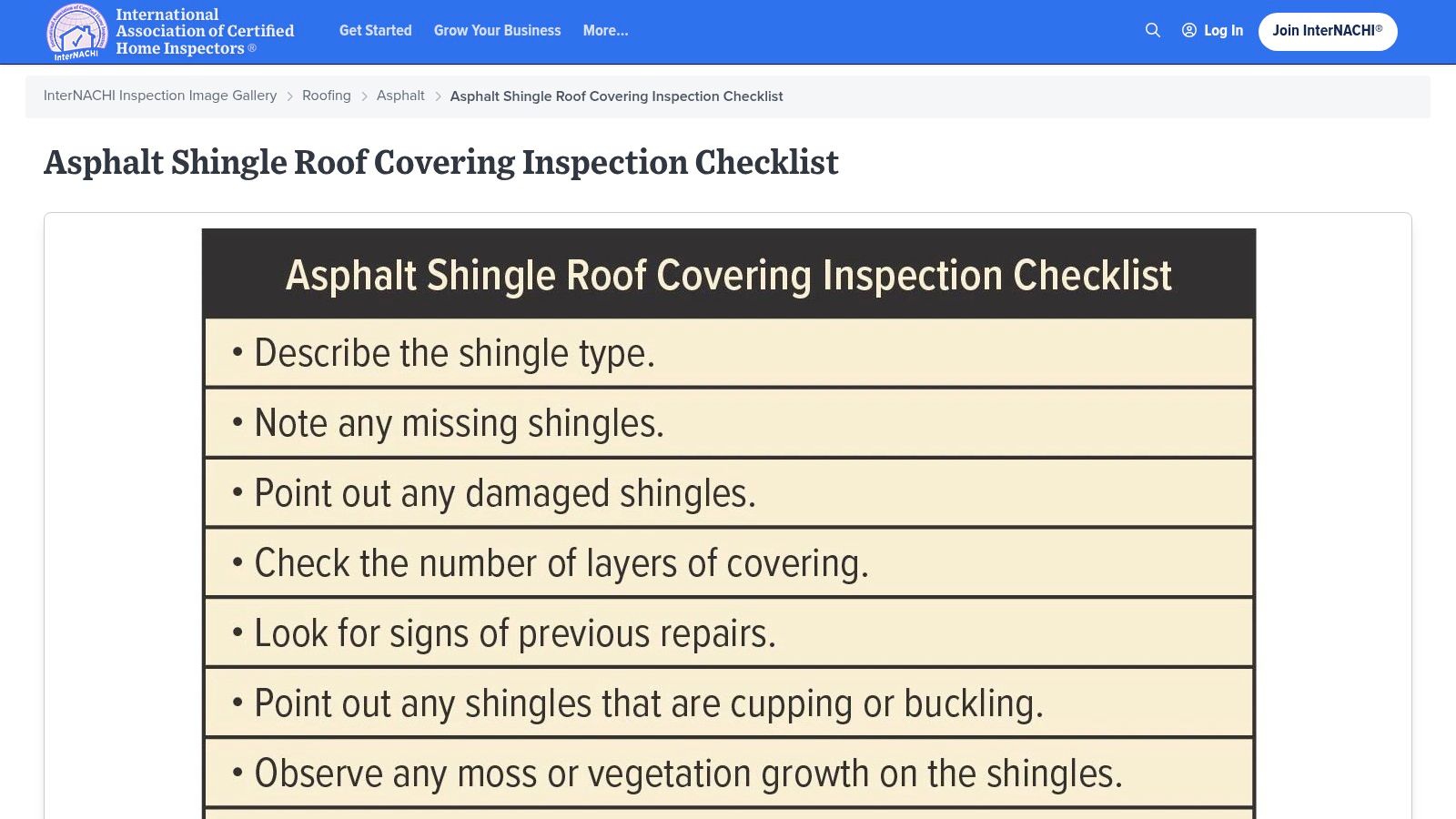
While created for professionals, homeowners can use this guide to learn what inspectors look for, helping them spot potential problems early. Knowing how to identify these issues is a key first step before determining if you need a new roof. For asphalt shingle roofs, understanding specific vulnerabilities to weather is also crucial; you can find a quick guide on the signs of hail damage on roof and how to inspect them to better prepare for assessments after a storm. This checklist helps translate visual cues into actionable inspection points.
Practical Use and Limitations
This InterNACHI checklist is best used as a reference sheet during an inspection rather than a form for documentation. Its strength lies in its clear, graphic-based examples of shingle damage. It helps standardize the identification of specific failure types.
Pros:
- Authoritative source: Created by a leading U.S. home inspector association.
- Highly specific: Focuses exclusively on common asphalt shingle issues.
- Visual guide: Excellent for learning to identify different types of roof damage.
Cons:
- Not a fillable form: It's an image-based reference, not a document for recording findings.
- Membership considerations: Full access to related materials may require InterNACHI membership.
Get the checklist: InterNACHI Asphalt Shingle Inspection Checklist
6. Fulcrum – Roof Inspection Checklist (mobile app template)
For roofing contractors and field service teams that require a powerful, mobile-first solution, Fulcrum offers a dynamic roof inspection checklist template within its data collection platform. This is not a simple PDF but a fully interactive template for their mobile app. It stands out by integrating rich data capture, such as geotagged photos, signatures, and GPS location, directly into the inspection workflow. The system is built for teams needing standardized, verifiable data from the field.
This app-based template allows for extensive customization, including conditional logic that can show or hide specific fields based on previous answers (e.g., revealing hail damage questions only if "hail" is selected as the inspection reason). This level of detail is perfect for professional contractors managing multiple inspectors and sites, ensuring every report is consistent and thorough. The ability to work offline is a major advantage for inspections in areas with poor connectivity, as data syncs automatically once a connection is restored.
Practical Use and Limitations
Fulcrum is best suited for businesses aiming to formalize their inspection process and generate professional, data-rich reports. The ability to export data to various formats or integrate via API makes it a strong component in a larger operational toolkit. However, it is overkill for a homeowner’s simple annual check-up.
Pros:
- Field-ready: Excellent for capturing geotagged photos and offline data on-site.
- Highly customizable: Tailor the checklist with conditional logic to fit specific inspection types.
- Team standardization: Ensures all inspectors follow the exact same process and data collection standards.
Cons:
- Subscription-based: Requires a paid subscription after the initial trial, which may include minimum user licenses.
- Learning curve: Initial setup and template customization require an investment of time.
Get the checklist: Fulcrum Roof Inspection Checklist
7. Fulcrum – Roof Condition Certification Form (template)
For roofing businesses and inspectors who need to formalize their findings for third parties like lenders or insurance carriers, the Fulcrum platform offers a powerful roof inspection checklist template focused on certification. This template goes beyond a simple condition report by incorporating fields for an inspector’s official sign-off and certification statement. Its primary strength lies in creating standardized, professional documents that can accelerate compliance and underwriting processes.
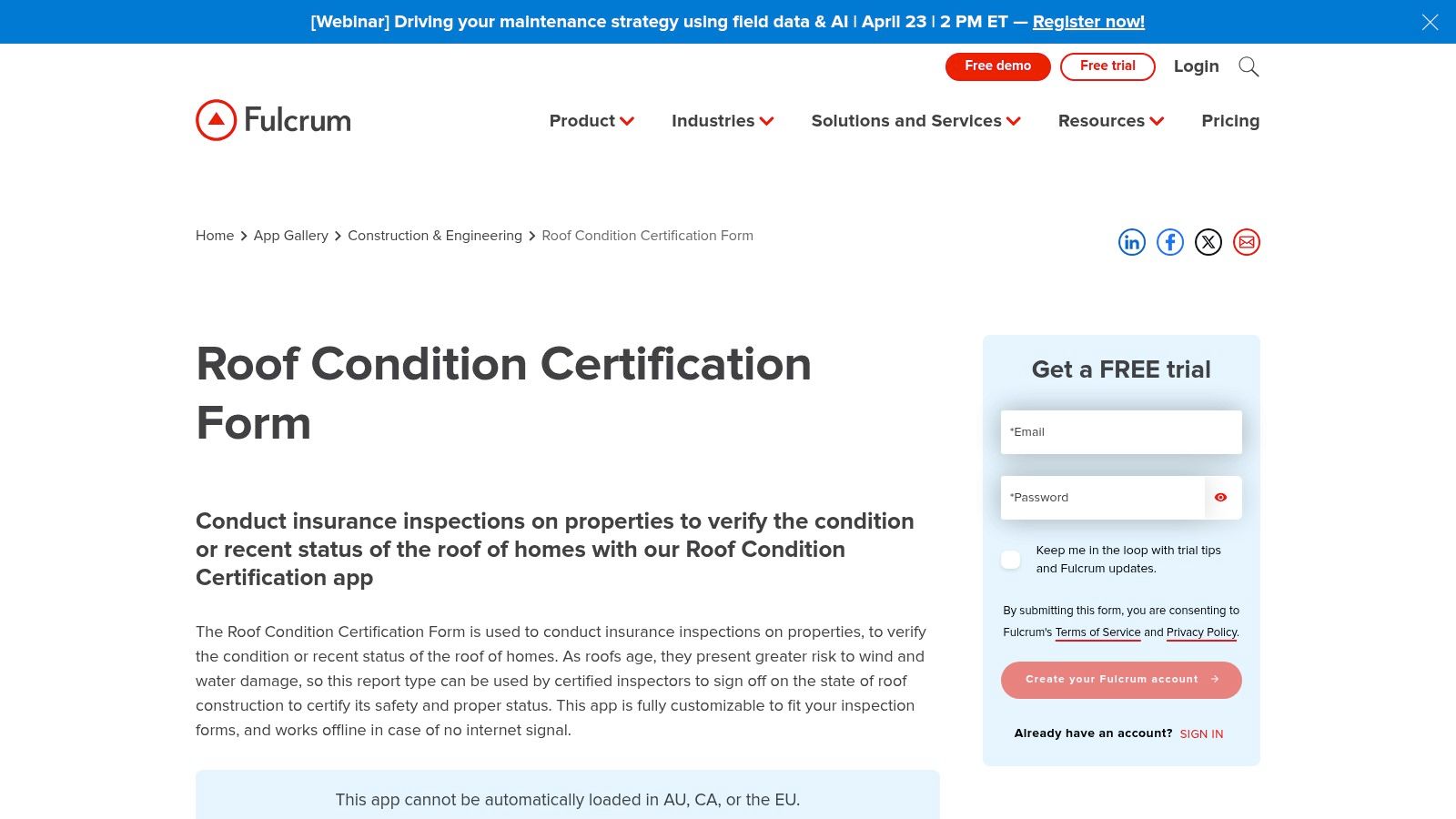
The template is designed for Fulcrum’s mobile application, allowing inspectors to capture data, photos, and even videos offline directly from the job site. This ensures all documentation is centralized and consistent, no matter which team member performs the assessment. Users can customize the certification language and add specific fields to meet the requirements of different stakeholders, making it a flexible tool for businesses handling a high volume of certification-style inspections.
Practical Use and Limitations
Fulcrum is best suited for professional contractors who require a repeatable and defensible documentation process for insurance or real estate transactions. The ability to generate a consistent PDF report with embedded photos and a digital signature provides a polished, authoritative final product.
Pros:
- Speeds compliance documentation: Ideal for insurance and lending needs where certification is required.
- Delivers consistent outputs: Ensures all inspectors produce reports with the same format and language.
- Offline capability: Allows for photo, video, and data capture without an internet connection.
Cons:
- Requires a subscription: Access is tied to a paid Fulcrum plan after the initial trial period.
- Legal review needed: The default certification language should be reviewed by legal or insurance advisors to ensure it meets specific business liabilities.
Get the checklist: Fulcrum Roof Condition Certification Form
8. SafetyCulture (iAuditor) – Roof Inspection Checklist (free, editable)
For roofing contractors or property managers aiming to digitize and standardize their processes, SafetyCulture’s iAuditor platform offers a powerful, free roof inspection checklist template. Unlike static PDFs, this is a fully dynamic tool built for mobile and desktop use. It allows inspectors to capture photos, add comments, and assign scores directly within the checklist, creating a detailed, professional report on the spot. This approach is ideal for teams needing to ensure consistent inspection quality across multiple job sites.
The platform’s strength is its customization. You can quickly edit the ready-made template to meet specific Texas requirements, such as adding fields for Class 4 shingle verification, hail impact notations, or checks for roof coating integrity. The ability to export an instant PDF report, complete with images and notes, is a significant advantage for communicating findings to clients or for insurance documentation. It also allows for assigning corrective actions, helping teams track repairs from identification to completion.
Practical Use and Limitations
SafetyCulture is best suited for businesses wanting to move beyond paper checklists to a more integrated digital system. The free plan is generous for small teams, providing access to core features without an initial investment.
Pros:
- Free for small teams: The platform is free for up to 10 users, including template access.
- Highly customizable: Easily adapts to specific needs like hail damage assessment or commercial flat roof details.
- Digital and interactive: Supports photo capture, scoring, and instant PDF report generation.
Cons:
- Platform-dependent: Maximum value is realized by adopting the broader SafetyCulture ecosystem.
- Variable template quality: The public library contains community-submitted templates that should be reviewed for accuracy before use.
Get the checklist: SafetyCulture Roof Inspection Checklist
9. SafetyCulture – Roof Assessment Checklist (community template)
For commercial property managers and contractors dealing with complex flat or low-slope roofing systems, SafetyCulture's community-contributed roof assessment checklist template offers a significant step up in detail. This digital-first tool is designed for a mobile workforce, moving beyond simple PDFs. It’s particularly valuable for its focus on specific commercial roofing materials, including BUR, single-ply (TPO, EPDM, PVC), metal, and modified bitumen.
This template guides inspectors through system-specific failure points like open laps, fish mouths on membrane seams, and previously failed repairs, which are critical for coating and restoration assessments. The platform’s structure allows for embedding photos, sketches, and summary ratings directly into the report. Because it's a community template, it is a great starting point that can be edited within the SafetyCulture platform to match a company’s specific standard operating procedures (SOPs) and reporting requirements.
Practical Use and Limitations
This checklist is best suited for professional contractors or facility managers who need to document conditions on commercial properties digitally. The ability to customize and integrate photos makes it powerful for generating detailed repair proposals or maintenance logs. However, unlocking its full potential requires committing to the SafetyCulture app and platform.
Pros:
- Robust for low-slope systems: Excellent detail for commercial membranes and metal roofs.
- Good for repair assessments: The structure is ideal for documenting specific failures for coating or repair bids.
- Digital and editable: Supports photo integration and can be customized to fit reporting needs.
Cons:
- Requires platform adoption: To use it effectively on mobile and generate reports, you need to use the SafetyCulture platform.
- Community content: As a community-contributed template, it should be reviewed and verified for accuracy before wide deployment.
Get the checklist: SafetyCulture Roof Assessment Checklist
10. Jotform – Roofing Inspection Form Template
For contractors who need a fast, professional-looking digital solution without any coding, Jotform’s roofing inspection form template is a powerful choice. This platform excels at creating mobile-friendly web forms that can be filled out on-site using a tablet or phone. Its main advantage is the ability to instantly generate a polished PDF of the completed inspection, complete with client signatures and uploaded photos, which can be immediately emailed or stored.
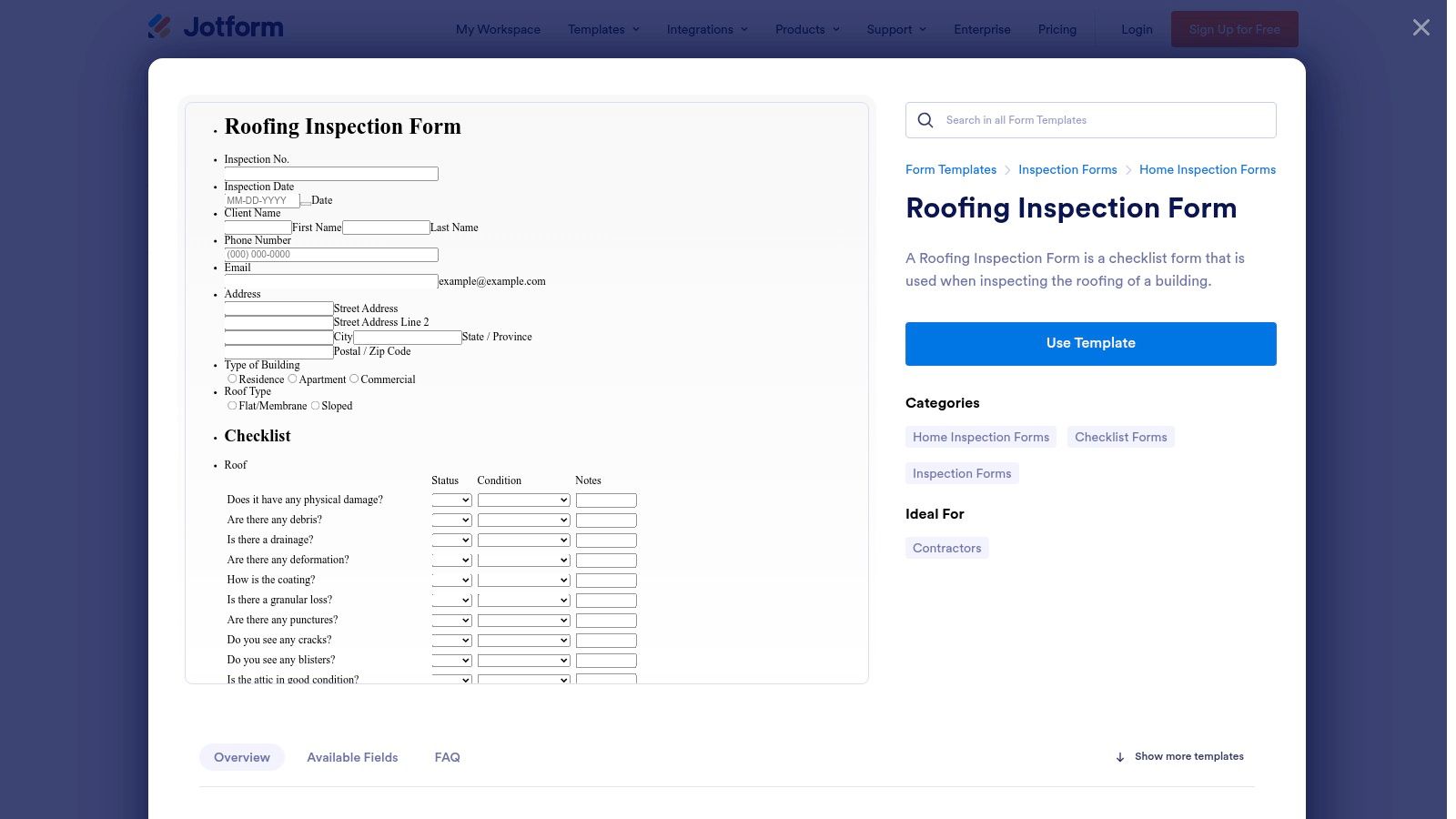
The template covers essential areas like roof, ceiling, exterior, and interior conditions. Its drag-and-drop builder allows for easy customization, so you can add or remove fields to match your specific process. For instance, a contractor in East Texas could add a section for noting specific pine needle accumulation or moisture issues common to the region. The form integrates with tools like Google Sheets and Dropbox, automating your data storage and workflow.
Practical Use and Limitations
Jotform is ideal for a small-to-medium-sized roofing company wanting to digitize its reporting process quickly and affordably. The ability to capture e-signatures and images directly in the form simplifies documentation for insurance claims and client records.
Pros:
- Fast setup: A functional inspection form can be ready for use the same day.
- Client-ready output: Automatically generates professional PDFs of submissions.
- Highly customizable: The no-code, drag-and-drop interface is easy to use.
Cons:
- Not roofing-specific: It's a general form builder, lacking specialized roofing analytics or project management features.
- Usage limits: The free plan has limits on monthly submissions and total storage, requiring a paid plan for heavy use.
Get the checklist: Jotform Roofing Inspection Form
11. Sitemate (Dashpivot) – Commercial Roof Inspection Checklist (smart form)
For commercial property owners and facility managers, Sitemate offers a powerful digital roof inspection checklist template through its Dashpivot platform. This tool moves beyond simple printable forms into a full-fledged workflow management system. It is designed for construction teams, asset managers, and quality control personnel who require detailed, version-controlled records for compliance, insurance, and maintenance audits. The system is built to centralize data from multiple team members in the field.
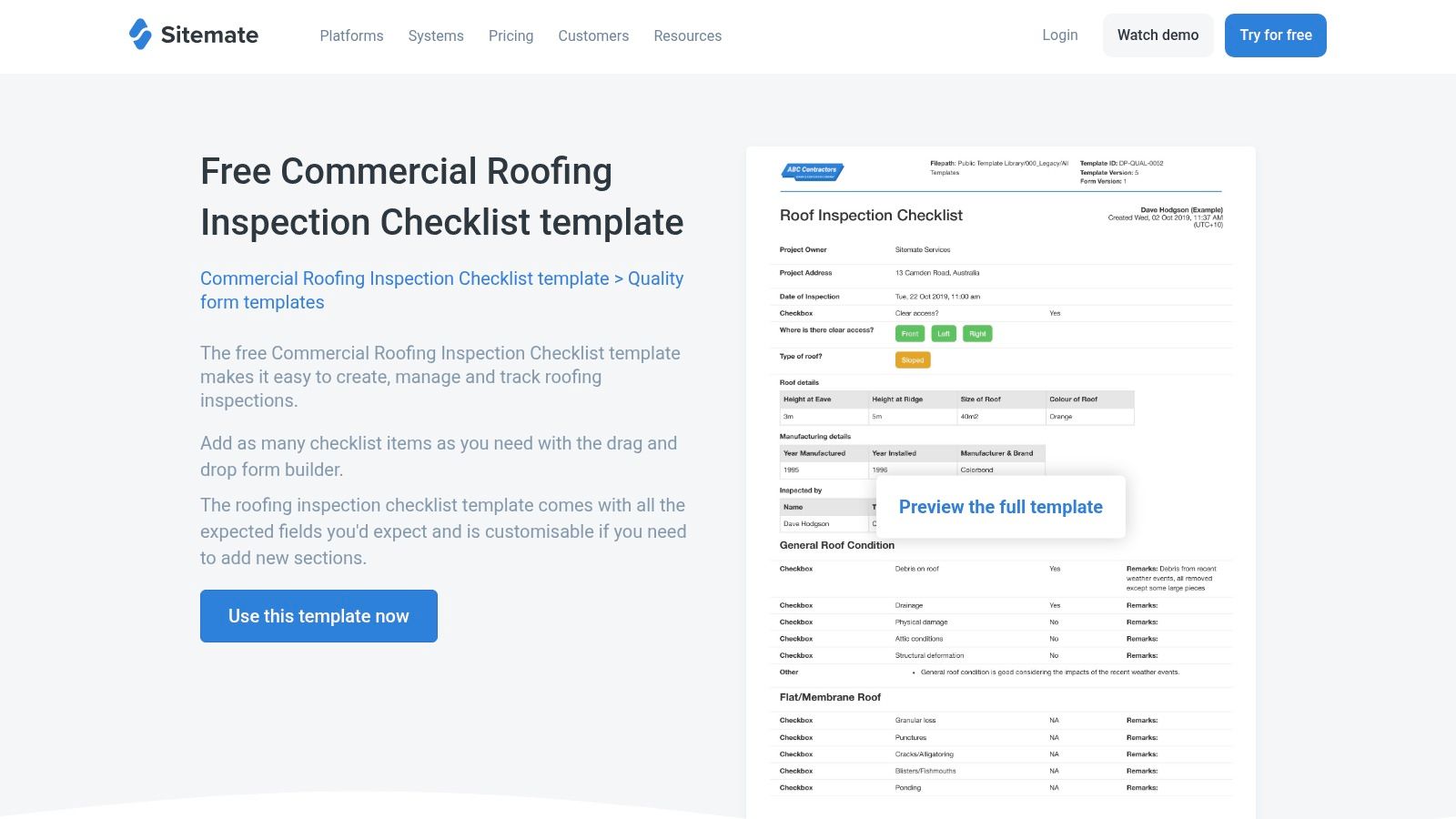
The template operates as a "smart form" that can be customized with specific fields, photo attachments, and digital sign-offs directly from a mobile device. This is especially useful for managing inspections across large commercial properties or multiple sites. For instance, a facility manager in Dallas can dispatch a technician who can complete the form on-site, attach geotagged photos of membrane damage, and have the report instantly available for review at the head office.
Practical Use and Limitations
Sitemate's solution is ideal for businesses needing a robust audit trail and collaborative features. The centralized reporting makes it simple to track the condition of roofing assets over time and prove due diligence for insurance claims.
Pros:
- Built for professional workflows: Supports team collaboration, photo evidence, and sign-offs.
- Strong audit trail: Provides versioning and centralized records critical for insurance and asset management.
- Mobile-first design: Allows inspectors to complete detailed forms directly from the job site.
Cons:
- Subscription required: This is a professional software service with recurring costs based on company size.
- Onboarding needed: Requires initial setup to align the templates with a company's standard operating procedures (SOPs).
Get the checklist: Sitemate Commercial Roof Inspection Checklist Template
12. Jobber – Roof Inspection Report/Checklist (printable + digital)
For roofing contractors who need a document that bridges the gap between an internal checklist and a client-facing report, Jobber provides a valuable free resource. Their roof inspection checklist template is structured more like a formal report, designed to be filled out and presented to a homeowner or insurer. It offers a professional layout that organizes key details like client information, roof age and material type, damage observations, and recommended actions.
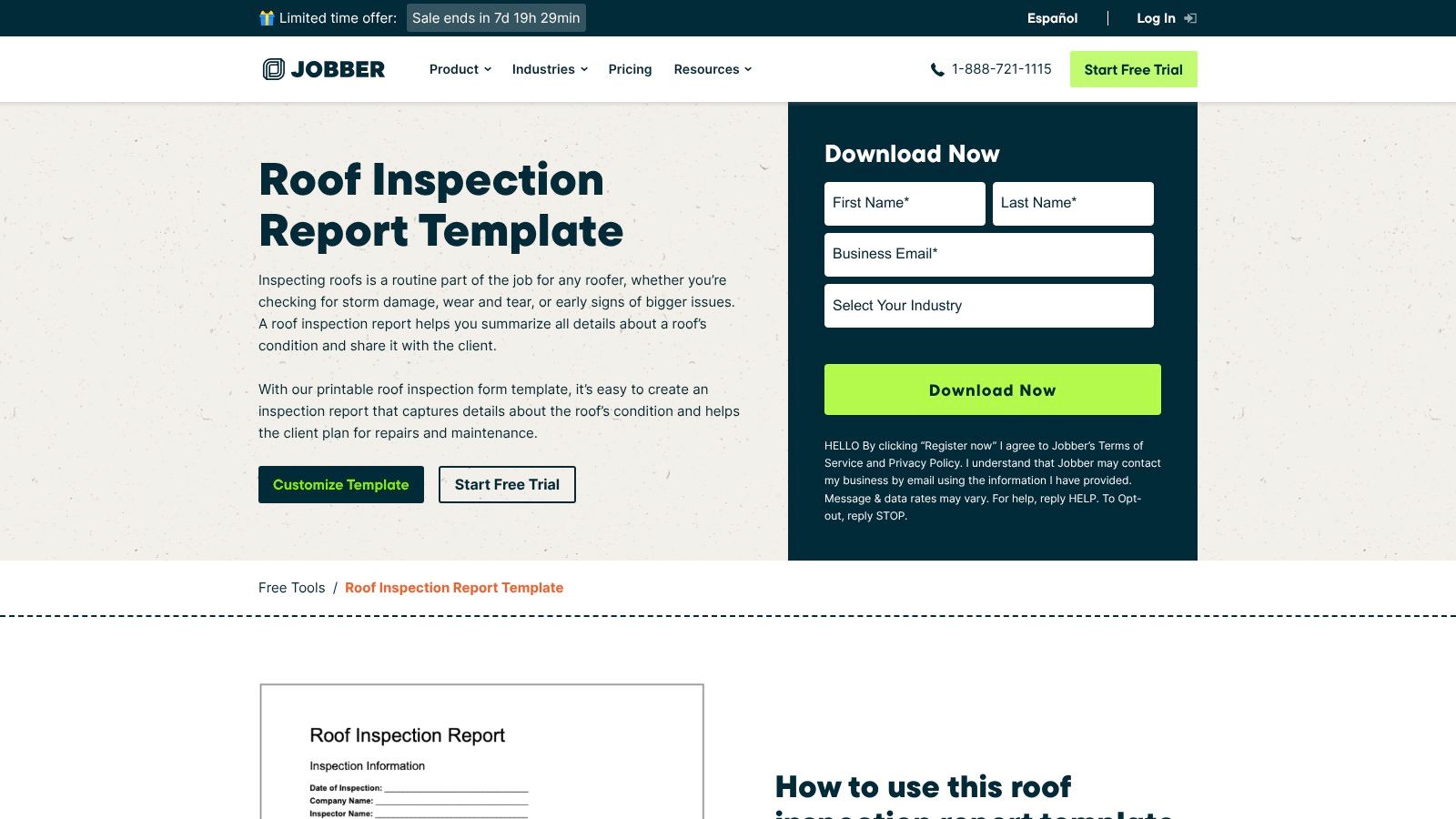
This template stands out by including dedicated sections for photo documentation, detailed notes, and signature lines for both the contractor and the client. This makes it an excellent tool for formalizing an estimate or documenting findings for an insurance claim. While it can be downloaded and printed as a PDF, its true power is unlocked when used within the Jobber field service management software, where it can be converted into a digital job form for mobile use by field technicians.
Practical Use and Limitations
The Jobber template is perfect for contractors who want to standardize their reporting process and present a polished document to clients. It’s particularly effective for creating same-day inspection summaries that clearly communicate findings and next steps.
Pros:
- Professional, client-facing format: Designed to be shared, with signature lines and clear summary sections.
- Digital potential: Can be integrated into Jobber's software for a fully mobile workflow.
- Free to download: The printable version is available without any cost or commitment.
Cons:
- Less of a technical checklist: It’s more of a summary report than a step-by-step inspection guide.
- Full features require a subscription: Advanced digital use is tied to the paid Jobber platform.
Get the checklist: Jobber Roof Inspection Report Template
Top 12 Roof Inspection Checklist Templates Compared
| Resource | Best for | Key features | Strengths | Limitations | Price |
|---|---|---|---|---|---|
| NRCIA – Free Printable Roof Inspection Template & Checklist | Homeowners & contractors needing a quick printable form | Structured fields for roof type, leaks, flashing; photo slots; PDF | Free; association-backed; fast to deploy | PDF only; limited depth for commercial/flat roofs | Free |
| GAF – Commercial Scheduled Maintenance Checklist (PDF) | Property managers & commercial roof teams | Scheduled items for membranes, flashings, drainage; defect notes | Manufacturer-backed; warranty-focused | GAF-specific recommendations; PDF format | Free |
| IBHS – Roof Damage/Inspection Checklist (Hurricane/Wind) | Storm-prep & post-storm documentation for homeowners/adjusters | Wind/storm exterior/interior checks; drainage and equipment items | Authority on severe-weather risk; plain language | Not comprehensive for commercial roofs; static format | Free |
| Owens Corning – Roof Storm Damage Checklist (Download) | Homeowners & contractors documenting storm damage | Step-by-step storm assessment; safety guidance; photo notes | Major shingle brand; claim-ready guidance | Focused on post-storm scenarios; residential emphasis | Free |
| InterNACHI – Asphalt Shingle Roof Covering Inspection Checklist | Home inspectors & pros inspecting asphalt shingles | Visual checklist of common shingle defects; downloadable | Widely referenced by inspectors; concise | Image-based (not fillable); membership/download terms may vary | Free (may have restrictions) |
| Fulcrum – Roof Inspection Checklist (mobile app template) | Field teams needing mobile, geotagged inspections | Custom fields, conditional logic, offline, GPS, photo capture, exports/API | Field-friendly; standardizes inspections across crews | Subscription required after trial; setup time to customize | Paid (subscription) |
| Fulcrum – Roof Condition Certification Form (template) | Insurance/lender compliance & certified sign-offs | Inspector sign-off fields; offline photos/video; customizable cert language | Speeds compliance documentation; consistent outputs | Subscription required; certification wording needs legal review | Paid (subscription) |
| SafetyCulture (iAuditor) – Roof Inspection Checklist (free, editable) | Small teams standardizing mobile inspections | Editable template, photo capture, scoring, comments, instant reports | Free for small teams; quick to customize for hail/Class 4 | Best value with platform adoption; community templates vary | Free tier; paid plans |
| SafetyCulture – Roof Assessment Checklist (community template) | Commercial/low-slope membrane assessments | System-specific checks (BUR, TPO, EPDM, etc.), photos, sketches, ratings | Robust for membranes and coatings; editable to SOPs | Community content needs vetting; platform required for full features | Free/paid platform |
| Jotform – Roofing Inspection Form Template | Fast no-code client-ready PDFs and intake forms | Drag-and-drop customization, e-sign, file uploads, auto-generated PDF | Very fast setup; produces good client-facing PDFs | Lacks roofing-specific analytics; free plan limits | Free tier; paid plans |
| Sitemate (Dashpivot) – Commercial Roof Inspection Checklist (smart form) | Construction teams & asset owners needing QA/QC and audits | Custom fields, attachments, sign-offs, centralized records, versioning | Built for construction workflows; strong audit trail | Subscription and onboarding required | Paid (subscription) |
| Jobber – Roof Inspection Report/Checklist (printable + digital) | Field reps/CSRs and residential inspections | Client info, material/age, damage notes, photos, recommendations, signatures | Easy for intake/estimates; homeowner-facing documentation | More report-style than technical step-by-step; digital features need Jobber | Free template; Jobber subscription for software |
From Checklist to Action: Your Next Step for a Secure Roof
Navigating the world of roof inspections can feel complex, but with the right tools, you gain clarity and control. Throughout this guide, we've explored a variety of resources, from the NRCIA's printable forms perfect for a quick homeowner walkthrough to Sitemate's sophisticated smart forms designed for commercial property managers. You now have access to specialized templates for every scenario, whether you're documenting hail damage with an Owens Corning checklist in Dallas, preparing an insurance claim with detailed photos, or conducting a routine safety audit on a flat roof using a GAF or SafetyCulture template.
The true power of any roof inspection checklist template, however, is not just in ticking boxes. Its purpose is to transform ambiguity into a clear, documented assessment of your roof's health. It helps you systematically identify potential issues, from minor maintenance needs like cleaning gutters to critical red flags like compromised structural decking or failing flashing around a solar array. For property owners in North and East Texas, where severe weather is a constant threat, this structured approach is not a luxury; it's a fundamental part of responsible property ownership.
Translating Your Findings into a Plan
Once you have completed your inspection, you'll possess a snapshot of your roof's condition. You might have noted areas of "significant granule loss," "blistering on a TPO membrane," or "lifted shingles" following a windstorm. This is the crucial turning point where a simple checklist becomes an actionable plan. The data you've gathered is invaluable, but interpreting its severity and determining the correct course of action requires seasoned expertise.
Consider these next steps based on your specific situation:
- For Homeowners with Minor Issues: If your self-inspection with a tool like the InterNACHI checklist reveals only minor upkeep tasks, you can confidently schedule those repairs. This proactive approach extends your roof’s lifespan and prevents small problems from becoming expensive disasters.
- For Commercial Property Managers: Using a detailed commercial checklist like those from GAF or Sitemate provides the documentation needed for annual maintenance budgets and long-term capital planning. Your findings can justify scheduling a professional roof coating or planning a phased replacement.
- For Storm Damage and Insurance Claims: Your meticulous documentation using a storm-focused checklist is your first and best tool for the insurance process. Clear, well-organized photos and notes corresponding to checklist items create a powerful and undeniable record of the damage. This is where professional assistance becomes most critical.
The Professional Bridge: From Data to Decision
The most important takeaway is that a checklist is a starting point, not a final diagnosis. What does "significant" granule loss actually mean for your specific shingle and its remaining warranty? Is a small ponding area on a flat roof an urgent issue or something that can be monitored? Answering these questions is where a professional's experience is irreplaceable.
For residents and business owners in the Dallas-Fort Worth and East Texas regions, this is where specialized, local knowledge makes all the difference. An expert can evaluate your checklist findings within the context of our region’s specific challenges: the intense summer heat that accelerates asphalt shingle aging, the violent hail that can pulverize shingles, and the torrential rains that test every seal and seam. They don't just see a checklist item; they see how that specific issue will behave under the strain of a Texas summer storm.
Don't let your completed roof inspection checklist template become just another piece of paper. You've taken the first important step by educating yourself and assessing your property. Now, take the next one. Use your findings to engage with a professional who can validate your concerns, provide accurate solutions, and help you protect your most valuable asset. This proactive partnership is the ultimate key to ensuring your roof remains a secure shield for years to come.
A checklist gives you the questions, but a local expert provides the definitive answers. The team at Hail King Professionals uses refined, hyper-local versions of these checklists every day to conduct free, no-obligation inspections across Dallas-Fort Worth and East Texas. Visit Hail King Professionals to schedule your assessment and let our licensed experts translate your findings into a clear, actionable plan that secures your property.